(xt) Cohen, S. I [Shalom ben Jacob]. Translated from Hebrew to English by Joshua van Oven.MareMagnum

714 résultats
18155575 (1815) 1st edition. Later Paper Wrappers, 8vo, 10, 10, 2, 2, 56, 56, [1], 6 pages [143 pages total]. Includes the often missing 6-page list of subscribers. The Introduction states that the book was undertaken at the behest of the Rabbi of the Aschkenazic community of London, Solomon Hirschell, together with Raphael di Meldola, Rabbi of the Sephardic community. It also includes the approbation of di Meldola as well as that of Rabbi Solomon ben Zevi Hirsch, the purpose of the work being to protect Jewish children from the inroads of Christian missionaries.The author indicates that the lack of understanding of Judaism among youth is the principle reason why he composed this work. Yet it was intended not just for Jews: Prof. David Ruderman has noted that, "except for its denunciation of Christian missionaries, Cohen's catechism with its English translation, seems to be nothing more than an innocent, uncontroversial presentation of the Jewish faith meant for both Jewish and Christian eyes" (D. B. Ruderman, Jewish Enlightenment in an English Key: Anglo-Jewry's Construction of Modern Jewish Thought, p. 250). Cohen's work was indeed shared with American non-Jews. The Jewish merchant David Isaacs, in his correspondence with Thomas Jefferson, sent the President a copy of the book [see University of Virginia exhibit (2001), To Seek the Peace of the City: Early Jewish Settlement in Charlottesville]. In 1818 Rebecca Gratz offered a copy to her friend Maria Fenno Hoffman, wife of the Attorney General of New York, Ogden Hoffman [see E. Wolf & M. Whiteman, The History of the Jews of Philadelphia, p. 304]. Jacob Marcus Rader lists Cohen's work as one of the Jewish educational books available to Rebecca Gratz when she began operating her Sunday School in Philadelphia [see United States Jewry, 1776-1985, 1-2, p. 393]. A review of this book was printed by Rabbi Yom Tov Benet in his book Tene Bekorim (1767). Shalom ben Jacob Cohen (17721845) himself was a Hebrew writer, poet, and editor. Born in Mezhirech, Poland, he studied German and read the new Hebrew literature, particularly Ha-Me'assef. His first book, Mishlei Agur (1799), was a collection of Hebrew fables in rhyme, with German translation, aimed at teaching Jewish children simple and clear Hebrew. Cohen went to Berlin in 1789 and taught in the Hinnukh Ne'arim school and in private homes. After the publication of several works he renewed the publication of Ha-Me'assef and served as its editor (180911). In 1813 Cohen left Germany, spent a short period in Amsterdam, and moved to London where he tried unsuccessfully to establish a Jewish school. From London, Cohen moved to Hamburg (1816 or 1817), where he spent three controversy-laden years. In a posthumously published poem he attacked the hypocrisy of the "reformists" for their lack of religious belief and national feelings and considered the establishment of the Reform temple in Hamburg an act of blasphemy. However, he refrained from public intervention on this controversy. In 1820 Cohen was invited by Anton Schmid to serve as head proofreader in the Hebrew section of his printing press in Vienna where he remained for 16 years. In 1821 Cohen established the annual Bikkurei ha-Ittim, three issues of which appeared under his editorship. In 1834 he published his poetic work, Nir David, a description of the life of King David, one of the first romantic works in Hebrew literature. In 1836 Cohen returned to Hamburg, where he lived until his death. His last extensive work was Kore ha-Dorot, a history of the Jewish people (1838). His other works include: Mattaei Kedem al Admat Zafon (1807), poetry; Amal ve-Tirzah (1812), an allegorical and utopian drama, a sequel to M.H. Luzzatto's La-Yesharim Tehillah; and Ketav Yosher (1820), a literary miscellany. Roth, Magna Bibliotheca Anglo-Judaica, p. 428, no. 2. Vinograd London 205. Roest 283. BE shin 2421; EJ; CD-EPI 0140837. SUBJECT(S): Judaism -- Juvenile literature. Juvenile works. OCLC: 44005964. OCLC lists 17 copies worldwide, High quality 18th Century paper and internal binding are in exceptionally good condition a very nice copy. (BR-4-2-B-xr)
New York: Yiddish Scientific Institute [YIVO], American Branch [Yidisher visnshaftlekher institut.; Amerikaner sektsie], 1927-29. Original Wraps, Large 8vo. In Yiddish. Four loose issues. This periodical survived only 2 volumes, ending with vol. 2, Nr. 1 in 1929. A quarterly devoted to the study of Yiddish literature, language, folklore and bibliography. SUBJECT(S): Yiddish philology -- Periodicals. Yiddish language -- Periodicals. OCLC: 122810294. OCLC lists 20 holdings worldwide. Not in Shunami. Binding repaired, good solid copy of this important Yiddish literary and linguistic journal. (CT-15-2A)
1947Stiff Wrappers, Small 8vo, 109 pages, with an additional [9] leaves of plates (1 folds out). 21 cm. In Yiddish. Added title page: "'Treblinka.' Reportaz". Series: Oysgabe fun der tsentraler Yidisher historisher komisye baym Ts. K. fun poylishe yidn ; number 33. SUBJECT(S): Holocaust, Jewish (1939-1945) -- Poland -- Personal narratives. World War, 1939-1945 -- Atrocities. World War, 1939-1945 -- Personal narratives, Jewish. OCLC lists 21 copies worldwide. Pages tanned. Some chipping to edges of wraps. Good Condition. Scarce (HOLO2-57-12A).
1888Both 1st editions, bond together (apparently as issued? ) . Original boards. 8vo. 310, 139, 180 pages. 23 cm. In Yiddish. Titles translates to The Jewish Peoples Library: A Book for Literature, Critique, and History and Yossi the Nighingale: A Novel. Sholem Aleichem was probably the most important Yiddish author and playwright. Apart from his own literary output, Sholem Aleichem used his personal fortune to encourage other Yiddish writers. In 188889, he put out two issues of an almanac, Di Yidishe Folksbibliotek ("The Yiddish Popular Library") which gave important exposure to young Yiddish writers. In 1890, after he lost his entire fortune, he could not afford to print the almanac's third issue, which had been edited but was subsequently never printed (Wikipedia, 2018) . SUBJECTS: Yiddish literature. OCLC lists 9 copies worldwide (OCLC: 44873369) . Moderate wear to boards. Pages lightly soiled in margins. Overall Very Good Condition. Important. (YID-41-4)
19071st edition. Original paper wrappers in protective cardboard binder. 8vo. 16 pages, 21 cm. In Yiddish with some Russian on title page. Title translates to A Little Chrestomathy. Chrestomathy refers to the selection of literary passages from a foreign language assembled for studying the language. Features passages by Y.L. Perets, Mendele Mokher Sefarim, and Avrom Reizen. SUBJECTS: Yiddish language study. OCLC: 233376695/58407193. OCLC lists three copies worldwide (NLI, YIVO, Harvard). Pages browning. Very good condition. Scarce. (YID-33-4-+)
19381st edition. Original paper wrappers. 4to. 329 pages. 33cm. In Yiddish. Holocaust-era imprint. Title translates to Haynt [Today]: Commemorative Book 1908-1938. 30th anniversary edition of Haynt, Yiddish daily newspaper, published in Warsaw between 1908 and 1939, shut down with the invasion of Poland. From its first years Haynt boasted an impressive list of authors and well-known writers such as Y. L. Peretz; David Frishman; Hillel Zeitlin; and Sholem Aleichem, a few of whose novels were serialized. Was one of the two longest running and most important Yiddish daily papers published in Warsaw in the early 1900s (YIVO, 2010) . Offers excellent insight into the interwar Polish Jewish literary and intellectual scene SUBJECTS: Jewish newspapers -- Poland -- Warsaw. OCLC lists 9 copies worldwide (OCLC 60600457) . Ex-library with no markings. Significant repairs throughout. Pages browning. All contents good. (YID-40-75)
19041st edition. Period boards. 8vo. 416 pages, 25 cm. In Yiddish. Issues 1-52. Title translates to Literary Suppliment to the Workers Friend. Arbeter Fraynd was a London-based weekly Yiddish radical paper founded in 1885 by socialist Morris Winchevsky. After the emigration of Saul Yanovsky to the United States in 1894, Woolf Wess became the editor in 1895. In 1898, Rudolf Rocker, a German non-Jewish anarchist who had immersed himself into the Yiddish radical culture of London's East End, became the editor of the paper. The paper was suppressed at numerous times by the British government (Wikipedia, 2018) . Prager p125. Also listed in John Pattens Yiddish Anarchist Bibliography Periodicals. SUBJECTS: Yiddish literature - England - Periodicals. OCLC lists 9 copies worldwide (OCLC: 174120785) . Binding repaired and spine rebacked. Paper brown but solid, occational margin wear, Overall good condition. Important. (YID-40-97)
réf. 13976669New York: Yiddish Scientific Institute - Yivo, 1951 8vo, 320 pages. Wpps. (soiled). Yiddish text, english abstracts.
1931Original Wraps. 8vo. 60 pages. 24 cm. First edition. In German. Insribed on title page. An explanation of the Kaddish prayer. The author, Wolf S. Jacobson was a leader of Agudas Yisroel in Berlin between the world wars; he emigrated to Denmark and served as Orthodox Rabbi at Machsike Hadas in Copenhagen; then to Sweden in 1943, and finally to Israel. Subjects: Kaddish. OCLC lists 21 copies. Light soiling to outer edges, overall very fresh and clean. Very good condition. (GER-43-6A)
1915Later Cloth. 8vo. [194] pages. 23 cm. First edition. In German. 'Asaf Judaeus, the oldest medical writer in the Hebrew language'. A landmark study on the Sefer Asaf, the earliest known Hebrew work on medicine, extant in 16 manuscripts, some complete; it constitutes a source of information on ancient customs and Jewish medical ethics as well as of ancient Jewish remedies and Hebrew, Aramaic, Persian, Latin, and Greek medical terminology. Excerpts from Greek medical books, some of which have been lost and are not known from any other sources, appear in Hebrew in this book. The most complete manuscripts are in Munich, Oxford, Brit. Museum London, Florence, and Paris. The book was not written by Asaph himself, but by his disciples. They mention, as teachers, R. Johanan b. Zavda and R. Judah ha-Yarhoni, as well as Asaph. Some sections of the book are very old, though others were written or translated from other languages as late as the seventh until the tenth century. The antiquity of the work is apparent from its style, similar to that of the older Midrashim, from its use of Persian (rather than Arabic) synonyms, and from the mention of weights current in Palestine during the talmudic period. - EJ 2008. Collection of the three parts of Asaf Judaeus published in the periodical: Jahresbericht der Franz-Josef-Landes-Rabbinerschule in Budapest; this collection spans the issues 38-40. Other material from the Jahresbericht is contained in the collection (namely, the annual report of the Franz Josef Landes-Rabbinerschule in Budapest for the years 1915-17) ; however, this bound collection of the Jahresbericht is specifically of Asaf Judaeus. Written by Lajos Venetianer (18671922) , Hungarian rabbi and historian He edited the publications of the first Jewish medical writers in linguistic and medical-historical respects: Asaf Judaeus (13, 191517) , a work of pioneering importance despite the sharp criticism that Immanuel Loew leveled against it. - EJ 2008. An edition was also published in Strassburg, 1916-1917. Subjects: Jews - Medicine. Asaph ben Berechiah. Later cloth loose; title page of issue 38 loose and edges brittle; later blank endpages are loose and brittle; internal paper with text is clean and fresh. Good - condition. (GER-43-25A)
1971Publishers cloth. 8vo. 161 pages. 23 cm. First edition. Covers the period of the Chmielnicki Massacre and the Thirty Years War, and the movement of impoverished refugees into Western Europe. Moses Avigdor Shulvass (19091988) , scholar and educator. Born in Plonsk, Poland, Shulvass studied in Berlin. He lived in Erez Israel from 1938 to 1948 and then immigrated to the United States, where he eventually became professor of Jewish history at Spertus College of Jewish Studies in Chicago. His publications in many languages include historical studies on Italian Jewry. Of special interest are his books Roma ve-Yerushalayim (Rome and Jerusalem, 1945) ; Hayyei ha-Yehudim be-Italyah bi-Tekufat ha-Renaissance (Jewish Life in Renaissance Italy, 1955) ; and his biographical sketch of Samuel David Luzzatto with documentary supporting material, Pirkei Hayyim (1951) . He also published two volumes of essays on various aspects of Jewish history, Bi-Zevat ha-Dorot (In the Grip of Generations, 1960) and Between the Rhine and Bosphorus (1964) as well as Die Juden in Wuerzburg waehrend des Mittelalters (1934) . He also wrote From East to West (1971) , Jewish Culture in Eastern Europe (1975) , and The History of the Jewish People (1982) . (EJ 2008) Subjects: Jews - Germany - History - 1096-1800. Jews - Poland - History. Jews - Migrations. Joden. Migratie (demografie) Migration. Geschichte 1600-1800. Very clean and fresh in VG jacket. Very good + condition. (EE-5-37)
1983Publishers cloth. 8vo. 433 pages. 25 cm. First English edition. With over 100 fascimile reproductions, and detailed catalogue of 154 inscriptions on ritual objects, tombstones, and other materials. Added title page: Corpus inscriptionum Hungariae Judaicarum, a temporibus saeculi III. , quae exstant, usque ad annum 1686. Revised English version of: Magyarországi zsidó feliratok a III. Századtól 1686-ig. 1960. Sandor Scheiber (19131985) , rabbi and scholar, rector of the Rabbinical Seminary of Budapest. As an editor and publisher, Scheiber took particular interest in Jewish sacred folklore, the history of Hungarian Jewry, and the connections between Hungarian folklore and world literature. He wrote significant works on János Arany and Kálmán Mikszáth, and kept a diary, written in the form of letters to his brother. After 1933, he published as many as 1, 600 works; one of the most important is his Geniza Studies (1981) , summarizing the results of 40 years of research. He also published the Kaufmann Haggadah (1957) , Immánuel Löws Fauna und Mineralien (1969) and Studien zur jüdischen Folklore (1975) , as well as Ignác Goldzihers Tagebuch (Diary; 1977) , the Maimúni Kódex (1984) , the Heller Bernát Emlékkönyv (Memorial Volume; 1943) , the Low Immánuel Emlékkönyv (Memorial Volume; 1947) , and the Ignace Goldziher Memorial Volume II (1958) . (YIVO Encyclopedia) Subjects: Jewish inscriptions - Hungary. Inscriptions, Hebrew - Hungary. Jewish epitaphs - Hungary. Jews - Hungary - Genealogy. Inscripties. Joden. Inscriptions hébraïques - Hongrie. Épitaphes juives - Hongrie. Juifs - Hongrie. Hungary - Genealogy. Hongrie - Antiquités. Clean and fresh in good jacket. Very good + condition. (EE-5-6)
1965Publishers cloth. 8vo. 445, [9], [12] pages. 22 cm. Edition. In Hebrew; one appendix in Russian; added t. P. And introductory matter in English. Folded map attached to lining paper. A history of the Jewish autonomous region of Birobidjan, with detailed sections on immigration and population figures, local and international funding and support for the colonization project, industry, agriculture, forestry, construction, handicrafts, medical services, literature, art, education and culture, Jewish life in the region, and the place of Yiddish. In the series: Sidrat "Galuyot" volume 2. Subjects: Birobidzhan (Russia) - History. Light soiling to cloth and outer edges, otherwise clean and fresh. Very good condition. (EE-5-43A) Xx
Leipzig: F. A. Brockhaus, 1882. Disbound; 8vo. Xii, 587 pages. Marbled endpapers. In German. Bibliographical citations. Max Grünbaum was a distinguished Munich Orientalist. A Chrestomathy is an aid, by means of prose passages, in learning a language. Contains Medieval Yiddish translations of the Bible. SUBJECT (S) : Yiddish language -- Translating into German. Ex-library with minimal markings. Some age staining. Corners of a few pages chipped. Although cover not present, binding is tight. Text in good condition. (GR-07-8)
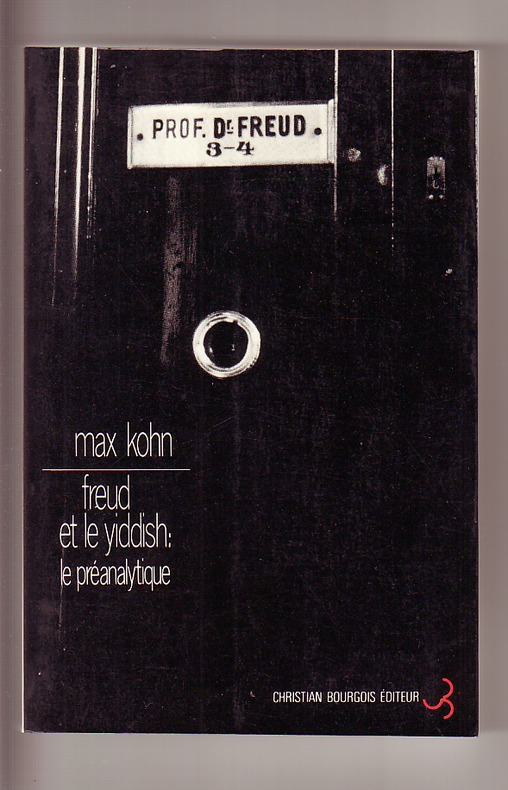
1982réf. PSYCHAAAAHH0320Paris, Christian Bourgois éditeur, 1982, 13 x 20, 382 pages cousues sous couverture rempliée illustrée.
1990Milano, Rizzoli, 1990, 16mo (cm. 18 x 11) brossura con copertina illustrata a colori, pp. 184 (I classici BUR, 763). Firma di possesso.
réf. a61093London 1904-1905. 45 issues of this Yiddish anarchist weekly bound in one volume. 4to. about 370pp. hardcover with new paper spine. Good corners of the binding are worn. The leaves are browned and a bit fragile. Issues 46 47 and 48 are chipped at the top corner with some loss of text all other issues are intact. Very scarce. . hardcover
1958Paper wrappers; 8vo. 38 pages. OCLC lists 12 copies worldwide. Cover chipped, bottom corner bumped, good condition. (ComHist-10-16)
Paper wrappers; 8vo. 38 pages. OCLC lists twelve copies worldwide. Some cover soil. Very good condition. (W-62)
1967IN YIDDISH. 24.5x17.5 cm. 359 pages. Hardcover. In good condition. PLEASE NOTE: This item is overweight. We may ask for extra shipping costs.
1976VOLUMES 2-4 ONLY. IN YIDDISH. [ALL VOLUMES]: 22.5x16cm. 183+204+208 pages. Softcover. Cover yellowing and age-stained. Cover edges worn. Spine tattered. Several pages age stained and yellowing. [VOL.2]: Pages yellowing. [VOL.4]: Front cover detached. Spine partly missing. [SUMMARY]: All volumes in good reading condition. PLEASE NOTE: This item is overweight. We may ask for extra shipping costs.
Birobidzhan-Shtot [USSR], The Committee, 1974. Newspaper, Elephant Folio, 4 pages each issue. "Organ fonem Gegntlekhn Komitet fun der Komunistisher Partay fun Sovetntnforbond un fonem Gegentlekhn Sovet fun Deputatn fun di Arbetndike fun der Yidisher Avtonomer Gegnt. " Yiddish daily established in 1930 in the Jewish Autonomous region of the USSR. "Stalin's suppression of Yiddish culture in 1948-1952, however, stopped the production of Yiddish periodical literature [in the USSR] except in the Jewish Autonomous Region (Birobidzhan) , where the newspaper Birobidzhaner shtern (Birobidzhan Star) , which had begun publication in 1930, was able to continue" (Yivo, "Yiddish Newspapers and Periodicals, N. D. ) . No Copies listed on OCLC, and only 1 holding (Columbia) with microfilm (Y-35)
19311st Edition. Original printed paper wrappers, 12mo [1], 15 [2] pages. In French and Yiddish. Issued by the Association Philanthropique de l'Asile de Nuit, Asile de Jour et de la Crèche Israélites. With extracts from the Rapport Moral de l'Oeuvre des Asiles, de Jour, de Nuit et de la Crèche Israélites de Paris (April, 1931). As more and more Jews fled, in successive waves, from the pogroms of Eastern Europe, many sought to take refuge in France. The "Asile Israélite philanthropic society was founded to provide temporary lodging for refugees who were passing through Paris. OCLC lists only 1 copy worldwide (NLI). Rare. Very Good Condition (K-1-1)
19131st edition. Period boards, 8vo, 168, [2], 148, [2], 152, 149, [1], 157, [1] pages [780 pages total]. In Yiddish. Title translates as, The Jewish World: A Literary Societal Monthly. Includes frontis portraits, a self-portrait by Max Lieberman, and many text and full-page-plate illustrations by E.M. Lilien. Di Yudishe Velt appears to have run only 4 volumes over 3 years, 1913-1915. OCLC Number: 10652260. Paper browning but solid. Institutional marks to final issue, which is bound separately with original wrappers, Solid good condition. (YID-33-48-LX)
1952280x205mm. 230+37 pages. Gilt hard water damaged cover. Cover and spine both torn at edges and corners. Pages yellowing wrinkled (water damaged) and partly stained. If fair condition. With B/W photos. 1.3 Kg