742 risultati
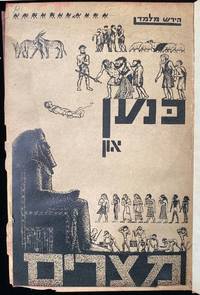
1930rif. 42782Rige Riga: Yungbukh 1930. 1st edition. Period boards with original covers bound in. 8vo. 157 pages 21 cm. In Yiddish with Latvian "front" cover and title page at rear. Title translates as "Canaan and Egypt: A Novel." Wonderfully illustrated cover bound in featuring cartoonish drawings of Canaanites and Egyptians. Two volumes in one: 1. Yoysef in Mitsroyim and 2. Yosef der reter fun Mitsroyim. SUBJECTS: Yiddish fiction. OCLC: 503648109. OCLC lists 8 copies worldwide including copies of an undated edition which we assume to be a later reprint. Ex-library with usual marks. Paper brown and somewhat fragile old dampstain to lower edge of boards extending into margins of first and last leaves. Original bound-in covers have come loose. Good condition thus. B YID-33-27-L-'ccex. Rige [Riga]: Yungbukh unknown
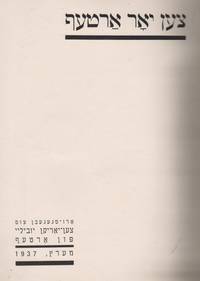
1937rif. 35363New York; Posy-Shoulson Press 1937. 1st edition. Original Wraps. 4to. 4 171 2 23 pages. 28 cm. In Yiddish with English section and title page: Ten years Artef; published for the tenth anniversary of the Artef March 1937. Extensively illustrated publication for the tenth year anniversary of the radical Yiddish theatre company Artef: "the radical Yiddish dramatic troupe based in New York during the heyday of the Yiddish theater in America. Begun in the mid-1920s as a study group of amateur worker-actors at one time there were nine separate studios with over 120 students in the 1930s the troupe went professional putting on at least two and often three new plays per season. With such plays as Jacob Mostel 's Strike Shmuel Godiner 's Jim Kooperkop Avrum Vevioka 's Diamonds and Maxim Gorky 's Egor Bulychev and Dostigaev and Others Artef spread propaganda to the masses. Ideologically Artef was far left; its hope was a Communist society here in America. As a troupe its role was 'agit-prop' to agitate and propagandize to serve as the cultural representative of radical workers. In fact most of its tickets were pre-sold through worker unions and at least in its early years Artef gave presentations at political events. Its first large-scale production was Mass Play and Ballet of the Russian Revolution which appeared at the Lenin memorial celebration in Madison Square Garden on January 21 1928. Artef 's greatest artistic and commercial successes were connected with the talented productions of director Benno Schneider. Schneider who had been active in the Zionist Habima troupe in Moscow wed aesthetic excellence to revolutionary ideology with his interpretation of Aristocrats an adaptation of Sholem Aleichem 's Mentshn. Incidentally Schneider earned such a positive reputation with Artef that he received offers to direct on Broadway a promotion that cost the radical Yiddish theater dearly. The end of the Artef was gradual and its causes were closely associated with the reduced role of Yiddish in American life. But there were bright lights before the darkness. During the 'days of the Popular Front ' when the Communists formed associations with less radical leftist parties the Artef attracted a larger audience which led to an optimistic expansion that later was responsible for huge financial losses. The darkness occurred at the end of the thirties when the number of Yiddish speakers began to diminish. The last performance of the Artef was on July 7 1941." Review by Dr. Brian Horowitz of 'Yiddish Proletarian Theatre: The Art and Politics of the Artef 1925–1940 ' written by Edna Nahshon. Many of the actors and directors in Artef went on to establish solid careers on Broadway Hollywood and for those blacklisted overseas. Bound in brown velour wraps with gilt title. Heavily illustrated. Subjects: Arbeiter theatre verband New York. Jewish theater. Theater - New York State - New York. Artef - Anniversaries etc. OCLC: 19310798. Light wear to edges of wraps otherwise clean and fresh. Good condition. B YID-22-9-LEBWW. New York; Posy-Shoulson Press unknown
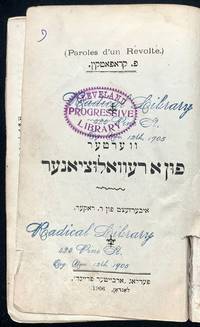
1906rif. 43217London: "Arbayter fraynd 1906. First Yiddish edition. Period boards 8vo xiii 426 pages 19 cm. In Yiddish. Title translates as “Words from a Revolutionary.” Translation of “Paroles d'un re´volte´.” Includes translation of the forewords by the author and Elise´e Reclus. Includes bibliographical references. “During his long exile Kropotkin wrote a series of influential works the most important being ‘Paroles d’un révolté’ 1885; “Words of a Rebel”.Kropotkin’s aim as he often remarked was to provide anarchism with a scientific basis. In Mutual Aid which is widely regarded as his masterpiece he argued that despite the Darwinian concept of the survival of the fittest cooperation rather than conflict is the chief factor in the evolution of species. Providing abundant examples he showed that sociability is a dominant feature at every level of the animal world. Among humans too he found that mutual aid has been the rule rather than the exception. He traced the evolution of voluntary cooperation from the primitive tribe peasant village and medieval commune to a variety of modern associations—trade unions learned societies the Red Cross—that have continued to practice mutual support despite the rise of the coercive bureaucratic state. The trend of modern history he believed was pointing back toward decentralized nonpolitical cooperative societies in which people could develop their creative faculties without interference from rulers clerics or soldiers.” SUBJECTS: Anarchism. OCLC: 19303211. Ex-library with early 19th Century left-wing library markings see photos. Good- Condition YID-48-41-LXCCGG-’e. London: "Arbayter fraynd unknown
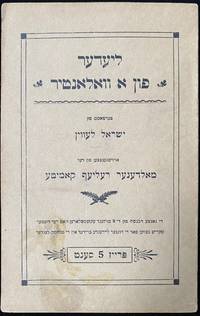
1919rif. 42896No Place Malden MA: Maldener Relief Komite 1919. No Date 1919. 1st Edition. Original printed paper wrappers 8vo 14 pages. 21 cm. In Yiddish. Title translates as "Verses of a Volunteer." No city or date listed but clearly published during or immediately after WW I with the Leksikon suggesting Malden MA 1919 OCLC suggests Boston the location of the printer and a clearly incorrect date of 1900 perhaps intending "1900s". Malden the poet's home town just outside of Boston and clearly the home of the "Maldener Relief Komite" makes much more sense making this is the first documented yiddish publication in Malden MA north of Boston. "The poet dedicated the entire income of 5 thousand copies to the brothers suffering from hunger in the countries at war" Translated from the front cover. Includes 4 poems: Der Volontir; Ikh Zukh a Vort; Nach der Milhome; Hazkharot Neshimot. The final poem is "in memory of the fallen Jewish heroes in all the war-torn lands." Israel Levine 1878-1970 "was born in a village in Minsk district Byelorussia. In 1895 he arrived in the United States lived in various cities worked as a teacher in Talmud Torahs and was secretary for Mizrachi in the town in which he lived Malden Massachusetts. He debuted in print in 1904 in Fraye arbeter-shtime Free voice of labor in New York with a poem entitled 'Funken shpritsn' Sparks fly and from that point he went on to contribute poetry and translations from Tanakh and from ethical books to: Yidishes tageblat Jewish daily newspaper Forverts Forward Dos yudishe folk The Jewish people Di varheyt The truth and Idisher kemfer Jewish fighter-in New York; Idishe shtime Jewish voice in Boston; and more. He published in book form: Lider fun a volontir Poems of a volunteer Malden 1919 16 pp.; Sefer naim zemirot tehilim Naim Zemirot on Psalms translated into a poetic form with short prefaces by Dr. Meir Vaksman and Aharon Kaminska Jerusalem 1934 19 pp" Khayim Leyb Fuks in Leksikon Fun Der Nayer Yidisher Literatur OCLC: 19307496. OCLC lists 4 copies worldwide YIVO Brandeis Harvard NYBC none outside the northeast. A few stains & discoloring Very Good Condition an excellent copy. Scarce. B YID-45-9XX-LE-'. No Place [Malden, MA]: Maldener Relief Komite unknown
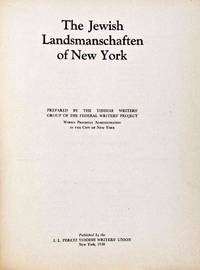
1938rif. 42985Nyu York New York: Aroysgegeben fun Y.L. Perets shrayber fareyn 1938. First edition. Original printed leather binding 4to 397 3 pages. Includes illustrations and facsimiles. 29 cm. In Yiddish. Title translates as “The Jewish Mutual Aid Societies of New York.” Research project led by the Works Progress Administration which contains articles about the history and activities of Jewish mutual aid societies in New York. Contains reviews of landmanshaft publications as well as a directory of all landsmanshaftn in the New York. “Landsmanshaftn are societies formed by Jewish immigrants from the same villages towns and cities in Central and Eastern Europe. The landsmanshaft became a dominant form of Jewish social organization in the late 1800s. The many types of landsmanshaftn include religious and socialist organizations as well as American-style fraternal orders. Landsmanshaftn provided immigrants with formal and informal social networks and members helped one another with financial needs such as medical care and burial plots. In 1938 a Federal Works Progress Administration WPA project identified 2468 landsmanshaftn in New York City. The number of landsmanshaftn began to decline in the 1950s though some societies continue to exist today.” Center for Jewish History SUBJECTS: Jews -- New York State -- New York. Fraternal organizations -- New York State -- New York. Jews. OCLC: 1018012020. Wear to spine and inside hinges Good Condition. YIZ-23-32S-CCLEX. Nyu York [New York]: Aroysgegeben fun Y.L. Perets shrayber fareyn unknown
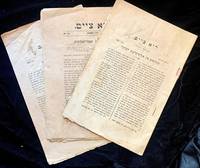
1898rif. 43426New York: N.M. Shaikewitz 1898. First edition staple binding 4to 29-31 pages each issue 30 cm. In Yiddish. Three issues of Di Tsayt a monthly Yiddish language publication published in New York. The journal ran from 1897-1898. Singerman S582; Freidus p. 282 Weissberger 56. "Menahem Mendel Dolitzky was a Hebrew and Yiddish poet and novelist. Born in Bialystok he received a traditional Orthodox education and as a teenager became interested in the ideas of the Haskalah.He served as a Hebrew teacher in various towns and in 1881 was an eyewitness to pogroms in southern Russia which had a profound effect on him. .In 1892 when the Jews were expelled from Moscow Dolitzki emigrated to New York and was warmly received by the small band of Hebrew maskilim in the U.S. He began publishing descriptions of the persecution of Jews in Russia in the journal Ha-Ivri mainly in poetic form.Despite the efforts of the Hebraists in the U.S. to assist him he found no way of making a living from Hebrew writing. After working at various jobs he finally took up writing for the daily Yiddish press turning out serialized novels which catered to the popular reader" EJ. SUBJECTS: Jews -- New York State -- New York -- Periodicals. Yiddish literature -- Periodicals. Jews. Yiddish literature. OCLC: 50546431. OCLC and Singerman together locate 4 complete holdings Harvard NYPL YIVO HUC and one of vol I only Yale. Lacks original outer paper wrappers some toning Good Condition Scarce YID-48-109-. [New York: N.M. Shaikewitz] unknown
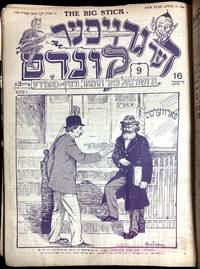
1909rif. 42930New York: Ferlag "Kibets 1909. 1st Edition. Original publisher's binding Folio newspaper. Complete first volume Starting with Vol I Nr 1 of "Der Kibitser" Dec. 15 1908 renamed and renumbered first as Vol I Nr 1 Jan 22 1909 of "Der Groyser Kibetser The big kibetzer" with the following issue of Feb 5 numbered as "3" to correctly follow from the first issue and then with Vol I Nr 6 March 19 1909 onward as "Der Groyser Kundes The Big Stick" or "The Big Prankster." Incidentally the other set of this volume we examined also did not have a Nr 2 so we are confident this is complete as issued. One centerfold cartoon by Zuni Maud see image features "Der Kaptialistisher Tayfel"--the Capitalist Devil-holding back a "mother" by the hair to stop her from interfering as "baby's milk-bottle" is drained off by the "milk-trust" cat. The caption reads "The Capitalist Devil: - to the mother: Never mind madam all in English in Hebrew letters you go to the factory the milk-trust will take good care of your baby." This cartoon-laden periodical was a New York City Yiddish language satirical bi- weekly which ran from 1908 until 1927. The humor paper was issued biweekly this volume for its first 20 months and then weekly after that. OCLC also references another Vol I Nr 1 from April 15 1908 a special S´imhes` Toyreh Simchas Torah issue but this may have been a one-off. Founded by the humorist Yosef Tunkel or Der Tunkeler his pen name meaning 'The Dark One' the paper was taken on by Jacob Marinoff when Tunkel left to work for an established paper in Warsaw. The paper consciously set itself up in opposition to the serious Yiddish-language press of the time such as the socialist Forverts.Naturally more traditional religious Judaism did not escape its satire: The later 1915 "Christmas" edition included a parodic conversation between Jesus and the prophet Elijah. Despite its irreverent attitude to everything it also published poetry by Di Yunge "The Young Ones" poets such as Moyshe-Leyb Halpern and Zuni Maud. At its height it had a circulation of 35000 but folded in 1927 due to flagging sales. Der Groyer Kunds is highlighted in this recent talk by Yiddish comics scholar Eddie Portnoy on the reactions in the Yiddish press to restrictions on Jewish immigration to the US: https://www.yiddishbookcenter.org/collections/archival-recordings/recorded-programs/ybcr-nybc-ybcr-1048/door-slams-shut-reactions-yiddish-press-immigration . SUBJECTS: Yiddish wit and humor -- Periodicals. OCLC: 28297536. Most holdings appear to be fragmentary and do not include these issues. Issue 18 with torn cover. In final issue the bottom margin suffers some loss to the final leaves none to the dramatic front cover though. Damaged boards are loose and most issues are coming loose though the quality paper used has remaind strong and bright much better than standard newsprint would have. Important graphic Yiddish humor from the great migration period. Dramatic and displayable! BK5 YID-43-9A-LEX. [New York]: Ferlag "Kibets unknown
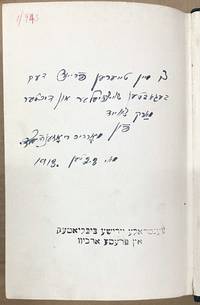
1912rif. 43120Nyu York New York: Forverts 1912. First edition. Original boards 8vo 266 266 268 pages. 20 cm. In Yiddish. Title translates as “Collected Writings.” Full set of Morris Rosenfeld’s collected works. Volume 1 contains poetry Volume 2 and 3 contain stories. Warmly inscribed by Rosenfeld in 1913 to Yiddish actor and director Mark Schweid 1891-1969: “To my dearest friend actor and poet Mark Shvayd. From Morris Rosenfeld 3. 2nd i.e. 3 of Feb 1913.” “Rosenfeld known as the ‘Poet Laureate of Labor’ was a pioneer of Yiddish poetry in the US. Born in Russian Poland he came to New York by way of London in 1889 and worked as a presser in a sweatshop. His sweatshop songs were often sung by Jewish workers in factories and at mass meetings. Moshe Starkman notes in the EJ that when his Lider-Bukh ‘The Book of Songs’ 1897 was translated in 1898 by Leo Wiener under the title Songs from the Ghetto his fame spread to non-Yiddish circles. Starkman also notes that ‘his proletarian poems and national songs stirred the Jewish masses during their early struggles in the New World and at the beginning of the Jewish national renascence’ sic. Aaron Kramer notes as well that ‘Of all Yiddish poets Morris Rosenfeld alone.was acknowledged by the non-Jewish literary world as a notable singer;’ Wiener's translation of Songs from the Ghetto ‘immediately established Rosenfeld's reputation among America's literati.” EJ 1971 14: 285-286; Kramer trans: The Teardrop Millionaire and Other Poems 1955. Mark Shveyd Schweid 1891-1969 to whom Rosenfeld inscribed this copy was a “playwright poet translator and artist born in Warsaw. His original Jewish given name was Volf-Mortkhe.…in 1911 he graduated from a Polish drama school in Warsaw and went on to act in Yiddish theaters and on the Polish stage as well. In 1911 he emigrated to the United States performed in New York’s Yiddish theaters and from 1921 was one of the principal artists in Maurice Schwartz’s Yiddish Art Theater. From 1926 he was also acting on the English-language stage. He wrote poetry drama studies one-act plays plays and longer articles on theater. He debuted in print in 1907 with poems in Roman-tsaytung….From 1946 he was an internal contributor to Forverts Forward in New York. Shveyd wrote adapted or translated roughly fifty plays” as well as 9 books. “Shveyd also translated novels from Polish Russian German and English some of which were published such as: Israel Zangwill Troymers fun’m geto Dreamers of the ghetto vol. 1 New York: M. Yankovitsh 1929 341 pp.; Stanislaw Przybyszewski Fun’m obgrund Out of the depths original: De Profundis New York n.d. 79 pp.; Fyodor Dostoevsky Erniderigte un baleytigte Humiliated and insulted original: Unizhennye i oskorblennye New York: Max Jankovitz 1920s 2 vols. Two novels he adapted were published in Warsaw’s Moment” Yekhezkl Lifshits in Leksikon Fun Der Nayer Yidisher Literatur. Schweid was director of the Bronx Art Theatre in 1930-1931; a partial collection of his papers is at the Center for Jewish History in New York. SUBJECTS: Yiddish language. Yiddish poetry. Short stories Yiddish. OCLC: 3758034 Vol I with inscription has unobtrusive number on spine and old Yiddish institutional stamp at bottom of inscribed endpaper with gutter taped at contents page. Otherwise a Very Good Condition set with important inscription. YID-46-36--’cc. Nyu York [New York]: Forverts unknown
19301st edition. Period boards with original illustrated cover mounted on front, 12mo, 138 + [5] pages ; 22 cm. In Yiddish. Complete Yiddish texts printed after each song. Contents: [1]. Folk? S-lider -- [2.] 80 Folk? S-lider. Yiddish folk songs for (medium) solo voice. Menahem Kipnis was "born in Ushomir, Ukraine in 1878. He was a singer, folklore collector, writer and photographer. From 1912 to 1932 he toured Poland, Germany and France, appearing in concerts with his wife Zimra Seligfeld in combined lecture - performances of the Jewish folk songs which he had collected and studied. He published collections of folk songs and songs for children, and was active in the Polish cantors' organization. He submitted a number of his photographs to the Forverts which were published in that newspaper in the 1920's. He died in 1942 in the Warsaw Ghetto. " (Guide to the Yivo Archives) . SUBJECT(S) : Folk songs, Yiddish. OCLC lists 10 copies worldwide. Paper browning and fragile as expected. Rear hinge starting, but very usable. About Good- condition. (music-7-2).
19351st edition. Original illustrated paper wrappers, 16mo (small) , 63 pages, 17 cm. Includes portrait of the author (tipped in as published) . A rare Yung Vilne publication. The cover makes use of an interesting period modernist font and design; the title page uses a different but striking constructivist layout and font as well. hil'e getseykhnt? , Roz'e Sutskever ; portret? , Bentye Mikt? Om. Rosa Sutzkever was one of the best-known artists of Vilna, and had trained at the Art Academy there (Bogen, 1991) and was part of Yung Vilna. Yung-Vilne (Young Vilna) , was a Yiddish literary group, introduced in the daily Vilner Tog in 1929 with the headline: Young Vilna Marches into Yiddish Literature. It aroused excitement through its miscellanies (Yung-Vilne, 193436) , its contributions to local and international Yiddish journals, and individual books of verse and fiction. Principal members included poets Chaim Grade , Shimshon Kahan, Peretz Miransky, Abraham Sutzkever , Elkhanan Wogler, and Leyzer Wolf , prose writers Shmerke Kaczerginski and Moyshe Levin, and artists Bentsie Mikhtom and Rokhl Sutzkever. Dozens more were associated with the group, whose members were united by generation, place, a shared humanistic orientation, and the encouragement of local intellectuals like Zalman Rejzen and Max Weinreich . A Yung-Vilne evening in the Vilna ghetto, the participation of several members in the partisan underground, and the accomplishments of Grade and Sutzkever as leading postwar Yiddish writers assure that Yung-Vilne will be remembered as one of the great incubators of Jewish creativity in interwar Poland (Lipzin & Cammy, 2007) . OCLC lists 11 copies worldwide (NYBC, HUC, McGill, TAU) . Title penned on spine, paper toning, touch of wear to corner, about Very Good Condition. Rare, important, and attractive (Yid-29-35)
1926Original boards. 8vo. 192, 186 pages, 21 cm. In Yiddish. Title translates to Theater and Drama. Michael Weichert (1890-1967) was a Galician Jewish theater director, historian, activist, and critic. He directed plays for the Vilner Trupe and published numerous articles on drama and theater history (YIVO). SUBJECTS: Theater, Yiddish. OCLC lists 16 copies worldwide (OCLC:42036360). Title page repair. Pages browning. Overall good condition. (YID-33-15-L-xe)
19281st edition. Original paper wrappers with portrait of Vertinskii on front wrapper, bound into later pamphlet protector.. 8vo. 14 pages, 23 cm. In Yiddish. Title translates to Twelve Songs. Vertinsky (1889 - 1957) was a Russian and Soviet artist, poet, singer, composer, cabaret artist and actor of Ukrainian origin who exerted seminal influence on the Russian tradition of artistic singing. He toured extensively throughout Russia and the USSR and appeared in many Russian films. His legacy includes the Stalin Prize and a Soviet astronomer even named a small planet after him. (Wikipedia, 2018) SUBJECTS: Songs, Russian -- Translations into Yiddish. OCLC: 53135253. OCLC lists 2 copies worldwide (Harvard and YIVO) . Ex-library with one faded stamp on front wrapper. Light soiling to wrappers. Contents are clear and very good. Some pages are a bit wavy. Very Good Condition. Rare. (YID-40-55-X-'l) xx
19391st edition. Original wrappers. 8vo. 324 pages, 25 cm. In Yiddish. Title translates to Between War and Peace. Nachman Shemen was a prominent Toronto rabbi. He was born in Poland and moved to Canada in 1930, where he was a disciple of Rabbi Yehuda Leib Graubart (Gasner, 2012) . SUBJECTS: War. Peace. Politics and government. Europe -- Politics and government -- 1918-1945.Wrappers are soiled with damp stains on first three pages. All contents are good. Overall Good Condition. (YID-40-62-CLX)
19341st edition. Original boards. 8vo. 364 pages, 22 cm. Features illustrations and portrait of Shvartsbard. In Yiddish. Title translates to In the Course of Years. Shalom-Shmuel Schwarzbard (1886-1938) was a Russian-born French Yiddish poet of Jewish descent. He served in the French and Soviet military, was a bolshevik, and is known for his assassination of the Ukrainian national leader Symon Petliura while in Paris. His trial was highly publicized and he claimed to have killed Petliura in retribution for the pogroms in Ukraine. He was eventually acquitted (Wikipedia, 2018) . He was viewed as a hero by many; this work is published by the Shalom Shvartsbard Committee in Chicago. SUBJECTS: Jews -- Ukraine -- Biography. Ex-library with usual markings. Very good Condition. (YID-40-91-X-'fl)
19251st edition. Original paper wrappers. 8vo. 48 pages, 27 cm. In Yiddish. Title translates to Canada: Periodical Literature Journal. S Edited by Y. Rabinowitz and S. Skolnikov. The Montreal Jewish community is Canadas second largest and is home to many Canadian Jewish institutions, including the Jewish Public Library of Montreal, Saidye Bronfman Centre for the Arts, Dora Wasserman Yiddish Theatre and Montreal Holocaust Memorial Centre. (Wikipedia, 2018) . SUBJECTS: Jews -- Canada -- Periodicals. Yiddish literature. OCLC lists 5 copies worldwide (NYPL, YIVO, JTS, Brandeis, NLI) , none south or west of New York. Ex-library with usual markings. Wrappers are edge worn. Internally Very Good. Overall Good Condition. Scarce. (YID-40-58)
1940Publishers Cloth. 4to. 209 pages. 26 cm. First edition. In Yiddish. Inscribed in Yiddish by author on front end paper. Written by Israel Rabinovitch (1894-1964) , an accomplished musician and writer, was chief editor of the Montreal Yiddish daily newspaper, the Keneder Adler, from 1924 to 1964. Following in the tradition of fellow musicologist Professor Abraham Tzvi Idelsohn, whom he greatly admired, Rabinovitch used the Keneder Adler as a platform to share his love for Jewish music, writing widely about it and contributing to the status and knowledge of hazzanut (cantorial arts) in Canada. In 1940, Rabinovitch published the book Muzik bai Yidn (Music by Jews) , which was translated from Yiddish into English by A. M. Klein in 1952 under the title Jewish Music: Ancient and Modern. Rabinovitch was one of the founders of the Jewish Public Library, a leader in the Labour Zionist group Poale Zion, and also the first president of the Jewish Music Council of Montreal. He passed away in Montreal in 1964. As Cantor Nathan Mendelson of the Shaar Hashomayim wrote in his obituary of Rabinovitch, his song, the song of our people remains eternal. (Le musée interactif du Montréal juif; Israel Rabinovitch) Subjects: Jews - Music - History and criticism. Hingest starting, but solid. Good+ condition. (YID-18-11)
1939First edition. Original wrappers featuring a beautiful illustration of Judah Maccabi. 8vo. 24 pages; text is partially vocalized. 23 cm. In Yiddish. Title translates to Judah The Maccabi: A Historical Operetta in Two Acts. SUBJECTS: Judas, Maccabeus, -161 B. C. -- Drama. OCLC lists 8 copies worldwide. Binding repaired. Overall Very Good Condition. (YID-27-41)
19431st edition, original wrappers, 62 pages. In Yiddish, back cover in English. Title translates as, Zionism and Yiddishkayt in Soviet Russia: A Trip Across the Soviet Union in 1940.Holocaust-era Zionist eye-witness account of Jewry in the USSR during 1940, with an introduction by Rabbi Meyer Berlin, or Meir Bar-Ilan. Meir Berlin, later Hebraized to Meir Bar-Ilan, was an Orthodox rabbi and leader of Religious Zionism, the Mizrachi movement in the United States and the British Mandate of Palestine. He inspired the founding of Bar Ilan University in Israel which is named for him. (wikipedia 2018) Heri Karp Ondenk Bibliotek Populere Broshurn-Num. 4-5. SUBJECT(S) : Zionism. Travel. Zionism. Soviet Union -- Description and travel. OCLC: 1011223445, OCLC lists 6 copies worldwide. Cover is wavy from moisture, rubbed and has some pencil markings, ex library sticker inside cover and blind stamp on title page. Internally very good. Good Condition overall. (HOLO2-141-32)
19291st edition. Original paper wrappers inside later stiff pamphlet protector. 8vo. 128 pages with illustrations, portraits, maps; 23 cm. In Yiddish. Title translates to Latvia: Her Culture, Economy, Government, Politics, Society, and Resorts. A Latvian tour guide of sorts for Yiddish speakers, printed by the press division of the Latvian foreign ministry. The author hailed from Riga, Latvia where he was a speaker for the press division of the Latvian foreign ministry. He contributed to the Riga Yiddish daily newspaper Frimorgn (Morning) and was the author of a series of Yiddish-language guides to Latvia which the Latvian government published for Jewish tourists from other countries. (Yiddish Leksikon, 2017) . SUBJECTS: Latvia -- Civilization. OCLC lists 5 copies worldwide (NYPL, LOC, Harvard, HUC, UCL) (OCLC: 19306073) . Ex-library with usual markings. Light soiling to front wrapper. Pages browning with some damp stains in margins. Overall Good+ Condition. Scarce. (YID-40-54)
19481st edition. Original boards. 8vo. 297 pages. 25 cm. In Yiddish. Title translates to Thresholds: A Trilogy. Levadi (1898 - 1973) was Russian writer. He served in the Turkish army during WWI and was stationed in Palestine. He moved to America in 1921 where his literary career blossomed. In this volume, Levadi designed the title page and included a glossary of Hebrew, Arabic, and Turkish words that the author used in the trilogy. (Yiddish Leksikon, 2017) . SUBJECTS: Autobiographical fiction. Yiddish fiction. Very light soiling to cloth. Very Good Condition. (YID-40-56-CLX)
1926First edition. Period boards. 8vo, 92 pages, 20 cm. In Yiddish. Title translates to A Provincial Newspaper. Miriam Karpilove (1888-1956) was one of the most prolific and widely published women writers of Yiddish prose. Her short stories and novels explore issues important in the lives of Jewish women of her generation. Frequent themes are the upbringing of girls and women in Eastern Europe, the barriers they encounter when they seek secular education, and the conflicts they experience upon immigration to North America. (Kellman, JWA, 2016) Over the course of her life, Karpilove lived in Minsk, Palestine, NYC, and finally Connecticut. OCLC lists 19 copies worldwide. Ex-library with usual markings. Some light water stains to top margins. Overall in Very Good Condition with few markings. (YID-23-13)
19221st edition. Original boards. 8vo. 122 pages, 21 cm. In Yiddish. Title translates to Around Me. Includes 10 beautiful Art Nouveau illustrations by Zuni Maud, which are repeated throughout the text. Kaluschiner (1893-1968) , also known as Joseph Leiser, was a Yiddish poet who released five books of Yiddish poetry. OCLC lists 29 copies worldwide (OCLC 40822983) . SUBJECTS: Yiddish poetry - literature. Author inscription from 1922 to the previous owner. Wear to boards. Some damp stains in bottom left of leaves. Overall Good Condition. (YID-40-71-L)
1967Original Cloth. 8vo. 414 pages. 24 cm. First edition. In Yiddish. The Yeshiva. "The monumental, two-volume novel Tsemakh Atlas (19671968; translated as The Yeshiva) is Grade's richest work about the Musar world and its attempt to shape the ethical personality. Through the memorable character of Tsemakh Atlas, a tortured teacher of Musar who is trapped between its self-abnegating demands, the enticements of the secular world, and his own elemental desires, readers enter a universe of high religious ideals, intellectual and moral debate, and intense spiritual struggle. " - YIVO Encyclopedia. "Grade was one of the rare interpreters of yeshivah life in modern Yiddish literature, recreating the daily life of the yeshivah student with photographic accuracy, objectivity, and affection, and illustrating it with such scenes as rabbis discussing talmudic law, as in the novel Tsemakh Atlas" - EJ 2008. Printed by Shulsinger Bros, New York. Subjects: Yeshiva Yiddish Fiction. Chaim Grade. Light stain and touch of wear to cloth, about Very good condition. (YID-21-50A) xx
18201st edition. Period full leather with spine label, 8vo, viii, 9-408 pages. Singerman 322; Rosenbach 209. The tipped in recommendation slip sign "Ph. Milledolar, " as noted by BAL, is present. President John Adams wrote of this literary anthology that it was "worthy to be presented by every father to every child, and deserve a place in every family. " Gomez's Jewish affiliation resonates in the book with his decision to include a selection from The History of Pope Pius V, which is the source for the "pound of flesh" incident in Shakespeare's Merchant of Venice. As opposed to Shakespeare's telling, in the History of Pope Pius V, it is the Jew who is the victim and the Christian who threatens him. Gomez prefaced the selection by writing: "The following subject shows that Shakespeare altered the character of Shylock, making him to be of the Jewish nation, when in reality he was not. " As Louis Harap notes (The Image of the Jew in American Literature, p. 260) , "Gomez was obviously trying to combat the effects of the Shylock stereotype. " Isaac Gomez (1768-1831) , whose great-grandfather had fled from Portugal to New York in 1703, was active in New York's Jewish community. The few early literary contributions by American Jews "was anything but impressive, but Gomez's book is worth remembering as one of American Jewry's earliest literary efforts… Gomez, both a devotee of the humanities and a committed Jew, lived comfortably ensconced in the two worlds of the Jew and the cultured American" (J. R. Marcus, United States Jewry, vol. 3, page 455) . See also Blau and Baron, The Jews of the United States, 1790-1840, Vol. II, pages 440-2. The last copy to appear at auction in the US, in 2013, sold for over $1800 (with commissions) . Foxing as expected. All endpapers present, and original period binding remains very handsome. A very good copy in outstanding period binding. (AMR-57-12)
19341st edition. Original wrappers. 8vo. 68 pages, 24 cm. In Yiddish. Title translates to Practical Guide and Information on Erets Israel. Nazi-era tips for newly arrived Yiddish speakers in Palestine. SUBJECTS: Palestine -- Guidebooks. Middle East -- Palestine. OCLC lists 5 copies worldwide (YIVO, Harvard, NYBC, JHU, HUC) (OCLC: 19312759) . Ex-library with usual markings. Original wrappers bound in to later library cardboard protector. Some damp stains. Light soiling to wrappers. Dog ears in bottom left margin. (YID-41-61)