Shochat, AzrielMareMagnum

674 résultats
1975Publishers cloth. 8vo. 200, XIII pages. 25 cm. First edition. In Hebrew with English summary. Added title page: The Crown Rabbinate in Russia; A Chapter in the Cultural Struggle Between Orthodox Jews and Maskilim. The Crown Rabbis of late imperial Russia held the government-mandated designation of rabbi, but their functions as record keepers, Russian administrative representatives, and sometimes Jewish communal (but secular) leaders belied the religious title. the opening of government-sponsored rabbinical training seminaries in Vilna and Zhitomir in 1847 these schools reflected the practical ideals of the maskilim, who emphasized the need for religious leaders to have a strong secular education. the crown rabbinate outlasted the crown rabbinical schools. On the one hand, the increasingly influential maskilim and other progressive Jews promoted the notion that a rabbi should embody worldly ideas and guide his community in the social, economic, and intellectual components of the Haskalah. Orthodox Jews, on the other hand, wanted only a traditional spiritual rabbinate. By the turn of the twentieth century, the question of who should be empowered with the religious representation of, and authority over, the Jewish communities in Russia had turned into a heated debate that played itself out in the Russian Jewish press and at various meetings of rabbis and the intelligentsia. The Russian Jewish journals Ha-Melits and Voskhod served as forums for this debate, which continued until World War I and aimed, ultimately, at solving the problem of the dual rabbinate. All the while, crown rabbis continued to function in their official capacities, even participating in various Russian rabbinic commissions as well as the Rabbinic Congress of 1910. (YIVO Encyclopedia) In the series: Mehkarim be-toldot `am-Yisrael ve-Erets-Yisrael : Sidrah monografit; kerekh 1 (Studies in the history of the Jewish people and the land of Israel; 1) Subjects: Crown Rabbinate. Haskalah - Russia. Jews - Europe, Eastern - Politics and government. Jews - Legal status, laws, etc. - Russia - History. Jews - Russia - Emancipation. Jews - Russia - Politics and government. Judaism - Russia. OCLC lists 15 copies. Light wear to cloth, otherwise fresh and clean. Very good + condition. (EE-5-39)
Milano, A. Mondadori, 1958, in-8 piccolo, br. edit. ill. a colori, pp. 398, [2]. "I Libri del Pavone".
1951IN YIDDISH. 150x225 mm. 491 pages. Hardcover. Rear cover loose. Cover corners bumped and worn. Spine wrinkled. Spine edges worn. Pages yellowing. Else in good condition.
réf. 46134Saint-Denis : Presses Universitaires de Vincennes, 1999. Un volume broché (13,5x22 cm), 280 pages. Avec une bibliographie et un index des personnes, périodiques et institutions cités. Bon état.
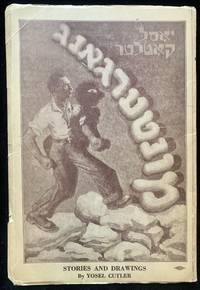
1934réf. 43320Nyu York New York: Farlag Signal 1934. Original illustrated paper wrappers 8vo 190 pages including illustrations. 20 cm In Yiddish. The title translates as “Underground” or “Success.” Nazi-era Poetry and fiction by Yosl Cutler with illustrations by the author. “A mish-mosh of wildly creative stories and illustrations by Yosl Cutler one of the most original and unique characters in Yiddish cultural life. Includes one of the first Yiddish science fiction stories ‘Afn shtern mars’ On the Planet Mars as well as a great deal of left wing political work in prose poem and cartoon.” Yiddish Book Center. “Cutler was born in Troyanets Volhynia. He studied in religious elementary school. He was orphaned in his youth and at age eleven he became a server in a tavern. He mastered sign painting and in 1911 departed for the United States. He pursued his study of painting and in 1925 he created with the artists Zuni Maud and Jack Tworkov a Yiddish marionette theater called “Modicut” which proved successful in the United States and Europe but didn’t last long because of the great expenses involved. Under the influence of Moyshe Nadir in 1922 he began writing poetry humorous sketches stories and short plays… Of his short plays that were published in journals: Di sokhrim fun fefer Merchants of pepper; Der kindermark The children’s market; and Mayn filozofisher vesher My philosophical laundry; among others. In book form: Muntergang Success New York 1934 190 pp. ‘Yosl Kotler worked in three realms’ wrote M. Olgin ‘which merged into one: writer of humor cartoonist and marionette operator.’ He died in Memphis.” Leksikon Fun Der Nayer Yidisher Literatur SUBJECTS: Yiddish wit and humor. Jewish wit and humor. Short stories Yiddish. Yiddish drama. OCLC: 23578196 Clean copy with some worn edges. Good Condition YID-48-75-MLX-’ggecc. Nyu York [New York]: Farlag Signal unknown
1940Publishers Cloth. 4to. 209 pages. 26 cm. First edition. In Yiddish. Inscribed in Yiddish by author on front end paper. Written by Israel Rabinovitch (1894-1964) , an accomplished musician and writer, was chief editor of the Montreal Yiddish daily newspaper, the Keneder Adler, from 1924 to 1964. Following in the tradition of fellow musicologist Professor Abraham Tzvi Idelsohn, whom he greatly admired, Rabinovitch used the Keneder Adler as a platform to share his love for Jewish music, writing widely about it and contributing to the status and knowledge of hazzanut (cantorial arts) in Canada. In 1940, Rabinovitch published the book Muzik bai Yidn (Music by Jews) , which was translated from Yiddish into English by A. M. Klein in 1952 under the title Jewish Music: Ancient and Modern. Rabinovitch was one of the founders of the Jewish Public Library, a leader in the Labour Zionist group Poale Zion, and also the first president of the Jewish Music Council of Montreal. He passed away in Montreal in 1964. As Cantor Nathan Mendelson of the Shaar Hashomayim wrote in his obituary of Rabinovitch, his song, the song of our people remains eternal. (Le musée interactif du Montréal juif; Israel Rabinovitch) Subjects: Jews - Music - History and criticism. Hingest starting, but solid. Good+ condition. (YID-18-11)
2012New New English Original bdg. Dust wrapper. Roy. 8vo. (24 x 17 cm). In English. B/w and color ills. 375 p. Memoirs of the President of the Turkish-Jewish Community 1989-2004. My life as a Turkish Jew. Memoirs of the President of the Turkish-Jewish Community 1989-2004. Compiled by Tülay Gürler. JUDAICA Jewish culture Memoirs Turkish Jews.
1934réf. STLE0064a?ernovits : Seminar far Jid. Literatur- un ?prachkenteni?, 1934. kl.-8°. 96 S., OKart. mit mont. Deckel- u. Rückenschildchen. Errata-Zettel beiliegend. In romanisiertem Jiddisch. Das Romanisierungsystem ist im Anhang erläutert.
1931Original Wraps. 8vo. 67 pages. 21 cm. First edition. In German. 'The Natural Sciences and Beliefs; Opening speech to mark the 25th anniversary of the Verein für Natur- und Heimatkunde in Koln and the Rhein. ' Inscribed to Rabbi Jakobovitz by the author. Bruno Zecharias Kisch (1890-1966) was a medical doctor, biochemist, and Jewish scholar. He was one of the founders of the Juedisches Lehrhaus in Cologne and taught experimental medicine, physiology, and biochemistry at the University of Cologne until 1936, when he was forced to leave Nazi Germany. He taught at Yale and Yeshiva Universities in the United States subsequent to his emigration. He was a founder and president of the American College of Cardiology and made many medical contributions. - Guide to the Bruno Kisch Papers, Yeshiva Univ. Subjects: Science - Philosophy. Materialism. OCLC lists 22 copies. Light soiling to wraps, light chipping to backstrip; edges bumped. Fresh and clean. Good condition. (GER-43-59)
19708vo; 361 pages; Includes 25-page bibliography & 14-page index. Very light wear, Very Good Condition (Comhist 3-3)
1995pp. xvii, 262. Inscribed by Max Rosenfeld to Ron Lieberman (bookseller). 8vo. Original printed wraps. JUDAICA BOX 4
1906Publishers cloth. 8vo. 107 pages. 20 cm. First appearance? With frontispiece portrait of Ibsen. Nora, or, a Dolls House; a Drama in Four Acts, by Henrik Ibsen, translated into Yiddish by Morris Winchevsky. Undated, ostensibly the first appearance of A Dolls House in Yiddish translation; however, the publisher, Max Maisel, went through at least five print runs of A Dolls House in various years from 1906 until 1920. Bound in yellow cloth, with debossed title and border. Subjects: Yiddish drama. Norwegian drama - Translations into Yiddish. OCLC lists 18 copies encompassing all print runs of Nora individually printed. Light wear to cloth, otherwise fresh and clean. Very good + condition. (YID-18-18)
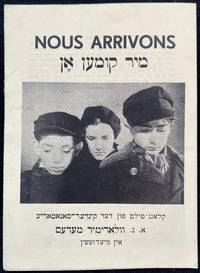
1938réf. 43520No Place Paris: No Publisher The Bund 1938. No Date 1938. 1st edition. Single fold pamphlet 12mo 3 pages. Includes photo on cover & inside. All text in Yiddish. Title translates as "We are Coming. A Sound-Film from the Children's Sanatorium Vladimir Medem in Miedzshin" a neighborhood in Warsaw. Promotional pamphlet for use in France and Belgium and possibly elsewhere for Aleksander Ford's 1936 film re-released in 1937-1938 for fundraising purposes on the children of the Medem Sanatorium entitled "Mir Kumen On" which translates literally as "We are Coming." For the English release of the film the title was instead translated as "Children Must Laugh;" it is viewable online at www.youtube.com/watchv=vozD_XbGHGA. The restored film was featured at the Museum of Modern Art's To Save and Project: The 14th MoMA International Festival of Film Preservation in 2016. "A rare record of Jewish life in Poland before World War II this 1936 film Mir Kumen Onwas produced in several language versions as an international fundraiser for the Medem Sanatorium near Warsaw a clinic sponsored by the General Union of Jewish Workers the Bund that provided care and an escape from urban poverty for some 10000 children between 1926 and 1939. Directed in a Soviet-influenced style by Alexander Ford a committed Communist who later became the head of Poland's National Film School the film follows three children as they gradually overcome their emotional withdrawal and distrust and enter the communal life of the institution" MoMA 2016. From the pamphlet text: "Narrow and dark streets of Greater Warsaw. Crowded and wet attics attics and cellars. 'Apartments' filled with people who lack mother's breasts for the always screaming child. An unemployed father. And - children everywhere many children. Children - withered rickety with crooked legs sunken chests and pale faces they - the children - know all the bitterness of life from a very early age. Often very often they are already 'earners' themselves - in a poor workshop in the street or until late at night they sell th apples and 'hot warm bagels'. And now from this environment the children arrive at the Medem sanatorium: Hanale from the Jewish secular school the pale Zalmanka from Cheder and Laser - the bagel seller. In the beginning everything is strange to them in the 'strange' Medem-Sanatorium: no one punishes no one shouts no one is angry. Everything is friendly to them everyone strives to understand them as their best friend. Joy and freedom mixed with free independent work rule over everything here. And our three heroes quickly got used to the new life-forms. They flourish. They become stronger physically and mentally they actively participate in the work of the 'self-management' of children they begin to understand that the world does not have to be like that as they realized in Warsaw that they can and must be someone else someone free someone equal someone beautiful. The children are taken in by the spirit of true friendship they begin to understand that person's suffering and get an aspiration to help that person. And when their daily newspaper brings news that the coal miners are on strike in Zaglembia that their children are starving they are deeply moved. Because - who can understand better than them what a strike means and feel more than them what is called hunger And at a general meeting the children according to their own proposal give each one a day of their time in the sanatorium so that the 180 children - create 180 days for their brothers in Zaglembia Times flies in the sanatorium. And now we see our 3 'heroes' as they drive off back home. The faces of all 3 are drawn. A deep sadness lies on the young childish faces." Both the pamphlet and the film end with the song "Mir Kumen On"--We Are Coming-the words by Nokhem Yud 1888-1966 and music by Yankl Troupianski 1909-1944. The film's theme song was also used by Camp Hemshekh in New York as its anthem in the 1960s & 1970s. "Everything in the film is factual and authentic. There is not a single artist in the film - everything is performed by the participating children of the Medem Sanatorium." We were unable to locate any copies using OCLC nor with a google search. An unrecorded promotional brochure for a very important film. Near Fine Condition. Very important. Exceedingly rare. PBERL-1-9-XX. No Place [Paris?]: No Publisher [The Bund?] unknown
1990Milano, Rizzoli, 1990, 16mo (cm. 18 x 11) brossura con copertina illustrata a colori, pp. 184 (I classici BUR, 763). Firma di possesso.
1996Seconda edizione. Introduzione, scelta e note a cura di Ferruccio Folkel In 16°; pp. 183; brossura editoriale illustrata; rilegato all'americana (fresato non cucito). CONDIZIONI OTTIME (conuseta ingiallitura delle pagine dovuta alla qualità della carta).
IN YIDDISH. 15x22 cm. VI+445+12+136 pages. Hardcover. Cover slightly stained. Cover edges slightly chafed. Cover partly detached from spine on lower edge. Spine is worn. Binding is visible between several pages. Else on good condition.
réf. 68771Mercure de France, 2000, 751 p., broché, très légères traces d'usage, bon état.
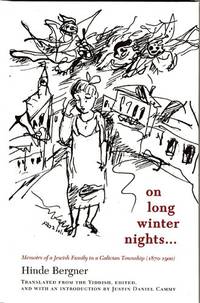
2005réf. L3 box729 a5On Long Winter Nights…: Memoirs of a Jewish Family in a Galician Township 1870–190 Harvard Center for Jewish Studies. By Hinde Bergner; Translated from the Yiddish edited and with an introduction by Justin Daniel Cammy. 2005 by Harvard University Center for Jewish Studies Harvard University Press. Hardcover 122 pp. Harvard University Center for Jewish Studies, Harvard University Press. hardcover
1973205x135, 198pp, hard green cover, slightly worn cover, Signed by the author, else in good+ condition.
191616', 229pp. hardcover. worn cover and edges, spine on edges slightly damaged. stamp and previous owners name on title page, yellowing pages, else in fair+ condition.
192024.5x16.5cm. 92 pages. Gilt hardcover. Cover slightly worn. Spine worn. Else in good condition.
1933réf. KNY100315631933. Language: Yiddish. Condition: not graded in detail, please see the photos. The photos show the actual copy offered. Ships from Ukraine by Nova Post with tracking after receipt of payment (bank transfer or PayPal); delivery time 12–28 business days including customs clearance. Shipping for this book (up to 1 kg): Netherlands €24.70, Belgium €29.60, Germany €19.90, France €29.10, Austria €29.10, Switzerland €46.00; other countries on request. The exact amount is confirmed when we accept your order. The parcel is sent from outside the EU/UK/Switzerland. Import VAT on books (e.g. Netherlands 9 %, Germany 7 %, Belgium 6 %, France 5.5 %, Switzerland 2.6 %, UK 0 %) and a customs handling fee of the carrier may be charged to the buyer on delivery; they are not included in the price. Antiquarian book (1933). Export from Ukraine of books older than 50 years may require a cultural-goods export certificate; we obtain it before shipping, which can add several weeks. Please ask before ordering if you need a firm delivery date. Consumers in the EU have the statutory 14-day right of withdrawal (see the seller terms). If the book does not match the description or is damaged in transit, please contact us right after receipt.
21.5x14 cm. 56 pages. Softcover. Cover edges worn and slightly torn. Cover yellowing and slightly age stained. Spine visible between several pages. Else in good condition.
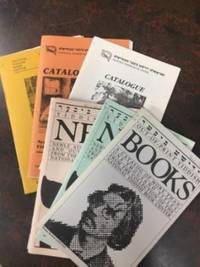
1988réf. bing65mm00009The National Yiddish Book Center 1988. Paperback. Very good. Prompt shipment with tracking. we ship in CLEAN SECURE NEW boxes Very good condition 7 staple-bound catalogues dating from the 1980s published by The National Yiddish Book Center Amherst MA. Mostly clean pages some dog-eared some dates and notes. The National Yiddish Book Center paperback
316pp. 24 cm. Hardcover Very good condition good