737 risultati
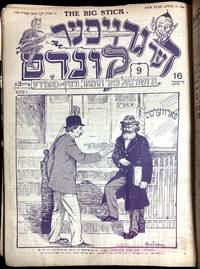
1909rif. 42930New York: Ferlag "Kibets 1909. 1st Edition. Original publisher's binding Folio newspaper. Complete first volume Starting with Vol I Nr 1 of "Der Kibitser" Dec. 15 1908 renamed and renumbered first as Vol I Nr 1 Jan 22 1909 of "Der Groyser Kibetser The big kibetzer" with the following issue of Feb 5 numbered as "3" to correctly follow from the first issue and then with Vol I Nr 6 March 19 1909 onward as "Der Groyser Kundes The Big Stick" or "The Big Prankster." Incidentally the other set of this volume we examined also did not have a Nr 2 so we are confident this is complete as issued. One centerfold cartoon by Zuni Maud see image features "Der Kaptialistisher Tayfel"--the Capitalist Devil-holding back a "mother" by the hair to stop her from interfering as "baby's milk-bottle" is drained off by the "milk-trust" cat. The caption reads "The Capitalist Devil: - to the mother: Never mind madam all in English in Hebrew letters you go to the factory the milk-trust will take good care of your baby." This cartoon-laden periodical was a New York City Yiddish language satirical bi- weekly which ran from 1908 until 1927. The humor paper was issued biweekly this volume for its first 20 months and then weekly after that. OCLC also references another Vol I Nr 1 from April 15 1908 a special S´imhes` Toyreh Simchas Torah issue but this may have been a one-off. Founded by the humorist Yosef Tunkel or Der Tunkeler his pen name meaning 'The Dark One' the paper was taken on by Jacob Marinoff when Tunkel left to work for an established paper in Warsaw. The paper consciously set itself up in opposition to the serious Yiddish-language press of the time such as the socialist Forverts.Naturally more traditional religious Judaism did not escape its satire: The later 1915 "Christmas" edition included a parodic conversation between Jesus and the prophet Elijah. Despite its irreverent attitude to everything it also published poetry by Di Yunge "The Young Ones" poets such as Moyshe-Leyb Halpern and Zuni Maud. At its height it had a circulation of 35000 but folded in 1927 due to flagging sales. Der Groyer Kunds is highlighted in this recent talk by Yiddish comics scholar Eddie Portnoy on the reactions in the Yiddish press to restrictions on Jewish immigration to the US: https://www.yiddishbookcenter.org/collections/archival-recordings/recorded-programs/ybcr-nybc-ybcr-1048/door-slams-shut-reactions-yiddish-press-immigration . SUBJECTS: Yiddish wit and humor -- Periodicals. OCLC: 28297536. Most holdings appear to be fragmentary and do not include these issues. Issue 18 with torn cover. In final issue the bottom margin suffers some loss to the final leaves none to the dramatic front cover though. Damaged boards are loose and most issues are coming loose though the quality paper used has remaind strong and bright much better than standard newsprint would have. Important graphic Yiddish humor from the great migration period. Dramatic and displayable! BK5 YID-43-9A-LEX. [New York]: Ferlag "Kibets unknown
1907Original Wraps. 12mo. 45 pages. 19 cm. First edition. The Intellectual: A Drama in Three Acts. In Yiddish, but printed with type employing Hebrew diacritics. An early play in Hirschbeyns repertoire, written in his symbolist phase. Subjects: Yiddish drama. OCLC lists 12 copies Wrap corner edgeworn, outer edges lightly aged, binding repaired, otherwise fresh and clean. Good condition. (YID-18-6)
1907Original Wraps. 12mo. 45 pages. 19 cm. First edition. The Intellectual: A Drama in Three Acts. In Yiddish, but printed with type employing Hebrew diacritics. An early play in Hirschbeyns repertoire, written in his symbolist phase. OCLC lists 12 copies Subjects: Yiddish drama. Wraps torn, edges frayed, internally fresh. Fair condition. (YID-18-6B)
19241st Yiddish edition. Original wrappers. 8vo. 79 pages, 17 cm. In Yiddish. Title translates to The Bloody Laughter: Hinkemann: A Tragedy in 3 Acts and 7 Scenes. First published in German in 1923. Toller (1893-1939) was a German left-wing playwright, best known for his Expressionist plays. He served in 1919 for six days as President of the short-lived Bavarian Soviet Republic, and was imprisoned for five years for his actions. He wrote several plays and poetry during that period, which gained him international renown. They were performed in London and New York as well as Berlin. In 2000, several of his plays were published in an English translation. In 1933 Toller was exiled from Germany after the Nazis came to power. He did a lecture tour in 1936-1937 in the United States and Canada, settling in California for a while before going to New York. He joined other exiles there. Struggling financially and depressed at learning his brother and sister had been sent to a concentration camp in Germany, he committed suicide in May 1939 (Wikipedia, 2018) . SUBJECTS: German drama -- Translations into Yiddish. OCLC lists 10 copies worldwide (OCLC: 429179006) . Edge wear. Minor repair. Bottom margin of title page is missing. Overall Good Condition. (YID-41-16)
19461st edition. Original paper wrappers 4to (magazine size) , 32, 128 pages. In Yiddish (128 pages) and English (32 pages). 3 Volumes were issued (1946, 1947, 1948) Includes many photos. 24 cm. SUBJECT(S) : Jews, East European -- United States -- Periodicals. : Jews -- Bessarabia (Moldova and Ukraine) OCLC lists 19 copies worldwide.. Spine crudely repaired with black tape, but covers are otherwise good, and internal paper and binding remain good and strong as well. Good condition thus. (GH-3-10A-ALX-o)
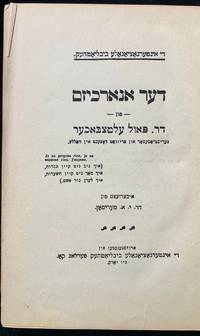
1909rif. 43139New York: Internatsyonale bibliothek Verlag ko 1909. First edition. Original boards 8vo 347 pages 21 cm. In Yiddish. Title translates as “Anarchism.” Translation of Paul Eltzbacher’s “Anarchism” into Yiddish. In it he covers seven anarchist figures: Godwin Proudhon Stirner Bakunin Kropotkin Tucker and Tolstoy. Includes bibliographical references. “Jacob Abraham Maryson was a Jewish–American anarchist doctor essayist and Yiddish translator. Maryson was among the few Pioneers of Liberty who could write in English. He was among the Pioneers who launched the Varhayt in 1889 the first American anarchist periodical in Yiddish….Maryson contributed to a variety of other Yiddish publications and became known as ‘the Kropotkin of the Jewish anarchist movement’. During Fraye Arbeter Shtime's hiatus in the late 1890s Maryson assisted in the cultural and literary journal Di Fraye Gezelshaft. Beginning in 1911 he edited the anarchist periodical Dos Fraye Vort. Maryson organized the Kropotkin Literary Society to print Yiddish translations of European thinkers. Maryson handled some of the group's most challenging translations including Marx's Das Kapital Stirner's The Ego and His Own and Thoreau's Civil Disobedience. He also translated John Stuart Mill's On Liberty. Maryson later wrote The Principles of Anarchism in 1935.” Wikipedia. SUBJECTS: Anarchism. OCLC: 19304220 Very Good Condition. YID-48-3-. New York: Internatsyonale bibliothek Verlag ko unknown
1822Contemporary marbled paper over boards. 12mo. 154; 140 pages. 17 cm. Only edition. Two Volumes in one. In German. A volume of Biblical history (including a retelling of many Bible stories) , with moral notes by Heimann Schwabacher. It is designated on the title page as a work for more mature youth. The author is also known as Hayyim Hirsch Schwabacher, and is listed as the translator of Behinot Olam by Jedaiah ben Abraham Bedersi and also of Olelot Ha-Bohen (by the same author) . These are both works on ethics, and in both the German translation is transliterated using Hebrew letters. He also wrote a book in Yiddish on ethics, entitled Keren Tushiya (Fuerth, 1817) . Attractively bound in marbled boards and leather backstrip. Printed on ragpaper. Subjects: Bible Germany Haskalah. OCLC lists three copies, none of which seem to contain both parts (UCLA, HUC, Natl Libr Israel) , none east of Cincinnati. Light wear to hinges, otherwise verry clean and fresh. Very good condition. (GER-43-48)
19011st edition. Original paper wrappers. 8vo. 30 pages, 19 cm. In Yiddish. Title translates to "Darwinism. " Benjamin Feigenbaum (1860-1932) was a Polish-American Yiddish socialist and Yiddish writer. He edited The Forward and the literary monthly Di Tshukunft. He was an outspoken critic of religion, and was also a pioneer of the Socialist Party of America and ran into considerable police trouble as a result of his activism (Wikipedia) . SUBJECTS: Darwin, Charles. OCLC lists 8 copies worldwide (OCLC: 19313039) . Front wrapper is loose with some chips in the margins. Pages brownings and omewhat fragile with very small chips in bottom right corner. Otherwise good condition. (YID-33-22-EL)
2019rif. RUSSIE56561212121123Paris, Editions de l'Antilope, 2019, 13 x 18,5, 508 pages sous couverture rempliée illustrée. Récit traduit du yiddish par Rachel Ertel.
Madrid, Alfaguara, 1977. Ilustraciones de Margot Zemach. Traducción de Leopoldo Rodríguez. 114 p. 2 h. 8º mayor. Rústica editorial. Muy buen ejemplar. 1ª edición en español.
19311st Edition. Original printed paper wrappers, 12mo [1], 15 [2] pages. In French and Yiddish. Issued by the Association Philanthropique de l'Asile de Nuit, Asile de Jour et de la Crèche Israélites. With extracts from the Rapport Moral de l'Oeuvre des Asiles, de Jour, de Nuit et de la Crèche Israélites de Paris (April, 1931). As more and more Jews fled, in successive waves, from the pogroms of Eastern Europe, many sought to take refuge in France. The "Asile Israélite philanthropic society was founded to provide temporary lodging for refugees who were passing through Paris. OCLC lists only 1 copy worldwide (NLI). Rare. Very Good Condition (K-1-1)
1985Traduzione: Biondi Mario dall'americano . Edizione: Prima traduzione italiana . Pagine: 284 . Illustrazioni: Grafica di John Alcorn . Formato: 8° . Rilegatura: Brossura originale . Stato: Ottimo . Caratteristiche: Timbro dell'editore . Collana: La gaja scienza n°138 .
1963IN YIDDISH. The first chapter is about the Khazars! 20x14.5mm. 353 pages. Hardcover. Cover and spine slightly age stained. Cover corners slightly bumped. Spine loose. Ex-library copy with usual marks. Several pages slightly stained - NO damage to text. Pages slightly yellowing. Else in good condition.
190522.5x15.5 cm. 7+759 pages. Hardcover. Spine is scuffed, with tears on top and bottom. Corners of cover are scuffed. Cover and spine are slightly dirty. Edges of book are dirty. Pages are yellowing. Else in good condition. PLEASE NOTE: This item is overweight. We may ask for extra shipping costs.
1996240x175 mm. 17+334+x pages. Hardcover. Sticker on front and rear cover. Else in good condition.
1980IN HEBREW. 23X15.5 cm. 369 pages. Softcover. Cover slightly chafed. Else in good condition.
1986IN YIDDISH WITH HEBREW INTRODUCTION. 21x14cm. 45+315 pages. Softcover. Cover slightly rubbed. Else in good condition.
1986YIDDISH (with Hebrew Introduction). 21x13.5 cm. 315 pages. Softcover. In Good Condition.
1928First edition. Original blue publishers cloth, large square. 8vo, 16 leaves with 15 tipped in plates. Each leaf contains a tipped in color print by Raban in the classic style with English text in a gilt Bezalel style frame on the facing page. Title translates as, "Chagaynu. Our Holidays: A Picture Book Drawn by Z. Raban of the Bezalel Srt school, Jerusalem." Chagaynu (meaning Our Holidays) is a beautiful picture book drawn by Zeev Raban of the Bezalel Art School in Jerusalem. The book includes 14 plates featuring gorgeous color illustrations by Raban, all showing Jewish holidays throughout the year. Each illustration includes with it a poem by Israeli children's author and poet Levin Kipnis ("Avi-Shai"). Each color plate is protect by tissue guards. Text in Hebrew. Raban, the artist, is regarded as a leading member of the Bezalel school art style, in which artists portrayed both Biblical and Zionist themes in a style influenced by the European Jugendstil (similar to Art Nouveau) and by traditional Persian and Syrian styles. Israel Museum Catalogue, Bezalel number 1348; Yeshiva University Museum Catalogue, Raban Remembered, number 78. Dime-sized stain on front end papers, otherwise very clean. Bookplate, no other markings. Wear to cloth boards. Overall Good+ Condition. (art-21-8AXX)
1980MACCHIETTE/FIORITURE ALLA COPERTINA E NELLE PRIME PAGINE BIANCHE. SEGNI DEL TEMPO. MAI SFOGLIATO. 25 anni nel cinema polacco. Il viaggio esemplare di un cineasta dell'Est dentro i miti della Polonia, dentro la storia, dentro i fantasmi della letteratura e del quotidiano, dentro le contraddizioni di un cinema critico che vuole restare popolare. Informazioni bibliografiche Titolo: Cenere e diamanti. Il cinema di Andrzej Wajda Autore: Giandomenico Curi Editore: Roma: Edizioni E/O, 1980 Lunghezza: 267 pagine, 21 cm. Soggetti: Cinema, Registi cinematografici, Polonia, Est, Europa, Critica, Wajda, Andrzej, Saggi, Film Polski, Opere, Filmografia, Cultura yiddish, Romanticismo, Sociale, Cattolico, Socialismo, Ribellione, Comunismo, Varsavia, Borghesia, Letteratura, Montaggio, Nouvelle Vague, Fellini, Orson Welles, Teatro, Katyn, Le signorine di Wilko, L'uomo di ferro, Oscar, Palma d'oro, La terra della grande promessa, Cannes, Anni settanta, Zbigniew Cybulski, simbolismo, Generazione, I dannati di Varsavia, Lech Walesa, Orso d'oro, Berlino, Cultura, Pierscionek z orlem w koronie, Zemsta - La Vendetta, Solidarnosc, Solidarnosc..., Popiól i diament
rif. feb122284Used. For more details please contact me unknown
rif. feb123153Used. For more details please contact me unknown
1981rif. 019682Oakville Ontario: Mosaic Press/Valley Editions 1981. Book. G/VG-. Trade Paperback. First Thus. Trade size gray paperback with black and white titles. Book has a remainder mak on the bottom closed page edges with light edge wear and rubs along the spine. Interior is clean tight and unmarked. Yiddish poetry by Abraham Sutzkever during World War II and his time in the Vilna Ghetto. 51 pages. Mosaic Press/Valley Editions Paperback
19471st edition. 4to, Original Paper Wrappers, 8 pages each issue, 13 numbers in 12 separate issues, as published. In Yiddish. Title translates as Bulletin of the Bund. Complete run of this early post-Holocaust iteration the Bunds monthly newsletter (also serving Kindred Jewish Socilaist Organizations), reflecting the concerns of its membership of secular Polish Holocaust survivors as well as pre-war immigrants to the US. Full of interesting articles including: Reports and declarations from the World Bund Conference in Brussels, including declarations on Antisemitism the workers movement, etc; The 1947 Socialist conference in Zurich; Bund activity in postwar-Poland, Belgium, Italy, France, Brazil, and Argentina; Jewish Socialists in Rumania; Bund Resolutions on the Camps; German Socialists and the Jewish Question; Professor Hirsh and Palestine; Discussion in the Bun on the Status of Palestine; On the Bundist Youth Movement in Poland; Special Camps; The Bulletin of the Bund [ie this periodical] in the [DP] Camps; Five Years in the Warsaw Ghetto, by Bernard Goldshtein; Bundist Academy in the Gan Eden Camp in New York; A Memorial for the Bund at the Congress of the French Socialists; etc. The General Jewish Labour Bund in Lithuania, Poland and Russia (Yiddish: algemeyner yidisher arbeter-bund in lite, poyln un rusland), generally called The Bund or the Jewish Labour Bund, was a secular Jewish socialist party.... founded in Vilnius on October 7, 1897 ..In 1917 the Polish part of the Bund, which dated to the times when Poland was a Russian territory, seceded from the Russian Bund and created a new Polish General Labor Bund which continued to operate in Poland in the years between the two world wars .The Bund sought to unite all Jewish workers in the Russian Empire into a united socialist party, and also to ally itself with the wider Russian social democratic movement to achieve a democratic and socialist Russia. The Russian Empire then included Lithuania, Latvia, Belarus, Ukraine and most of present-day Poland, areas where the majority of the world's Jews then lived. They hoped to see the Jews achieve a legal minority status in Russia. Of all Jewish political parties of the time, the Bund was the most progressive regarding gender equality, with women making up more than one-third of all members. The Bund actively campaigned against anti-Semitism. It defended Jewish civil and cultural rights and rejected assimilation. However, the close promotion of Jewish sectional interests and support for the concept of Jewish national unity (klal yisrael) was prevented by the socialist universalism of the Bund. The Bund avoided any automatic solidarity with Jews of the middle and upper classes and generally rejected political cooperation with Jewish groups that held religious, Zionist or conservative views. Even the anthem of the Bund, known as "the oath" (di shvue in Yiddish), written in 1902 by Sh. An-ski, contained no explicit reference to Jews or Jewish suffering. At the heart of the vision of the future of the Bund was the idea that there is no contradiction between the national aspect on the one hand and the socialist aspect on the other. As a strictly secular organization, the Bund renounced the Holy Land and the sacred language (Hebrew) and chose to speak Yiddish .In its early years the Bund had remarkable success, gaining an estimated 30,000 members in 1903 and an estimated 40,000 supporters in 1906, making it the largest socialist group in the Russian Empire . the Bund was a founding collective member at the RSDLP's first congress in Minsk in March 1898. For the next 5 years, the Bund was recognized as the sole representative of the Jewish workers in the RSDLP, although many Russian socialists of Jewish descent, especially outside of the Pale of Settlement, joined the RSDLP directly .The Bund generally sided with the party's Menshevik faction led by Julius Martov and against the Bolshevik faction led by Vladimir Lenin during the factional struggles in the run-up to the Russian Revolution of 1917 .In the Polish areas of the [Russian] empire, the Bund was a leading force in the 1905 revolution. At that time the organization probably reached the height of its influence. It called for an improvement in living standards, a more democratic political system and the introduction of equal rights for Jews. At least in the early stages of the first Russian Revolution, the armed groups of the "Bund" were likely the strongest revolutionary force in Western Russia. During the following years, the Bund went into a period of decay .The Bund eventually came to strongly oppose Zionism, arguing that emigration to Palestine was a form of escapism. The Bund did not advocate separatism. Instead, it focused on culture, rather than a state or a place, as the glue of Jewish nationalism. . The Bund also promoted the use of Yiddish as a Jewish national language and to some extent opposed the Zionist project of reviving Hebrew. The Bund won converts mainly among Jewish artisans and workers, but also among the growing Jewish intelligentsia. It led a trade union movement of its own. It joined with the Poalei Zion (Labour Zionists) and other groups to form self-defense organisations to protect Jewish communities against pogroms and government troops. During the Russian Revolution of 1905 the Bund headed the revolutionary movement in the Jewish towns, particularly in Belarus and Ukraine ..In 1921, the Communist Bund [in the USSR] dissolved itself and its members sought admission to the Communist Party....Many former Bundists, like Mikhail Liber and David Petrovsky, perished during Stalin's purges in the 1930s. The Polish Bundists continued their activities until 1948. During the latter half of the 20th century the Bundist legacy was represented through the International Jewish Labor Bund, a federation of local Bundist groups around the world .Among the exiled Bundists who went on with Socialist politics in America was Baruch Charney Vladeck (18861938), elected to the New York Board of Aldermen as a Socialist in 1917 [and] 1937 [and] manager of The Jewish Daily Forward Moishe Lewis (18881950)....the father of David Lewis (19091981), a leader of the New Democratic Party in Canada .David Dubinsky (18921982), though never formally a member of the party, had joined the bakers' union, which was controlled by the Bund, and was elected assistant secretary within the union by 1906 ..He later became a member of the Socialist Party of America, helped found the American Labor Party in 1936 and was from 1932 till 1966 the leader of the International Ladies' Garment Workers' Union ..under the name Max Goldfarb, David Petrovsky (18861937) was a member of the Central Committee of the Jewish Socialist Federation of America, a member of the Socialist Party of America, and the labor editor of The Forward (Wikipedia). SUBJECT(S): Jews -- United States -- Periodicals. Jewish socialists -- New York (State). Jewish labor unions. OCLC: 234327189. OCLC: 234327189. OCLC-Worldcat lists 6 holdings worldwide (NYPL, NLI, YIVO, Harvard, Yale, USHMM), though some listings may be for partial runs. Light wear, Very Good Condition. Rare and important complete set. (Yid-33-51)
1991First edition. Tall octavo, viii + 402 pp. Bound in black and gray boards. Photographs on inner front cover and front free fly and back cover and back free fly. Glossary. Notes on sources. Selected bibliography. Photograph credits. Index