6 495 résultats
réf. RGW19164AEtching and burnished aquatint TRIAL PROOF ON THIN JAPAN PAPER before all letters This is a posthumous printing but before the edition printed in 'L'Art' in 1877. Harris considers the quality of these impressions almost identical to the working proofs. unknown
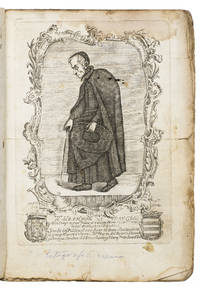
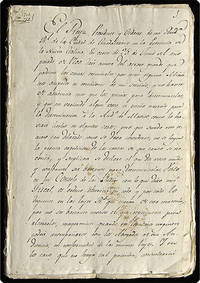
1770réf. ABC_47902Córdoba 1770. 8vo. Contemporary limp parchment. With a large engraving of Juan de Santiago on the second leaf and a pen drawing on page 102. 4 "159" = 162 pp. Manuscript version of the only contemporary source on the life and death of the Córdoban Jesuit Juan de Santiago 1689-1762. It follows a work by the same name by Vincent Morales 1708-1765 which was probably published for the first time in 1763 in Córdoba. The copper engraving in the present manuscript likely comes from this edition. Judging from the ownership annotation the present manuscript was also made in Córdoba probably for a local university or convent. It contains an extra paragraph at the end about a feast held in honour of Juan de Santiago including six epigrams written for him. This part is not present in the printed versions of this work.Juan de Santiago was born in Écija. He became known as the "niño de la razón" because of his love for studying. He entered the Jesuit College at Sevilla at a young age. After he was ordained he moved to Córdoba College where he stayed for 40 years. He was seen as a model of holiness and many miracles were attributed to him. One of these occurred when he put out his hand to a blind woman who tried to enter the church and said to her: "Come in and take a good look." Upon which the woman cried "I see it I have recovered my sight." Throughout his life he was much loved in Córdoba because he helped and advised a great number of inhabitants. When he died there was an enormous grieving crowd in town and the City Council ordered that one of the three keys of his coffin should be kept in the city archive. The work by Morales was written at the request of the grieving Córdobans.With a crossed out ownership annotation on the verso of the title page. The parchment is stained and wrinkled with a few small holes and is somewhat smaller than the paper leaves. The borders of the first two leaves are frayed the manuscript is somewhat stained throughout. Otherwise in good condition.l Cf. De Backer-Sommervogel 1894 V 1284 printed ed. AUTOGRAPHS DOCUMENTS & MANUSCRIPTS BOOK HISTORY & PRINTING EUROPE HISTORY RELIGION & DEVOTION Bibliography & Biography Catholicism & Eastern Orthodox Church Manuscripts & Documents Spain unknown
1501réf. 36083Madrid Barcelona & elsewhere: Various publishers 18281927. Mostly small 8vo. Bound in 43 volumes. This considerable gathering of Spanish 19th- and early 20thcentury plays includes in 43 sammelbande plays by Hartzenbusch Rodriguez Rubi Breton de los Herreros Lopez de Ayala Garcia Gutierrez Echegaray Zorrilla Eguilaz Gil de Zarate and many others. => One play was expressly written for the actress María Ana de Jesús Guerrero Torija. => Three of the plays are presentation copies from the playwrights. Evidence of Readership: Six plays are marked up either as prompt or acting copies or by very interested readers. => A list of the collection is available. All volumes are in good condition except one which has waterstaining throughout. Texts sometimes have foxing or stains. Ten plays lack title-leaves. Such condition problems have been taken into account in establishing the price. Various publishers unknown books
1507réf. 34851Barcelona Madrid Valldolid Spain Aranjuez Mexico City & elsewhere 170179. Small 4to folio & larger. Approximately 135 ff. Explaining why manuscript cedularios were made in the era of the printing press is called for here and the answer is simple: The number of copies that were printed of any given royal cédula tended to be smaller than the number of lawyers clerks judges and other legal sorts who needed a copy. And within months of the issuance of the decree no printed copies were available for love or money. Owning the various editions of the Recopilación de leyes de Indias was insufficient for most cédulas related to => specific issues peculiar to one person place institution or event and such specificity is not included in the recopilaciones though the royal decrees provided good useful precedents to cite. QED: Every colonial-era lawyer had to resort to maintaining his own cedulario. This cedulario was assembled in Mexico during the 18th century probably around 1778 or 1780 for the use of a lawyer before the audiencia or perhaps for an audiencia judge or a judge's staff member. The decrees relate to a wide variety of topics: criminal cases the army and navy confiscation of property the use of stamped paper the royal treasury royal officials in Nicaragua cabildos proselytization of Indians commodities dress codes bigamy and other social matters in the regions of Mexico New Galicia and Guatemala. Of the 43 items 22 are printed decrees all but one printed in Spain and the remaining 21 are manuscript. Fifteen bear => true rather than stamped royal signatures: six are signed by Felipe V and nine are by Ferdinand VI. Of the 28 documents not signed by a king 17 are printed and 11 are manuscript. The documents are sewn and were once bound; binding removed some time ago. 18th-century numbering of documents shows that 10 documents were removed som time before the collection came into our hands. There are some stains a few holes at folds a few edges a little tattered nothing worse. => A sound and interesting collection. unknown books
1550réf. 67900First Edition in Spanish of Ecclesiasticus BIBLE IN SPANISH. ENZINAS Francisco de translator. Ecclesiastics. Libro de Jesus Hiio de Syrach qu'es llamado el Ecclesiastico. traduzido de Griego en lengua Castellana En Leon i.e. Strassburg: en Casa de Sebastian Grypho i.e. Augustin Fries 1550. First edition in Spanish of Ecclesiasticus. Small octavo 6 x 3 5/8 inches; 151 x 91 mm. 3 109 leaves. With numerous woodcut initials. With an imitation Gryphius woodcut device printed in reverse on title. We could only locate 3 copies at libraries Cambridge Madrid and Copenhagen. No other copy besides this present copy has been at auction in the past 50 years. Early 19th-century mottled sheep. Boards tooled in gilt. Spine stamped in gilt. With red morocco spine label lettered in gilt. Board edges tooled in gilt. Marbled endpapers. Some minor dampstaining mainly to lower blank margin of preliminaries. Signature G is toned. Leaves O3 and O4 with marginal paper repair not affecting text. Final leaf is toned and has a near invisible paper repair not affecting text. Overall a very good copy. "A native of Burgos educated at Louvain and Wittenberg Francisco de Enzinas 1518-52 was a humanist scholar and Protestant convert who produced the first Spanish version of the New Testament printed in 1543 in Antwerp. He formed a partnership with the Strassburg printer Augustin Fries to publish Spanish translations of Greek classics and the remainder of the Bible of which he was only able to complete Psalms Ecclesiasticus Job and Proverbs before his death. Baudrier VIII 241 not having seen or located a copy citing Brunet supplement II 712" "Even before the complete edition of Castellio's Latin Bible appeared Enzinas who had already produced a Spanish Bible New Testament in Antewerp in 1543 had translated the Psalter the Wisdom of Solomon Jesus Sirach present copy and the book of Job into Spanish. All of these appeared with the false address 'En Leon en casa de Sebastian Grypho' though they were in fact his translations from manuscript versions of Castellio's edition. Enzinas continued to work on his translations until his death on 30 December 1552. He had planned to have his Spanish Bible printed in Geneva but this fortunately for Calvin never came to pass." Gilly Spanien und der Basler Buchdruck pp. 342-9 510-11. Found in Sebastian Castellio 1515-1563: Humanist and Defender of Religious .By Hans R. Guggisberg Bruce Gordon. "FRIES Augustine: printer in Zurich and Strasburg began to print at the former place about 1540. In 1547 he printed two books in English by John Hooper Heitz p. 39. Soon after this he moved to Strasburg and there printed among other things several works in Spanish by Franzisco de Enzinas in 1550 and 1551 Wiffen I pp 179 etc." A Century of the English Book Trade: Short Notices of All Printers. By Edward Gordon Duff. HBS 67900. $8500 en Casa de Sebastian Grypho [i.e. Augustin Fries] hardcover books
1960réf. 1338Pablo Picasso Spanish 1881 - 1973 Vallauris Exposition 1960 Linocut on Arches Bloch 1290 signed in pencil "Picasso. " 1 of 170 copies. Image Size: 25 x 21 inches. Size: 29.5 in. x 24.5 in. 74.93 cm x 62.23 cm. In the late 1940s Picasso became interested in ceramics. He wanted to design a ceramic form that could be produced in a small limited edition just as he would produce a print on paper. In 1953 Picasso met artist Jacqueline Roque at Madoura Pottery in Vallauris where she worked. Together they created his ceramics. In 1961 they married and moved to Mougins France where Picasso continued creating ceramics until his death in 1973. Annually he created a poster to advertise his show and sale of new ceramics. This run of posters included a small signed limited edition on special paper as here. Nicely framed. Picasso books
1617réf. WRCAM34089Madrid: Por la viuda de Alonso Martini 1617. 4344 leaves plus several pen and ink illustrations. Folio. Later speckled calf maroon gilt morocco label spine gilt. Covers with slight wear and scuffing at extremities. Faint dampstain in lower margin. Occasional contemporary manuscript notes and marks. Overall internally clean. Very good. A comprehensive list of rules addressed to ship captains governing the proper provisioning of Spanish vessels based in Sicily and Naples both then under Spanish rule. The text includes a bevy of rules expense guidelines and more and offers a fine window into the near-obsessive attention to detail that marked the administration of the Spanish military at the peak of its powers. Of particular interest are several pen and ink sketches that include tools a ship in dry dock and storage bins as well as two much larger harbor plans of Palermo and Naples. Each drawing is keyed to a printed description of the location and shows fortifications lookouts and in the case of Naples dormitories. These are charming and well accomplished. Good evidence of the Spanish navy at work at the height of empire with rules which certainly applied to vessels in the Americas as well. Extremely rare. Por la viuda de Alonso Martini unknown books
1654Folio (320 x 215mm). (16) ll, including frontispiece, 618 pp, (14) ll. Engraved frontispiece, title in red and black with large engraved vignette, numerous engraved illustrations including large-format ones, and numerous woodcut illustrations, headpieces and initials, with final blank. Contemporary vellum, manuscript title on spine. Somewhat browned and with a small defect in the engraved title-page, but still in good condition, binding slightly bowed.
réf. 371476Amsterdam: Joseph Jacob and Abraham the sons of Solomon Proops 5522. Titled printed in red and black. 2 178 2 179-332 10 Introduction etc. 2 160 2 161-350pp. Publisher's introduction and other preliminaries misbound preceding the later Prophets. Folio 15-7/8x10 inches. Nineteenth or early 20th century half morocco and marbled paper boards rear joint splitting worn at joints and head and tail of spine. Foxing principally to the title tear to the final text leaf. Provenance: General Theological Seminary bookplate. Titled printed in red and black. 2 178 2 179-332 10 Introduction etc. 2 160 2 161-350pp. Publisher's introduction and other preliminaries misbound preceding the later Prophets. Folio 15-7/8x10 inches. Besides being the first bi-lingual edition in Hebrew and Spanish this edition is the first Hebrew book whose publication was financed by an American - Abraham Mendes de Castro 1689-1762 of Curaçao - intended for use in the West Indies with the sale proceeds to benefit the Jewish communities of Jerusalem and Hebron. Cowley 102; Darlow & Moule 5156; Zedner 102; not in Steinschneider or Roest Joseph, Jacob and Abraham, the sons of Solomon Proops unknown
1550réf. 67900En Leon i.e. Strassburg: en Casa de Sebastian Grypho i.e. Augustin Fries 1550. BIBLE IN SPANISH; ENZINAS Francisco de. First Edition in Spanish of Ecclesiasticus BIBLE IN SPANISH. ENZINAS Francisco de translator. Ecclesiastics. Libro de Jesus Hiio de Syrach qu'es llamado el Ecclesiastico. traduzido de Griego en lengua Castellana En Leon i.e. Strassburg: en Casa de Sebastian Grypho i.e. Augustin Fries 1550. First edition in Spanish of Ecclesiasticus. Small octavo 6 x 3 5/8 inches; 151 x 91 mm. 3 109 leaves. With numerous woodcut initials. With an imitation Gryphius woodcut device printed in reverse on title. We could only locate 3 copies at libraries Cambridge Madrid and Copenhagen. No other copy besides this present copy has been at auction in the past 50 years. Early 19th-century mottled sheep. Boards tooled in gilt. Spine stamped in gilt. With red morocco spine label lettered in gilt. Board edges tooled in gilt. Marbled endpapers. Some minor dampstaining mainly to lower blank margin of preliminaries. Signature G is toned. Leaves O3 and O4 with marginal paper repair not affecting text. Final leaf is toned and has a near invisible paper repair not affecting text. Overall a very good copy. "A native of Burgos educated at Louvain and Wittenberg Francisco de Enzinas 1518-52 was a humanist scholar and Protestant convert who produced the first Spanish version of the New Testament printed in 1543 in Antwerp. He formed a partnership with the Strassburg printer Augustin Fries to publish Spanish translations of Greek classics and the remainder of the Bible of which he was only able to complete Psalms Ecclesiasticus Job and Proverbs before his death. Baudrier VIII 241 not having seen or located a copy citing Brunet supplement II 712" "Even before the complete edition of Castellio's Latin Bible appeared Enzinas who had already produced a Spanish Bible New Testament in Antewerp in 1543 had translated the Psalter the Wisdom of Solomon Jesus Sirach present copy and the book of Job into Spanish. All of these appeared with the false address 'En Leon en casa de Sebastian Grypho' though they were in fact his translations from manuscript versions of Castellio's edition. Enzinas continued to work on his translations until his death on 30 December 1552. He had planned to have his Spanish Bible printed in Geneva but this fortunately for Calvin never came to pass." Gilly Spanien und der Basler Buchdruck pp. 342-9 510-11. Found in Sebastian Castellio 1515-1563: Humanist and Defender of Religious .By Hans R. Guggisberg Bruce Gordon. "FRIES Augustine: printer in Zurich and Strasburg began to print at the former place about 1540. In 1547 he printed two books in English by John Hooper Heitz p. 39. Soon after this he moved to Strasburg and there printed among other things several works in Spanish by Franzisco de Enzinas in 1550 and 1551 Wiffen I pp 179 etc." A Century of the English Book Trade: Short Notices of All Printers. By Edward Gordon Duff. HBS 67900. $8500. en Casa de Sebastian Grypho [i.e. Augustin Fries] unknown
1540réf. 0031701540 Portefeuille grand in-quarto (230 X 337 mm) vélin ivoire recouvert de satin bleu (en partie décousu avec petits manques en marge) et bordé d’un fin galon doré, cordons de fermeture brodés de fils couleurs et or (en partie manquants) ; 28 feuillets (dont deux réglés sans inscription et deux autres vierges) sur peau de vélin reliés au portefeuille par un cordon de soie à brins jaune, vert et rouge (Reliure de l'époque).
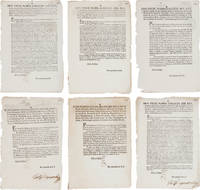
1561réf. 63610México. March 15 - November 6 1813. Rare Mexican Printings of Twenty-One Decrees from Spain's First Constitutional Government A substantial and significant collection of twenty-one rare Mexican printings of Spanish decrees issued by the short-lived but deeply influential constitutional government established in 1812. Each of these decrees was promulgated in Mexico by the Viceroy of New Spain Félix María Calleja del Rey y de la Gándara primer conde de Calderón in 1813. Drafted and ratified in the absence of any monarch Joseph Bonaparte had been rejected by the Spanish and the ousted Ferdinand VII had yet to return the constitution of 1812 followed a period of great political upheaval and married the liberal ideals of the French Revolution with an abiding fear of its outcome resulting in Spain's first ever constitutional monarchy. While the constitution left some power in the hands of the King his absence at the time of its implementation meant that Spain was effectively ruled by a constituent congress and regency council which notably included for the first time representatives from all of Spain's overseas dominions as well as the provinces on the Iberian Peninsula. The considerable majority of the proclamations in this group deal with the repercussions of this dramatically new form of government including clarifying details of the constitution publicly printing some of its laws and regulations and organizing programs meant to protect its legitimacy and longevity. While changes in home government and the Napoleonic Wars were certainly relevant to colonies in the New World a handful of these decrees also relate more materially to the Western Hemisphere including some related to colonial trade and the ongoing war for independence in Venezuela. All of the present documents were promulgated in Mexico City and are signed in type and most of them rubricked in manuscript by the Viceroy Félix María Calleja. Calleja was a general sent to New Spain in 1810 to put down the early rumblings of Mexican independence which he did with ruthless efficiency. He was Viceroy from 1813 to 1816 when he was replaced for fear that his merciless stamping of the insurrection would only further stoke the fires of anti-Spanish sentiment. The full list of decrees in this group ordered by the date they were promulgated by Calleja and accompanied by brief notes on their contents is as follows: All twenty-one documents share the same caption title: Don Felix Maria Calleja del Rey Bruder Losada Flores Campeño Montero de Espinosa Mariscal de Campo de los Exércitos Nacionales Virey Gobernador y Capitan General de Esta N.E. Presidente de Su Audiencia Superintendente General Subdelegado de la Hacienda Pública Minas Azogues y Ramo del Tabaco Juez Conservador de Éste Presidente de Su Junta y Subdelegado General de Correos en el Mismo Reyno. 1 El Orden de las Cortes Generales y Extraordinarias Comunicada…Que en los Papeles de Oficio Usen Siempre el Gobierno y Todas las Autoridades del Mismo Lenguage Que Usa la Constitucion.first lines of main text. March 15. Decrees that all official government papers should follow the language of the new constitution. 2 La Regencia del Reyno Se Ha Servido Levantar el Riguroso Bloqueo en Que Se Hallaba Puerto Cabello en la Provincia de Caracas. March 31. Lifts the Spanish blockade of Caracas now that a peace arrangement had been made with the insurgents in Venezuela. While the Royalists took back the province and the "First Republic of Venezuela" was officially ended in late 1812 it would only be a few months before Simon Bolívar returned and Caracas changed hands once again in the ongoing war for independence. 3 El Consejo de Estado y el Supremo Tribunal de Justicia Que Con Arreglo à la Constitution Política de la Monarquía Española Se Sirvieron Crear las Córtes Generales. March 31. Announcing that the Córtes Generales created by the new constitution and which was effectively the new governing body of the empire is officially in effect and performing duties as described in that document. 4 Las Córtes Generales y Extraordinarias Convencidas de la Necesidad y Utilidad de Que los Expedientes Sobre Infraccion de la Constitucion Sean Determinados Con la Mayor Prontitude Decretan. April 27. Declares that courts will prioritize cases regarding constitutional infractions above all others—one of many decrees particularly concerned with maintaining loyalty to the constitution. 5 Las Córtes Generales y Extraordinarias Queriendo Fixar Por Todos los Medios Posibles en la Memoria de los Españoles la Feliz Época de la Promulgacion de la Constitucion. May 22. In celebration of "the joyous event of the promulgation of the constitutional monarchy" this decree renames the public plaza in which the document was promulgated in every city in the empire to the "Plaza de Constitucion" and orders that a stone marker or monument be built to commemorate the event. When Ferdinand VII was reinstated as absolute monarch in 1814 monarchists tore down many of these monuments in celebration. Others remain to the present day including one in St. Augustine Florida which was still in Spanish hands in 1813. 6 Las Córtes Generales y Extraordinarias Con el Justo Fin de Redimir los Montes y Plantíos de Dominio Particular. May 25. 17 × 12 inches. A notable law removing all regulations on the use of private lands. Land owners would now be allowed to farm collect lumber hunt fish or otherwise profit from their land however they choose. The body of the decree begins our translation: "All laws and ordinances of forests and plantations are repealed and annulled in all their parts insofar as they concern those of private ownership and as a consequence the owners are left in full and absolute freedom to do with them what best suits them without subjection." 7 Las Córtes Decretan Que Ecsen los Individuos Que Actualmente Coponen la Regencia del Reyno y Que Se Encarguen de Ella Provisionalmente los Tres Consejeros de Estado Mas Antiguos Que en el Dia Se Hallan en Deicho Consejo Que Son. July 2. 17 × 12 inches. Appointing a new provisional regency to replace the regency which preceded the constitution to consist of Pedro Agar Gabriel Ciscar and the Archbishop of Toledo. 8 Atendiendo las Córtes Generales y Extraordinarias à la Importancia y Necesidad de Que No Solo los Individuos del Supremo Tribunal de Justicia Sino Tambien los Demas Magistrados y Jueces de Qualquiera Otro Tribunal. July 8. Establishes qualifications for judges and magistrates at all levels. In an attempt to reduce nepotism and ensure the proper enforcement of the new constitution all employees of the judiciary "must enjoy a positive public reputation be accredited in their field possessed of selflessness and good morals dedicated to the Constitution and to have proven themselves in reality to be friends of independence and the political freedom of the nation" our translation. 9 S.M. C D. Fernando VII Rey de España y de las Indias y S.M. el Emperador de Todas las Rusias Igualmente Animados del Deseo de Restablecer y Fortificar las Antiguas Relaciones de Amistad Que Han Subsistido Entre Sus Monariquías. July 13. 16 × 12 inches. The Mexican printing of this treaty between Spain and the Russian Emperor Nicolas I. It is a treaty of amity and commerce as well as a formal military alliance "with the express intention of waging a vigorous war with the Emperor of France their common enemy." 10 La Clase de Guerra Que el Enemigo Comun de los Pueblos de Europa Ha Heco y Hace a Esta Heroycion: Los Exquisitos Pero Siempre Pérfidos Medios Que Ha Puesto en Practica Para Dominarla. August 5. 17 × 12 inches. A solemn and dramatic public warning about the perfidious effects of disloyalty and internal division. Other governmental decrees are referenced including specific reference to numbers four and eight described above. 11 Deseando S.A. Dar un Testimonio Indudable de Su Religiosa Puntualidad en el Cumplimiento de Quanto Prescribe la Constitucion Politíca de la Monarquía. August 11. States that the secretary of state does not have the authority to pardon deserters who present themselves for trial. They will be sent to their respective companies to be judged by them in accordance with the severity of their crime notwithstanding special cases where an individual might be pardoned by the Regency. 12 Las Córtes Generales y Extraordinarias Decretan: El Supremo Tribunal de Justicia Debe Conocer de los Recursos de Nulidad Que Se Interpongan de las Sentencias Dadas en Última Instancia. August 21. Decrees that the supreme court will hear appeals from the previous session's special courts. 13 Las Córtes Generales y Extraordinarias Considerando Que la Reduccion de los Terrenos Communes á Dominio Particular Es Una de las Providencias Que Mas Imperiosamente Reclaman el Bien de los Pueblos. August 23. 21½ × 16¾ inches printed in two columns. A monumentally important law decreeing that all publicly owned lands in Spain the outlying islands and all of her colonies in the New World would be converted to private property. The broadside prints the full text of the law and begins: "The Córtes Generales.considering that the reduction of common lands to private ownership is one of the provisions that most imperiously demand the good of the people and the promotion of agriculture and industry and wanting at the same time to provide with this type of land an aid to public needs a reward for worthy defenders of the country and relief for non-proprietary citizens." Despite the lofty language realistically this law formed part of an ongoing program of confiscation of lands in order to defray mounting debts from the internal and external conflicts of the late 18th and early 19th centuries. The law divided the confiscated property into two even portions: one would be sold at auction and the proceeds contributed directly to the national debt the other would be divided into lots and apportioned to veterans or sold for a fee to landless citizens. 14 Las Córtes Generales y Extraordinarias…Se Propusieron Abrir la Carrera del Honor y Da la Gloria á los Hijos de las Familias Honradas de la Monarquía. September 2. 17 × 12 inches. In order to sustain the "positive feelings and equality" won by the war the government decrees that college university and military admissions cannot take into account whether or not someone is nobility even if that information is offered voluntarily. Along the same lines they also are not allowed to "permit expressions or distinctions which contribute to the fomentation in their ranks of the perfidious ideals of legal inequality or class rivalry." 15 Las Córtes Generales y Extraordinarias Considerando Que el Aniversario del Diez y Nueve de Marzo en Que Se Publicó la Constitucion. September 7. With Calleja's manuscript rubric but not signed. Outlines ceremonies for the upcoming first anniversary of the constitution. Every church is to sing a solemn Te Deum and an artillery salvo is to be fired in the public square of each city. 16 Las Córtes Generales y Extraordinarias Decretan: 1. La Regencia Actual de las Españas Compuesto Del. September 8. Decrees that the provisional regency is no longer provisional but actual and appoints the Archbishop of Toledo as its president. 17 Debiendo las Córtes Generales y Extraordinarias Fixar los Términos en Que la Regencia del Reyno Ha de Exercer Su Autoridad. September 10. 22¾ × 16 inches printed in two columns. Prints the rules and regulations related to the now official Regency council its composition and the extents of its power. The Regency's chief mission is described as to "Uphold the Constitution and its laws protect the individual liberty of the citizens and to elevate these over both the conservation of public order within and the security of the nation without." 18 Habiendo Ocurrido á la Regencia del Reyno el Diputado en Córtes Por Maracaybo D. José Domingo Rús. September 28. No rubric or signature. Responding to a petition by a citizen of Venezuela the Regency grants free import and export of all tools machines and artifacts for agriculture and industry to the province of Maracaybo. 19 Hemos Dado Cuenta á las Córtes Generales y Extraordinarias de la Consulta. September 30. No rubric or signature. Decrees that all persons involved in cases regarding a constitutional infraction should be suspended from employment and duties for the duration. 20 Las Córtes Generales y Extraordinarias Enteradas de Que Quasi en Todos los Puertos de la Península Se Cobraba Por Cuenta de la Inquisicion. October 20. No rubric or signature. Repeals certain duties levied by the Inquisition which was abolished by the new constitution. The text begins our translation: "The General Courts aware that in almost all the ports of the Peninsula vessels were charged on behalf of the Inquisition upon entering them and when they were foreigners or coming from foreign ports a right known as the Right of Inquisition and tax on on boxes of books assortments of prints handkerchiefs and printed fabrics boxes of tobacco and other effects." 21 Las Córtes Generales y Extraordinarias Decretan Por Punto General: Que la Facultad Que Segun la Pragmática de Matrimonios. November 6. In an unusual move for the generally liberal new government this text states that the Real Pragmática Sanción de Matrimonios continues in effect. The Pragmática required all males under the age of twenty-five and all females under the age of twenty-five of any class or race to secure formal consent from their fathers in order to marry and applied to Spain as well as all of its overseas possessions. As of 1803 the father was not required to supply any reason whatsoever for denying a marriage proposal and the law was generally seen as a tool to maintain strict class divisions. These broadside decrees printed in Mexico at an important moment in Spanish constitutional history are rare in the market and institutionally. We locate only a few copies of each in OCLC. A remarkably thorough and continuous set of rare Mexican printings of Spanish decrees from this time of great political and military turmoil and clearly demonstrating the direct influence of affairs in Europe on colonies in the Western Hemisphere. Old folds. Varying degrees of edge wear. Scattered tanning and staining. Very good. unknown
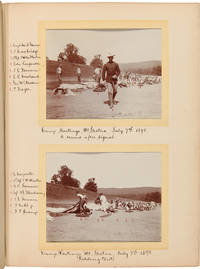
1898réf. WRCAM54683Various places including Pennsylvania Virginia at sea New Jersey and Puerto Rico 1898. 171pp. with 342 photographs. Four large quarto photograph albums. Matching contemporary three-quarter crimson morocco and cloth front covers gilt. Minor shelf wear and some rubbing. Images in overall very good condition. An amazing assemblage of photographs documenting the Spanish-American War experiences of the First Troop Philadelphia City Cavalry which was at that time the oldest volunteer military unit in continuous service to the United States. The photographs are arranged chronologically in four contemporary photo albums with the images occasionally annotated in a contemporary hand and including the identification of numerous members of the Troop. The first volume opens with images of Mt. Gretna Pennsylvania "where troops were sworn into U.S. service May 7th 1898 by Maj. Thompson U.S.A." The photographs record field exercises camp building and tent organization at Camp Hastings cavalry drills an image of "Capt. Groome reading the Articles of War to Troop June 1898" a "first arrival of government horses" several shots of men training and "throwing" their horses shooting practice "Capt. Groome assigning Government horses to Troopers" and various shots of the men at work and even some play. Over the course of the album the names of numerous soldiers are recorded below several of the photographs. The second album opens with several photographs of the Troop striking their tents in preparation for leaving Camp Hastings at Mt. Gretna headed for Camp Alger at Dunn Loring Virginia. Here the Troop was ordered to increase their enlistment numbers. At Camp Alger the Troop was also fitted out with federal supplies and assigned to the Second Army Corps commanded by Maj. Gen. William Graham who is pictured here. Other photographs capture the camp scene at Alger "the First Troop picket line" the Troop receiving their federal-issue khaki uniforms the Troop at roll call and some shots featuring African-American helpers. In late July the Troop was sent to Newport News and several photographs record their brief time there with about a dozen shots of their temporary camp. On July 28 1898 the Troop left Virginia on the transport ship MASSACHUSETTS bound for Puerto Rico. Several images here capture the frenetic loading of the troops and their horses onto the ship with the remaining half dozen or so shots recording the Troop's time on board. The third album picks up where the second left off with the First City Troop embarked on the transport ship MASSACHUSETTS headed for Guanica Puerto Rico. Shipboard activities captured here include a few shots of groups of men being showered with water hoses. Several shots record the arrival of the men in the port of Guanica where they encounter the hospital ship NUECES which reports of the news of the "surrender of Ponce." After the men disembark they pitch their camp around Cathedral Virgin del Carmen on August 5. The next day several photographs record the unloading of horses and stores in the harbor at Ponce. The remaining thirty-eight photographs in this volume record scenes in the interior of Puerto Rico and are the most heavily annotated of the four albums. The images record scenes from the "road from Port of Ponce to Ponce" several scenes capturing a market day in Ponce and recording numerous native islanders the Troop's "temporary camp about 2 miles beyond Ponce" the "Troop wagon leaving camp beyond Ponce to join wagon train for Guayama" on August 8 a shot of the Troop's wagon "on road to Guayama in a Porto Rico mudhole" images of the wagon train to Guayama with the H Troop 6th U.S. Cavalry the "Point of Advance Guard entering Guayama within the lines" the Troop itself "entering Guayama passing General Brooke's Headquarters" a "View of First Troop Phila. City Cavalry U.S.V. Camp at Arroyo August 10th to 6A.M. Aug. 13th 1898" with the last ten images recording the camp or the streets at Arroyo. The fourth album documents the Troop's voyage home to Philadelphia. This time they take passage on the transport ship MISSISSIPPI and about half of the images record their voyage on board. On Sept. 10 1898 they reach Jersey City in New York harbor where they camp for a short time before returning to camp in Pennsylvania where the album ends. A couple of months later all three officers and the ninety- eight enlisted men of the First City Troop were mustered out of federal service for the Spanish-American War. Originally founded in 1774 by twenty-eight Philadelphia patriots as the "Light Horse of the City of Philadelphia" the First Troop of Philadelphia Cavalry is the oldest mounted military unit operating in continuous service to the American republic being the first volunteer cavalry troop organized in defense of the colonies. Among the Troop's original founders was John Dunlap printer to Congress from 1778 to 1789 publisher of the first American daily newspaper and the first printer of the Declaration of Independence. Most of the earliest members were similarly notable professional men of Philadelphia. The Troop served with valor in the American Revolution the War of 1812 the Mexican- American War the Civil War the Spanish- American War and every major American war through the Korean War. The present albums present a unique and important visual record of the First City Troop's activities before during and on the way home from the Spanish-American War. hardcover books
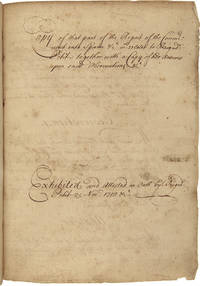
1713réf. WRCAM53351Minorca Spain 1713. 690pp. Thick quarto. Later three-quarter calf and marbled boards. Moderate wear to edges and spine extremities boards rubbed corners bumped. Small later ownership inscription on front pastedown. Light foxing and tanning marginal dust soiling. Composed in a neat legible hand. Very good. Untrimmed. A lengthy and highly detailed manuscript volume containing documents related to the British takeover of Minorca after its capture from Spain during the War of Spanish Succession and an investigation into the governance of the island. In September 1708 British forces occupied the Mediterranean island with little opposition the inhabitants and nobles having mostly supported the Anglo-Dutch designs for the Spanish throne. The inherent importance of the island as a military outpost and trading way point in the Mediterranean led the British to occupy it for the rest of the war and to receive it as a possession in the Treaty of Utrecht which ended the conflict in 1713. The documents collected here relate to the English Brigadier Lewis Petit who served as Lieutenant Governor and Chief Engineer of the island during its occupation. As Chief Engineer Petit was in charge of improving the fortifications and defenses of Minorca and although a Spanish ally was named as titular Governor Petit exercised the true authority over the island. Although his improvement plans may have been sound his management of the island's public moneys was suspect. "Petit somehow found time to enter into commercial speculations on his own account. In partnership with two Spaniards and Stanhope's secretary Arent Furley Petit purchased a French prize at Mahón for 7800 dollars with which to trade between Minorca Majorca Sardinia and the Spanish and Barbary coasts. He advised Furley that he had found it necessary to use funds supplied for the fortifications to complete the purchase and urgently requested capital from his partners to repay this misappropriation. Petit's participation was valuable to the enterprise owing to his ability to land cargoes at Mahón without paying duty an activity much objected to by the local town government. "Petit was soon to find himself under the scrutiny of the inspectors sent from London to investigate irregularities in the expenditure of the army in Spain as an attempt to disgrace the previous ministry.The accusations against him concerned imperfections in his accounts including allegations of missing vouchers irregularities and overcharging in the numbers of workmen and mules and alleged differences between prices contracted and prices paid among other charges" - DNB. The documents compiled here therefore relate principally to the investigation of those actions by a specially convened Board of Commissioners and contain Petit's written responses to specific inquiries about his expenditures. In transmitting these answers the reports provide a detailed perspective regarding the management of Minorca's finances defenses and engineering improvements under Petit's charge. Moreover in order to buttress or to undermine those claims voluminous correspondence financial figures construction reports testimonies affidavits and other material are reproduced that span the length of the British occupation of the island before it officially became a possession. As a result the manuscript documents contained here provide a thorough encapsulation of the economic and military situation on Minorca and the growth of its importance as a British outpost in the Mediterranean. A highly valuable set of manuscript documents that meticulously details the development and management of a British possession gained through the War of Spanish Succession worthy of much deeper research. Paul Latcham "Petit Lewis 1665-1720" in OXFORD DICTIONARY OF NATIONAL BIOGRAPHY Oxford University Press 2004 http://www.oxforddnb.com/view/article/22038. hardcover books
réf. LCS-18309Somptueux manuscrit sur peau de vélin, soigneusement calligraphié à l'encre brune, ligné en rouge, et orné de 21 superbes lettrines enluminées et peintes, dorées ou argentées. Grenade, août 1602. Manuscrit enluminé sur peau de vélin. Petit in-folio de 56 ff.n.ch., le dernier blanc, complet. 34 lignes écrites à l’encre noire sur des lignes rouges horizontales. Justification : 260 x 160 mm. 4 peintures à pleine page, 4 grandes initiales historiées et enluminées en tête de chapitres, 17 initiales ornées et enluminées, 1 portrait du roi. Chaque page est encadrée d’un large filet doré. Relié en velours rouge sur ais de bois, dos à nerfs muet, gardes de peau de vélin. Reliure du XVIIIe siècle. 310 x 208 mm.
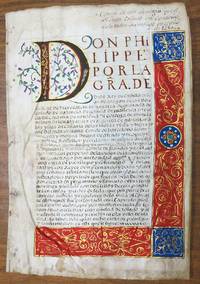
1572réf. RF 1076Royal Provision of Phillip II Confirming and Ratifying the Privileges Granted by the Masters of the Order of Santiago to the Village of Corral de Almaguer Toledo 1572 Manuscript. Small folio. 12 1/4 x 8 1/4". 8 double-sided vellum manuscript leaves originally bound together now unbound hand painted and decorated in blue red and gilt at various points throughout the text. The first page is hand-painted and decorated along the edge and includes a large decorative initial in multiple colors. Manuscript text in gothic style. Signed "Yo el Rey" on the back of the final leaf by King Phillip II of Spain in 1572. ATTRACTIVELY ILLUMINATED EARLY MANUSCRIPT. JUDAICA INTEREST. Our manuscript contains the 4 confirmed provisions originally drafted by Infante Henry Duke of Aragon 1421 and 1440 Alonso de Cárdenas here listed as "Alfoso" sic in 1480 and then "The Catholic Kings" in 1494 all of whom at various times served as "Grand Masters of the Order of Santiago". The provisions were instigated against the Jewish communities of the villages of Corral de Almaguer and Ocana in Toledo province. Residents of the towns affiliated with the Order of Santiago repeately complained throughout the 15th and 16th centuries to the the authorities of that order of that the Jews and later conversos had bought land from Christians and had not paid any taxes on their purchases. Ultimately the Jews of Corral de Almaguer were ordered to pay comparable taxes to the Christians for said property but the Jews of Ocana were excepted because of their previous payments of other taxes. Given the fact that this manuscript copy dates from 1572 and was signed and reconfirmed by King Phillip II so long after the expulsion of 1492 shows there were still clearly tensions and persecution of local conversos even long after the communities had converted to Catholicism. The top left margin on the front of the first leaf contains a handwritten note in ink stating in Spanish "It consists of this-privilege that Juan Collado was a secretary of the Order of Santiago in the year 1480". There are a few additional scant marginal notes in ink throughout and additional handwritten notes and signatures some indecipherable on the verso of the final leaf under the King's signature. This document provide a fascinating and invaluable resource to those studying the history of Jews in Spain during the 15th and 16th centuries. Text in Spanish. hardcover
1708réf. 53351Minorca Spain. 1708–1713. Important Documents of the War of the Spanish Succession A lengthy and highly detailed manuscript volume containing documents related to the British takeover of Minorca after its capture from Spain during the War of Spanish Succession and an investigation into the governance of the island. In September 1708 British forces occupied the Mediterranean island with little opposition the inhabitants and nobles having mostly supported the Anglo-Dutch designs for the Spanish throne. The inherent importance of the island as a military outpost and trading way point in the Mediterranean led the British to occupy it for the rest of the war and to receive it as a possession in the Treaty of Utrecht which ended the conflict in 1713. The documents collected here relate to the English Brigadier Lewis Petit who served as Lieutenant Governor and Chief Engineer of the island during its occupation. As Chief Engineer Petit was in charge of improving the fortifications and defenses of Minorca and although a Spanish ally was named as titular Governor Petit exercised the true authority over the island. Although his improvement plans may have been sound his management of the island's public moneys was suspect. "Petit somehow found time to enter into commercial speculations on his own account. In partnership with two Spaniards and Stanhope's secretary Arent Furley Petit purchased a French prize at Mahón for 7800 dollars with which to trade between Minorca Majorca Sardinia and the Spanish and Barbary coasts. He advised Furley that he had found it necessary to use funds supplied for the fortifications to complete the purchase and urgently requested capital from his partners to repay this misappropriation. Petit's participation was valuable to the enterprise owing to his ability to land cargoes at Mahón without paying duty an activity much objected to by the local town government. "Petit was soon to find himself under the scrutiny of the inspectors sent from London to investigate irregularities in the expenditure of the army in Spain as an attempt to disgrace the previous ministry.The accusations against him concerned imperfections in his accounts including allegations of missing vouchers irregularities and overcharging in the numbers of workmen and mules and alleged differences between prices contracted and prices paid among other charges" - DNB. The documents compiled here therefore relate principally to the investigation of those actions by a specially convened Board of Commissioners and contain Petit's written responses to specific inquiries about his expenditures. In transmitting these answers the reports provide a detailed perspective regarding the management of Minorca's finances defenses and engineering improvements under Petit's charge. Moreover in order to buttress or to undermine those claims voluminous correspondence financial figures construction reports testimonies affidavits and other material are reproduced that span the length of the British occupation of the island before it officially became a possession. As a result the manuscript documents contained here provide a thorough encapsulation of the economic and military situation on Minorca and the growth of its importance as a British outpost in the Mediterranean. A highly valuable set of manuscript documents that meticulously details the development and management of a British possession gained through the War of Spanish Succession worthy of much deeper research. Thick quarto. Later three-quarter calf and marbled boards. Moderate wear to edges and spine extremities boards rubbed corners bumped. Small later ownership inscription on front pastedown. Light foxing and tanning marginal dust soiling. Composed in a neat legible hand. Very good. Untrimmed. DNB online. hardcover
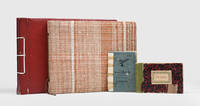
1936réf. 142062Spain & northern Europe: 1936-44. Auf-zum! so ging es tagtäglich" "Off we go! That's how it went every day" An exceptional and unusually complete archive documenting the career of Leutnant Konrad Ellermann a decorated airman who served with the Condor Legion in Spain and later in flying-boat operations on the Eismeer Front. Centred on two meticulously compiled photograph albums and augmented by scarce supporting documents it offers a rare coherent visual record of theatres where comprehensive personal archives seldom survive. The first album charts his Condor Legion service beginning with 43 tourist views of Spain and 25 informal images of squadron life followed by sequences showing Heinkel 59 flying boats in preparation and in flight with aerial views of enemy positions and bomb damage. Ellermann dedicates a page to comrades killed in March 1938 almost certainly the crew of the HE 59 downed near Cambrils and records their funerals and repatriation. Additional images include Condor Legion fighters He 51 He 112 Bf 109 long-range raids from Portbou to Oropesa and bombed railway lines. A section headed "Einiges von den Taten!" depicts two merchant vessels sunk by his unit - the British SS Jean Weems and the Danish SS Edith - alongside further action shots. The album closes with off-duty scenes and high-quality aerial photographs of Pollença Tangier and Portbou. The second album covers northern service. It opens with trials of the Dornier Do 26 flying boat in late 1938 with fine airborne views images of the second prototype and photographs of Dornier staff at work. Other aircraft represented include the Blohm & Voss Ha 139 the Latécoère 521 and the Dornier Do 18. Around 20 aerial views of Norway follow including encounters with He 111s and Ellermann's aircraft moored in Rombaken fjord culminating in a medal ceremony featuring Oberleutnant Karl Otto Max Barth. A final section documents his posting with Flussklärungsfliegerstaffel 1/125 in Finland with portraits of his Heinkel HD 114 scenes in Helsinki and Turku maintenance shots and a concluding portrait of Ellermann. Born in Geisingen in 1915 Ellermann began as a funkmeister before becoming an observer in 1938. He received the Iron Cross First and Second Class the Narvikschild the Frontflugspange für Kampfflieger in gold and silver the Luftwaffe Honour Cup and the Deutsches Kreuz in Gold. His service included AS-88 in Spain 1937-38 Sonderstaffel Tr. O 1939-41 Küstenflieger-Staffel 1/406 in Norway 1942-43 and Seeaufklärungsgruppe 131 1943-45. His surviving logbook records 484 flights between October 1937 and March 1944 378 of them operational including 62 Condor Legion sorties on ships and towns such as Barcelona Sagunto and Alicante. Later missions encompassed reconnaissance and anti-submarine patrols over the North Sea and Norwegian coast one section countersigned by Captain Martin Harlinghausen later the Luftwaffe's leading ship-killer of the Second World War. 4 items. Album 1: 245 x 320 mm original pale red and white rough-weave cloth punch holes at spine golden brown fastening cord bookseller's ticket of Otto Memmert Kiel; 222 original photographs on 24 black card leaves mainly deckle-edged snapshot images most 60 x 90 mm some larger up to 110 x 170 mm manuscript "title page" in coloured chalks with crossed Spanish and Nazi flags. Album 2: 250 x 330 mm original dark red faux leather punch holes to spine white coated-wire fastening tape bookseller's ticket of Bohrer & Co Kiel; 171 original photographs 50 x 60 mm to 240 x 180 mm on 24 tan card leaves glassine guards; manuscript "title page" with illustration of Nazi eagle above legend; 2 divisional pages first with watercolour drawing of unit insignia ram's skull above title; second with watercolour drawing of unit insignia penguin wearing clogs and flying over sea above title. Soldbuch: 28 pp 145 x 100 mm original blue card printed wrappers Ellermann's photograph mounted on inside front cover punch holes with metal eyelets to front cover. Log book: 100 x 155 mm pp. 114. Original marbled sides green cloth spine paper label on front cover. Album 1 in very good condition; Album 2 with a little wear to binding shallow indentations to covers leaf loose; Soldbuch: general signs of handling paper sometime taped around spine; Log book with some loss of marbled paper from front cover a little finger soiling. A well-preserved group. Sebastian Cox & Peter Gray eds Air Power History: Turning Points from Kitty Hawk to Kosovo 2002. hardcover
1770réf. est142t5Dimension extérieur (carton) 43,8 x 59 cm, intérieur 25,5 x 41,2 cm. Gravure dans son jus, scotché sur cadre carton. Image en bon état, très jolie travail de la fin du 18 ème siècle. Dimensiones exteriores (cartón) 43,8 x 59 cm, interiores 25,5 x 41,2 cm. Grabado en su estado original, pegado en un marco de cartón. Imagen en buen estado, obra muy bonita de finales del siglo XVIII.
1979réf. est146t7Dimension extérieur 34,8 x 52,5 cm, cuvette 23,4 x 27,9 cm. Très belle eau-forte moderne, réalisée par Josep Vives Campomar, peintre et graveur espagnol du 20 et 21 ème siècle. Elle fut probablement réalisée en 1979. Tirage 97/100. En excellent état. Dimensiones exteriores 34,8 x 52,5 cm, cuenco 23,4 x 27,9 cm. Bellísimo grabado moderno de Josep Vives Campomar, pintor y grabador español del siglo XX y XXI. Probablemente se hizo en 1979. Tirada 97/100. En excelente estado.