MUSTAFA SERDAR PALABIYIK.MareMagnum
From Dance Hall to White Slavery
réf. 1357950608.Ghardcover. Good. Access codes and supplements are not guaranteed with used items. May be an ex-library book. hardcover

Bonita · États-Unis66,63 $US≈ 59,53 €
23 958 résultats
2019New English Paperback. Cr. 8vo. (20 x 14 cm). In English. 285 p. This book analyzes the Turkish and Greek narratives of shared Turkish-Greek history by focusing on the "long nineteenth century", which was a period of turmoil for both societies. The four centuries of Ottoman rule over the Greek community, the Greek rebellion/war of independence, emergence of an independent Greek state, Ottoman reforms with regard to millet system, joint efforts of some Turkish and Greek communities for the re-promulgation of the Ottoman Constitution, increasing tensions between the Committee of Union and Progress and the Greek community and finally the transformation from coexistence to conflict during and after the World War I are covered briefly with the conflicting lenses of Turkish and Greek historiography. The book also attracts attention to Greek claims for a Greek Genocide by the Ottoman/Turkish authorities during and after the World War I and questions whether inter-communal clashes in Western and Northern Anatolia in this period can be considered as genocide in accordance with international law.
1974Book has minor bumping to corners. Dustjacket has a few small tears (mostly to top of spine) and some chipping. ; Richly illustrated with more than 200 photographs, drawings, and maps, this book offers an original and informed interpretation of a major cultural synthesis and a panoramic view of the crucial zone of creative contact between the cultures of the Mediterranean and the Near East. ; Jerome Lectures Tenth Series; 127 pages
1974Book is fine. Dustjacket has sunning to spine and minor shelfwear. ; Richly illustrated with more than 200 photographs, drawings, and maps, this book offers an original and informed interpretation of a major cultural synthesis and a panoramic view of the crucial zone of creative contact between the cultures of the Mediterranean and the Near East. ; Jerome Lectures Tenth Series; 127 pages
1974Book has minor shelfwear and rubbing. DJ is price-clipped. Dustjacket has a few small nicks and tears. Corners are lightly bumped. ; Richly illustrated with more than 200 photographs, drawings, and maps, this book offers an original and informed interpretation of a major cultural synthesis and a panoramic view of the crucial zone of creative contact between the cultures of the Mediterranean and the Near East. ; Jerome lectures; 127 pages
réf. 1357950608.Ghardcover. Good. Access codes and supplements are not guaranteed with used items. May be an ex-library book. hardcover
réf. 1432604651.Ghardcover. Good. Access codes and supplements are not guaranteed with used items. May be an ex-library book. hardcover
réf. 1497977258.Gpaperback. Good. Access codes and supplements are not guaranteed with used items. May be an ex-library book. paperback
1998Scholar's name to ffep (R. E. Fantham). Else book is fine. 1 small closed tear to DJ (1 cm). Else Very light shelfwear to DJ. ; 0.79 x 8.43 x 5.67 Inches; 207 pages; The role of women in Roman culture and society was a paradoxical one. They enjoyed social, material and financial independence yet they were denied basic constitutional rights. Although Roman history is not short of powerful female figures, such as Agrippina and Livia, their power stemmed from their associations with great men and was not officially recognized. Ariadne Staples' book examines how women in Rome were perceived both by themselves and by men through women's participation in Roman religion, as Roman religious ritual provided the single public arena where women played a significant formal role. From Good Goddess to Vestal Virgins argues that the ritual roles played out by women were vital in defining them sexually and that these sexually defined categories spilled over into other aspects of Roman culture, including political activity. Staples provides an arresting and original analysis of the role of women in Roman society, which challenges traditionally held views and provokes further questions.
1998Very minor edgewear to top corners of DJ else Fine. ; 0.79 x 8.43 x 5.67 Inches; 207 pages; The role of women in Roman culture and society was a paradoxical one. They enjoyed social, material and financial independence yet they were denied basic constitutional rights. Although Roman history is not short of powerful female figures, such as Agrippina and Livia, their power stemmed from their associations with great men and was not officially recognized. Ariadne Staples' book examines how women in Rome were perceived both by themselves and by men through women's participation in Roman religion, as Roman religious ritual provided the single public arena where women played a significant formal role. From Good Goddess to Vestal Virgins argues that the ritual roles played out by women were vital in defining them sexually and that these sexually defined categories spilled over into other aspects of Roman culture, including political activity. Staples provides an arresting and original analysis of the role of women in Roman society, which challenges traditionally held views and provokes further questions.
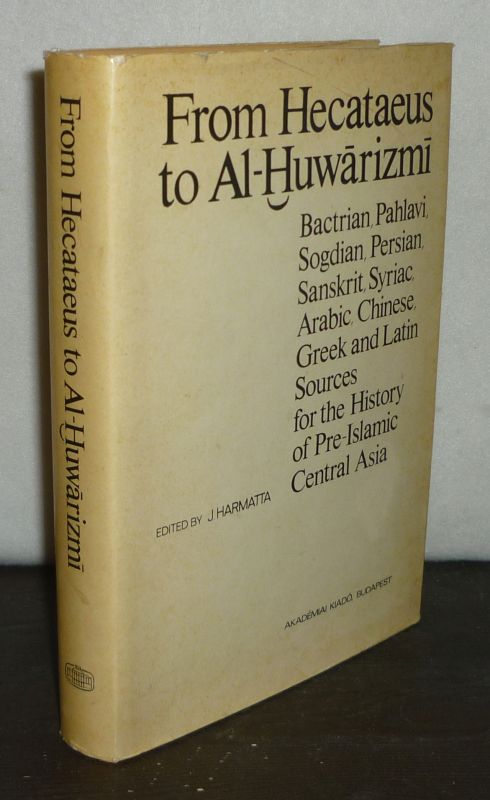
1984réf. 2116013Budapest: Akademiai Kiado 1984. (4), 352, (4) Seiten. Mit einigen Abbildungen auf Tafeln und Faltkarten. Gr. 8° (24,5 x 17 cm). Orig.-Leinenband mit Orig.-Schutzumschlag. [Hardcover / fest gebunden].
réf. 1330119002.Gpaperback. Good. Access codes and supplements are not guaranteed with used items. May be an ex-library book. paperback
1951Foxing to textblock. Shelfwear and rubbing to boards. Minor edgewear to corners. ; Looks at Greek epic, comedy and tragedy from a single viewpoint. ; Sather classical lectures; 333 pages
1951Minor shelfwear to book. Scholar's bookplate to inner cover (G. P. Goold). . DJ is price-clipped. Dustjacket spine is sunned. Light edgewear to DJ. ; Looks at Greek epic, comedy and tragedy from a single viewpoint. ; Sather classical lectures; 333 pages
1990Dustjacket has minor shelfwear and rubbing. Book has light shelfwear with light foxing to top of textblock. Small black line marker line to half-title. Scholar's bookplate to inner cover (G. P. Goold). ; Examines the nature of poetic allusion in classical Greek poetry in every tragedy from the fifth century B. C. This book should be of interest to students and teachers of classical studies and Greek poetry. ; 268 pages
2006Small chip to laminate along edge of rear wrap else fine. ; "This study proposes to investigate the origin of this special sensitivity of Greeks toward balanced structures, and its fundamental influence on Greek literature as a whole. Consequently this work consists of two parts. The first part traces the development of the veneration of balanced structures from the Neolithic period, and the second demonstrates that the aesthetic tradition of balanced structures fundamentally affected practically all genres of Greek literature. ; Classical and Byzantine Monographs Vol. LXII; 331 pages
1978Very Good English Paperback. Pbo. 12mo. (17 x 12,5 cm). In English. 142, [26] p., b/w plts. Signed and inscribed by Genç. From my 1974 diary.
1964Creasing along spine. ; Using evidence from archaeology and the recently deciphered Linear B tablets the author examines Mycenean civilization and the subsequent literary traditions in the Homeric epics. ; 333 pages
1979DJ has tear to middle of spine (3 cm) with piece chipped off head. DJ has waterstain to foot of spine; Examination of moderation and self-control in Greek literature. ; Cornell Studies in Classical Philology Vol. XL; 288 pages
1979Foxing/dustsoiling to top of textblock. Scholar's bookplate to inner cover (G. P. Goold). Minor shelfwear to DJ. ; Examination of moderation and self-control in Greek literature. ; Cornell Studies in Classical Philology Vol. XL; 288 pages
1999Light foxing to top of textblock else fine. Dustjacket is protected in mylar. ; 8.8 X 5.7 X 1.1 inches; 384 pages
1977This volume only. In Hebrew. 230x155 mm. 332 pages. Softcover. Cover and spine slightly yellowing. Cover slightly stained. Spine slightly worn. Pages slightly yellowing. Else in good condition.
1954Ex-library copy with usual stamps, call numbers and pocket. Light edgewear. ; Facilitates the teaching of Greek History by means of original sources. The theme is Athenian democracy and its development during the Peloponnesian War. Extracts included are from Andocides, Antiphon, Aristophanes, Aristotle, Demosthenes, Euripedes, Hermippus, Herodotus, Isocrates, Lysias, Plato, Plutarch, Thucydides and Xenophon. ; 260 pages
2013Light bump to top of spine. Else book is fine. ; From Polypragmon to Curiosus is a study of how Greek and Latin writers describe curious, meddlesome, and exaggerated behaviour. Founded on a detailed investigation of a family of Greek terms, often treated as synonymous with each other, and of the Latin words used to describe them, opening chapters survey how they were used in Greek literature from the 5th and 4th centuries BC, moving onto their Latin usage and relationship to that of Hellenistic and imperial Greek. Other chapters adopt a more thematic approach and consider how words, such as polypramon, periergos, philopragmon, and curiosus, are employed in descriptions of the world of knowledge opened up by empire - in discourses of pious and impious curiosity, in reflections on what constitutes useful and useless learning, and in descriptions of style. The themes which the volume addresses remain alive throughout the literature of the Middle Ages and the Renaissance, most obviously through emblematic figures of human curiosity, such as Dante's Ulisse and Marlowe's Dr Faustus. ; 272 pages
1989IN HEBREW WITH INTRODUCTION IN ENGLISH, FRENCH AND SPANISH. 24x17 cm. 16+12 pages. Soft cover. Cover slightly dirty. Else in good condition.
1993DJ has tiny tears to corners (1/2 cm). DJ spine slightly discolored. DJ has minor shelfwear. Small white dots to back board else Fine. Inscribed to Fergus Millar from the editors. ; 261 pages; The empire created by Alexander the Great's general, Seleucus, constituted the largest Hellenistic kingdom of the successor states: yet this is the first substantial treatment of Seleucid history to appear for fifty years. The authors approach this important and successful state from new perspectives, seeing it as part of the Middle Eastern world rather than solely in Greco-Roman terms, and arguing that the Seleucid state is best understood as heir to the great Achaemenid Persian empire and earlier Middle Eastern states. They investigate the economies, social structures, political systems, and cultures of the many peoples making up the empire, and analyze, in the context of colonialism and imperialism, such evidence as exists for cultural changes, including Hellenization. The book makes accessible the great variety of new and important documents that have been recently discovered. It will be welcomed by students, teachers, and all readers with an interest in Hellenistic and Middle Eastern history. ; Signed by Editors