539 résultats
8vo large Paperback. 279pp. Hellenistic Egypt was the setting for perhaps the first Jewish Golden Age, a time "golden" in Jewish memory as an era of vibrant cultural interaction between the Jews and their gentile hosts. This is the story of the adventures and misadventures of the people of Israel in the land of Egypt the years shrouded in the mists of biblical history under the Pharaohs; the strange intermezzo of the Jewish mercenary detachment on the island of Elephantine on the upper Nile; the apogee of Jewish culture under Ptolemies; and finally, the Jewish community's rapid decline and catastrophic disappearance under Roman rule. Joseph Mélèze Modrzejewski uses scientific analysis to illuminate the reality underlying our image of the past. The biblical accounts and Jewish and pagan literary texts are juxtaposed with discoveries of a century of archaeological and papyrological research that has unearthed the edicts of emperors as well as the humble correspondence of common people. In a tantalizing epilogue, Modrzejewski probes a turning point in Western civilization: the brief but crucial episode when budding Christianity and the Alexandrian Jews parted company.
318pp. Excellent condition
94pp. Original cloth, Gilt lettering, illustrated endpapers, illustrations, genealogies, index. Impressive embossed card with relief color illustrations of coins laid in. Publisher series: By-Paths of Bible Knowledge 20 . (Religion, Bible, Coin Collecting, Jews, Numismatics) le monete della bibbia. numismatica biblica.
8vo, br. ed. 220pp. Jewish Communism' was one of the most powerful and destructive political myths in 20th-century Europe. The cry of Jewish communist conspiracy turned traditional, often religiously inspired anti-Jewish sentiments into a murderous anti-Semitic rampage. The connection of Jews with communism has always been an extremely sensitive issue, which cannot simply be dismissed as a fully irrational phenomenon. Jews were disproportionately present in the revolutionary movement. This does not make the myth of Jewish Communism less mythical, but it does imply that real interests and conflicts were involved. This book presents the first full-length analysis of the identification of Jews with communism. It traces the myth of Jewish Communism from the traditional anti-Jewish prejudices on which it is built, to its crucial role in Eastern European Stalinist and post-Stalinist politics. It documents the painful controversies that the participation of Jews in the revolutionary movement has generated among Jewish observers, among communists, and also among historians. The Author : André Gerrits is Associate Professor in East European Studies at the University of Amsterdam, where he holds the Jean Monnet Chair in European Integration, and Senior Research Fellow at the Netherlands Institute of International Relations (Clingendael).
8vo, Paperback, xix, 188 pages, illustrated, 24 cm. The Passover and its rite are central in the history of Judaism and Christianity. Explaining how the Passover evening celebration, the seder, became one of the most popular Jewish rituals, Baruch M. Bokser shows how it was based on and transformed a biblical sacrificial meal. Bokser demonstrates the significance of the motif of Passover in ancient Judaism, indicating why Jews and Christians employed it to express hopes for redemption. And he also illuminates the process of historical development through the interaction of a traditional heritage with contemporary and outside cultural influences. This is a fascinating book which will add much to our understanding of Judaism and Christianity and of the nature of religion in a changing world. Baruch Bokser was ordained as arabbi at Jewish Theological Seminary and also received a Ph. D. In religious studies from Brown University. Beginning in 1974, he taught at the University of California at Berkeley, leaving in 1982 for Dropsie College in Philadelphia (now the Annenberg Research Institute for Judaic and Near Eastern Studies) . Then in 1986, Bokser returned to the Jewish Theological Seminary to join the faculty and where, at his early death at age 44 in 1990, hewas the director ofthe program in ancient Judaism. "Packs facts, analysis and insight into its relatively short 141 pages of text and footnotes. The hypothesis and argument are clearly spelled [out] and and then supported by detailed references to various Talmud and Mishnah sections which are reproduced as necessary. Although.reprinted in 2002, it is current and consistent with more recent works. I read the book in the weeks leading up to 2009 Passover holidays and found much in Dr. Bokser's work to work into the actual Seder and ignite the interest of those present. In essence, Dr. Bokser makes a very persuasive case that the Passover Seder, as molded in the Hagaddah, was one of the key pillars for the survival of Judaism after the catastrophic destruction of the Second Temple in 70 C. E. Certainly, he establishes that the basics of the Seder as we know it today with its emphasis on freedom, community and symbolic ritual owes its genesis to the Tanna and the Amora of the centuries following the destruction" (Jerome Hoffman, Amazon review)
pp. 180.
8vo, original red cloth , black and white frontis portrait, xiii + 386pp, index, Errata slip mounted on p. [xiv]. translated by Samuel Katz. English version edited, with notes, by Ivan M. Greenberg.. Mr Begin's personal account of Hebrew revolt against British Mandatory rule in Palestine.
18x13cm, original brown cloth gilt and black titles, 96pp. 1st ed. Medicine in the Bible.
8vo, Between 1894 and 1914, 2.5 million Jews were forced to abandon their homes in their native Eastern Europe for the safety and security of the Western Europe, with many escaping to America. This is the story of Fusgeyer Contingent #4, a group of sixty young Jewish men and women who left Birlad, Romania on April 1, 1904 to escape the pograms, poverty and anti-semitism of their homeland for a better life in America. La storiA DEI FUSGEYERS, I CAMMINATORI MIGRANTI CHE ATTRAVERSARONO A PIEDI BALCANI ED EUROPA CENTRALE PER EMIGRARE IN AMERICA.
1988réf. 472241988 grand in-8 reliure toile rouge éditeur - 1988 - 439 pages - Ed. Librairie Droz S. A. Genève - coll. Travaux d'Humanisme et Renaissance N° CCXXVI
1972réf. 154619Garden City, New York: Doubleday 1972. XXX, 271 Seiten. Gr. 8° (22,5-25 cm). Orig.-Leinenband mit Orig.-Schutzumschlag. [Hardcover / fest gebunden].
réf. 650In 12 plein cuir fauve à nerfs raciné.titre,fers filets dorés.Faux-titre,titre,252 pages tranches rouges Moutard 1781,une coiffe réparée.Edition originale
1935réf. 33011Paris Librairie Lipschutz 1935 in-8° traduction française par le Dr J-M Rabbinowicz
8vo , rilegato , tela , sovracoperta , formato 14x22 , pagine 453 , ottime condizioni
pp. 264. Pietà antica ebrei-palestinesi Size: 8vo - over 7¾" - 9¾" tall
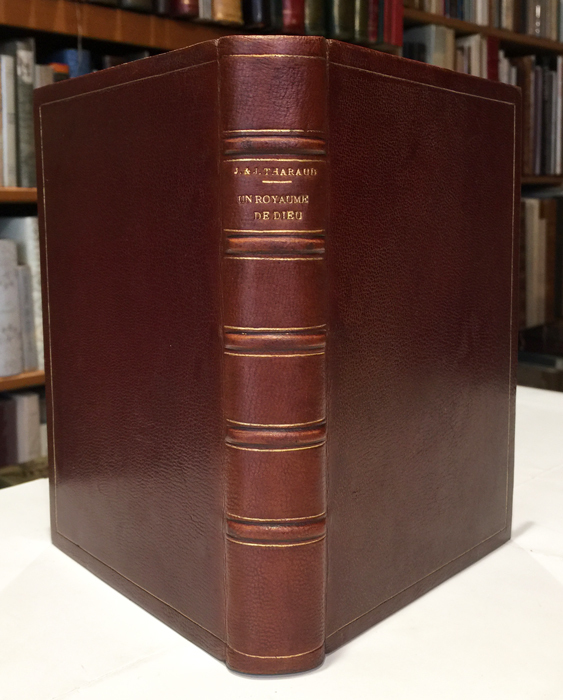
1933réf. 21864Paris, Plon, collection Byblis, 1933 ; in-8, chagrin maroquiné prune, dos à nerfs soulignés de filets à froid et dorés, titre doré, filet doré d'encadrement des plats, double filet doré d'intérieur, tête dorée, non rogné, couverture imprimée en orange et noir et dos conservés (rel. de l'époque) ; 208 pp., [4] ff. les 2 derniers blancs, 12 compositions hors-texte en couleurs, avec serpentes, de Manuel Orazi, y compris le frontispice.
8vo, br. ed.
8vo, ril. ed. sovracoperta, pp. 670. (Supercoralli). Figlio unico di un commerciante ebreo, Kurt Gerron ha avuto una vita sensazionale: prima studente di medicina, poi attore e regista di fama, tra i più celebri protagonisti del cinema degli anni Venti. Ma la sua carriera è destinata a infrangersi sotto la scure delle leggi razziali: sospeso da ogni incarico, nel 1944 è deportato a Theresienstadt, il ghetto "modello" dietro cui i nazisti celarono a lungo la verità su campi di concentramento. Non solo la sua carriera, ma l'intera esistenza di Gerron sembra giunta alla fine. Finché non riceve un'inaspettata proposta: dirigere un film di propaganda che racconti all'Europa la vita di quella "città". Rifiutare significa morire, accettare vuol dire rendersi complice dei propri aguzzini. E lui accetta, sperando in una possibilità di salvezza. Gli undici giorni di riprese saranno l'occasione per ripercorrere il passato: la guerra, il matrimonio, e soprattutto la carriera, gli incontri - Brecht, Marlene Dietrich, Max Reinhardt -, i film. Fino al drammatico epilogo, assurdo eppure inevitabile: appena terminate le riprese Gerron sarà trasferito ad Auschwitz e ucciso.
8vo, br. ed. 448pp. Dopo Auschwitz, è possibile pensare l'antisemitismo come ideologia politica? L'antisemitismo europeo è stato talvolta considerato dalla ricerca storica come un atteggiamento irrazionale, senza precisi obiettivi politici. Anche nella storiografia italiana sono stati finora pochi i contributi che indagavano gli aspetti teorico-politici dell'antisemitismo. Questo è invece da considerare un vero e proprio universo ideologico, alla stregua del liberalismo e del marxismo. Come qualsiasi altra ideologia, non solo l'antisemitismo ha avuto i suoi ideologi, ma ha un proprio mercato politico, i ceti medi e soprattutto quei settori della società borghese liberale timorosi che le crisi finanziarie possano erodere il loro status. Possiamo definire l'antisemitismo come un progetto di rivoluzione antiborghese, ma non anticapitalistica. In altri termini, esso è da considerarsi un socialismo del capitale, ovvero un socialismo della circolazione contrapposto al socialismo della produzione di impianto marxista.
8vo, br. ed. pp.344. Al centro di questo libro sono gli ebrei di Ancona. Le pagine che seguono si interrogano sulle forme di giustificazione e di realizzazione della presenza di questa minoranza in una città portuale di antico regime, nella più ampia cornice dello Stato dei papi. L'arco cronologico di riferimento va dalla metà del Seicento alla prima metà del Settecento. Tuttavia, gli aspetti peculiari dell'organizzazione economica ebraica nella città, laddove pertinente, sono indagati con uno sguardo di più lunga lena, che abbraccia l'età moderna. All'analisi dei rapporti istituzionali e alle forme di collaborazione interna ed esterna al nucleo ebraico viene affiancata la focalizzazione di alcuni casi specifici, di alcune storie individuali o familiari, al fine di comprendere più intimamente la sovrapposizione dei fattori culturali, religiosi e più latamente sociali che sottostavano alle scelte degli uomini e delle donne del passato, anche in campo economico. Lo studio si situa all'interno di un dibattito storiografico molto vivace, quasi febbrile, sul ruolo economico delle minoranze nella formazione dei moderni spazi di mercato. Scala locale di analisi e scala macro sono alternate e intersecate per dare maggiore risalto alle peculiarità prese in considerazione e per contribuire a spiegare il funzionamento articolato delle relazioni economiche fra periferie e centro dei commerci. Se i riferimenti alle vicende del più ampio Mediterraneo costituiscono un cardine, è nel quadrante geografico del medio Adriatico che le storie che qui vengono seguite trovano la loro esplicazione più completa. Prefazione di Ercole Sori.
1998réf. Rel-ju-histoiredeshébreux-lebeau-1-1In-8,broché, 291 pages, intérieur frais, légèrement jauni sur les tranches. Bon état général. Taillandier. Paris.
8vo, ril. ed. sovracop. pp.xx-308. Per gran parte del XX secolo, l'Europa è stata perseguitata da una minaccia scaturita dalla propria immaginazione: il bolscevismo giudaico. Questo mito - che riteneva il comunismo un complotto ebraico volto a distruggere le nazioni d'Europa - era una fantasia paranoica, eppure i timori di una cospirazione giudaico-bolscevica si affermarono dopo la Rivoluzione russa e si diffusero in tutta Europa. E durante la Seconda guerra mondiale tali paure contribuirono a seminare la morte, l'odio e l'orrore. Il racconto di Paul Hanebrink inizia con i movimenti controrivoluzionari che turbavano l'Europa alla fine della Prima guerra mondiale. Fascisti, nazisti, cristiani conservatori e molti altri europei, terrorizzati dal comunismo, immaginavano i bolscevichi ebrei come nemici sul punto di varcare i confini per sovvertire l'ordine dall'interno con le loro idee devastanti. Negli anni che seguirono, il bolscevismo giudaico fu un'arma politica potente e facile da usare. Dopo l'Olocausto, quello spettro, lungi dal morire, semplicemente si modificò, diventando uno dei componenti della guerra fredda. Dopo un'ennesima trasformazione, persiste ancora oggi su entrambe le sponde dell'Atlantico nella politica tossica del nazionalismo di destra rivitalizzato.
341 pgs. 1950. Rustica. Buen Estado. 12mo. Ilustrado con forografías b/n en láminas fuera del texto. en espanol.