[Bible in Latin]; [Bible in Greek]; [Bible in Hebrew]; [Polyglot Bible]; Montano, Benito AriasBiblio.com
54 résultats
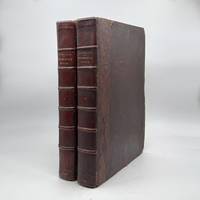
1584réf. 665155Ex officina Christophori Plantini / Christopher Plantin 1584. Leather Binding. Near Fine. A near fine copy austerely but attractively bound in full 19th-century dark aubergine morocco spine with raised bands and gilt titling inner dentelles tooled win gilt with a repeating floral scroll all edges gilt covers bordered in blind minor wear corners show some wear; an old inscription on the New Testament title page has been removed with slight loss and paper restoration; some minor occasional marginal stains. An attractive intact copy of this 16th-century Plantin polyglot Bible. N.T. first in volume. O.T. starts at back of volume Title page of Greek N.T. reads:'Novum Testamentum Græcum cum Vulgata interpretatione Latina Græci contextus lineis inserta: quæ quidem interpretatio cùm à Græcarum dictionum proprietate discedit sensum videlicet magis quàm verba exprimens in margine libri est collocata: atque alia Ben. Ariæ Montani Hispalensis operâ è verbo reddita ac diuerso characterum genere distincta in eius est substituta locum. Accesserunt & huic editioni libri Græcè scripti quos Ecclesia Orthodoxa Hebræorum Canonum secuta inter Apocryphos recenset; cum interlineari interpretatione Latina ex Bibliis Complutensibus deprompta.' The Greek N.T. Novum testamentum graecum cum vulgata interpretatione Latina Graeci contextus lineis inserta is at the beginning of the vol. with the Hebrew O.T. at the end with the Greek Apocrypha 128 p. between. Each Testament has its own title page and the mention of the Apocrypha on both suggests that it was intended to form an appendix to either of the Testaments if they were issued separately Reprinted from the 1569-72 Antwerp Polyglot. PROVENANCE: With the ownership inscription of auhtor Archibald Douglas Fox on verso of front endpaper: 'Archibald Douglas Fox 1901 / belonged to my father and grandfather.'. Ex officina Christophori Plantini / Christopher Plantin unknown
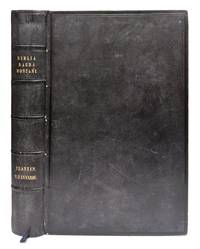
1569réf. 372210Geneva: Henri Estienne 1569. Printer's device on title page. Text in four columns in Greek Latin and Syriac. 6 28 1 324; 325-709 leaves. 2 vols. Folio. Later calf. Rebacked edgeworn and dry. Very good overall. Printer's device on title page. Text in four columns in Greek Latin and Syriac. 6 28 1 324; 325-709 leaves. 2 vols. Folio. The New Testament in Greek Latin and Syriac given in Hebrew characters with a Latin translation of the Syriac by Immanuel Tremellius 1510-1580 professor of Hebrew at Heidelberg. The Dedicatory Epistle is addressed to Queen Elizabeth I. The Syriac version is the second edition the first 1555 of the New Testament; the Latin translation is the first edition and was the basis for translations down to the eighteenth century. This copy with his Grammatica Chaldaea et Syriaca including teminal blank bound preceding Matthew; the second volume begins with Acts. RARE. Darlow & Moole 1421; Renouard Annales de l'imprimerie des Estienne p.132; Adams B1701. OCLC reports fewer than 20 locations over multiple records. Provenance: General Theological Seminary blindstamps bookplate Henri Estienne unknown
1518réf. 371799Cologne: Johann Soter 1518. Title within woodcut borders. Text in double columns in Latin Amharic not Chaldaean Greek and Hebrew types across double page spreads. Collation: a-y6 ç6 &6 ¶4 -&6 blank. 147 ff. 1 vols. 4to. Twentieth century red morocco and cloth. Some traces of rubbing to joints. GTS bookplate stamps on first and last leaves. Very good plus. Title within woodcut borders. Text in double columns in Latin Amharic not Chaldaean Greek and Hebrew types across double page spreads. Collation: a-y6 ç6 &6 ¶4 -&6 blank. 147 ff. 1 vols. 4to. The third polyglot Psalter edited by Johannes Potken who had edited an Ethiopic Psalter in 1513. The work is preceded only by the Genoa Psalter 1516 and the Complutensian Bible printed 1514-1517 but not published until 1522. The Introductiunculae in tres linguas externas: Hebraeam Graecam Chaldaeam sic introduction to three languages Greek Hebrew and Chaldaean i.e. Ethiopic is bound after the main text. Preserving an early binder's blank marked Duplum Bibliothecae Regiae Monacensis with ink inscription beneath The General Seminary of the Protestant Episcopal Church in the U States new York 10 December 1826 gift of John Pintard. This marks it as one of the earliest books donated to the newly established library. Pintard 1759-1844 was a prominent New Yorker of Huguenot origin patron of education and one of the earliest and staunchest advocates for the preservation and study of the history of New York and the United States. Pintard began to work towards the establishment of a historical society in the city in early 1804 and he was the leader in the organization of the New-York Historical Society in November 1804. He was also a patron of the old French Huguenot Church of St. Esprit and the General Theological Seminary. Important and early work. Darlow & Moule 1413; VD16 B 3101; Adams B-1371; Vinograd Cologne 1; D.S. Berkowitz In Remembrance of Creation 1968 no. 175; Fumagalli G. Bibliografia etiopica 1243 [Johann Soter] unknown
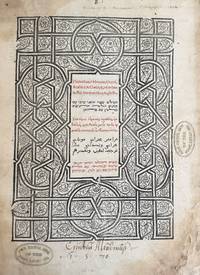
1516réf. 371021Genoa: Petrus Paulus Porrus 1516. Title printed in red and black within woodcut arabesque border printer's device on final leaf. Parallel text in Hebrew Latin Greek Arabic and Chaldaean Aramaic 4 columns to a page 41 lines. 13 woodcut floriated initials. A10 B-Z8 &8 con6; 200 leaves complete. Folio 13-1/8 x 9-3/8 inches. Contemporary blind tooled pigskin over bevelled wooden boards boards with repeated roll of hound hunter and stag spine with floral tools. Clasps perished early repairs with vellum at lower corners; spine darkened with chip at foot joint starting wormholes to the covers. Toning throughout worm holes throughout but heavier to the preliminary and terminal leaves paper loss not affecting text at the lower outer corners of the first 3 leaves minor dampstaining at the lower corners of most leaves and extending from the top inner margin. Scattered early marginalia. Title printed in red and black within woodcut arabesque border printer's device on final leaf. Parallel text in Hebrew Latin Greek Arabic and Chaldaean Aramaic 4 columns to a page 41 lines. 13 woodcut floriated initials. A10 B-Z8 &8 con6; 200 leaves complete. Folio 13-1/8 x 9-3/8 inches. The Genoa Psalter also known as the Octaplum or Quadruplex Psalter was the first polyglot psalter to be published and the first polyglot edition of any part of the Bible. Financed by the Oriental language scholar Bishop Agostino Giustiniani and printed in Genoa in 1516 it presents the psalms laid out in eight columns i.e. four per page on double-page spreads: in Hebrew a Latin paraphrase the Vulgate Latin the Septuagint Greek Arabic Chaldean Aramaic a Latin paraphrase and the editor's notes. "A monument of Renaissance typography this Psalter was linguistically the most ambitious work attempted to date and the first Polyglot work ever published. It provides the Psalms in five languages as well as a marginal scholarship based largely on rabbinic sources. The Arabic text is one of the first two texts and the first biblical text ever printed in this language. The Hebrew types used in this book were apparently never used again" B. Sabin Hill Hebraica from the Valmadonna Trust The Piermont Morgan Library 1989 no. 18. Notably within a lengthy editor's note to Psalm XIX is what is considered the first printed biography of Christopher Columbus along with a very early description of his voyage. A native son of Genoa Giustiniani presents the discovery of the new world as a fulfilment of Biblical prophecy appropriately glossing verse four of Psalm XIX to include his biography of Columbus: "Their sound is gone out through all the earth and their words to the end of the world." The text of the biography of Columbus written a decade after his death includes a brief account of his childhood and continues at length on his discovery of America. Translated from the Latin it begins: "And so their words have reached unto the ends of the earth at least in our own times in which by the marvelous daring of Christopher Columbus of Genoa almost another world was discovered and joined to the community of Christians. And since Columbus often declared that he was chosen by God so that through him this prophecy would be fulfilled I did not consider it unsuitable to include his life here. Therefore Christopher surnamed Columbus a Genoese by birth . lived in our age and through his own efforts explored more lands and seas in a few months than almost all other mortals had done throughout all previous ages . More swiftly than the Portuguese had done he approached new lands and new peoples and at last penetrated regions unknown before now. The news of this matter quickly reached the King who - both out of rivalry with the Portuguese kings and a desire for such new marvels and glory that might accrue to him and his descendants - after long discussions with Columbus finally ordered two ships to be outfitted. With these Columbus set sail from the Fortunate Islands directing his course slightly off the western line . After many days of sailing they had covered great distances. While the others having lost all hope urged a change in course Columbus persisted asserting by reason and conjecture that continuing but a little longer might lead them to discover continents or islands. Nor was he wrong. On the following dawn they sighted land. From this event immense confidence arose in human minds. Later it was learned that these were islands and observations were made of certain peoples there uncultivated and prone to raids on their neighbors even devouring human flesh like wolves. There were violent encounters yet eventually some of these islanders were brought safely to Spain astonishing and delighting all who saw them because they were at first timid unfamiliar with approach easy to persuade and marveling at everything as new." An important and desirable work from a liturgical linguistic and historical perspective. Adams B1370; BM STC Italian p. 97; Darlow & Moule 1411; Sabin 66468; European Americana 516/4; Harrisse BAV 88; JCB 3 I:64; Smitskamp 236; Roper Early Arabic Printing in Europe in Sprachen des Nahen Ostens und die Druckrevolution p. 132; Vinograd Genoa 1. Provenance: Cenobii Alois 1570 inscription below title; Bibliotheca Regia Monacensi pencil inscription on the inside front board identifying it as a duplicate; General Theological Seminary ink and blindstamps and other markings Petrus Paulus Porrus unknown