MareMagnum

9 241 résultats
2007Libro d’Ore di Bonaparte Ghislieri (Libro d’Ore del Perugino, Hours of Bonaparte Ghislieri). British Library, Yates Thompson MS 29, Londra. Franco Cosimo Panini Editore, 2007. Riproduzione in facsimile del manoscritto con miniature, a piena pagina, realizzate dal Perugino altri miniatori quali Lorenzo Costa, Amico Aspertini, Francesco Francia, Matteo da Milano. Legatura in marocchino con, sui piatti, due castoni di pietre dure e due medaglioni centrali raffiguranti l’Annunciazione. Formato 15x21 cm. Pagine 270. Commentario, in italiano, di Benevolo Giancarlo, Kidd, Peter e Medica Massimo. Cofanetto di custodia. Tiratura limitata e numerata di 980 copie. Condizioni ottime.
2002Il Virgilio Riccardiano (Ms. Ricc. 492). Vergilius Publius Maro: Bucolicon, Georgicon, Aeneis Biblioteca Riccardiana, Firenze. ArtCodex, Modena, 2002. Riproduzione in facsimile delle Bucoliche, Georgiche, Eneide di Virgilio con miniature che rappresentano il viaggio di Enea ambientato città di Firenze al tempo di Lorenzo il Magnifico. Legatura in pelle con cornici di filetto impresse a secco sui piatti. Formato 20x31 cm. Pagine 512. Commentario (21x31 cm. pagine 173) in italiano. Cofanetto in legno pregiato, formato 34x44x13 cm. Tiratura limitata e numerata di 999 copie. Condizioni ottime.
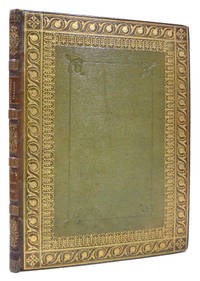
réf. 98472Milano Giovanni Silvestri 1811. . Second enlarged edition 4to 29 x 21.5 cm. 4 98 2pp. half-title errata explanation of plates III-V engraved vignette to title 5 maps and plans on 3 sheets 1 double-page 2 folding green straight-grained morocco gilt covers with broad gilt borders spine faded to olive all edges gilt a fine copy. A superb large copy in contemporary green morocco of the preferred enlarged second edition. Ferrer Maldonado's account of a spurious 1588 voyage through the Polar seas during which the Spanish navigator claimed to have discovered the fabled Northwest Passage here called the Strait of Anian depicted in the folding maps. A scarce item in any edition. Hill p103; Howes F95; Lada-Mocarski 66; Sabin 44109. Milano, Giovanni Silvestri, 1811. unknown
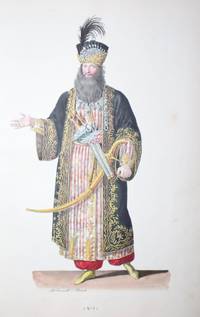
1827réf. 007797Napoli: Stamperia Real 1827. First Edition. Quarter Morocco. Very Good. A glorious memorial to the fun-loving Bourbon Neapolitan court of the day. Folio 33.5 by 23.5 cm. 19 1 pp. followed by 11 hand-colored plates and 220 cm long concertina or leporello depicting a procession of sorts or perhaps a frieze of the masqueraders 84 in all and all of whom are hand-colored figures. Below the line-up of dancers on the frieze are nine separate excerpts of musical notation. Eight of these are for various quadrilles with the title of the particular dances above the bars of music. The ninth music quotation is for a Persian march its participants the ones depicted in the eleven larger plates. The actual people at the masquerade and represented by the illustrations are listed and keyed in the text portion. The names are rich in the titled and the English are also well-represented with a few familiar names such as Acton among them. Contemporary binding both leather spine and paper pastedown on boards fairly heavily rubbed. Light foxing throughout. Repaired closed tear repair on frieze. The concertina is folded in an unusual manner and thus requires care when opening it up. Hand-colored figures are all bright. Stamperia Real unknown
1827réf. 007797Napoli: Stamperia Real 1827. First Edition. Quarter Morocco. Very Good. A glorious memorial to the fun-loving Bourbon Neapolitan court of the day. Folio 33.5 by 23.5 cm. 19 1 pp. followed by 11 hand-colored plates and 220 cm long concertina or leporello depicting a procession of sorts or perhaps a frieze of the masqueraders 84 in all and all of whom are hand-colored figures. Below the line-up of dancers on the frieze are nine separate excerpts of musical notation. Eight of these are for various quadrilles with the title of the particular dances above the bars of music. The ninth music quotation is for a Persian march its participants the ones depicted in the eleven larger plates. The actual people at the masquerade and represented by the illustrations are listed and keyed in the text portion. The names are rich in the titled and the English are also well-represented with a few familiar names such as Acton among them. Contemporary binding both leather spine and paper pastedown on boards fairly heavily rubbed. Light foxing throughout. Repaired closed tear repair on frieze. The concertina is folded in an unusual manner and thus requires care when opening it up. Hand-colored figures are all bright. Stamperia Real unknown books
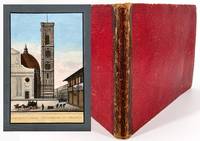
1840réf. 1613Florence: Lorenzo Bardi 1840. Very good. Oblong quarto 7 3/4 11 inches 195 x 280 mm. 18 aquatint plates engraved by G. Carrocci and others image size 14 x 19 cm plate mark size 18 x 25 cm with superb hand coloring in heavy watercolor and gouache within black line and grey gouache borders. Preceded by a dedication page printed on blue paper; original upper wrapper with aquatint vignette also printed on blue paper bound in. Contemporary red sheep-backed boards rubbed with brown calf spine. Provenance: Library of Norman Bobins. Bobins vol. 5 1675. Exceptionally fine series of views of Florence landmarks with a few from Pisa being a new version of Zocchi's "Scelta di XXIV vedute delle principali contrade piazze chiese e palazzi della città di Firenze" first published in 1744. Lorenzo Bardi unknown
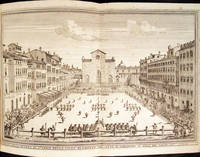
1688réf. 29719Firenze: Stamperia di S.A.S. alia Condotta 1688. Rare First Edition of this very early work on football. Engraved armorial title-vignette featuring a figure with a football by Francesco Nacci two folding engraved plates one with players lined up for play in the Piazza Sante Croce by Alexander Cecchini and one a diagram of player's positions. 4to in nineteenth-century marbled boards backed in black morocco the spine gilt lettered and with multi-line gilt ruled flat bands additional gilt tooling at the foot bookplate of Franco Niccoli to front paste-down. xii 118 2 manuscript entries pp. A very handsome and proper copy of this rare book with a couple of contemporary marginal annotations and one contemporary manuscript leaf bound at the end a little scattered foxing throughout but not obtrusive. RARE FIRST EDITION OF PIETRO BINI'S ANTHOLOGY ON FLORENTINE FOOTBALL a forerunner to the modern games of soccer rugby and American football. THIS IS ONE OF THE EARLIEST TREATISES ON THAT PREDECESSOR TO OUR MODERN GAMES. In the game of calcio two teams each consisting usually of 27 men are engaged on an enclosed ground of 172 x 82 braccie fiorentine just little smaller than a modern football field. The action consists of carrying and kicking a pumped ball of medium size with fists and feet hence the name calcio in order to make it pass beyond the terminal barriers of the adversaries' half. One such successful action is called caccia. The team making the most caccie is the winner. Games typically last one hour and are played 'for honour's sake'. The wonderfully detailed description of the game is largely by Giovanni de' Bardi and though it was first published anonymously nearly a century earlier the text included here is greatly expanded and illustrated. It fully explains the rules and manners of the game and describes a number of games that had recently been played in and near Florence. The double-page plate depicts a match in the Piazza Santa Croce is very impressive and provides us with a lasting 17th century "instant replay" of the event. Stamperia di S.A.S., alia Condotta hardcover
1796réf. 40343PRIMERA EDICION De orden del Rey.- Madrid: En la Imprenta Real Año de 1796.- 1 h. 54 p.: Al final 2 h. con sendos modelos plegados de 42 x 473 cm. uno con el "Modelo del Pasaporte ó Patente de Mar que se concede á los Buques para navegar en Europa citado en el Artículo XVII" y el otro con el "Modelo del Pasaporte ó Patente de Mar que se concede á los Buques para navegar en América citado en el Artículo XVII"; 4º 23 x 173 cm.; Excelente impresión a dos columnas sobre magnífico papel verjurado; Edición bilingüe en español e inglés; Enc. moderna ca.1925 finamente ejecutada en Media Piel lomo dorado.- MUY RARO. El tratado de San Lorenzo de 1795 también conocido como tratado de amistad límites y navegación o tratado Pinckney en los Estados Unidos fue firmado por España y los Estados Unidos para definir las fronteras entre los Estados Unidos y las colonias españolas en Norteamérica y regular los derechos de navegación en el río Mississippi. El acuerdo fue firmado en San Lorenzo de El Escorial el 27 de octubre de 1795 por Manuel de Godoy en nombre de Carlos IV de España y por Thomas Pinckney en representación de Estados Unidos; sería ratificado por el presidente estadounidense George Washington el 7 de marzo de 1796 en Filadelfia y por el rey de España en Aranjuez el 25 de abril del mismo año. SIGLO XVIII ESPAÑOL Libro en español En la Imprenta Real hardcover
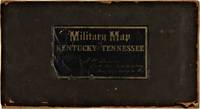
1863réf. 68463Cincinnati: Ehrgott Forbriger & Company 1863. Rare and Immense Civil War Map of Kentucky and Tennessee The first state of this rare and important Civil War map of Kentucky and Tennessee and still one of the largest maps of those two states ever produced. Completed by accomplished engineer James Hervey Simpson surveyor for the Abert expedition among many other accolades and lithographed by Cincinnati's own Ehrgott Forbriger & Company this map was commenced under Don Carlos Buell and finished under Ambrose Burnside for the express use of the Union army. Maps of the southeastern United States were scarce and of generally poor quality at the outbreak of the Civil War—veteran surveyors Michler Sitgreaves and Simpson spent two years compiling the present work at the time the largest and most accurate depiction of the region despite a note on the Library of Congress copy declaring it "Full of errors" and "worthless so far as the 5 northern counties are concerned". By the time the map was actually issued in 1863 however Tennessee was more or less firmly under Union control. Kentucky remained the site of considerable action in early 1863 but was relatively quiet in the second half of the year. In addition to military encampments many of them placed incorrectly though whether by accident or as intentional obfuscation is unclear the map goes to great lengths to record infrastructure including current and future railroads highways iron works and mills post offices and coal fields. These maps were valuable military intelligence and closely guarded for that reason—a manuscript note in the lower left corner of this copy reads: "Officers to whom the Maps are sent will hold them useful for the public service and be careful to transmit to their successors in command." This important map is present here in its first state with the lithographers' name printed in an arc and the "out line of coal field" added to the later issue unmarked. Interestingly the location of Camp Burnside on the Cumberland River not present in the first state but added for the second has been appended in red ink at the appropriate location. A rare production great in both size and significance. OCLC records fewer than ten copies of this first state. Folds into original cloth covers gilt label map backed on linen as issued. Covers rubbed and stained. Map tanned scattered stains minor wear at edges of panels without loss. About very good. LC CIVIL WAR MAPS 216.7. RUMSEY 5384A. OCLC 71228867. hardcover
1863réf. 68463Cincinnati: Ehrgott Forbriger & Company 1863. Rare and Immense Civil War Map of Kentucky and Tennessee The first state of this rare and important Civil War map of Kentucky and Tennessee and still one of the largest maps of those two states ever produced. Completed by accomplished engineer James Hervey Simpson surveyor for the Abert expedition among many other accolades and lithographed by Cincinnati's own Ehrgott Forbriger & Company this map was commenced under Don Carlos Buell and finished under Ambrose Burnside for the express use of the Union army. Maps of the southeastern United States were scarce and of generally poor quality at the outbreak of the Civil War—veteran surveyors Michler Sitgreaves and Simpson spent two years compiling the present work at the time the largest and most accurate depiction of the region despite a note on the Library of Congress copy declaring it "Full of errors" and "worthless so far as the 5 northern counties are concerned". By the time the map was actually issued in 1863 however Tennessee was more or less firmly under Union control. Kentucky remained the site of considerable action in early 1863 but was relatively quiet in the second half of the year. In addition to military encampments many of them placed incorrectly though whether by accident or as intentional obfuscation is unclear the map goes to great lengths to record infrastructure including current and future railroads highways iron works and mills post offices and coal fields. These maps were valuable military intelligence and closely guarded for that reason—a manuscript note in the lower left corner of this copy reads: "Officers to whom the Maps are sent will hold them useful for the public service and be careful to transmit to their successors in command." This important map is present here in its first state with the lithographers' name printed in an arc and the "out line of coal field" added to the later issue unmarked. Interestingly the location of Camp Burnside on the Cumberland River not present in the first state but added for the second has been appended in red ink at the appropriate location. A rare production great in both size and significance. OCLC records fewer than ten copies of this first state. Folds into original cloth covers gilt label map backed on linen as issued. Covers rubbed and stained. Map tanned scattered stains minor wear at edges of panels without loss. About very good. LC CIVIL WAR MAPS 216.7. RUMSEY 5384A. OCLC 71228867. hardcover books
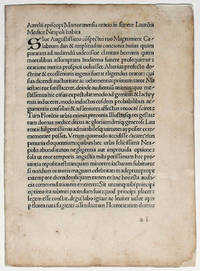
1492réf. 26804to. 20.5 x 15 cm 4to. 20.5 x 15 cm 8 ff. rather dog-eared at edges and with some light soiling. Disbound in a cloth-covered box. Rare first edition of this funeral oration for Lorenzo de Medici read in Santa Maria Nuova on 16 April 1492 evidently the only contemporary printed oration of the many delivered and printed in his honor to survive. "Lorenzo de' Medici… born January 1 1449 Florence Italy—died April 9 1492 Careggi near Florence Florentine statesman ruler and patron of arts and letters was the most brilliant of the Medici. He ruled Florence with his younger brother Giuliano 1453–78 from 1469 to 1478 and after the latter's assassination was sole ruler from 1478 to 1492." Brittanica.com The present publication is the sole oration devoted to Lorenzo in the Short-Title List of Funeral Orations from the Italian Renaissance Ca. 1374-1534 compiled by John McManamon and the only printed example featured in the 1992 exhibition at the Bibliotheca Nazionale Centrale Lorenzo dopo Lorenzo La Fortuna Storica di Lorenzo il Magnifico. Notwithstanding the poor survival rate of ephemeral publications and the controversial character of the laudandus the statistic remains remarkable. The motive for the present oration was overwhelmingly political and meant to insure continuation of the traditionally strong alliance between Naples and Florence at a difficult time of dynastic transition. According to Miglio DBI X.369-70 the work was published before it was read. A Naples edition was published the same year from the press of Cristannus Preller IGI VI.1722-A. The work was re-published in the 19th century by Vito Capialbi in Memorie di R. Zeno e A. Bienato Naples 1838 49-86. Milanese born Aurelio Bienato was Reader in Rhetoric at the University of Naples 1470-80 and later elected Bishop of Martirano modern Catanzaro in which sinecure he remained until his death. Miglio also lists an unpublished commentary on Quintilian Iter Italicum I.415-16 II.570 and a collection of Latin verses Elegantiarum epithomata an epitome of Lorenzo Valla's Elegantiae linguae latinae which went through a number of incunable editions 1479/80; 1488; 1491. US copies ISTC: Huntington Newberry and Yale. Provenance: Ritman copy. Goff B-667; BMC vi.784; GW IV.1346; Paolo Pira ed. Lorenzo dopo Lorenzo. La Fortuna Storica di Lorenzo il Magnifico Florence Biblioteca Nazionale 1992 I.24; John M. McManamon Funeral Oratory and the Cultural Ideals of Italian Humanism 1989 p. 256 & 41-43. Phillipus de Mantegatiss
1492réf. 26804to. 20.5 x 15 cm 4to. 20.5 x 15 cm 8 ff. rather dog-eared at edges and with some light soiling. Disbound in a cloth-covered box. Rare first edition of this funeral oration for Lorenzo de Medici read in Santa Maria Nuova on 16 April 1492 evidently the only contemporary printed oration of the many delivered and printed in his honor to survive. "Lorenzo de' Medici… born January 1 1449 Florence Italy—died April 9 1492 Careggi near Florence Florentine statesman ruler and patron of arts and letters was the most brilliant of the Medici. He ruled Florence with his younger brother Giuliano 1453–78 from 1469 to 1478 and after the latter's assassination was sole ruler from 1478 to 1492." Brittanica.com The present publication is the sole oration devoted to Lorenzo in the Short-Title List of Funeral Orations from the Italian Renaissance Ca. 1374-1534 compiled by John McManamon and the only printed example featured in the 1992 exhibition at the Bibliotheca Nazionale Centrale Lorenzo dopo Lorenzo La Fortuna Storica di Lorenzo il Magnifico. Notwithstanding the poor survival rate of ephemeral publications and the controversial character of the laudandus the statistic remains remarkable. The motive for the present oration was overwhelmingly political and meant to insure continuation of the traditionally strong alliance between Naples and Florence at a difficult time of dynastic transition. According to Miglio DBI X.369-70 the work was published before it was read. A Naples edition was published the same year from the press of Cristannus Preller IGI VI.1722-A. The work was re-published in the 19th century by Vito Capialbi in Memorie di R. Zeno e A. Bienato Naples 1838 49-86. Milanese born Aurelio Bienato was Reader in Rhetoric at the University of Naples 1470-80 and later elected Bishop of Martirano modern Catanzaro in which sinecure he remained until his death. Miglio also lists an unpublished commentary on Quintilian Iter Italicum I.415-16 II.570 and a collection of Latin verses Elegantiarum epithomata an epitome of Lorenzo Valla's Elegantiae linguae latinae which went through a number of incunable editions 1479/80; 1488; 1491. US copies ISTC: Huntington Newberry and Yale. Provenance: Ritman copy. Goff B-667; BMC vi.784; GW IV.1346; Paolo Pira ed. Lorenzo dopo Lorenzo. La Fortuna Storica di Lorenzo il Magnifico Florence Biblioteca Nazionale 1992 I.24; John M. McManamon Funeral Oratory and the Cultural Ideals of Italian Humanism 1989 p. 256 & 41-43. Phillipus de Mantegatiss books
1596réf. 52658Venice Girolamo Franceschi 1596. Folio 400x260 mm. Two parts bound in one later presumably 19th century sprinkled full calf with blindstamped geometrical ornamentations to boards. Leather on back board renewed. Engraved title-page neatly restored at inner margin far from affecting imprint; old owner's inscription ""Ex libris Ludovici A. la." crossed-out previous owner's name and traces after a stamp to title-page. With Medici arms at the top and those of Sirigatti at foot of title-page repeated on title-page of part two. As with all other copies we have been able to locate the title-page is trimmed affecting approximately 1 cm of the allegorical depictions in margin. Large woodcut printer's device at the end of the volume. Light occassional discolouring but overall in very fine condition. 1 f. allegorical frontispiece 3 ff. of dedication and index 43 plates numbered with parallel text 1 f. large woodcut printer's device 22 copper engraved plates including the title-page of the second part numbered 44-65. I.e. 65 plates in total - fully complete. The rare first edition of this most important work on the art of perspective: "Questa e la più elegante delle edizioni di libri prospettici per i tipi pei caratteri per la carta" Cicognara 860. Sirigatti's work is famous for being one of the very earliest thorough works solely dedicated to the art of perspective. Combining the visual language of the German book tradition of Lencker and Jamnitzer with the Italian tradition of linear perspective treated previously by Serlio and Barbaro and earlier that of Leon Battista Alberti unillustrated as applied to stage design and architectural theory this is one of the seminal Italian works on the subject of perspective. Presumably this work functioned as basis for Galileo’s drawing technique. The book quickly became very popular and several Italian editions were reprinted in the 17th century; its reputation was so long-lived that an English translation was published no less than 160 years after the original. The work is divided in two parts: The first part is dedicated to the elementary rules of perspective to plane and solid geometric figures which also contain musical instruments like the lute plate 41 and 42. The second part depicts architectural elements facades of palaces and churches in polyhedrons of various forms and regular Platonic solids with several references to Luca Pacioli's "divina proportione". Furthermore Sirigatti famously contributed to the study of theatrical perspective: "He is the first to mention that the full effect of the perspective frame for instance in a stage set can be enjoyed only by those sitting along the main axis. This is a fundamental aspect of absolutist theater that no doubt had been noticed by designers of princely entertainments earlier but is first commented on in print by Sirigatti whose observations were taken up more extansively by Pietro Accolti." Millard.Two problems were endemic in perspective designs. First because perspective scenery exploits the difficulty of the eyes in judging the sizes and distances of objects it works best by assigning the spectator to a single point of vision and manipulating relative magnitudes to make small images represent objects that are larger and farther away. Second the apparent magnitude and distance of painted objects tended to clash with the fixed size of live actors when applied to the theater threatening to produce absurd combinations of scale when performers wandered upstage. Sirigatti was first to "acknowledge the problem of spectator position. Sirigatti proposed a way to combine a painted perspective backdrop with fixed three-dimensional scenery that diminished in size as it neared an upstage vanishing point". Camp The First Frame. Sirigatti was not only influential in the theory of architecture and stage design. "Galileo "most certainly studied" La pratica di prospettiva which was published in Venice while Galileo was teaching nearbyby in Padova and that when Galileo and Thomas Harriot simultaneously pioneered the use of the telescope to study the moon's surface it was Galileo's training in chiaroscuro that led him to see mountains and craters where Harriot only saw "strange spottedness"." The Partnership of Art and Science: The Moon of Cigoli and Galileo.Sirigatti was a member of the Academy of Drawing Accademia del Disegno a school for artists and engineers where Galileo studied as a young man. Any young artist or mathematician working his way through Sirigatti and learning to create the spikes on a ring diagram such as this would master perspective and the handling of light and shadow chiaroscuro. Each spike must cast an appropriate shadow not unlike the patches Galileo would later discern through his "perspective tube" and interpret as the shadows of mountains protruding up from the surface of the Moon.Adams S-1224Cicognara 860Fowler 336Graesse VI417 Macclesfield 1896Mortimer 479Millard 129 the 1625-edition hardcover
1596réf. 52658Venice, Girolamo Franceschi, 1596. Folio (400x260 mm). Two parts bound in one later (presumably 19th century) sprinkled full calf with blindstamped geometrical ornamentations to boards. Leather on back board renewed. Engraved title-page neatly restored at inner margin, far from affecting imprint" old owner's inscription (""""Ex libris Ludovici A. la...""), crossed-out previous owner's name, and traces after a stamp to title-page. With Medici arms at the top and those of Sirigatti at foot of title-page, repeated on title-page of part two. As with all other copies we have been able to locate, the title-page is trimmed, affecting approximately 1 cm of the allegorical depictions in margin. Large woodcut printer's device at the end of the volume. Light occassional discolouring, but overall in very fine condition. 1 f. (allegorical frontispiece), 3 ff. (of dedication and index), 43 plates numbered with parallel text, 1 f. (large woodcut printer's device), 22 copper engraved plates (including the title-page of the second part) numbered 44-65. I.e. 65 plates in total - fully complete.
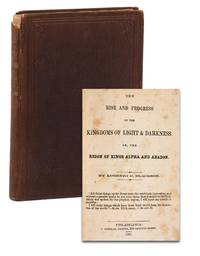
1867réf. 140949748Philadelphia: J. Nichols 1867. First edition. Good. First edition first and only printing. 288pp. Bound in publisher's brown pebbled cloth stamped and ruled in blind gilt to spine. Complete with frontis portrait twelve plates. Good with wear to cloth split to front joint loss at head of spine one page gathering out of binding. Light foxing occasional soiling and sporadic pencil marks to text. An allegorical novel where the struggles between good and evil take place in a mythical land written by an African-American Methodist preacher just after the Civil War. Published in Philadelphia where the Reverend Blackson preached to a congregation at the African M.E. Zion Church the copies from the single printing were probably absorbed by his flock as it does not seem to have been widely advertised or reviewed. Noted as a "critically important window into the religious worlds of African-American Protestants" in American Scriptures: An Anthology the text begins with a valuable 16 page autobiographical sketch and ends with a 22 page poetical summing-up followed by an index. This title is widely held in other formats by libraries but the 1867 printing remains incredibly scarce; records list only two copies at auction in the last 100 years. J. Nichols unknown
1867réf. 140949748Philadelphia: J. Nichols 1867. First edition. Good. First edition first and only printing. 288pp. Bound in publisher's brown pebbled cloth stamped and ruled in blind gilt to spine. Complete with frontis portrait twelve plates. Good with wear to cloth split to front joint loss at head of spine one page gathering out of binding. Light foxing occasional soiling and sporadic pencil marks to text. An allegorical novel where the struggles between good and evil take place in a mythical land written by an African-American Methodist preacher just after the Civil War. Published in Philadelphia where the Reverend Blackson preached to a congregation at the African M.E. Zion Church the copies from the single printing were probably absorbed by his flock as it does not seem to have been widely advertised or reviewed. Noted as a "critically important window into the religious worlds of African-American Protestants" in American Scriptures: An Anthology the text begins with a valuable 16 page autobiographical sketch and ends with a 22 page poetical summing-up followed by an index. This title is widely held in other formats by libraries but the 1867 printing remains incredibly scarce; records list only two copies at auction in the last 100 years. J. Nichols unknown books