9 125 résultats
1975réf. 165174Firenze: Edizione d'Arte Il Fiorino 1975. Hardcover. First Italian Edition. Text in Italian. Near Fine in a Very Good plus dust jacket. Oversize volume shipping billed at cost. Edizione d'Arte Il Fiorino unknown books
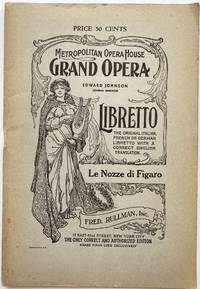
réf. 1358New York: Fred. Rullman Inc No date c. 19--. Wraps. Very good. 8vo; 17pp 6pp musical score; stiff grey pictorial wrapper; one staple binding; rear wrapper advertisement for Knabe pianos with pictorial portraits of opera artists; musical score follows text; light age-toning of wrapper one leaf with creases from printer; very good. English translation and text of the opera Le Nozze di Figaro. No date but circa 1935-1950 based on Edward Johnson as General Manager. Fred. Rullman, Inc unknown books
1926réf. 29565New York: Edward Eberstadt 1926. Rare Limited Edition with Notes by Eberstadt One of thirty-five large paper copies from an edition limited to 385 copies total. The first appearance in book form having only previously appeared in an obscure newspaper. The author later served as chief justice of the Supreme Court of California and judge on the Federal Bench. An excellent overland narrative Eberstadt has enhanced this edition with historical notes and an introduction. ".One of the most readable of all the overland narratives of the gold rush days" - Wagner-Camp. The bookplate illustrated by the prolific and talented Donn P. Crane belongs to Guthrie Y. Barber. Barber was a Canadian native who moved to New York around the turn of the century amassing an impressive collection of Americana and Canadiana. Original half Japanese vellum and paper-covered boards gilt-stamped front board and spine. Contemporary bookplate on front pastedown. A near fine copy unopened. HOWES S133. GRAFF 3687. MINTZ 403. COWAN p.570. WHEAT GOLD RUSH 175. KURUTZ 556. WAGNER-CAMP 191 note. EBERSTADT 107:349 ref. hardcover books
1972réf. 146744Beverly Hills CA: H.B.L. Productions 1972. Draft script for an unproduced film. With a few small manuscript pencil and ink annotations throughout. Based on the 1969 heist novel by Lawrence Block about a burnt-out former Green Beret who gets a tip-off about a valuable shipment of tactical nuclear weapons which he intends to steal with the help of a trained killer. Screenwriter Lorenzo Semple Jr. was known for his action and thriller films including "Daddy's Gone A-Hunting" 1969 "Papillon" 1973 and "Never Say Never Again" 1983. Set in the Florida Keys and Washington DC Red titled wrappers. Title page present with credits for screenwriter LORENZO SEMPLE JR. 123 leaves with last page of text numbered 122. Xerographic duplication rectos only. Pages Very Good plus wrapper Very Good plus bound internally with two gold brads. H.B.L. Productions unknown books
1802réf. 66781802. KNAPP SAMUEL LORENZO. Letters of Shahcoolen a Hindu Philosopher Residing in Philadelphia; to his Friend El Hassan an Inhabitant of Delhi. Boston: Russell and Cutler 1802. 152 p. Contemporary boards rebacked in modern calf. Foxing heavy on some leaves. First edition of the author's first book. Reflections on women's rights and Mary Wollstonecraft American poetry and the American landscape. S&S 2490. unknown books
1853réf. 8941853. SABINE LORENZO. Report on the Principal Fisheries of the American Seas. Washington 1853. 317 p. Cloth worn and lightly chipped along extremities and at spine ends. First edition. An important history of American fisheries prepared for the United States Treasury Department. unknown books
1902réf. 353977Ka Papa Hawaii Honolulu; Hoopukaia e L. Laiana paiia e Biglow & Main New York: 1902 1902. First edition. 4 216 8; 304pp. Oblong 8vo. Publisher's maroon cloth-backed tan cloth boards upper cover lettered in gilt. Custom morocco clamshell box. First edition. 4 216 8; 304pp. Oblong 8vo. Published in 1902 by the Hawaiian Evangelical Association this collection of 298 hymns was compiled by Theodore Richards and Ella H. Paris. This edition bound with presumably as issued a reprint of Lorenzo Lyons's Hoku Ao Nani a collection of Sunday school hymns. [1902] unknown books
1792réf. 1397434Ferrara: Eredi di G. Rinaldi 1792-1793. Hardcover. Quarto two volumes. In Good condition. Quarter bound in vellum with tipped corners and brown patterned paper boards. Spines have maroon leather labels with gilt lettering with discoloration pencil marks and rubbing wear. Spine of volume 2 has a green pencil line. Boards are slightly warped have significant age toning and rubbing wear stains throughout tears along the edges and chipping to extremities. Bumping to corners in some cases exposing the boards. Textblocks have library labels on the front pastedowns light plus foxing throughout and stains scattered on some pages throughout. Red speckling to edges and in some cases the red ink bleeds slightly into the margins of some pages. Text in Italian. Shelved in Room A. CONTENTS: VOL I “Memorie Istoriche Di Letterati Ferraresi Opera Postuma Di Giannandrea Barotti” 423 pages. Published in 1792. Stated second edition on title page. VOL II: “Memorie Istoriche Di Letterati Ferraresi Volume Secondo Dell Abate Lorenzo Barotti” 387 pages. Published in 1793. Lacks edition statement on title page. LCCN: 03027346 OCLC: 22224484. 1397434. Special Collections. [Eredi di G. Rinaldi] hardcover books
1834réf. 351919Paris: Imprenta De Decourchant 1834. First edition. vii 374pp. Scattered annotations. 12mo. Contemporary red morocco marbled endpapers. Minor foxing and toning. First edition. vii 374pp. Scattered annotations. 12mo. Exiled from Mexico in 1830 Zavala came to New York to seek colonization for his empresario grants in southeastern Texas transferring his interests to the Galveston Bay and Texas Land Company. "From December 1832 until October 1833 he again served as governor of the state of Mexico before returning to the Congress as a deputy for his native state of Yucatán. Named by President Antonio López de Santa Anna in October 1833 to serve as the first minister plenipotentiary of the Mexican legation in Paris he reported to that post in the spring of 1834. When he learned that Santa Anna had assumed dictatorial powers in April of that year Zavala denounced his former ally and resigned from his diplomatic assignment. Disregarding Santa Anna's orders to return to Mexico City he traveled to New York and then to Texas where he arrived in July 1835. From the day of his arrival he was drawn into the political caldron of Texas politics. Although he first advocated the cause of Mexican Federalism within a few weeks he became an active supporter of the independence movement; he served in the Permanent Council and later as the representative of Harrisburg in the Consultation and the Convention of 1836. At the convention he signed the Texas Declaration of Independence along with Jose Francisco Ruiz Jose Antonio Navarro and fifty-six other delegates" Handbook of Texas. The present work described his journey and impressions of the United States during his visit from 1830-1831 and was published while stationed in Paris in 1834. Raines praises the work as "One of the few books of travel in the U.S. worth reading. A fine picture of American manners customs and institutions by a Mexican republican with some notice of Austin's colonization in Texas . A true patriot and uncompromising lover of liberty" Raines. The work is further noted as "an incredibly important although little known.meticulously written narrative about the democratic culture and institutions of the United States. Zavala's narrative not only stands as a major document of early Mexican-American letters but also as one of the first theoretical and ethnographic examinations of democracy as a political and cultural institution. Thus Zavala's book challenges the widespread acceptance by American scholars that Alexis de Toqueville's Democracy in America 1835 is the first book to take United States democracy as a focus of political and cultural study . Zavala's story of democratic peoplehood will no doubt in time be read as one of the founding political texts of U.S. and Mexican democratic culture" John-Michael Rivera in the introduction of the 2005 English translation of the present work published by Arte Público Press University of Houston 2005. Clark Old South III:118; Howes Z3; Palau 378349; Raines p. 224; Sabin 106280; Streeter Texas 1156 Imprenta De Decourchant unknown books
réf. 305063Printed with platetone 1-2 mm. margins all around. Watermark: Letters in circle. Signed in plate Laur.Lo.I.F. and in lwer right of legend Lorenzo tinti D.D.D. 297 x 202 mm. pale stain in image marginal fold not affecting the image. Printed with platetone 1-2 mm. margins all around. Watermark: Letters in circle. Signed in plate Laur.Lo.I.F. and in lwer right of legend Lorenzo tinti D.D.D. 297 x 202 mm. Loli a Bolognese painter and engraver was the favorite student of Guido and is called by the Italians Lorenzo del Signor Guido Reni. Bartsch XIX 169 8 unknown books
1928réf. 215017Tucson: Acme Printing Co 1928. First edition. Illustrated. 293 pp. 1 vols. 8vo. Orange brown cloth. Very good some wear. First edition. Illustrated. 293 pp. 1 vols. 8vo. "Although this book has become scarce and is a collector's item it is full of errors." Adams Burrs under the Saddle. Howes W-73; Six Guns 2300; Adams Burrs under the Saddle 398 Acme Printing Co unknown books
réf. m2743Candler School of Theology Emory University 1983. Signed & inscribed by author to Bishop T. Otto Nall. Quarto hardcover red cloth gilt letters 194 pp. Fine As New. From Abstract: This project is concerned with the laity’s role as active participants in public worship along models extant in documents of the New Testament and the Early Church. The study seeks to understand what roles are filled in public worship and what persons fill the roles. It also asks what it means to participate in public worship. The project was designed to formulate a plan for the revamping of morning worship at the First United Methodist Church Okeechobee Florida.This project paper includes an historical and contemporary review of the Okeechobee United Methodist Church; an explanation and evaluation of the work of the core group; results and interpretation of the questionnaires; the direction in which the congregation’s worship is presently headed and the initial work of Phase II which puts into effect the results of the project. hardcover books
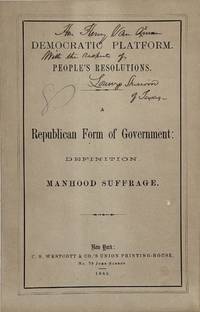
1865réf. 69087New York: C. S. Westcott & Co.'s Union Printing House. No. 79 John Street 1865. First edition. 23 cm. 15pp. Printed gray wrappers. Inscribed by Lorenzo Sherwood of Texas to Hon. Henry Van Aernam on front wrapper. Sherwood's anti-slavery opinions and his beliefs that internal improvements should be done by the state not financed by the state for private corporations were not popular. His anti-slavery views lead to his resignation in 1856 as a Texas legislator. He went to New York in 1861 to buy steel for the railroad and would never return to Texas. Van Aernam to whom this pamphlet is inscribed was an abolitionist in New York State. The final lines of this pamphlet: "Liberty to all"-"Rights to all"-"Justice to all!" This has been the vantage ground upon which the Union has fought the battle and this great platform will yet be contemplated in the South as the source of highest satisfaction. The world is beginning to comprehend that the Union arms have fought the battle of the South and that all the Union victories under the dispensation of a wise Providence have been victories also in favor of the South. Let this be the sentiment and this the consolation and all will be well. C. S. Westcott & Co.'s Union Printing House. No. 79 John Street unknown books
2016réf. 110134Atglen:: Schiffer Publishing. Very Good in Very Good dust jacket. Hardcover. Complete in two volumes. Edited by Neil G. Stewart and Michael I. Davis. Color and black and white photographs throughout both volumes. First editions. Publisher's bookmarks are laid in. Removed tape abrasion and tape remnants on paste-downs else both volumes are very good in very good "bubbling" to laminate on flaps acetate dust covers. . 2016. Schiffer Publishing, hardcover books
1983réf. 24607The Hague: Martinus Nijhoff 1983. Cloth. Very Good. A solid copy of the 1983 1st edition. Tight and VG in its off-white cloth with light to medium soiling to the panels. Internally very clean with no writing or markings to speak of. Octavo 459 pgs. part of the "NATO ASI series Martinus Nijhoff unknown books
1825réf. SS10294Torino:: Pietro Marietti 1825. 1825. Three books in one volume. Thick 8vo. 132 220 iv 328 pp. 1012 plates 156 text figs. Black library buckram gilt-stamped spine title; front hinge weak. Ex-lib spine markings. Very good. RARE. Included with this title: 2 ROGER Aristide pseud. for Jules Rengade. Les Monstres Invisibles. Paris: P. Brunet 1868. Part of the "Bibliotheque de la Science pittoresque." and: 3 COULIER Paul-Jean. Manuel Pratique de Microscopie Appliquee a la Medecine. Paris: Desobry E. Magdeleine 1859. The first work by Martini relates to the work of Johann Gottfried Bremser 1767-1827 the Vienna parasitologist and hygienist. His classic "Uber lebende Wurmer im lebenden" Munich 1819 introduces his studies on intestinal worms in man. Pietro Marietti, 1825. hardcover books
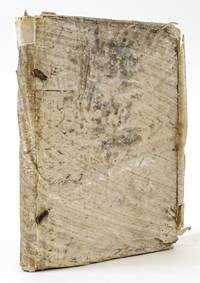
1675réf. 1398897n.p.: n.p c. 1675. Hardcover. Octavo 324 pages. In Good condition. Bound in full contemporary vellum "boards" composed of multiple sheets of 17th-century sheets. Vellum is beginning to separate from composite-sheet boards along fore-edges. Boards have moderate plus staining overall with moderate plus chipping and wear to vellum along edges. Textblock shows moderate age toning and light wear to untrimmed edges with occasional light staining to pages not impacting legibility. Undated ink manuscript in an unidentified 17th-century Italian hand. Shelved Room A. An early handwritten manuscript of Lippi's Il Malmantile Racquistato which appears to predate the second printed edition in 1688 and possibly the first printed edition in 1676. The present manuscript differs from one or both of the 17th-century editions in multiple points please see notes for further analysis of contrast with the published manuscript tradition of the text. Title page includes a dedication to Cardinal Leopoldo de Medici lacking in the first printed edition and attributes the work to Lippi's pseudonym Perlone Zipoli - unlike both 17th-century editions. The title page is followed by the prefatory Disfatto here attributed to the anagrammatic pseudonym Amostante Latoni Antonio Malatesti. The work is then prefaced by an index revealing the "true identities" of all the figures appearing pseudonymously in the work. Contrary to both printed editions each book is here referred to as canto rather than cantare and each stanza is numbered similarly to the 1688 edition and unlike the 1676 edition. Shelved Room A. The mock-heroic epic Malmantile Racquistato was written by Florentine painter Lorenzo Lippi 1606–1665 during the 1640s. Writing under the anagrammatic pseudonym Perlone Zipoli Lippi composed the poem while serving Cardinal Leopoldo de’ Medici and his wife at Innsbruck. Il Malmantile is often read as a parodic response to contemporary literary conventions particularly the epic stylings of Tasso’s Gerusalemme Liberata. Yet beyond its burlesque tone the work serves as a celebration of the Tuscan—specifically Florentine—dialect and is still studied today as a rich repository of regional idioms and turns of phrase. While the core of the poem was composed in Innsbruck between 1643 and 1644 reports from Lippi’s contemporaries many of whom were members of the informal literary academy degli Apatisti suggest that substantial additions and refinements were made after his return to Florence in 1648. Lippi wary of scandal or public backlash resisted calls to publish the poem during his lifetime. Nonetheless it circulated widely among members of the Apatisti the Accademia degli Svogliati and even the Accademia della Crusca. It was not published until 1676 eleven years after Lippi’s death in a flawed and limited edition only 50 copies issued by Giovanni Rossi. That edition was viewed by Lippi’s admirers as a distorted presentation of the poem—possibly even an act of literary revenge. A more authoritative version was published in 1688 under the editorial guidance of Paolo Minucci and the posthumous patronage of Leopoldo de’ Medici. The present manuscript appears to have been produced prior to the 1688 edition but after the completion of the poem before Lippi’s death in 1665. Based on textual evidence it is unlikely to have been copied from either printed edition. Instead it likely reflects a version circulating independently—perhaps within Lippi’s literary circle or among manuscript readers close to the Medici court. Several features underscore the manuscript’s significance as a witness to the early textual transmission of Malmantile Racquistato. Please note that this list is not comprehensive or exhaustive. Dedication to Cardinal Leopoldo de’ Medici 1617-1675 The manuscript bears a dedication “al Serenissimo Princeps Cardinal Leopoldo de’ Medici”—a form appropriate only during Leopoldo’s lifetime. The 1676 edition includes no dedication. The 1688 edition dedicates the work “alla gloriosa memoria” of the deceased cardinal. This places the present manuscript’s source text prior to Leopoldo’s death in 1675 supporting an early dating. Attribution of the “Malmantile Disfatto Enigma” The manuscript attributes the poem’s enigma to Latoni a fictional character in the narrative and anagram of Antonio Maltesti author of the argomentos. The enigma in the present manuscript follows the 1688 edition’s title: “Malmantile Disfatto Enigma” as opposed to the 1676 edition which title it simply the “Malmantile Disfatto”. Unlike the present manuscript both printed editions attribute the Disfatto to Malatesti friend of Lippi and author of the the argomentos prefacing each canto/cantare. Lexical Variant in the Enigma’s First Line The manuscript and the 1676 edition share the rare form inospite inhospitable whereas the 1688 edition substitutes the more conventional indomite untamed. The retention of inospite aligns the manuscript with the earlier textual variants prior to normalization. Dialectal Verb Form: “dalli” vs. “dagli” The manuscript occasionally makes use of the form dalli a dialectal or colloquial variant of dagli. This reflects non-standard or pre-Cruscan orthography and suggests a version of the poem less filtered by formal editorial revision. “Canto” vs. “Cantare” The manuscript titles the poem’s sections as “Cantos” contrasting with the “Cantare” found in both printed editions. While “Cantare” evokes the popular cantari tradition the manuscript’s use of “Canto” suggests either scribal normalization or an attempt to frame the work more in line with classical epic conventions. Book Seven Stanza 73 The present manuscript lacks the seventy-third stanza of the seventh canto/cantare which appears in both the 1676 and 1688 editions. Various Textual Differences including: The Argomento of the eighth canto/cantare: Lines 2-5 of the present manuscript have elements that appear to be either hybrids of the two printed editions or are unique to the manuscript. Line 2 matches the second edition of 1688 Line 3 matches the first edition of 1676 Line 4 is a unique rendering more closely aligned with the 1676 edition Line 5 matches the first edition of 1676 Book 7 Stanza 104 105 of the printed editions has in distinction to both print editions burlando for brillando. . 1398897. Special Collections. [n.p] hardcover books
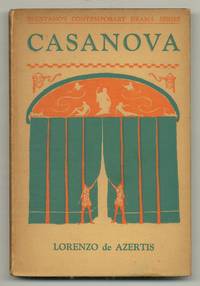
1924réf. 559539New York: Brentano's 1924. Hardcover. Near Fine. First edition. Translated by Sidney Howard. Pictorial papercovered boards. A little spine-toned else near fine lacking the scarce dust jacket. Brentano's hardcover books
1960réf. 552541San Juan Puerto Rico: Instituto de Cultura Puertorriqueña 1960. Unbound. Very Good. Poster. Measuring 19¼" x 29¼". Tiny price inked on the blank verso pinholes and tiny rustmarks in the corner margins several very short edge tears all but two marginal one barely touches the top left corner and the other ventures ½" into the bottom edge of the image and some thin creases in the brown paint near the top bright and very good. Copy 9 of 30 copies printed numbered and Signed in pencil by Homar in the bottom margin. We have not been able to find much about Padre Martin Berntsen but he may have died in 1958 prompting the exhibition advertised here. Instituto de Cultura Puertorriqueña unknown books
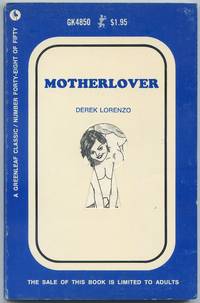
1975réf. 438782San Diego: Greenleaf Classics 1975. Softcover. Near Fine. First edition. Paperback original. Illustrated wrappers with a die-cut keyhole on front wrap. Modest rubbing near fine. A boy's best friend is his mother. OCLC locates a single copy. Greenleaf Classics unknown books
1967réf. 523938Brooklyn: The Poets Press 1967. Softcover. Very Good. Magazine. Cover by Michael Bowen. 28pp. Single sheets printed both sides and secured with two staples. Front cover detached at staples with slight chipping along spine and stamp mailing label and handwritten address of Frontier Press publisher Harvey Brown rear wrap else a very good copy. An influential mimeograph created by di Prima and LeRoi Jones featuring some of the most important poets of the 20th Century. Unlike other magazines this so-called "newsletter" was distributed via a mailing list many of which were noted poets journalists critics publishers and artists. For this reason most copies were hand addressed or affixed with a mailing label and stamp and folded for mailing. This issue contains the first appearance of "Hitchhiker" and "How To Meditate" by Jack Kerouac Charters C110 and C109 and "Newark Black Survival Committee" by LeRoi Jones Amiri Baraka along with contributions from Jack Spicer Keith Wilson Gary Synder Stuart Perkoff Rajkamal Chowdhury Lorenzo Thomas George Stanley Frank O'Hara Johannes Koenig Yukio Matsuda Yu Suwa Atsushi Sekiguchi Philip Lamantia and David W. McKain. The Poets Press unknown books
1995réf. 362281Athens: The University of Georgia Press 1995. Softcover. Very Good. Uncorrected proofs. Offsetting on front wrap thus very good in wrappers. The University of Georgia Press unknown books
1820réf. 3960Mexico City: Impreso en Madrid en la imprenta de Vega y compañia y reimpreso en México en la de D. Alejandro Valdés en dicho año 1820. Second edition. Very good. Small 4to. 26 pp. a little age toning. Recent drab wrappers lettered in manuscript. REPUBLICAN SPAIN COLLAPSES ERODING SPANISH DOMINION OVERSEAS: A WEIRD AND VERY LITTLE-KNOWN DIATRIBE CONCERNING THE 1820 SPANISH ELECTION SCANDAL INVOLVING LATIN-AMERICAN BORN REPRESENTATIVES IN THE NEWLY REFORMED SPANISH PARLIAMENT "CORTES OF CÃDIZ. This issue fueled the debate on the future of the former Spanish colonies in the Americas which openly advocated independence -- as here. In 1820 the provisional Cortes of Cádiz election board limited to 30 the number of Latin-American born substitute deputies which led to strong criticism across the Atlantic. Particular outrage was expressed by those born in the Americas and who had been summoned to Spain to elect the aforementioned substitutes on May 28 and 29 1820 an event which occasioned the present pamphlet. While the present text is more than 200 years old its venomous spew reminds us of more recent claims of "election fraud." The first paragraph of this "Manifesto on the Nullity of the Elections" conveys the foaming nonsensical language throughout: "The crazy or drunk populace often shout in the excess of their delirium: 'Long live our death Perish our life!' This sublime concept of Dante is the most faithful depiction of the power of seducers over the common imbecile. A strong genius a strong character an ambition without limits are the weapons with which an impostor attracts to his party a large number of weak spirits of little people. With the examples with modern and ancient history he presents the master of our political works. We do not need this to happen to know this truth to ancient or alien events. We continually see iniquitous men who disturb the internal peace of states and who sacrifice the most sacred rights of their compatriots for petty interests. Monster enemies of society you had to have a thousand heads and even then your blood would not compensate for the horrendous evil that your greed caused! What a horrible compromise in which the imprudence of a few American Spaniards constitutes me!" And finally the last paragraph which in its rhythmic desparation reminds us of Ginsburg's "Howl": "When America screams without her voices dissipating either by distance or the seas asking for help from her own children; when she presents them with her hands in manacles her feet in chains; when she discovers the aged and deep sores that her fanaticism and tyranny caused on her delicate body; when she stretches out her arms to rest on the chest of the beings she produced and to recover from the spirits that are beginning to fail her ah! She is neglected despised insulted. In what debates do we waste time when the Homeland demands our help What laurels do we think will cover us if our countries turn to ashes What peaceful sleep awaits us in abundance if we are continually agitated by the cries of our unfortunate people But the denatured American does not hear me: I turn to the European Spaniards and tell them with the most illustrious tragedy: You who have broken the chains that oppressed you generously defend the freedom of your brothers." It is a remarkable fact that the author Manuel Lorenzo de Vidaurre 1773-1841 was the enlightened liberal president of the first Peruvian Supreme Court see: Lissell Quiroz-Pérez "The Books and Private Libraries of Peruvian High Magistrates of the Nineteenth Century" in: Revue historique 658:2 2011 p. 265 et seq. Sabin 99488 Madrid and Mexico City editions. Impreso en Madrid en la imprenta de Vega y compañia, y reimpreso en México en la de D. Alejandro Valdés, en dicho año unknown books
1883réf. 24041Fort Monroe Virginia: Printed at the United States Artillery School 1883. First Edition. Cloth. Very Good. First Edition. Two works bound as one. 8vo. Red cloth spine and corners over pebbled cloth. 1 vii 144 pages VII plates. Chemical Manipulations by Wissner. 1883 2 iv 40 pages. Instruction in Photography by Major Lorenzo Lorain. 1882. Cloth. Two unusual titles both scarce with OCLC showing only four physical copies of each title as of this writing. "Chemical Manipulations" is intended as a manual for use in the laboratory and covers much ground containing a brief summary of the Principles of Chemistry and Chemical Analysis and part II contains the Special Analyses prescribed in the Programme of Instruction. "Instruction in photography" reviews various processes both theoretical and practical and contains useful "short examples" where there is a stated problem with printing for instance and possible reasons and solutions are presented. As with many military manuals these are focused on practical considerations for the military rather than theory accessible only to the elite. Printed at the United States Artillery School unknown books
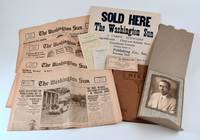
réf. 8828Washington D.C. 1914 ca. 1920 1928. See below for archive contents. A collection of materials relating to pioneering Black linguist professor and publisher Lorenzo Dow Turner including several very scarce early issues of his short-lived newspaper; ephemera promoting the newspaper; the first yearbook of Howard University his alma mater inscribed to his mother; and a fine studio photograph of Turner as a young man taken by noted Black photographer Arthur P. Bedou. These items evidently all once belonged to Turner's mother. Lorenzo Dow Turner 1890-1972 was born in Elizabeth City North Carolina the youngest son of Elizabeth Freeman and Rooks Turner. He graduated from Howard University in 1914 afterwards obtaining a Master's Degree and PhD from Harvard and the University of Chicago respectively and becoming head of the English Department at Howard. In 1928 university politics led him to leave the position and with his brother Arthur as the business manager he established The Washington Sun. "Fearless Aggressive and Independent" according to its byline the paper was intended to "stimulate a wider and keener local interest in education religion and business.and.promote the civic welfare of the community" Wade-Lewis p. 55. The first issue appeared on September 6th 1928 but the paper lasted only through January of 1929. The following summer Turner accepted a temporary position at South Carolina State College at Orangeburg now South Carolina State University where he heard Gullah spoken for the first time by two of his students. After visiting their families on John's Island Turner became convinced that Gullah was not as scholars had previously supposed merely "bad English" derived from the "baby talk" spoken by white masters to new slaves. In the fall of 1929 he accepted a position at Fisk University where he would teach for the next sixteen years found the first African Studies program in the country and conduct extensive research on the African linguistic diaspora in the United States England Brazil Sierra Leone Nigeria Ghana and elsewhere along the west coast of Africa. This work informed his groundbreaking 1949 study Africanisms in the Gullah Dialect for which he is best known. From 1946 until his retirement in 1970 Turner taught at Roosevelt University in Chicago and in the 1960s helped found a training program for Peace Corps volunteers to Africa collaborated with the Encyclopedia Britannica Educational Corporation on filmstrips for classroom use and consulted with two dictionaries as they attempted to better account for African languages and African American culture. He was elected to the Hall of Fame of Chicago in 1969 and on his death two years later he was mourned as "one of America's truly great linguistic scholars" Chicago Daily Defender February 10 1972. ARCHIVE CONTENTS The Washington Sun. Washington D.C. No. 1 September 8 1928; No. 8 October 27 1928; No. 11 November 17 1928; No. 16 December 22 1928. 21.5" x 17.75" 8 pp. CONDITION: Very good to good slight chipping and a few minor tears to margins moderate chipping to central horizontal folds with slight losses to text in the Nov. 17 edition. Published shortly after Turner was pushed out of his professorship at Howard University and less than a year before he embarked on the landmark study that would establish the field of Gullah studies The Washington Sun aimed "To Serve All The People All The Time" according to its motto. The Turner brothers garnered some early and important subscribers including many of Lorenzo's former colleagues at Howard and the "quality of the reporting was first-rate" with "News underscoring triumphs in the progress of African Americans gracing the front page along with details of defeats and tragedies. The coverage was local national and international. The multifold message to the black population like that of other black newspapers was: be a model American citizen be proud of black accomplishments be aware of the virulence of racism work vigorously to advance both individual and group progress and be politically active in order to foster change" Wade-Lewis p. 56. Topics covered in the four editions offered here include court cases and crimes including a particularly brutal murder of a mother by her son biographical sketches including an interview with a pastor who had been enslaved until the age of fourteen sports for instance "Hampton U Upsets Va. State 16-0" society and church news the arts including a piece on an honorary reception for Harlem Renaissance painter Laura Wheeling Waring race relations "Of unusual significance" being the National Interracial Conference which took place in Washington D.C. in December of 1928 Black political success "Five Negroes Will Go to the State Legislature in Illinois" and more. Ads for beauty products cafes signmakers cleaners funeral services shoe repair upcoming plays and musicals and so on appear throughout. OCLC records just one issue of The Washington Sun at Emory University. Other issues are held in the Lorenzo Dow Turner papers at Northwestern University. Promotional materials for The Washington Sun. Washington D.C. ca. 1928. Paperboard window placard 10.75" x 13.875". CONDITION: Very good somewhat rubbed 2.5" crease at lower left corner. Bearing the announcement: "Sold Here : The Washing Sun" and characterizing it as "A Unique Newspaper" with "Strong Editorials" "Clean Rand Reliable News" and "Exceptional Features." With Paperboard promotional card 3.25" x 5.875". CONDITION: Very good. Leading with the question "Do You Read The Washington Sun" and characterizing the publication again as "Unique" with "Strong Editorials" etc. this card emphasizes it as "an excellent advertising medium." With Circular with advertising rates 5.875" x 3.5" 2 pp. on heavy stock. CONDITION: Very good light spotting to recto and light rubbing to verso. Noting rates for "General Advertising" between five and ten cents per line as well as "Mysticism Hypnotism Fortune Telling" twenty-five cents per line; "Mechanical" and "Line" requirements for ads information on "Commission and Discount" as well as "Subscription Rates." With Circular with "Display Advertising Rates" 9" x 4" 2 pp. on green paper. CONDITION: Very good. Below the rates advertising terms are listed on the recto "Bills not paid within 30 days of date subject to 6 per cent interest per annum"; "Cancellation of orders by telephone not effective unless confirmed in writing same day" etc. The verso characterizing the paper as "Tolerant" "Clean-Progressive" is a blank advertising contract "In Effect November 1 1928." Arthur P. Bedou photog. Portrait photograph of Turner. Washington D.C. ca. 1920. Silverprint 7" x 5" mounted in original paperboard folder. CONDITION: Very good excellent tonality. Arthur P. Bedou 1882-1966 worked for many years as personal photographer to Booker T. Washington and documented life at several Black institutions including Fisk University and the National Negro Business League before opening his own studio in New Orleans in the 1920s. Nikh Howard University Yearbook. Volume 1. Washington D.C. 1914. 4to 12" x 9" original printed brown paperboard 103 pp. 10 pp. ads. Inscribed on ffep: "To Mother-from Lorenzo." CONDITION: Very good cover with wear to extremities and some hand sewn repairs to spine; partial photo excised on p. 90. A few checkmarks in pencil draw attention to Turner's presence in the superlatives section as having "done the most for Howard" and being "the most handsome" though also being "the most hen-pecked." A scarce array of materials from the early life and career of a pathbreaking and influential Black scholar. REFERENCES: Amos Alcione M. "Connecting Communities through Language: Life and Work of Lorenzo Dow Turner" in Bérose - Encyclopédie internationale des histoires de l'anthropologie online; Wade-Lewis Margaret. Lorenzo Dow Turner: Father of Gullah Studies University of South Carolina Press 2007. Washington, D.C., 1914, ca. 1920, 1928 unknown books