Jacob, Monod, Lwoff, and BrennerBiblio.com

1.218 Ergebnisse
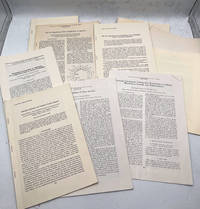
1968Best.-Nr. 387331968. Jacob Francois 1920- ; Monod Jacques 1910-75; Lwoff Andre 1902-94; & Brenner Sydney 1927- . Group of 22 offprints mimeographs etc. on molecular biology and bacterial genetics together with 2 related papers by other authors. Various sizes. 1947-1968. Together in one volume cloth "Institut Pasteur" in gilt on the spine. Overall good to very good; see detailed condition descriptions below. From the library of G. G. and Elinor Meynell authors of Theory and Practice in Experimental Biology 1970 with their address label on the front endpaper and ownership signatures on several of the offprints. First / First Separate Editions. Jacob Monod and Lwoff all colleagues at the Institut Pasteur received the 1965 Nobel Prize in physiology / medicine for their discoveries concerning genetic control of enzyme and virus synthesis-discoveries that "opened up a new field of research that deserved to be called 'molecular biology'" Magill The Nobel Prize Winners: Physiology or Medicine II p. 921. Their work answered the fundamental question of how the hereditary information contained in DNA can be translated into the chemical processes that synthesize cellular proteins this question had been posed most succinctly and explicitly in Francis Crick's theoretical paper "On protein synthesis" 1957 which laid the groundwork for over a decade's worth of research in this area. Brenner another key figure in this field worked with Jacob and Matthew Meselson on providing experimental evidence for messenger RNA; he was awarded a share of the 2002 Nobel Prize for his discoveries concerning genetic regulation of organ development and programmed cell death. The collection we are offering here focuses largely on the Nobel Prize-winning work done by the Institut Pasteur group-Lwoff Jacob and Monod-in the 1950s and 1960s. The work can be divided into four sections: 1 lysogeny and bacterial conjugation 2 expression of the genetic material via messenger RNA 3 the regulation of the genetic activity of bacterial cells by operons 4 the organization of bacterial genetic material. In the following paragraphs we will attempt to highlight the more important papers in this remarkable collection; however all the papers here touch upon these central questions of molecular biology. Lysogeny defined as the hereditary ability to produce the bacteriophage virus is a peculiar type of infection in which the phage becomes part of the genetic material of a bacterial cell; in this non-infective form prophage it can then be inherited by succeeding generations of cells becoming virulent only when some environmental stimulus causes the bacterium to produce and release phage. "Lysogeny brought a model for the interrelation between a virus and a cell. And also a model for the possible mode of action of carcinogenic agents which could disturb something in this balance" Judson p. 368. Lwoff studied this phenomenon intensively in the late 1940s and early 1950s successfully demonstrating the genetic nature of lysogeny which was disputed by several scientists including Delbruck and discovering how it is induced. In 1953 he published an important review of the subject "Lysogeny" Bacteriological Review 17; see no. 2 below. Lysogeny was also studied by Jacob and Elie Wollman whose paper "Induction of phage development in lysogenic bacteria" CSH Symposia on Quant. Biol. 18 1953; see no. 5 below summarizes what had been learned about lysogeny as of that date. Lwoff's work on lysogeny inspired Jacob and Wollman to investigate the phenomenon of bacterial conjugation the transfer of genetic information from a male donor bacterium to a female recipient resulting in genetic recombination to see if they could discover where in the bacterium's genetic material the prophage was located. In 1955 working with a highly recombinant strain of E. coli K12 discovered by William Hayes Jacob and Wollman performed what came to be known as their "coitus interruptus" experiment in which they used a Waring blender to interrupt the mating bacteria at various stages of their conjugation. They found that the donor cell's genetic characteristics were not transferred all at once but rather sequentially over time-a discovery of great importance. "Wollman and Jacob had stumbled upon a way to measure off the genes on the bacterial chromosome as directly and physically as a child squeezes toothpaste onto a brush or a carpenter unrolls a coiled steel tape measure. As they saw instantly and reported in a note in mid-June 1955 in the weekly Comptes rendus of the Academie des Sciences "Sur le mecanisme du transfert de materiel genetique au cours de la recombinaison chez E. coli K12"; see no. 6 below they had the means to make a genetic map of biochemical characteristics expressed in units of time" Judson p. 385. In 1956 Wollman and Jacob published the first albeit rudimentary timed map of the K12 strain of E. coli in a paper published in France. This map was printed again in their English-language paper "Conjugation and genetic recombination in E. coli K-12" CSH Symposia on Quant. Biol. 21 1956; see no. 8 below which also contained the first publication of Thomas Anderson's famous electron micrograph of two conjugated bacteria. In 1958 Jacob delivered his paper "Transfer and expression of genetic information in E. coli K12" see no. 9 below at a symposium in Brussels; this paper together with one given by Jacob's sometime colleague Arthur Pardee "ranged over the whole matter of transfer of genes between bacteria and the regulation of their expression" Judson p. 400. Jacob and Wollman had originally represented the hereditary material in linear form while stating that the genetic map could be formally represented as a circle. In 1963 at a Cold Spring Harbor conference the researcher J. Cairns provided physical evidence that the E. coli chromosome was circular; at this same conference Jacob Brenner and co-author Francois Cuzin presented their paper "On the regulation of DNA replication in bacteria" CSH Symposia on Quant. Biol. 28; see no. 16 below containing their "replicon model of chromosome replication in bacteria a model that almost required circularity of chromosomal and F factor DNA" Brock p. 103. Experimental proof of the existence of messenger RNA the substance responsible for coding protein synthesis was announced in Brenner Jacob and Meselson's landmark paper "An unstable intermediate carrying information from genes to ribosomes for protein synthesis" Nature 190 1961; see no. 1 below. The theoretical groundwork for messenger RNA had been laid in Crick's "On protein synthesis" 1957; demonstration of the substance's existence had been foreshadowed by Volkin and Astrachan's discovery of a high-turnover unstable RNA distinct from the ribosomal and transfer varieties 1956 and by the famous "PaJaMo" experiment demonstrating the negative control mechanism of enzyme induction 1958. However it was not until the spring of 1960 that these previous findings were combined by Brenner Jacob and Francis Crick into a biological model setting forth the exact means of communication between gene and cytoplasm while eliminating the various problems associated with earlier ribosome-based theories of gene expression. As Brock puts it the ribosome was now seen as "simply a nonspecific translation machine something like a computer whose behavior depended on what software it contained" Brock p. 306. Working with Matthew Meselson who had developed experimental techniques for tagging and separating ribosomes Brenner and Jacob performed the critical experiment described in their paper which provided direct evidence for the existence of an unstable rapidly turning over messenger RNA. The concept of the operon-a group of adjacent genes functioning as a unit under the control of another gene the operator gene-developed between 1958 and 1960 on the basis of work done by Monod and Jacob who were investigating the repressor model of gene regulation. Jacob developed the idea that gene regulation was based on a repression system that operated like an on-off switch and that "genetic units of a higher order existed . . . that contained several genes subject to unitary expression. . . . On the basis of these ideas and observations Jacob and Monod developed the concept of two kinds of genes structural which coded for the synthesis of proteins and regulatory which did not" Brock p. 300. In October 1959 Jacob and Monod published the theoretical basis for the operon in "Genes de structure et genes de regulation dans la biosynthese des proteines" C. r. Acad. Sci. 249; see no. 11 below. Their paper "established the sharp distinction between the familiar genes that determined protein structures and the new class of genes that regulated. It even looked to them then as though the product of the regulatory gene were not a protein by RNA. But the fact to be underlined they said was that in every known case when several structural genes had their expression controlled by the same regulatory gene-'that is to say in all probability by a unique repressor'-the structural genes were grouped tightly together. . . . The best fit to the evidence was that the group of genes had among them a single element: the operator target of the repressor" Judson p. 410. The Jacob/Monod operon model of gene expression was further explored in their 1961 paper "On the regulation of gene activity CSH Symposia on Quant. Biol. 26; see no. 14 below which presented a more detailed examination of the mechanics of protein synthesis. For further information see Judson The Eighth Day of Creation 2nd ed. and Brock The Emergence of Bacterial Genetics; specific references are given below. 1. Brenner Sydney; Jacob Francois; & Meselson Matthew. An unstable intermediate carrying information from genes to ribosomes for protein synthesis. Offprint from Nature 190 May 13 1961. 576-581pp. Diagrams. Without wrappers as issued. Light toning. Ownership signature of E. W. Meynell on the first page. Garrson-Morton 256.10. Brock ch. 10.12. Judson pp. 414-27. 2. Lwoff Andre. Lysogeny. Offprint from Bacteriological Review 17 1953. 269-337pp. Without wrappers. Small stamp on first page. Brock ch. 7.4. 3. Monod Jacques. Inhibition de l'adaptation enzymatique chez une bacterie E. coli infectee par un bacteriophage. Offprint from C. r. Acad. Sci. 224 1947. 2 2 blankpp. Without wrappers. Light browning creased horizontally with small tear along crease. Ownership stamp and ms. annotations of A. A. Miles. 4. Lwoff & Siminovitch Louis. Induction de la lyse d'une bacterie lysogene sans production de bactÈrophage. Offprint from C. r. Acad. Sci. 233 1951. 3pp. Fore-edge frayed marginal tear affecting a few words. A. A. Miles's signature. 5. Jacob Francois & Wollman Elie. Induction of phage development in lysogenic bacteria. Offprint from CSH Symposia on Quant. Biol. 18 1953. 101-121pp. Without wrappers. Light soiling a few annotations. Owner's name on first page. Judson p. 382. 6. Wollman & Jacob. Sur le mecanisme du transfert de materiel genetique au cours de la recombinaison chez E. coli K12. Offprint from C. r. Acad. Sci. 240 1955. 3pp. Without wrappers. Creased horizontally light toning. Ownership signature of Elinor Meynell. Brock ch. 5.7. 7. Jacob; Alfoldi Lajos; & Wollman Elie. Zygose letale dans des croisements entre souches colicinogenes et non colicinogËnes d'E. coli. Offprint from C. r. Acad. Sci. 244 1957. 3pp. Without wrappers. Small marginal tears. Elinor Meynell signature. 8. Wollman; Jacob & Hayes W. Conjugation and genetic recombination in E. coli K-12. Offprint from CSH Symposia on Quant. Biol. 21 1956. 141-162pp. Without wrappers. Brock ch. 5.11. 9. Jacob. Transfer and expression of genetic information in E. coli K12. Manuscript for the Symposium of the Society for Cell Biology Brussels 1958. 29 3pp. Dittoed table. Mimeographed. Without wrappers. Edges a bit frayed. E. Meynell signature. Judson p. 400. 10. Jacob & Fuerst Clarence R. The mechanism of lysis by phage studied with defective lysogenic bacteria. Offprint from J. Gen. Microbiol. 18 1958. 518-526pp. Without wrappers. E. Meynell signature. 11. Jacob & Monod. Genes de structure et genes de regulation dans la biosynthese des proteines. Offprint from C. r. Acad. Sci. 249 1959. 3pp. Without wrappers. Creased horizontally. E. Meynell signature. Brock ch. 10.10. Judson p. 410. 12. Changeux Jean-Pierre. Sur l'expression biochimique de determinants genetiques d'E. coli introduits chez Salmonella typhimurium. Offprint from C. r. Acad. Sci. 250 1960. 3pp. Creased horizontally. Meynell signature. 13. Jacob. Comments. Offprint from Cancer Research 20 1960. 695-697pp. Without wrappers. 14. Jacob & Monod. On the regulation of gene activity. Offprint from CSH Symposia on Quant. Biol. 26 1961. 193-211pp. Without wrappers. Meynell signature. Brock ch. 10.13. 15. Jacob & Monod. Elements of regulatory circuits in bacteria. Unesco Symposium on Biological Organization. Paris 1962. Mimeographed. 27pp. plus tables and figures. Without wrappers. Light browning. 16. Jacob; Brenner Sydney; & Cuzin Francois. On the regulation of DNA replication in bacteria. Offprint from CSH Symposia on Quant. Biol. 28 1963. 329-348pp. Without wrappers. Meynell signature. Brock ch. 5.11. 17. Jacob & Ryter Antoinette. Etude au microscope Èlectronique des relations entre mÈsosomes et noyaux chez Bacillus subtilis. Offprint from C. r. Acad. Sci. 257 1963. 4pp. Plate. Without wrappers. Meynell signature. 18. Lennox Edwin S. ; Novick Aaron; & Jacob. Relation between repression level and rate of enzyme synthesis. Offprint from Colloques Internationaux du Centre Nat. de la Recherche Scientifique. No. 124. Mecanismes de regulation des activites cellulaires chez les microorganisms 1965. 209-219pp. Orig. wrappers. Meynell signature. 19. Sebald Madeleine & Schaeffer Pierre. Toxinogenese et sporulation chez Clostridium histolyticum. Offprint from C. r. Acad. Sci. 260 1965. 3pp. Without wrappers. 20. Jacob & Ryter. Segregation des noyaux chez Bacillus subtilis au cours de la germination des spores. Offprint from C. r. Acad. Sci. 263 1966. 4pp. Plate. Without wrappers. Meynell signature. 21. Jacob & Ryter. Segregation des noyaux pendant la croissance et la germination de B. subtilis. Offprint from C. r. Acad. Sci. 264 1967. 3pp. Plate. Without wrappers. 22. Jacob. Genetics of the bacterial cell. Offprint from Science 152 1966. 9pp. Orig. printed self-wrappers. Nobel address. Meynell signature. 23. Jacob; Pereira da Silva Luiz; & Eisen Harvey. Sur la rÈplication du bacteriophage l. Offprint from C. r. Acad. Sci. 266 1968. 3pp. Without wrappers. 24. Ryter A.; Hirota Y.; & Jacob. DNA-Membrane complex and nuclear segregation in bacteria. Offprint from CSH Symposia on Quant. Biol. 33 1968. 669-676pp. . unknown
1968Best.-Nr. 387331968. Jacob Francois 1920- ; Monod Jacques 1910-75; Lwoff Andre 1902-94; & Brenner Sydney 1927- . Group of 22 offprints mimeographs etc. on molecular biology and bacterial genetics together with 2 related papers by other authors. Various sizes. 1947-1968. Together in one volume cloth "Institut Pasteur" in gilt on the spine. Overall good to very good; see detailed condition descriptions below. From the library of G. G. and Elinor Meynell authors of Theory and Practice in Experimental Biology 1970 with their address label on the front endpaper and ownership signatures on several of the offprints. First / First Separate Editions. Jacob Monod and Lwoff all colleagues at the Institut Pasteur received the 1965 Nobel Prize in physiology / medicine for their discoveries concerning genetic control of enzyme and virus synthesis-discoveries that "opened up a new field of research that deserved to be called 'molecular biology'" Magill The Nobel Prize Winners: Physiology or Medicine II p. 921. Their work answered the fundamental question of how the hereditary information contained in DNA can be translated into the chemical processes that synthesize cellular proteins this question had been posed most succinctly and explicitly in Francis Crick's theoretical paper "On protein synthesis" 1957 which laid the groundwork for over a decade's worth of research in this area. Brenner another key figure in this field worked with Jacob and Matthew Meselson on providing experimental evidence for messenger RNA; he was awarded a share of the 2002 Nobel Prize for his discoveries concerning genetic regulation of organ development and programmed cell death. The collection we are offering here focuses largely on the Nobel Prize-winning work done by the Institut Pasteur group-Lwoff Jacob and Monod-in the 1950s and 1960s. The work can be divided into four sections: 1 lysogeny and bacterial conjugation 2 expression of the genetic material via messenger RNA 3 the regulation of the genetic activity of bacterial cells by operons 4 the organization of bacterial genetic material. In the following paragraphs we will attempt to highlight the more important papers in this remarkable collection; however all the papers here touch upon these central questions of molecular biology. Lysogeny defined as the hereditary ability to produce the bacteriophage virus is a peculiar type of infection in which the phage becomes part of the genetic material of a bacterial cell; in this non-infective form prophage it can then be inherited by succeeding generations of cells becoming virulent only when some environmental stimulus causes the bacterium to produce and release phage. "Lysogeny brought a model for the interrelation between a virus and a cell. And also a model for the possible mode of action of carcinogenic agents which could disturb something in this balance" Judson p. 368. Lwoff studied this phenomenon intensively in the late 1940s and early 1950s successfully demonstrating the genetic nature of lysogeny which was disputed by several scientists including Delbruck and discovering how it is induced. In 1953 he published an important review of the subject "Lysogeny" Bacteriological Review 17; see no. 2 below. Lysogeny was also studied by Jacob and Elie Wollman whose paper "Induction of phage development in lysogenic bacteria" CSH Symposia on Quant. Biol. 18 1953; see no. 5 below summarizes what had been learned about lysogeny as of that date. Lwoff's work on lysogeny inspired Jacob and Wollman to investigate the phenomenon of bacterial conjugation the transfer of genetic information from a male donor bacterium to a female recipient resulting in genetic recombination to see if they could discover where in the bacterium's genetic material the prophage was located. In 1955 working with a highly recombinant strain of E. coli K12 discovered by William Hayes Jacob and Wollman performed what came to be known as their "coitus interruptus" experiment in which they used a Waring blender to interrupt the mating bacteria at various stages of their conjugation. They found that the donor cell's genetic characteristics were not transferred all at once but rather sequentially over time-a discovery of great importance. "Wollman and Jacob had stumbled upon a way to measure off the genes on the bacterial chromosome as directly and physically as a child squeezes toothpaste onto a brush or a carpenter unrolls a coiled steel tape measure. As they saw instantly and reported in a note in mid-June 1955 in the weekly Comptes rendus of the Academie des Sciences "Sur le mecanisme du transfert de materiel genetique au cours de la recombinaison chez E. coli K12"; see no. 6 below they had the means to make a genetic map of biochemical characteristics expressed in units of time" Judson p. 385. In 1956 Wollman and Jacob published the first albeit rudimentary timed map of the K12 strain of E. coli in a paper published in France. This map was printed again in their English-language paper "Conjugation and genetic recombination in E. coli K-12" CSH Symposia on Quant. Biol. 21 1956; see no. 8 below which also contained the first publication of Thomas Anderson's famous electron micrograph of two conjugated bacteria. In 1958 Jacob delivered his paper "Transfer and expression of genetic information in E. coli K12" see no. 9 below at a symposium in Brussels; this paper together with one given by Jacob's sometime colleague Arthur Pardee "ranged over the whole matter of transfer of genes between bacteria and the regulation of their expression" Judson p. 400. Jacob and Wollman had originally represented the hereditary material in linear form while stating that the genetic map could be formally represented as a circle. In 1963 at a Cold Spring Harbor conference the researcher J. Cairns provided physical evidence that the E. coli chromosome was circular; at this same conference Jacob Brenner and co-author Francois Cuzin presented their paper "On the regulation of DNA replication in bacteria" CSH Symposia on Quant. Biol. 28; see no. 16 below containing their "replicon model of chromosome replication in bacteria a model that almost required circularity of chromosomal and F factor DNA" Brock p. 103. Experimental proof of the existence of messenger RNA the substance responsible for coding protein synthesis was announced in Brenner Jacob and Meselson's landmark paper "An unstable intermediate carrying information from genes to ribosomes for protein synthesis" Nature 190 1961; see no. 1 below. The theoretical groundwork for messenger RNA had been laid in Crick's "On protein synthesis" 1957; demonstration of the substance's existence had been foreshadowed by Volkin and Astrachan's discovery of a high-turnover unstable RNA distinct from the ribosomal and transfer varieties 1956 and by the famous "PaJaMo" experiment demonstrating the negative control mechanism of enzyme induction 1958. However it was not until the spring of 1960 that these previous findings were combined by Brenner Jacob and Francis Crick into a biological model setting forth the exact means of communication between gene and cytoplasm while eliminating the various problems associated with earlier ribosome-based theories of gene expression. As Brock puts it the ribosome was now seen as "simply a nonspecific translation machine something like a computer whose behavior depended on what software it contained" Brock p. 306. Working with Matthew Meselson who had developed experimental techniques for tagging and separating ribosomes Brenner and Jacob performed the critical experiment described in their paper which provided direct evidence for the existence of an unstable rapidly turning over messenger RNA. The concept of the operon-a group of adjacent genes functioning as a unit under the control of another gene the operator gene-developed between 1958 and 1960 on the basis of work done by Monod and Jacob who were investigating the repressor model of gene regulation. Jacob developed the idea that gene regulation was based on a repression system that operated like an on-off switch and that "genetic units of a higher order existed . . . that contained several genes subject to unitary expression. . . . On the basis of these ideas and observations Jacob and Monod developed the concept of two kinds of genes structural which coded for the synthesis of proteins and regulatory which did not" Brock p. 300. In October 1959 Jacob and Monod published the theoretical basis for the operon in "Genes de structure et genes de regulation dans la biosynthese des proteines" C. r. Acad. Sci. 249; see no. 11 below. Their paper "established the sharp distinction between the familiar genes that determined protein structures and the new class of genes that regulated. It even looked to them then as though the product of the regulatory gene were not a protein by RNA. But the fact to be underlined they said was that in every known case when several structural genes had their expression controlled by the same regulatory gene-'that is to say in all probability by a unique repressor'-the structural genes were grouped tightly together. . . . The best fit to the evidence was that the group of genes had among them a single element: the operator target of the repressor" Judson p. 410. The Jacob/Monod operon model of gene expression was further explored in their 1961 paper "On the regulation of gene activity CSH Symposia on Quant. Biol. 26; see no. 14 below which presented a more detailed examination of the mechanics of protein synthesis. For further information see Judson The Eighth Day of Creation 2nd ed. and Brock The Emergence of Bacterial Genetics; specific references are given below. 1. Brenner Sydney; Jacob Francois; & Meselson Matthew. An unstable intermediate carrying information from genes to ribosomes for protein synthesis. Offprint from Nature 190 May 13 1961. 576-581pp. Diagrams. Without wrappers as issued. Light toning. Ownership signature of E. W. Meynell on the first page. Garrson-Morton 256.10. Brock ch. 10.12. Judson pp. 414-27. 2. Lwoff Andre. Lysogeny. Offprint from Bacteriological Review 17 1953. 269-337pp. Without wrappers. Small stamp on first page. Brock ch. 7.4. 3. Monod Jacques. Inhibition de l'adaptation enzymatique chez une bacterie E. coli infectee par un bacteriophage. Offprint from C. r. Acad. Sci. 224 1947. 2 2 blankpp. Without wrappers. Light browning creased horizontally with small tear along crease. Ownership stamp and ms. annotations of A. A. Miles. 4. Lwoff & Siminovitch Louis. Induction de la lyse d'une bacterie lysogene sans production de bactÈrophage. Offprint from C. r. Acad. Sci. 233 1951. 3pp. Fore-edge frayed marginal tear affecting a few words. A. A. Miles's signature. 5. Jacob Francois & Wollman Elie. Induction of phage development in lysogenic bacteria. Offprint from CSH Symposia on Quant. Biol. 18 1953. 101-121pp. Without wrappers. Light soiling a few annotations. Owner's name on first page. Judson p. 382. 6. Wollman & Jacob. Sur le mecanisme du transfert de materiel genetique au cours de la recombinaison chez E. coli K12. Offprint from C. r. Acad. Sci. 240 1955. 3pp. Without wrappers. Creased horizontally light toning. Ownership signature of Elinor Meynell. Brock ch. 5.7. 7. Jacob; Alfoldi Lajos; & Wollman Elie. Zygose letale dans des croisements entre souches colicinogenes et non colicinogËnes d'E. coli. Offprint from C. r. Acad. Sci. 244 1957. 3pp. Without wrappers. Small marginal tears. Elinor Meynell signature. 8. Wollman; Jacob & Hayes W. Conjugation and genetic recombination in E. coli K-12. Offprint from CSH Symposia on Quant. Biol. 21 1956. 141-162pp. Without wrappers. Brock ch. 5.11. 9. Jacob. Transfer and expression of genetic information in E. coli K12. Manuscript for the Symposium of the Society for Cell Biology Brussels 1958. 29 3pp. Dittoed table. Mimeographed. Without wrappers. Edges a bit frayed. E. Meynell signature. Judson p. 400. 10. Jacob & Fuerst Clarence R. The mechanism of lysis by phage studied with defective lysogenic bacteria. Offprint from J. Gen. Microbiol. 18 1958. 518-526pp. Without wrappers. E. Meynell signature. 11. Jacob & Monod. Genes de structure et genes de regulation dans la biosynthese des proteines. Offprint from C. r. Acad. Sci. 249 1959. 3pp. Without wrappers. Creased horizontally. E. Meynell signature. Brock ch. 10.10. Judson p. 410. 12. Changeux Jean-Pierre. Sur l'expression biochimique de determinants genetiques d'E. coli introduits chez Salmonella typhimurium. Offprint from C. r. Acad. Sci. 250 1960. 3pp. Creased horizontally. Meynell signature. 13. Jacob. Comments. Offprint from Cancer Research 20 1960. 695-697pp. Without wrappers. 14. Jacob & Monod. On the regulation of gene activity. Offprint from CSH Symposia on Quant. Biol. 26 1961. 193-211pp. Without wrappers. Meynell signature. Brock ch. 10.13. 15. Jacob & Monod. Elements of regulatory circuits in bacteria. Unesco Symposium on Biological Organization. Paris 1962. Mimeographed. 27pp. plus tables and figures. Without wrappers. Light browning. 16. Jacob; Brenner Sydney; & Cuzin Francois. On the regulation of DNA replication in bacteria. Offprint from CSH Symposia on Quant. Biol. 28 1963. 329-348pp. Without wrappers. Meynell signature. Brock ch. 5.11. 17. Jacob & Ryter Antoinette. Etude au microscope Èlectronique des relations entre mÈsosomes et noyaux chez Bacillus subtilis. Offprint from C. r. Acad. Sci. 257 1963. 4pp. Plate. Without wrappers. Meynell signature. 18. Lennox Edwin S. ; Novick Aaron; & Jacob. Relation between repression level and rate of enzyme synthesis. Offprint from Colloques Internationaux du Centre Nat. de la Recherche Scientifique. No. 124. Mecanismes de regulation des activites cellulaires chez les microorganisms 1965. 209-219pp. Orig. wrappers. Meynell signature. 19. Sebald Madeleine & Schaeffer Pierre. Toxinogenese et sporulation chez Clostridium histolyticum. Offprint from C. r. Acad. Sci. 260 1965. 3pp. Without wrappers. 20. Jacob & Ryter. Segregation des noyaux chez Bacillus subtilis au cours de la germination des spores. Offprint from C. r. Acad. Sci. 263 1966. 4pp. Plate. Without wrappers. Meynell signature. 21. Jacob & Ryter. Segregation des noyaux pendant la croissance et la germination de B. subtilis. Offprint from C. r. Acad. Sci. 264 1967. 3pp. Plate. Without wrappers. 22. Jacob. Genetics of the bacterial cell. Offprint from Science 152 1966. 9pp. Orig. printed self-wrappers. Nobel address. Meynell signature. 23. Jacob; Pereira da Silva Luiz; & Eisen Harvey. Sur la rÈplication du bacteriophage l. Offprint from C. r. Acad. Sci. 266 1968. 3pp. Without wrappers. 24. Ryter A.; Hirota Y.; & Jacob. DNA-Membrane complex and nuclear segregation in bacteria. Offprint from CSH Symposia on Quant. Biol. 33 1968. 669-676pp. . unknown books
Best.-Nr. 119212aaf(par:) Groupement des photographes veveysans, 1977, 50x40 cm, 3 feuilles ens.
Best.-Nr. 130681aafLausanne, Roth et Sauter Editeurs à l?enseigne du Verseau, (1977) gr. in-Folio, (61x45 cm feuille de titre + 6 planches couleurs sur fond noir, sous couverture à rabat illustrée carton d’emballage d’origine. Exemplaire à l'état de neuf.
1961Best.-Nr. 18040Various places and publications 1961-1965 Includes the following offprints: 1. JACOB François and Jacques Monod. "On the Regulation of Gene Activity." Reprinted from Cold Spring Harbor Symposia on Quantitative Biology Volume XXVI 1961 pp. 193-211; 2. MONOD Jacques and François Jacob. "General Conclusions: Teleonomic Mechanisms in Cellular Metabolism Growth and Differentiation." Reprinted from Cold Spring Harbor Symposia on Quantitative Biology Volume XXVI 1961 pp. 389-401; 3. JACOB François and Jacques Monod. "Determinisme et regulation specifique de la synthèse des proteines." Reprinted from "Proceedings of the Fifth International Congress of Biochemistry" Volume I Pergamon Press 1963. pp. 132-154l; 4. JACOB François and Jacques Monod. "Genetic Repression Allosteric Inhibition and Cellular Differentiation. Reprinted from Cytodifferential & Macromolecular Scynthesis New York: Academic Press Inc. 1963. pp. 30-64; 5. MONOD Jacques Jean-Pierre Changeux and François Jacob. "Allosteric Proteins and Cellular Control Systems." Reprinted from the Journal of Molecular Biology Volume 6 1963 pp. 306-329. All ten papers are in excellent condition. Also includes: 6. JACOB François Sydney Brenner and François Cuzin. "On the Regulation of DNA Replication in Bacteria." Reprinted from Cold Spring Harbor Symposia on Quantitative Biology Volume XXVIII 1963 pp. 329-348;7. JACOB François and Jacques Monod. "Mécanismes biochimiques et génétiques de la régulation dans la cellule bactérienne." Reprinted from Bulletin de la Société de Chimie biologique Extrait du Tome XLVI No. 12 1964 pp. 1499-1532; 8. MONOD Jacques Jeffries Wyman and Jean-Pierre Changeux. "On the Nature of Allosteric Transitions: A Plausible Model." From the Journal of Moleculary Biology Volume 12 1965 pp. 88-118; and 9. JACOB François A. Ullmann and J. Monod. "Délétions fusionnant l'Opéron Lactose et un Opéron Purine chez Escherichia coli." Reprinted from the Journal of Molecular Biology Volume 13 1965 pp. 704-719. Also with an extra paper by Jean-Pierre CHANGEUX collaborator of François Jacob and Jacques Monod: Effet des Analogues de la L-Thréonine et de la L-Isoleucine sur la L-Thréonine Désaminase." Reprinted from the Journal of Molecular Biology pp 220-255. December 1961.
1961Best.-Nr. 18040Various places and publications 1961-1965 Includes the following offprints: 1. JACOB François and Jacques Monod. "On the Regulation of Gene Activity." Reprinted from Cold Spring Harbor Symposia on Quantitative Biology Volume XXVI 1961 pp. 193-211; 2. MONOD Jacques and François Jacob. "General Conclusions: Teleonomic Mechanisms in Cellular Metabolism Growth and Differentiation." Reprinted from Cold Spring Harbor Symposia on Quantitative Biology Volume XXVI 1961 pp. 389-401; 3. JACOB François and Jacques Monod. "Determinisme et regulation specifique de la synthèse des proteines." Reprinted from "Proceedings of the Fifth International Congress of Biochemistry" Volume I Pergamon Press 1963. pp. 132-154l; 4. JACOB François and Jacques Monod. "Genetic Repression Allosteric Inhibition and Cellular Differentiation. Reprinted from Cytodifferential & Macromolecular Scynthesis New York: Academic Press Inc. 1963. pp. 30-64; 5. MONOD Jacques Jean-Pierre Changeux and François Jacob. "Allosteric Proteins and Cellular Control Systems." Reprinted from the Journal of Molecular Biology Volume 6 1963 pp. 306-329. All ten papers are in excellent condition. Also includes: 6. JACOB François Sydney Brenner and François Cuzin. "On the Regulation of DNA Replication in Bacteria." Reprinted from Cold Spring Harbor Symposia on Quantitative Biology Volume XXVIII 1963 pp. 329-348;7. JACOB François and Jacques Monod. "Mécanismes biochimiques et génétiques de la régulation dans la cellule bactérienne." Reprinted from Bulletin de la Société de Chimie biologique Extrait du Tome XLVI No. 12 1964 pp. 1499-1532; 8. MONOD Jacques Jeffries Wyman and Jean-Pierre Changeux. "On the Nature of Allosteric Transitions: A Plausible Model." From the Journal of Moleculary Biology Volume 12 1965 pp. 88-118; and 9. JACOB François A. Ullmann and J. Monod. "Délétions fusionnant l'Opéron Lactose et un Opéron Purine chez Escherichia coli." Reprinted from the Journal of Molecular Biology Volume 13 1965 pp. 704-719. Also with an extra paper by Jean-Pierre CHANGEUX collaborator of François Jacob and Jacques Monod: Effet des Analogues de la L-Thréonine et de la L-Isoleucine sur la L-Thréonine Désaminase." Reprinted from the Journal of Molecular Biology pp 220-255. December 1961. books
1912Best.-Nr. 561692e série, deuxième édition, 1 vol. in-12 reliure demi-basane rouge, cuir guilloché, Librairie Fischbacher, Paris, s.d. [ circa 1912 ], 318 pp.
1980Best.-Nr. 1197771980 A Dakar, Ifan - Etrait du Bulletin de l'Institu Fondamental d'Afrique Niure, tome 41, série B, n°1, janvier 1980 - 1980 - In-8, broché - 34 p. - Iconographie in et hors texte en N&B - Inclut 2 lettres manuscrites à en-tête "Musée National d'Histoire Naturelle", une d'un auteur non identifié, l'autre de Théodore Monod
1955Best.-Nr. 1013Berlin Akademie Verlag 1955 Un fascicule grand in-4 broché, 14 pages, figures dans le texte. Bibliothèque de Z. Ligers. Manques à la couverture, mouillure en marge.
Best.-Nr. 4413préface de m Gabriel Monod, Paris , Félix Alcan éditeur, 1909 282, 32 p. superbe etat , reliure demi chagrin à coins , fauve , dos à nerfs filets dorés titre et auteurs gravés dorés , ?Dos cassé avec manque, ouvrage débroché?
1973Best.-Nr. 2083002116408054Misuzushobo 1973. Soft Cover. Fine. The book is in fine condition. Misuzushobo paperback
1974Best.-Nr. 2081402109701544Not Available 1974. Soft Cover. Fine. The book is in fine condition. Not Available paperback
1972Best.-Nr. 2090502124800197Misuzushobo 1972. Soft Cover. Fine. The book is in fine condition. Misuzushobo paperback
1998Best.-Nr. 11316Maisonneuve et Larose 1998 In-4, 127pp
1860Best.-Nr. 2138050Bielefeld: Velhagen und Klasing 1860. XXXVI, 177, (5), 117, (5), 96, (4), 96, (6); 131, (1) Seiten. Frakturdruck. 8° (17,5 x 12 cm). Pappband der Zeit mit goldgeprägtem Rückentitel. [Hardcover / fest gebunden].
2026Best.-Nr. LRB22001072Paris: Editions Recreasoft 2026 Langue : Français. Environ 536 pages. Tome 2 d'un ouvrage en plusieurs volumes. / Volume 2 of a multi-volume work. Français : Réimpression à la demande. Édition originale : 1885. Ouvrage biographique consacré à Adolphe Monod figure marquante du protestantisme français au XIXe siècle. Le volume réunit des souvenirs de sa vie des extraits de sa correspondance ainsi qu'un choix de lettres adressées à sa famille et à ses amis. Rédigé sous la signature de S. M. Sarah Monod il présente un intérêt notable pour l'histoire religieuse la biographie spirituelle et l'étude des réseaux familiaux et épistolaires de l'époque. Images du livre non contractuelles English : Print-on-demand reprint. Original edition : 1885. Biographical work devoted to Adolphe Monod a major figure of 19th-century French Protestantism. The volume brings together recollections of his life excerpts from his correspondence and a selection of letters to his family and friends. Signed S. M. Sarah Monod it is of clear interest for religious history spiritual biography and the study of family and epistolary networks in the period. Book images are non-contractual. Editions Recreasoft. Softcover. New. Editions Recreasoft paperback
Best.-Nr. B9781015780880Hardback. New. hardcover
Best.-Nr. 45405945-nnew. unknown
Best.-Nr. 45405945like new. unknown
1885Best.-Nr. 061178London: James Nisbet & Co. 21 Berners Street 1885. New Edition . Hardcover. Very Good Plus. Small 8vo. NEW EDITION. LONDON : 1885. First published in French in 1854 . Hardback. Original dark-red cloth; gilt lettered spine and cover. Black stamped decorative border. Original black end-papers. Neat owner name dated 1888. No internal markings. A tight bright and clean copy. Minor wear only. VERY GOOD. xx 204 pages. Early copies of this important book are scarce. Only 5 copies held in the UK : no copy in Cambridge National Library of Wales or Trinity College Dublin. Small 8vo. Will be well-packed for shipping. London: James Nisbet & Co. 21 Berners Street. SCARCE. James Nisbet & Co., 21 Berners Street hardcover
1865Best.-Nr. 060495London: James Nisbet & Co. 21 Berners Street 1865. New Edition . Soft cover. Very Good Plus. Small 8vo. LONDON : 1865. First published in French in 1854 . Softback. Original dark-green pebble-grained cloth gilt lettered cover within blind stamped decorative border. No owner name or internal markings. A tight bright and clean copy. Minor wear only. VERY GOOD INDEED. xx 204 pages. Early copies of this important book are scarce. Only 5 copies held in the UK : no copy in Cambridge National Library of Wales or Trinity College Dublin. Small 8vo. London: James Nisbet & Co. 21 Berners Street. James Nisbet & Co., 21 Berners Street paperback
Best.-Nr. QWA-18984Librairie Fischbacher, 1885, in-8 rel. 1/2 chag. marron (14,5 x 23), XIII-479 p., 2ème édition, un portrait de A. Monod en front., bonne reliure d'époque avec dos à 5 faux-nerfs et caissons, tranche sup. dorée, plats un peu frottés aux angles, intérieur frais, bon état.
Best.-Nr. 19463Paris, 1932 196 p., 3 planches, 1 carte, relié. 18 x 27
Best.-Nr. 1778berger-levrault 1952 in 8 broché 240 pages photographies
1976Best.-Nr. 71174Kraus reprint 1976 9 tomes en 3 volumes in-8, toile éditeur.