SEBAH, PascalBiblio.com

14.422 risultati
rif. 67811c.1880. . Albumen print. Good tonal range and in good condition photographers number title and credit in negative. [c.1880]. unknown
rif. 67821c.1880. . Albumen print. Good tonal range and in good condition photographers credit title and number in negative. [c.1880]. unknown
1880rif. ABC_487241880. Housed in a clear plastic sleeve. Three albumen prints each ca. 19.5 x 26 cm. Three historically important photographs by Pascal Sébah 1823-1886 showing festivities in Cairo. The first photograph depicts the ceremony of the Dosseh. During this event hundreds of dervishes lay on the ground in a long row while the Sheikh seated on a white horse trampled them. The event was incredibly popular in Cairo but also received extensive criticism from around the Muslim world because of its barbarism. The feast was banned in the late 1880s. The present photograph appears to be the only photograph ever taken of it.The other two photographs show the arrival of the holy carpet in Cairo. This carpet was woven every year by the best Egyptian craftsmen. It was then placed into the mahmal a special reliquary and carried to Mecca where it would cover the Kaaba during hajj. One of these two photographs is cut short and therefore missing its signature but it is almost certainly also by Pascal Sébah.Sébah founded a large photographic studio in the centre of Constantinople in 1857 which came to be called El Chark or "The Orient." He extensively photographed Egypt including views of many of the temples as well as rare portraits of tribespeople in the Nubian desert. His work is lauded for its beautiful lighing and compositions. He won a silver medal for his Egyptian photographs at the 1878 Exposition Universelle.The two photographs of the holy carpet are slightly foxed near the top edge and one of them is folded horizontally in the middle. Otherwise in good condition. unknown
rif. 59979c.1880s. . Abumen print 10 x 13.5 cm pasted on original card. Photographer's credit and title in negative manuscript title on card; card margins chipped. Pascal Sebah 1823-1886 famous for the attention to detail in his photograph's of Constantinople. [c.1880s]. unknown
rif. 77243c.1865. . Albumen print. Fair tonal range and in good condition photographer's credit title and number in negative pasted on original thin card. [c.1865]. unknown
rif. 71270c.1880. . Albumen print. Good tonal range and in good condition photographer's title credit and number in negative. [c.1880]. unknown
1880rif. 6776ca. 1880. Good. Albumen-silver photograph on paper 355 x 270 mm. Signed and titled in plate. Toned to sepia. Some spotting visible in sky portion of photograph. Mounted on board excised from album. unknown
rif. 59474c.1880. . Albumen print. Good rich tones and in fine condition. Photographer's title credit and number in negative. Jean Pascal Sebah 1838-1910 was active from around 1856-1900. Owner of a large photographic studio in Constantinople he eventually entered into partnership with Joaillier. Sebah photographed Egypt extensively staging many oriental genre scenes. His photographs were often used in the illustration of scientific orientalist books. [c.1880]. unknown
1880rif. 6775ca. 1880. Good. Albumen-silver photograph on paper 260 x 200 mm. Signed and titled in plate. Toned to sepia. Mounted on board excised from album. Additionally titled in ink in lower margin of mounting board. unknown
rif. 65775Cairo c.1880. Original albumen print 25 x 20.5 cm of the Muhammad Ali Mosque in Cairo. Some light spotting two small dark marks on left edge. Generally excellent. Pascal Sebah was an Ottoman photographer active from the 1850s to 1886. He worked primarily in his native Turkey and later in Egypt where he made a living by selling his photographs to the tourists now arriving in greater and greater numbers. He died in 1886 whereupon the business was taken up by his son Jean Pascal who partnered with Polycarpe Joaillier to form Pascal & Joaillier. No. 10. Cairo, [c.1880]. unknown
1880rif. ABC_47239Egypt 1880. Three edges gilt. 9 albumen prints approx. 340 x 260 mm each mounted on backing cardboard ca. 400 x 340 mm. A fine set of nine albumen images of Egyptian sights and views including Karnak ships on the Nile the Aswan cataract the Temple of Edfu murals at the Sanctuary at Karnak camel drivers on the Sinai etc. Pascal Sébah 1823-86 a leading photographer of the Middle East was renowned for his well-judged compositions and for the excellent print quality achieved by his technician A. Laroche. His studio founded in 1857 was continued under his brother Cosimo and his son Jean. A single image in this series is not by Sebah: a view of the island of Philae near the First Cataract of the Nile is signed "A. Beato" in a shaded portion of the image identifiying this as the work of Antonio Antoine Beato after 1832-1906 a British and Italian photographer noted for his genre works portraits views of the architecture and landscapes of Egypt and the other locations in the Mediterranean region.Slight fading; well preserved. unknown
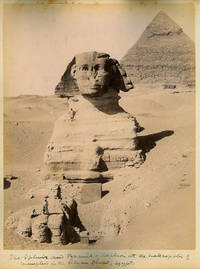
1880rif. I45A4CVFDU99Egypt and Switzerland 1880. Contemporary black half morocco. 4to 29.5 x 23.5 cm. 50 photographs of Egypt albumen prints and cyanotypes and approximately 40 albumen prints of Switzerland. Impressively presented series of original photographs taken at various important sites and cities in Egypt including Giza Thebes Karnak Luxor Abydos Esna and others. They show archaeological sites like the temple of Seti I at Abydos the precinct of Ahmen-Rah near Luxor the Avenue of Sphinxes at Karnak the Ramesseum and the Colossi at Thebes the temple of Khnum at Esna the Sphinx and pyramids of Giza and many more. Other photographs show the local population engaged in a wide variety of activities such as catching crocodiles on the nile a Luxor barber shaving the head of a sailor or life in a Bedouin camp in the Libyan Desert. The Istanbul-based Sebah studio catered to the Western European interest in the exotic "orient" and the growing numbers of tourists visiting the Islamic world who wished to take home images of the city ancient ruins in the surrounding area portraits and local people in traditional costumes. "Sebah rose to prominence because of his well-organized compositions careful lighting effective posing attractive models great attention to detail and for the excellent print quality" Saretzky. When Pascal Sébah 1823-1886 died his son Jean Sébah 1876-1947 took over the studio and signed his productions "J. P. Sebah" on the negative putting his initial in front of his fathers.Some spotting and fading binding worn. Otherwise in good condition.l Cf. for Sébah: Saretzky Photo history. unknown
1880rif. J3HGA8OYHYKWEgypt and elsewhere 1880. With 9 carte de visite albumen prints ca. 8.5 x 5.5 cm by Hammerschmidt and Van Lint two albumen prints 9.5 x 12.5 cm by Sébah mounted on paper one silver gelatin print 8.5 x 11.5 cm by Lehnert & Landrock and one silver gelatin print 27 x 21 cm by Schroeder & Cie in a passepartout. Collection of early photographs of North-Africa and the Middle East by several photographers who had worked in the region. The main part of this collection consists of carte de visite portraits by Wilhelm Hammerschmidt ca. 1830-1869 from the 1860s. Most of them show Egyptians including a porter carrying a large chest on his back and a blind man. Three outdoor photographs show a group of men one holding a pipe almost as long as himself a camel rider and two camels in profile. Two larger photographs by the firm of Pascal Sébah from Istanbul date from the 1870s or 1880s and show a caravan halting in the desert. Of later date is the single image by the photographic duo Lehnert & Landrock who worked in Tunis in 1904-1914. Their picture which was popularly used in picture postcards shows a small group overlooking an oasis near Tripoli. The largest and most artistic photograph is by the Swiss firm Schroeder & Cie and dates from the 1880s. This striking image shows the Mosque of Muhammad Ali in Cairo with the crumbling remains of a rock and wall acting as repoussoir and a figure at the front watching from the shade. A strange stowaway in this collection is a single carte de visite by the Italian photographer Enrico Van Lint 1829-1882 of "Galileo's Lamp" the bronze lamp which Vincenzo Possenti created after a drawing by Leon-Battista Alberti in 1587 for the Pisa Cathedral.With 4 of the cartes de visite labelled on the back and one stamped with a name; the paper of the Sebáh photograph with an inscription in English and the Schroeder with an inscription on the back. Some of the sheets or cards on which the photographs are mounted are somewhat tattered at the edges and the cartes de visite have probably been trimmed. Photograph by Lehnert & Landrock with a diagonal fold. All photographs are otherwise in very good condition. unknown
rif. 77256c.1865. . Collection of three albumen prints. Credit title and number in negative pasted on original thin card. [c.1865]. unknown
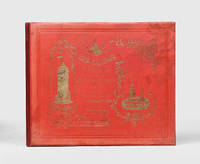
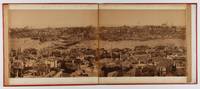
1880rif. 36797Istanbul 1880. Oblong 8vo. 6 x 7 3/4 inches. 10 albumen photographs mounted on thick card and bound in concertina folds as issued length 70 inches. Occasional spotting. Publisher's red grained cloth upper cover tooled in gilt and lettered in French and Arabic. A smaller version probably published at the same time of "Panorama de Constantinople pris de la Tour de Galata." A photographic panorama offering a sweeping view of the city walls and seven towers the great Mosques of Sultan Ahmed and Santa Sophia the 'Green Mosque' and Mosque of Oulon the Golden Horn tower of Galatea and the Bosphorus. unknown
rif. 61375c.1880. . Albumen print. Rich tonal range and in good condition. Photographer's number title and credit in negative; Dimensions: 260 x 195mm. 10 x 8 inches. [c.1880]. unknown
1888rif. 167887Istanbul: Sébah & Joaillier c. 1888. Remarkable photographic panorama of Istanbul A superb panoramic view of the city taken from the Galata Tower looking over the Bosporus towards the Asian side; across the Golden Horn can be seen the Topkapi Palace and the great mosques of the city Haghia Sophia the Blue Mosque the Yeni Mosque and the Süleymaniye. In 1857 Pascal Sébah opened one of the first photographic studios in Constantinople. Having met with great success in 1873 he expanded the business setting up a further establishment in Cairo near to the renowned Shepheard's Hotel. In 1883 he suffered a stroke and the business was taken over by his son Jean who styled himself J. Pascal Sebah so as not to break the continuity of the business and was to become a talented photographer in his own right. In 1888 he went into partnership with a French photographer resident in Istanbul Policarpe Joaillier the firm in time becoming official photographers of the Sultan. In various forms this business continued down to the middle of the 20th century when in 1952 its last incarnation Foto Sabah finally closed its doors. "From the 1870s Sébah and Joaillier were major suppliers of evocative imagery to the increasing number of people who undertook the Victorian Grand Tour" Hannavy p. 1261. Landscape folio 310 x 375 mm. With 10 albumen prints mounted on card panels and joined with linen tape leporello-style to form a panorama approximately 3.47 m over 11 feet in length card panels 3054 x 340 mm; photographic prints 247 x 340 mm. Original red sand-grain cloth over bevelled boards red roan backstrip title gilt to front cover within elaborate ornamental gilt panel and incorporating images of the Galata and Maiden's towers gilt stamp to back cover of the ay-y ld z star and crescent within a laurel wreath. Covers variably sunned old splash stain to head of front cover a few marks to back light foxing and marginal dust marking the images bright and clean. A very good example. John Hannavy ed. Encyclopaedia of Nineteenth-Century Photography Vol. I 2005; Engin Özendes From Sebah & Joaillier to Foto Sabah: Orientalism in Photography 2004. hardcover
1880rif. ABC_487181880. Housed in a clear plastic sleeve. Two albumen prints each ca. 27 x 21 cm signed and numbered in the negative. Two beautiful photographs by Jean Pascal Sébah 1872-1947 one of the most famous photographers of his time who specialised in Orientalist photography. He continued the business of his father Pascal Sébah 1823-1886 one of the first photographers working in Egypt. Apart from their photographs of important locations in the Middle East the Sébahs were known to stage genre scenes which were used as illustrations in scientific Orientalist publications. The present photographs were likely one of those scenes. They show four Arabic men demonstrating the positions of the raka'ah. The first photographs shows the first and second position standing and bowing or qiyam and ruku. The second photographs shows kneeling and the beginning of prostration or jalsa and sujud.Father and son Sébah rose to prominence because of their well-organized compositions careful lighting and quality of their prints. The present photographs are indeed beautifully lit and composed and still in very good condition despite their age. They are wonderful examples of Jean Pascal Sebah's craftmanship.The photographs are slightly creased and discoloured around the edges but otherwise in very good condition. unknown
1880rif. 729951880. SBAH J. Pascal and BCHARD Emile et al. Photograph Album. Twenty-two Albumen Prints of Egypt with Views of the Pyramids. Egypt circa 1880. Oblong quarto period style full green morocco gilt raised bands gilt and blind-stamped boards watered silk endpapers; 22 vintage albumen prints each measuring 8 by 10 inches mounted on heavy card stock total of each measuring 10 by 14 inches. $3800.Original photograph album of the Middle East circa 1880 with 22 splendid exhibition-size albumen prints from glass negatives featuring the work of renowned photographers J. Pascal Sbah mile Bchard Langahi and others including Sbah's images of Alexandria's Column of Pompey Nile yachts and desert vistas Langahi's view of Nubian tribesmen and Bchard's iconic image of people climbing the massive stones of the Great Pyramid. Splendidly bound.Near the end of the 19th century many ""were captivated by photography's capacity to 'take them there' and bring them directly in contact with the long ago and far away"" Parr & Badger I:18. With that Egypt's majestic pyramids and exotic worlds beckoned. This rare album of 22 vintage albumen prints characteristically produced for England and France highlights the work of two highly respected photographers: J. Pascal Sbah and mile Bchard. The Turkish-born Sbah especially possessed a keen sense of his subjects' ""interaction with one anotherÉ His outside work involving people is very dramatic: for example the well-known images of camel caravans in the desert where a string of camels and their riders walk across the picture place."" Those very qualities are seen here in Sbah's ""Marshe aux Chameaux"" March of Camels ""Chameliers"" Camels and his images of crowded bazaars and Nile River yachts. In addition Sbah's striking views of Alexandria include one of its catacombs and another of the Column of Pompey one of the best known ancient monuments standing today. Like Sbah French photographer Bchard worked in Egypt in the 1870s and 80s where he was ""known primarily for his photographs of Egyptian antiquities and archaeological sitesÉ characterized by a dramatic sense of presentation"" Micklewright and Brassey Victorian Traveler 118-120. One of his most famous photographs is that featured at the close of this album: ""Ascension de la grand pyramide."" With the misleading signature of Sbah's brother Cosimi who ran Sbah's studio after his death Bchard's evocative view of people climbing the massive stones of the Great Pyramid is one of the era's most iconic. This impressive album also features several unattributed prints: a view of the Great Pyramid and Sphinx that closely resembles Francis Frith's distinctive photograph panoramas of Smyrna in Sbah's Turkish homeland and the portrait of an Ottoman soldier together with a print of Nubians astride camels by Langahi and the image of a veiled woman seated on a donkey unclear in-negative caption. With 22 vintage albumen prints from glass negatives each measuring 8 by 10-1/2 inches individually mounted on heavy card stock most with in-negative captions and signatures. See Rosenblum 163. Photographs fresh with only light scattered margin foxing not affecting prints. A rare album of vintage prints in about-fine condition. Beautifully bound. hardcover books
1880rif. 729951880. SBAH J. Pascal and BCHARD Emile et al. Photograph Album. Twenty-two Albumen Prints of Egypt with Views of the Pyramids. Egypt circa 1880. Oblong quarto period style full green morocco gilt raised bands gilt and blind-stamped boards watered silk endpapers; 22 vintage albumen prints each measuring 8 by 10 inches mounted on heavy card stock total of each measuring 10 by 14 inches. $3800.Original photograph album of the Middle East circa 1880 with 22 splendid exhibition-size albumen prints from glass negatives featuring the work of renowned photographers J. Pascal Sbah mile Bchard Langahi and others including Sbah's images of Alexandria's Column of Pompey Nile yachts and desert vistas Langahi's view of Nubian tribesmen and Bchard's iconic image of people climbing the massive stones of the Great Pyramid. Splendidly bound.Near the end of the 19th century many ""were captivated by photography's capacity to 'take them there' and bring them directly in contact with the long ago and far away"" Parr & Badger I:18. With that Egypt's majestic pyramids and exotic worlds beckoned. This rare album of 22 vintage albumen prints characteristically produced for England and France highlights the work of two highly respected photographers: J. Pascal Sbah and mile Bchard. The Turkish-born Sbah especially possessed a keen sense of his subjects' ""interaction with one anotherÉ His outside work involving people is very dramatic: for example the well-known images of camel caravans in the desert where a string of camels and their riders walk across the picture place."" Those very qualities are seen here in Sbah's ""Marshe aux Chameaux"" March of Camels ""Chameliers"" Camels and his images of crowded bazaars and Nile River yachts. In addition Sbah's striking views of Alexandria include one of its catacombs and another of the Column of Pompey one of the best known ancient monuments standing today. Like Sbah French photographer Bchard worked in Egypt in the 1870s and 80s where he was ""known primarily for his photographs of Egyptian antiquities and archaeological sitesÉ characterized by a dramatic sense of presentation"" Micklewright and Brassey Victorian Traveler 118-120. One of his most famous photographs is that featured at the close of this album: ""Ascension de la grand pyramide."" With the misleading signature of Sbah's brother Cosimi who ran Sbah's studio after his death Bchard's evocative view of people climbing the massive stones of the Great Pyramid is one of the era's most iconic. This impressive album also features several unattributed prints: a view of the Great Pyramid and Sphinx that closely resembles Francis Frith's distinctive photograph panoramas of Smyrna in Sbah's Turkish homeland and the portrait of an Ottoman soldier together with a print of Nubians astride camels by Langahi and the image of a veiled woman seated on a donkey unclear in-negative caption. With 22 vintage albumen prints from glass negatives each measuring 8 by 10-1/2 inches individually mounted on heavy card stock most with in-negative captions and signatures. See Rosenblum 163. Photographs fresh with only light scattered margin foxing not affecting prints. A rare album of vintage prints in about-fine condition. Beautifully bound. hardcover
1890rif. 54541Constantinople: Sebah & Joaillier 1890. First edition. Hardcover. vg- to vg. Oblong small folio. 12 1/4 x 14 1/4". Red pebbled cloth boards with decorative gilt ruling tooling and lettering on the covers. Rebacked maroon leather spine. Gilt-stamped crescent moon and star motif the national emblem of Turkey on the back cover. Taken from the Galata Tower in what is now the Karaköy neighborhood of Istanbul this magnificent panorama displays the skyline and cityscape of Constantinople as it appeared sometime in the late 1880s or early 1890s. The panorama is comprised of 10 original albumen photographs mounted on heavy card stock and bound together in accordion style leporello measuring a total of more then 11 feet when completely unfolded. Shot in a southwardly direction the viewer can see Galata Karaköy in the foreground and from left to right across the Bosporus to the Uskudar district on the Asian side and then across the harbor at the mouth of the Golden Horn the Galata Bridge and across to the Pérama neighborhood and the Faith district where many famous landmarks of the city can be seen including the New Mosque Topkapi Palace Hagia Sophia and many others. Each panel measures about 13" wide and 12" tall. The photography is credited to "Sebah & Joaillier" one of the most prominent and prolific photography studios of Ottoman Empire during the second half of 19th century. Originally founded sometime around 1857 in Instanbul by Syrian-Armenian photographer Pascal Sebah 1823-1886 the studio was one of the earliest in the city and all of Ottoman Turkey. By the 1870s Sebah had become among the most prominent Ottoman photographers having also opened a branch of the studio in Cairo. Upon Sebah's death in 1888 the firm was taken over by his 16 year-old son Jean Pascal Sebah who then partnered with photographer Policarpe Joaillier 1848-1904. The firm was renamed "Sebah & Joaillier". Therefore although this panorama is undated it could not have been issued earlier than 1888; most likely sometime shortly thereafter circa 1890. Spine of of the portfolio has been professionally re-backed. Plates with minor to light foxing although the images are still quite clean and vibrant. Binding in very good images in very good- to very good condition overall. A slightly later version of the panorama from Sebah & Joaillier simply titled "Constantinople" is comprised of 12 slightly smaller panels instead of 10 and measures around the same size in total. Bibliographic refences: Jacobson Ken. Odalisques & Arabesques: Orientalist Photography 1939-1925. Quaritch 2007; Özendes Engin. "Photography in the Ottoman Empire"; Öztuncay Bahattin. The Photographers of Constantinople. Aygaz 2003. Sebah & Joaillier hardcover books
1890rif. 055023Sebah & Joaillier. ca. 1890 1890. No Binding. Very Good. A small original albumen print photograph by Sebah & Joaillier mounted on paper. Size: 65x8 cm. Rare albumen print photograph mounted on a grey album paper taken by Sebah & Joaillier photograph studio of Constantinople showing Syrian women and men in their traditional clothes. In 1857 photographer Pascal J. Sébah opened a studio in Constantinople today Istanbul Turkey. Photographing city views daily activities and ancient ruins in the surrounding area Sébah sold many of his prints to visiting tourists a prosperous and common market for other contemporary photographers such as the well-known Abdullah Frères. Tourists would select a range of prints from professional photo studies in the countries they visited and compile a travel album of their journey. In 1888 two years after Pascal J. Sébah passed away his 16-year-old son Jean Johannes became involved in the studio work. Jean started a partnership with another photographer from Istanbul the Frenchman Policarpe Joaillier which became a great success. Jean worked both on assignments for the studio and as an individual photographer which can be determined from the signatures on the works: some prints were signed "Sébah & Joaillier" and others have the signature "J.P. Sébah" The studio flourished and Sébah & Joaillier were named as the official photographers of the Ottoman Empire by the Turkish sultan. In the early 1900s Joaillier returned to Paris and Sébah continued his work in Constantinople. After different partnerships the studio was taken over by Ismail Insel and renamed "Foto Sabah" i.e. Photo Morning. Sebah & Joaillier., [ca. 1890] unknown
1890rif. 54541Constantinople: Sebah & Joaillier 1890. First edition. Hardcover. vg- to vg. Oblong small folio. 12 1/4 x 14 1/4". Red pebbled cloth boards with decorative gilt ruling tooling and lettering on the covers. Rebacked maroon leather spine. Gilt-stamped crescent moon and star motif the national emblem of Turkey on the back cover. Taken from the Galata Tower in what is now the Karaköy neighborhood of Istanbul this magnificent panorama displays the skyline and cityscape of Constantinople as it appeared sometime in the late 1880s or early 1890s. The panorama is comprised of 10 original albumen photographs mounted on heavy card stock and bound together in accordion style leporello measuring a total of more then 11 feet when completely unfolded. Shot in a southwardly direction the viewer can see Galata Karaköy in the foreground and from left to right across the Bosporus to the Uskudar district on the Asian side and then across the harbor at the mouth of the Golden Horn the Galata Bridge and across to the Pérama neighborhood and the Faith district where many famous landmarks of the city can be seen including the New Mosque Topkapi Palace Hagia Sophia and many others. Each panel measures about 13" wide and 12" tall. The photography is credited to "Sebah & Joaillier" one of the most prominent and prolific photography studios of Ottoman Empire during the second half of 19th century. Originally founded sometime around 1857 in Instanbul by Syrian-Armenian photographer Pascal Sebah 1823-1886 the studio was one of the earliest in the city and all of Ottoman Turkey. By the 1870s Sebah had become among the most prominent Ottoman photographers having also opened a branch of the studio in Cairo. Upon Sebah's death in 1888 the firm was taken over by his 16 year-old son Jean Pascal Sebah who then partnered with photographer Policarpe Joaillier 1848-1904. The firm was renamed "Sebah & Joaillier". Therefore although this panorama is undated it could not have been issued earlier than 1888; most likely sometime shortly thereafter circa 1890. Spine of of the portfolio has been professionally re-backed. Plates with minor to light foxing although the images are still quite clean and vibrant. Binding in very good images in very good- to very good condition overall. A slightly later version of the panorama from Sebah & Joaillier simply titled "Constantinople" is comprised of 12 slightly smaller panels instead of 10 and measures around the same size in total. Bibliographic refences: Jacobson Ken. Odalisques & Arabesques: Orientalist Photography 1939-1925. Quaritch 2007; Özendes Engin. "Photography in the Ottoman Empire"; Öztuncay Bahattin. The Photographers of Constantinople. Aygaz 2003. Sebah & Joaillier hardcover
2011rif. 500022127National Geographic 2011 320 pages 13x21x2cm. 2011. Broché. 320 pages.
2011rif. 500028635National Geographic 2011 320 pages 13x21x2cm. 2011. Broché. 320 pages.