1 629 résultats
Ensemble relié en 2 volumes in-12 (140 x 78 mm), plein maroquin vert sapin, dos à 5 nerfs guillochés or, garnis de compartiments entièrement dorés à la fanfare, large roulette d'encadrement sur les plats garnie de fleurons aux coins, roulette sur les coupes, titre doré, dorés sur tranche, gardes de tabis rose (reliure de l'époque). Exceptionnel exemplaire relié en maroquin de l'époque, réunion en deux volumes de l'ensemble de la production contemporaine française de / et autour de Spinoza 1- Première édition française du "Tractatus Theologico-Politicus", augmentée des additions apportées par Spinoza à son texte ("Remarques curieuses") publiées ici pour la première fois. Le traducteur, Gabriel de Saint-Glain, calviniste français réfugié en Hollande, devint un fervent spinoziste après sa rencontre avec un élève du philosophe. Rigoureusement interdite et poursuivie en France, cette édition fut présentée sous pages de titre et adresses différentes afin de détourner la censure. La traduction de Saint-Glain, "avec des éclaircissements et un commentaire inestimable", contribua directement à la diffusion du spinozisme en Europe (cf. Vernière, I, p. 25 sq., qui signale que Saint-Glain effectua sa traduction sur un exemplaire annoté de la main de Spinoza). (Kingma & Offenberg, n° 13, 14 et 15. "Catalogue du tricentenaire, Institut hollandais", p. 59. Van der Linde, n° 10, 11 et 12. Sauvy, 'Livres saisis à Paris', n°204 et 568). 2 et 3- Edition originale de ce recueil collectif consacré à Spinoza et à sa doctrine, édité par Nicolas Lenglet du Fresnoy. Il contient la "Vie de Spinoza" (p. 1 à 150) par Jean Colerus (Johann Koehler), pasteur luthérien à La Haye -- La préface et la "Réfutation" de Spinoza par le comte de Boulainvilliers ainsi que celle de Fénelon (p. 151 à 320) – "Extrait du nouvel athéisme renversé" oeuvre du cartésien François Lamy (p. 321 à 386) sous page de titre particulière à la date de 1696 – "Certamen Philosophicum" (...) d’Isaac Orobion médecin et personnalité de la communauté juive d’Amsterdam (p. 387 à 483), également sous page de titre particulière, à la date de 1703. "Sous prétexte de rendre plus facile la réfutation de Spinoza en mettant ses opinions à la portée de tout le monde, Boulainvilliers a eu réellement pour but de propager le système de ce philosophe (...) en substituant au langage austère du métaphysicien hollandais une forme simple et pleine d’attraits" (Franck, p. 202). Sur l’importance décisive de ce recueil dans la propagation du spinozisme en France, cf. P. Vernière, ‘Spinoza et la pensée française’, p. 373 sq. (Brunet, II, 1209. Fürst, III, p. 54. Cat. Expo. Spinoza, Herzog August Bibliothek, n° 64. Tchemerzine-Scheler, III, 232. Van der Linde, 107 et 108). Ex-libris amorié du Dr Armand Ripault à sa devise "D'espérer servir". Très bel exemplaire, exceptionnelle réunion en reliure de maroquin de l'époque orné à la fanfare.
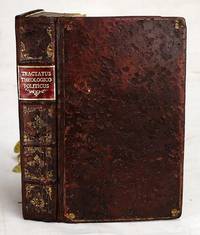
1674réf. 2110210037N.P.: Amsterdam : Jan Rieuwertsz 1674. 3rd. Hardcover. Good. The Origins of Secular Thought: Moral Philosophy Unbound from Religion Octavo 162 x 102 mm. 2 parts in one volume. Bound in contemporary sheep with gilt spine. Rebacked and restored with new spine label. Scattered spotting. Collated: 22 334 4; 16 182 19 pages including blanks Z3-4. 18th-century signatures of George Wycherley and Alexander Hatton of St. John's College Cambridge on front free endpaper. Van der Linde states that the text block was printed in 1673 while the title page was printed in 1674. No publisher is listed because the work was banned in Holland this edition was intended for distribution in England. This work was censored for its dangerous ideas arguing for a philosophical interpretation of scripture. "Spinoza's thought a fusion of cartesian rationalism and the Hebraic tradition in which he grew up is a solitary but crystal-clear exposition of the theory of natural right. It is also the forerunner of modern Biblical criticism." - Printing and the Mind of Man 153 1670 original edition; Bamberger T3.E this edition. N.P.: [Amsterdam] : [Jan Rieuwertsz] hardcover
1663réf. 1005First Edition of Spinoza's First Book – Explicating Descartes SPINOZA Benedict. Renati Des Cartes Principiorum Philosophiæ Pars I & II More Geometrico demonstratæ per Benedictum de Spinoza per Amstelodamensem . Accesserunt Eiusdem Cogitata Metaphysica Rene Descartes' Principles of Philosophy Parts I & II Demonstrated According to the Geometric Method by Benedict de Spinoza of Amsterdam. the same followed by Metaphysical Thoughts Johannem Riewerts Amstelodami Amsterdam 1663. 1 blank leaf TP i-vii = Præfatio viii = Ad Librum ix-xiv = Index 1-90 91 = half-title 93-140 blank leaf; Small Quarto. First Edition in original paper wrappers Kingma-Offenberg 1. This Spinoza's first work is the only one published during his lifetime that identified him as the author and had the correct information on the printer-publisher. Spinoza's next two works Tractatus Theologico-Politicus & Opera posthuma were very much his own radical thought rather than a reworking of Descartes ideas as here and so were necessarily published anonymously listing false information about the printer-publisher on the title page. The radical nature of Spinoza's thought and the dangers of publishing such materials in this time and place are brilliantly explained in Jonathan Israel's Radical Enlightenment Oxford 2001. Here Spinoza presents an exposition of Cartesian philosophy but he has recast it using his own geometrical method of reasoning and presentation. The origins of this work are interesting and clearly explained by the author himself in a letter to his friend Oldenburg written shortly after the book's publication: "Some of my friends asked me to make them a copy of a treatise containing a precise account of the Second Part of Descartes' Principia Philosophiæ 1644 demonstrated in the geometric style and of the main points treated in metaphysics. Previously I had dictated this to a certain young man to whom I did not want to teach my own opinions openly. They asked me to prepare the First Part also by the same method as soon as I could. Not to disappoint my friends I immediately undertook to do this and finished it in two weeks. I delivered it to my friends who in the end asked me to let them publish the whole work. They easily won my agreement on the condition that one of them Lodewijk Meyer in my presence would provide it with a more elegant Latin style and add a short preface warning readers that I did not acknowledge all the opinions contained in this treatise as my own since I had written many things in it which were the opposite of what I held and illustrating this by one or two examples. One of my friends to whose care the publishing of this little book has been entrusted has promised to do all this and that is why I stayed for a while in Amsterdam" Nadler Spinoza A Life 205. This rather straightforward – though completely reformatted – exposition of Descartes is followed by the Cogita Metaphysica 91-140 – with its own half-title page which is written from the Cartesian perspective defending for instance the freedom of the will but with some serious foreshadowing of Spinoza's later doctrines. CONDITION: Very good in original brown paper wrappers most of backstrip lacking with wear to extremities. Woodcut illustr. to title-page and several woodcut mathematical and physical illustrations throughout. Annotations to both free end-paper. Some minor brownspotting and even light browning to leaves. A very nice and attractive copy of Spinoza's first book housed in a custom cloth archival box. Johannem Riewerts paperback
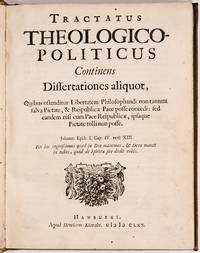
1670réf. 42820837Contemporary vellum hand-lettered spine edges sprinkled blue. A fine copy. First edition of this landmark of 17th-century thought the Theological-Political Treatise. This is the rare first edition readily identified by the misspelled "Künraht" imprint and the mis-numbering of page 104 as 304. "Although there is only one genuine first edition the other quarto editions also pretend that they were printed in the year 1670. … The reason for this is that the work was highly controversial: although formally banned only in 1674 it was considered illegal from its publication and there were attempts to have it repressed from the very start. So the Amsterdam publisher Jan Rieuwertsz had to be careful. He did not reveal his identity on the title page which carries a fictitious imprint: Henricus Künrath in Hamburg and when there was a demand for reprints it was important to make the book look like copies left over from the original 1670 issue rather than newly printed ones" Melamed and Rosenthal. Baruch Spinoza is a giant of 17th-century thought and a key figure of the Enlightenment. "He made significant contributions in virtually every area of philosophy and his writings reveal the influence of such divergent sources as Stoicism Jewish Rationalism Machiavelli Hobbes Descartes and a variety of heterodox religious thinkers … He is usually counted along with Descartes and Leibniz as one of the three major Rationalists. … Spinoza has remained an enormously controversial figure. For many he is the harbinger of enlightened modernity who calls us to live by the guidance of reason. For others he is the enemy of the traditions that sustain us and the denier of what is noble within us" IEP. "Spinoza's thought a fusion of Cartesian rationalism and the Hebraic tradition in which he grew up is a solitary but crystal clear exposition of the theory of natural right. He defends with eloquence the liberty of thought and speech in speculative matters and the Tractatus contains the first clear statement of the independence of each other of philosophy and religion" PMM. Spinoza held that "Man is moved to the knowledge and love of God; the love of God involves the love of our fellow men. Man in order to obtain security surrenders part of his right of independent action to the State. But the State exists to give liberty not to enslave; justice wisdom and toleration are essential to the sovereign power" Printing and the Mind of Man 153. Spinoza's Tractatus Theologico-Politicus was a notorious book in its own time both for what it attacked and for what it advocated. Spinoza scrutinized religious teachings and Scripture to argue that they were mere products of the human mind. At the same time he "believed that the political model of the ancient Hebrews could be imitated in certain key respects. … Unlike Hobbes whose social contract theory justified absolute monarchy Spinoza argued that democracy was a preferred form of government. And finally he thought that the state would be better off if it granted limited religious toleration and the freedom to philosophize" Melamed and Rosenthal eds. Spinoza's Tractatus Theologico-Politicus: A Critical Guide. The author's concerns about political repercussions delayed publication of the book for years. It finally appeared anonymously in 1670 with a false imprint. The Tractatus was soon placed on the Index of Prohibited Books and was interdicted in Holland. Leibniz rejected its scandalous arguments while Hobbes is said to have declared "I durst not write so boldly." Spinoza has come to be embraced by many seemingly irreconcilable "-isms" including liberalism Marxist materialism conservatism and Zionism. The first printing of the Tractatus is rarely found in this excellent condition. This true first edition has become a rare book in a period binding. Heinrich Künraht [i.e. Amsterdam: Rieuwertsz] hardcover