4 758 résultats
1516réf. 4621Strasbourg: Johann Knobloch 1516. Hardcover. Fine. Bound with: 2. Erasmus Desiderius 1466-1536 De duplici copia verborum ac rerum commentarij duo. Ab authore ipso diligentissime recogniti & emaculati atque in plerisque locis aucti. . ; Item Epistola Erasmi Roterodami ad Iacobum Vuimphelingium Selestatinum. Strasbourg: Mathias Schürer October 1516 And: 3. Hutten Ulrich von 1488-1523; Weiditz Hans 1495- ca. 1536 artist. ΟΥΤΙΣ. Nemo Augsburg: Johann Miller 9 September 1518 Three Publications in One Volume: Quarto: 19.3 x 13.6 cm. I. Burley 8 LII ff. Collation: i-viii8 A-B8 C-D4 E8 F4-H4 I8 leaf 8 in fist gathering blank. II. Erasmus 6 LXXIII 5 ff. Collation: 1-66 a4 b8 c4 d8 e-f4 g8 h-i4 k8 l-m4 n8 o6. III. Hutten 12 ff. Collation: A-C4 A humanist sammelband featuring Ulrich von Hutten's satire championing the liberal arts with the impressive woodcut of Hutten's Odyssean hero surrounded by the equipment of all students: books a flagon board games musical instruments. Bound in 16th c. pigskin signed S.K.E. and dated 1575 soiled and stained corners bumped. The binding tooled in blind with a roll tool with images of Christ St. Paul and King David playing his lyre signed HW Haebler I p. 486/8. Contents in good condition a little careworn binding and contents moderately soiled scattered marginal notes and underscores occasional stains. Text block cut a bit close at the head at the time 1572 of rebinding; text block separating at front of volume. I. Burley: title page with numerous pen-trials 17th c. ownership note; short worm-trail to first three leaves only not affecting text; damp-stain to corner of first gathering. II. Erasmus: Title with white-on-black woodcut border with fools columns and putti supporting a shield with the printer’s initials. The name of Erasmus has been censored on the first two lvs. in ink with shine though onto the following two lvs. and by scratching out the name elsewhere in the text. Small marginal dampstain occ. notes. III. Hutten: With the iconic full-page woodcut title by Hans Weiditz see below for details. Mild soiling throughout final gathering lightly browned/stained cut close at head. I. Medieval Encounters with the Ancient Philosophers Burley Walter Pseudo- ca. 1320; Diogenes Laertius 3rd c. CE Vita Philosophorum et Poetarum : cum auctoritatibus et sententiis aureis eorundem annexis Strasbourg: Johann Knobloch 1516 ONE OF NUMEROUS EARLY EDITIONS. The first edition was printed in 1470. Now believed to have been composed in the early 14th c. from the 15th c. up until the 20th “The Lives of the Philosophers and Poets” was transmitted under the name of Walter Burley ca. 1275–1344 one of the most prominent and influential philosophers of the fourteenth century. Burley had a very long career in both England and France becoming Master of Arts at Oxford by 1301 and Master of Theology at Paris by 1324. He produced a large body of about fifty works many of which were widely read in the later Middle Ages. “In 1990 the image of ‘De vita et moribus’ suffered a terrible blow when Mario Grignaschi severed its connection with Walter Burley Grignaschi “Lo Pseudo Walter Burley” 131–90 and in the same volume “Corrigenda et addenda” 325–54. Grignaschi showed that the work had to have been composed in northern Italy which had the resources in classical materials and that – from the evidence of an anonymous work dated 1326 that made use of it – it had to have been made no later than the 1320s perhaps even about 1310 that is during a period long before Burley arrived in Bologna. Overnight ‘De vita et moribus’ was deprived of its glamorous Burleian associations with Oxford Paris high scholasticism debates about realism and the Plantagenet court to be revealed as the work of an anonymous Italian who is now referred to – teasingly and cruelly – as the ‘Pseudo-Burley.’ How the work came to be attributed to Burley in fifteenth - century manuscripts is unclear although the attribution stuck and was reaffirmed in early prints… “Adding insult to injury the ‘De vita et moribus’ was hack work not the product of thoughtful pedagogical ruminations in the Oxford common rooms. The anonymous Italian was keen to get his work out there in a competitive literary market so he worked quickly. To this end to find lively day-to-day pictures of the ancient philosophers the Pseudo-Burley turned to that eminently chatty anecdootal resource long derided by classicists and philosophers Diogenes Laertius’ Lives and scooped out from it as much detail as suited his purpose supplementing it with anything else to hand to expand his topic. Thus he lumps Pre-Socratics Cynics Skeptics Epicureans Academicians and Stoics together almost indiscriminately with poets dramatists orators and sophists physicians historians and grammarians and he extends the coverage beyond Diogenes’ Hellenic limits to include various authors of Latin antiquity. Some of the gnomic material in the work is derived from the Arabic -Spanish-Latin ‘Bocados de oro’ notably in the chapter on Plato Hasse 50–52; Ferrer 682.”Rita Copeland “Behind the Lives of Philosophers Reading Diogenes Laertius in the Western Middle Ages” A Pleasing Fullness of Expression II. Erasmus Desiderius 1466-1536 De duplici copia verborum ac rerum commentarij duo. Ab authore ipso diligentissime recogniti & emaculati atque in plerisque locis aucti. . ; Item Epistola Erasmi Roterodami ad Iacobum Vuimphelingium Selestatinum. Strasbourg: Mathias Schürer October 1516 An early edition of ‘De duplici copia’. Erasmus was working for a number of years on a treatise on Latin composition begun while in Italy but completed only in 1512 during his third stay in England at the request of John Colet for use in the latter’s newly founded school in St. Paul’s churchyard. This treatise was designed to help the young student in acquiring an elegant and copious style and to provide abundant examples of how to say the same thing in different ways. It was first printed in Paris by Badius in 1512 but was soon reprinted several times becoming a standard textbook in schools throughout Western Europe. This edition contains Erasmus’ long letter to the Alsatian humanist Jakob Wimpfeling 1450-1528 dated 21 September 1514 in which he relates his previous journey to Basle mentioning all the humanist scholars he had met from Alsace and Basle where Erasmus had just taken up residence. Erasmus had first become acquainted with Wimpheling in August 1514 when he stopped in Strassburg on his way to Basle and was officially welcomed by the members of the recently founded literary society which included Sebastian Brant and Joannes Sturm. The work concludes with three poems by Erasmus addressed to Sebastian Brant Joannes Sapidus and Thomas Didimus together with the latter’s reply. "The word ‘copia’ presents a special problem to the translator. Weltkirch a sixteenth-century Erasmian commentator defined ‘copia’ as the ‘faculty of varying the same expression or thought in many ways by means of different forms of speech and a variety of figures and arguments. ‘Copia’ of words has its origins in grammar; ‘copia’ of thought in dialectic.’ However the word is used by Erasmus to denote not only the faculty of varying but also varying itself. Indeed as used by Erasmus ‘copia’ encompasses within its meaning the meaning of four English words: variation abundance or richness eloquence and the ability to vary or enrich language and thought. "In his lengthy discussion of school curriculum in Shakespeare’s age T.W. Baldwin discusses at great length the importance of the ‘De Copia’ in the educational pattern of the time. The schoolmasters’ editions and commentaries that began to appear even in Erasmus’ lifetime provide further evidence of Erasmus’ impact on Renaissance education… "In his study of Renaissance humanism R.R. Bolgar says: ‘The ‘De Copia’ provides us in a sense with a clue to the whole of Humanism. Specifying the techniques on which imitation depended it makes clear what men were attempting not only in Latin but also in the vernaculars . If we want to trace how the Humanist practice of imitation affected creative writing if we want to go behind the scenes and cast an eye on the mechanism of the process.our best guide is Erasmus. The ‘De Copia’ outlines his method. The ‘Adagia’ presents us with the fruits of that method. and finally the ‘Colloquies’ and the ‘Praise of Folly’ show us the finished product.’"Donald B. King and H. David Rix "On Copia of Words and Ideas". Bezzel Erasmusdrucke no. 740; VD16 E 2647; Knaake Reformationsschriften II 144 The Original Liberal Arts Student Hutten Ulrich von 1488-1523; Weiditz Hans 1495- ca. 1536 artist. ΟΥΤΙΣ. Nemo Augsburg: Johann Miller 9 September 1518 FIRST EDITION FIRST ISSUE. With a full-page woodcut title page by Hans Weiditz. First printing of Hutten's second "Nemo" a substantially re-worked and enlarged version of the 1516 original. This edition has been augmented by 60 verses mainly on political subjects an introduction dedicated to Johannes Crotus Rubianus 1480-1545 and a letter to Julius von Pflug 1499-1564. It also marks the first appearance of the celebrated woodcut title page described in detail below. Hutten found the inspiration for his Nemo "Nobody" in Homer's Odyssey where Odysseus calling himself Nobody outwits the Cyclops Polyphemus. Hutten builds on this wordplay to create a new hero a humanist reformer capable of speaking out against the Church "Nobody dares to criticize the luxury of the priests and the idle life of the Pope." and one who appreciates the value of humanistic learning "Nobody gives scholarly studies the rewards they deserve." The title woodcut cleverly illustrates the dual identities of Hutten's satirical hero. Nemo clad in classical garb stands upon a beach with the familiar attributes of the humanities student gaming boards books a lute a drinking flagon strewn about him. In the background the Cyclops threatens to hurl a boulder onto Nemo's waiting ship. The revised "Nemo" is more overtly political than the earlier version. The added distichs reveal Hutten's anger over corruption in the Church and his mounting frustration with German politics. Shortly after he published "Nemo" Hutten assumed a central role in the politics of the nascent Reformation. In the letter to Pflug that concludes this edition Hutten praised Erasmus with whom he had maintained a good relationship since 1514 as the "Forger of a new way"; Erasmus spoke approvingly of Hutten's work Ep 961 967. Soon after publication of "Nemo" however relations between the two men became strained eventually leading to hostility between them. In 1522 Erasmus would lament that "This whirlwind of Luther" had torn Hutten away from him. See "Contemporaries of Erasmus" vol. II p. 218 ff. "Ulrich Von Hutten German humanist neo-Latin poet and political publicist in the service of the Reformation was born into a family of imperial knights in Steckelberg castle in Franconia. Between 1505 and 1511 Hutten pursued humanistic studies at various Germany universities. In 1512 on his way to Italy to study law he visited Joachim Vadian in Vienna and other humanists in the circle of the Emperor Maximilian. He then turned from personal literary interests to political matters. After studying at the universities of Pavia and Bologna and serving briefly in the army of Maximilian Hutten returned to Germany in 1514. There he met Erasmus who expected much of the young poet and who dedicated his epistolary biography of Thomas More to him. During his second stay in Italy 1515-17 he wrote a series of epigrams denouncing not only the enemies of the Emperor Maximilian -the French and the Venetians- but also Pope Julius II. "On his return from Italy Hutten was crowned poet laureate by Maximilian and entered the service of Albert of Brandenburg archbishop of Mainz as councilor; in four dialogues Hutten nonetheless castigated not only the luxury and moral excess of the papal court and the concept of celibacy but also Rome’s fiscal exploitation of the German nation. With its pointed triplets Hutten’s "Vadiscus sive trias Romana" 1521 contains the most comprehensive catalogue of German grievances against Rome. "Despite his antipapal stance Hutten initially viewed the controversy following Luther’s postings of the Ninety-five Theses in Wittenberg as a monks’ squabble and a welcome rift among his opponents. It was only after two years of virtually ignoring Luther that Hutten began to consider himself as an ally. Although Luther’s opposition to Rome was rooted primarily in religious-theological concerns and Hutten’s was prompted by political-nationalist aspirations the two men exercised considerable influence on each other. "In 1520 Hutten embarked on a feverish campaign in which he challenged the Emperor the German nobility the princes the cities and the general reader to take up the fight against Rome if necessary with arms. During the Diet of Worms he next to Luther became the most prominent representative of the antipapal party in Germany. Realizing in the wake of the Diet that a general uprising would not occur Hutten launched the so-called "Priests’ War" in the hope that it would provide the spark that would ignite the German powder keg. In 1522 having lost the protection of Sickingen Hutten fled to Basel and then in 1523 to Zurich where he died on 29 August of Syphilis." Oxford Encyclopedia of the Reformation Benzing Hutten 62; Fairfax-Murray 211; Musper "Petrarka Master" L7; Roettinger 7; Adams H 1237; BM STC German p. 427; VD 16; H 6384; Worst Brock German humanism 1480-1520 2009 p 1200 f. No. 10.2; Röttinger Weiditz 7; Fairfax Murray 211; Richard C. Kessler Reformation Collection I 114. Johann Knobloch hardcover books
1524réf. 2455Paris: Jodocus Badius Ascensius 1524. THE 1524 BADIUS ASCENSIUS EDITION. Written in 1509 as a visitor's gift to Thomas More whose name -Morus- was so aptly similar to the Greek "moros" folly the "Moriae Encomium" was first printed by Gilles de Gourmont at Paris probably in 1511. Hardcover. Fine. Bound in contemporary limp vellum lightly soiled. The contents are in very good condition with a few pencil annotations and light soiling to the title page. With Badius' device of his print shop the “Praelum Ascensianum” showing printers working a press on the title page. With large attractive crible initials and smaller charming historiated initials. Passages in Greek. A fine unsophisticated copy of this rare edition. From the personal library of Bob and Emily De Graaf. The rare 1524 Parisian “Praise of Folly” printed by Erasmus’ friend the scholar-printer Badius Ascensius who printed the first authorized edition in 1512. This edition contains all of the supplementary texts found in the Froben edition of 1519 see the note “additional Moria texts” below including the dedicatory letter to Thomas More and the letter to Martin Dorp in which Erasmus explains his motives for writing the “Moria”: “My aim in the ‘Folly’ was exactly the same as in my other works. Only the presentation was different. In the ‘Enchiridion’ I simply outlined the pattern of a Christian life. In my little book the ‘Education of a Christian Prince’ I offered plain advice on how to instruct a prince. In my ‘Panegyric’ I did the same under the veil of eulogy as I had done elsewhere explicitly. And in the ‘Folly’ I expressed the same ideas as in the ‘Enchiridion’ but in the form of a joke.” “The ‘Praise of Folly’ is Erasmus’ most famous and controversial work… In Erasmus’ lifetime the ‘Moria’ was condemned in 1527 by the theologians of Paris for its attacks on faith and morality and again in 1533 by the Franciscans who found it full of heresies. The officials of the Sorbonne put it on the list of condemned books in 1542 and 1543 a list that was the basis of the Tridentine Index of 1564… “The ‘Moria’ may start as a learned joke to amuse a fellow humanist Thomas More but it moves into sharp criticism of contemporary mores and ends with a plea for a return to the Christianity of the Gospels… Erasmus writes in a Lucianic spirit of irreverent burlesque of the gods of classical mythology and light-hearted amusement at the irrationality of mankind. Folly argues that she is all that is natural youthful fecund and happy and that life would be intolerable if it were not ruled by civilized conventions which necessitate a degree of humbug and illusion. By contrast the Stoic ideal rational man is a ‘kind of marble statue of a man devoid of sense and any sort of human feeling.’ She then shifts her viewpoint and lists the people who enjoy her benefits insofar as they try to preserve their illusions or are happy in their ignorance self-deception or self-love. She even adds superstitious piety to alchemy gambling and the nobility’s obsession with hunting and extravagant building… “Next Erasmus starts to deliver a sharp and often bitter attack on all the victims of blind folly those who are deaf to the voice of true religion and lacking the gentler Christian virtues among whom are sycophants self-seekers money-makers pedants scholastics lawyers theologians superstitious worshippers of images and relics courtiers and kings worldly monks and irreligious pontiffs. This section culminates in a savage thrust at Pope Julius II the bellicose pope. The keen wit and ingenuity of the satire can be highly entertaining but there is no note of gaiety now. As Erasmus surveys the gulf between the Church and the ‘true philosophy of Christ’ he moves into the final section where the alternative offered to barren scholasticism is the vision of reality taken from Plato and folly in the sense used by Saint Paul that of receptivity to the Christian message by the ‘fool in Christ.’ All irony is dropped until the final short epilogue when Folly light-heartedly cuts short her ‘hotch-potch of words’; this is a direct and simply worded account of Erasmus’ personal belief moving into an exposition of the Neoplatonist concept that the soul’s ascent to beatitude ends in ecstasy a form of folly which is its supreme fulfillment.”Betty Radice Collected Works of Erasmus Vol. 27 pp. 78 ff. Additional Moria Texts: In addition to Erasmus' main text this edition includes two ancient examples of the mock-encomium Seneca's "Ludus de Morte Claudii Caesaris" and Synesius of Cyrene's "De Laudibus Calvitii" "In Praise of Baldness" translated from the Greek by the Englishman John Phreas d. 1465. In his introductory letter to Thomas More Erasmus cites both the "Ludus" and the "Praise of Baldness" in a pre-emptive defense against those who will object to his literary frivolity "levitas et ludicrum argumenti" pp. 102-104 in this edition. The text of the "Moria" is accompanied by the commentary of Gerard Listrius with assistance from Erasmus. Jodocus Badius Ascensius hardcover books
1977réf. 177447New York: Free Press 1977. Hardcover. Very Good. First edition. Very good plus hardcover with similar dust jacket. First edition. Pages and cover are clean. Dustwrapper spine lightly faded. Free Press hardcover books
1907réf. 600046NY: Swords. 1907. The second American edition. Contains "The Economy of Vegetation" and "Loves of the Plants." 1844 gift inscription; owner name; backstrip mostly gone; front board missing entirely. A poor copy priced accordingly. Hardcover. Poor. Swords hardcover books
1935réf. 22778Np: Np 1935. Hardcover. Orig. brown boards lettered and decorated in gilt. Near fine in original slightly nicked glassine. 12 leaves. Small folio 31 x 23 cm. Limited edition one of 100 privately printed in New York. The original letter cannot be traced but the greater part of this epistle was first published in 1536 and established in all the biographies of More. Text in Latin and English the translation made by Laverne Madigan. At the end of this letter Erasmus terms Cicero a sycophant. Some mottling to covers interior very clean and fresh. Laid-in calling card of Mr. Philip Hofer. Np hardcover books
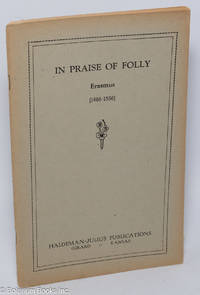
réf. 302930Girard KS: Haldeman-Julius Publications nd. Pamphlet. 79p. stapled wraps 5.25x8.5 inches wraps toned along edges and lightly edgeworn pages evenly browned else very good condition. Haldeman-Julius Publications unknown books
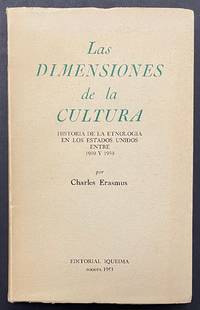
1953réf. 297271Bogota: Editorial Iqueima 1953. Paperback. 198p. paperback very good. Editorial Iqueima paperback books
1996réf. 235173Washington DC: James White Review Assoc. & Phil Willkie 1996. Newspaper. 24p. folded tabloid newspaper on heavy white newsprint news fiction poetry art reviews interviews ads services and resources very good. James White Review Assoc. & Phil Willkie unknown books
1953réf. 131274Bogota: Editorial Iqueima 1953. 198p. text entirely in the Spanish language; stiff wraps with dj formerly in the library of Harvard professor Gordon F. Wiley donated to Tozzer Library but rejected with stamp to that effect inside front cover. Long inscription in English by author to Wiley includes the note "Had it not been for your eventful letter to me dated April 18 1950 I would not be an anthropologist today. Editorial Iqueima unknown books
1995réf. 109594New York: Evelina López Antonetty Puerto Rican Research Collection Centro de Estudios Puertottiqueños 1995. Paperback. 34p. 8.5x11 inches illustrated with b&w photos in text very good in spiral-bound pictorial wraps. Contains a biography of militant journalist/playwright/poet in both English and Spanish. Evelina López Antonetty Puerto Rican Research Collection, Centro de Estudios Puertottiqueños paperback books
1996réf. 107031San Juan: Emelií Vélez de Vando e hijos 1996. Paperback. 120p. very good first edition trade paperback in pictorial wraps. Poetry by the militant Puerto Rican journalist written in the early 20th century. Emelií Vélez de Vando e hijos paperback books
1977réf. 7092New York: The Free Press 1977. Hardcover. viiii 424p. very good condition in like dj. The Free Press hardcover books
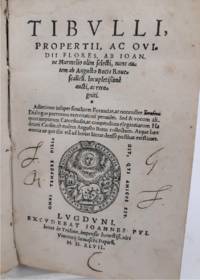
1547réf. 1328082Lugdunum: Ioannes Pul Ioannes Pullonus 1547. Other. Tibulli propertii ac Ovidii flores ab Ioanne Murmelio olim selecti nunc autem ab Augusto Botta Rouescallen. Iocupletissimè aucti ac recogniti. Edited by Ioannes Murmellius and Augustus Botta Rouescallen. Lugdunum: Ioannes Pullonus 1547. 117 pp. Text in Latin. Duodecimo in early vellum boards. A partial title has been written on the spine in faded ink. The initials F.R.G.F.C. appear in ink on the title page and the name Erasmus has been crossed out in two instances. A book stamp likely placing this volume in a library or collection in Bologna in the 19th century appears on the final page of text. Condition: Very Good. The boards are very thin and have become cockled. The vellum is somewhat darkened with age and light staining and shows minor insect damage. There is evidence of a closure device now absent on both boards. Both paste downs are partially detached but the binding is overall very solid. The pages are somewhat age-toned with occasional foxing. There are a handful of small ink marks to the textblock. Dimensions 4.25 x 6.375 x 0.625 inches shelved case 3. 1328082. Shelved Dupont Bookstore. Ioannes Pul [Ioannes Pullonus] unknown books
1777réf. 008900Roi Neuchâtel Switzerland: chez Samuel Fauche Libraire du Roi Neuchâtel 1777. First Edition Thus. Half Leather. Very Good /No Dj. engraved plates. Lacking title page but clearly the edition of 1777 of Chez Samuel Fauche Libraire du Roi Neuchâtel with the double frontispiece featuring the portraits of Erasmus Thomas Moore and Holbein. 8vo. rebound in navy half leather over light blue cloth c. early 20th century no title page double engraved frontispieces plus 6 engraved foldout plates 73 half page plates in text and 3 engraved vignettes. Frontis 2 advertissement nouvelle edition 2 translators preface 6 author's preface 6 234 tables 14 and gilt titles and decorations on rasied spine. Small scuff to light blue cloth at front cover a few small stains rear cover. Corners gently bumped and very modestly worn. Binding tight and firm. Text and and plates slightly toned but remarkably unfoxed better than very good condition. chez Samuel Fauche Libraire du Roi Neuchâtel unknown books
1977réf. 1375301New York: The Free Press 1977. Hardcover. Octavo viii 424 pages. In Good plus condition. Spine is brown with gold print. Boards in brown cloth. Light wear to spine caps and corners cracking to front hinge. Text block has light spotting to edges. Inscribed in ink by the author on the title page. NOTE: Shelved in Netdesk Column C. 1375301. FP New Rockville Stock. The Free Press hardcover books
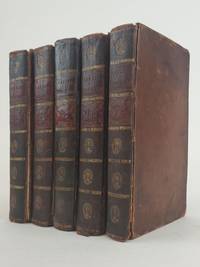
1774réf. 1359545London: J.ohn Murray 1774; 1776; 1778; 1783. Mixed Editions. Hardcover. Octavos iii-iv 5-458 Vol. 1; 2 iii-x 11-484 Vol. 4; 2 5-521 Vol. 5; 4 vii-xii 464 Vol. 7; iii-xii iii-v 7-457 Vol. 8. Good; all bound in contemporary leather with burgundy spine labels with gilt titling modern stickers added to three of the five volumes' spines some scratches and surface marks to covers and slight tears to spine edges and corners; front hinges to all volumes somewhat compromised but bindings else tight; text blocks age toned but clean; minor age toning to pages and some foxing throughout all volumes; ffeps torn out of Vol. 4; previous owner bookplate on front pastedowns "John Fletcher;" MF consignment. Volume I Parts 1-4 1774 Volume IV Parts 1-4 1776 Volume V Parts 1-4 1778 Volume VII 1783 2nd Edition Volume VIII 1783. 1359545. Special Collections. J.[ohn] Murray hardcover books
1774réf. 1359551London: J.ohn Murray 1774; 1775; 1777; 1779. Mixed Editions. Hardcover. Octavos iii-iv 5-458 Vol. 1; 2 iii-x 11-484 Vol. 4; 2 5-521 Vol. 5; 4 vii-xii 464 Vol. 7; iii-xii iii-v 7-457 Vol. 8. Good; all bound in contemporary leather with burgundy spine labels with gilt titling modern stickers added to three of the five volumes' spines some scratches and surface marks to covers and slight tears to spine edges and corners culaccino coffee ring on cover of Vol. 3; front hinges to all volumes somewhat compromised but bindings else tight; text blocks age toned but clean; minor age toning to pages and some foxing throughout all volumes; ffeps torn out of Vol. 4; previous owner bookplate on front pastedowns "John Fletcher;" MF consignment. Volume 1 Parts 1-4 1774 2nd Volume 2 Parts 1-4 1774 2nd Volume 3 Parts 1-4 1775 Volume 5 Parts 1-4 1777 Volume 6 Parts 1-4 1779 . 1359551. Special Collections. J.[ohn] Murray hardcover books
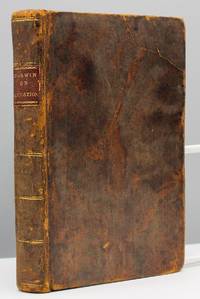
1798réf. 17365Philadelphia: Printed by John Omrod 1798 First American edition of this educational classic that shows the influence of Rousseau on the work of Erasmus Darwin 1731 – 1802. First published in London the previous year. Included in this edition is an American printing of Mrs. M. Peddle's Rudiments of Taste a popular conduct book was first published in London in 1789 and in the United States in 1790. Contemporary tree sheep with red morocco spine label. Gilt-ruled spine. Twelvemo. Separate title-page for Mrs. M. Peddle's The Rudiments of Taste. Some wear to binding and a couple cracks to sheep on upper board. Quite a fresh copy despite some foxing to first few leaves and some slight toning throughout. A very good tight copy of a fragile book. Darwin wrote the present work after helping his daughters Susan and Mary Parker establish a boarding school for young women in 1794. Here he draws on the theories of Rousseau Locke and Genlis to advocate for the education of women in schools in topics like philosophy the natural sciences history art manufacturing and language. Darwin believed that women should be educated for the purpose of becoming better wives and companions to men but promoted progressive notions that women's education would take place in well-resourced schools rather than in the home and that women should be educated in the concepts of finance industry and manufacturing. In Peddle's The Rudiments of Taste "Classical influence blends with Christian…Peddle recommends reading ancient and modern history travels biography science and good poetry not novels which leave their readers incapable of 'relishing anything superior'" Blain Grundy and Clements eds. The Feminist Companion to Literature in English p. 841. Printed by John Omrod, books
1942réf. 113744New York: Black 1942. Hardcover. Very Good. Later. Very good Lightly bowed. Tape marks inside front and back cover. Writing on end paper. Black hardcover books
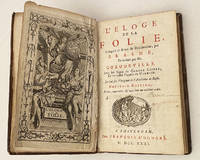
1731réf. bb_erasmus_eloge_folieErasmus Desiderius of Rotterdam: L'Eloge de la Folie In Praise of Folly … traduit par Mr. Gueudeville. Amsterdam: Francois L'Honore 1731. Engraved frontispiece partially wrinkled and detached also portrait with Erasmus Sir Thomas More and Hans Holbein six folding plates and 75 text engravings. These are the same copperplates as used in the first "counterfeit" edition of 1713/1714. Tall 12mo xxiv 234 pp. xvii index; vintage mottled calf gilt-titled label on spine. In 1509 Erasmus composed his famous essay as a satirical attack on superstitions and other unconventional traditions in European society. Since its inception it has been considered one of the most important works of the Renaissance and helped develop early stages of the Protestant Reformation. Erasmus uses satire to examine doctrine and corruption within the Catholic Church even though he was devoted deeply to Catholicism. He concludes with statements supporting Christian Protestantism and frequently references Greek mythological creatures and figures. Early printing of this popular translation from Latin into French. Francois l'Honore hardcover books
1923réf. 98477London:: Chapman & Dodd. Very Good. 1923. Hardcover. This copy is from the personal library of the late Madeleine L'Engle 1963 Newbery Award winner for her now classic young adult fantasy novel A WRINKLE IN TIME and bears her handwritten name Madeleine L'Engle Camp her maiden name on the front paste-down. Number XVII in The Abbey Classics series. Translated from the Latin by Sir Roger L'Estrange. Introduction by Charles Whibley. First edition thus. Fading along the spine else very good in blue cloth with gilt lettering and design on the spine. No dust jacket. ; 257 pages . Chapman & Dodd, hardcover books
1946réf. 22645Paris: Editions Litteraires De France. 1946. Softcover. Unbound signatures not numbered but one of 440 copies this copy with an original color woodcut signed by Boucher. Fine in fine wraps. The chemise has owner's decoration on the spine else fine in near fine box. ; 4to 11" - 13" tall . Editions Litteraires De France paperback books
1900réf. 67256London:: Gibbings & Company. Very Good. 1900. Hardcover. B0006ADY7K . Complete in three volumes. Translated by N. Bailey. Edited with notes by E. Johnson. First edition thus. Small octavos bound in brown cloth with gilt lettering and design top edges gilt. A few bumped corners light edge wear and aging else the three volumes are very good. No dust jackets. Bindings are solid. . Gibbings & Company, hardcover books
1975réf. 226906Rio de Janeiro: Livros Tecnicos E Cientificos Editora 1975. Softcover. Very Good. First edition. Very good in wrappers. 3 paperbacks very minor wear of edges. Livros Tecnicos E Cientificos Editora paperback books
1981réf. 226902Brasilia: Conselho Nacional De Desenvolvimento 1981. Softcover. Very Good. First edition. Very good in wrappers. s lightly flared vol 1 has crease on top right front cover. Conselho Nacional De Desenvolvimento paperback books