ALGERUS and Desiderius ERASMUS (editor).Biblio.com
4.836 resultados
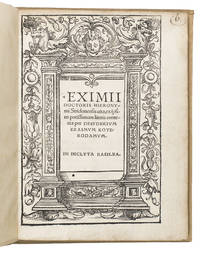
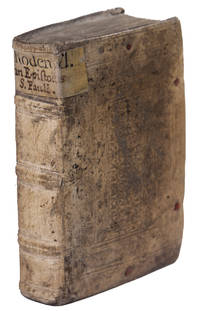
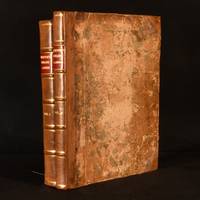
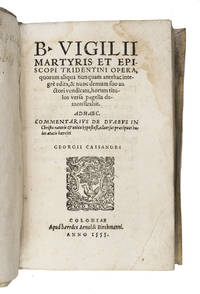
1535ref. ABC_49895Cologne: printed by Jaspar von Gennep for Peter Quentel 1535. Limp overlapping vellum with ties. 8vo. With an elaborate woodcut border on the title page of ad 1 several decorated woodcut initials and Quentels woodcut device at the end. 2 works in 1 volume ad 2 in 2 parts. With bound before ad 1:2 VIGILIUS. Opera .Including: CASSANDER Georg. Commentarius de duabus in Christo naturis .Cologne Arnold Birckman 1555. A rare and significant edition of De veritate corporis et sanguinis Domini by Alger of Liège Algerus ca. 1060-ca. 1131 Benedictine monk of Cluny and one of the most influential medieval theologians on the Eucharist. This major treatise composed during the so-called second Eucharistic controversy defends the doctrine of the real presence of Christ in the Eucharist against the teachings of Berengarius of Tours. Admired by both medieval scholars and later by Erasmus Algers work remained central to Catholic theology well into the sixteenth century.This copy represents the Erasmian edition prepared under Erasmuss supervision with his corrections and editorial guidance. His involvement gave the text a new humanist form and authority making Algers theology newly relevant at a time when Eucharistic doctrine was again fiercely debated during the Reformation. Erasmuss careful attention to clarity and Latinity situates this edition within his broader humanist programme of restoring theological texts to philological precision and doctrinal coherence.Only a handful of copies of this edition are known and no record of it appears in recent sales databases underlining its rarity on the market. It is the second edition overall following the first printing in Freiburg im Breisgau 1530 and the first to be issued by Peter Quentel in Cologne.Bound together with the Opera of Vigilius 1555 and a Commentarius opposing the Christological views of Georg Cassander 1555 this important Sammelband reflects the continuing Catholic polemic against Reformation-era innovations in both Eucharistic theology and Christology.The vellum is slightly dampstained lacking part of the bottom closing tie on the front. Some stains and browning throughout. Otherwise in good condition.l Ad 1: BM STC German p. 20; USTC 626331; Vander Haeghen II 6; VD 16 A 1871; cf. Adams 173 1530 ed.; Ad 2: Adams V 748; BM STC German p. 893; USTC 615055; VD 16 V 1184. [printed by Jaspar von Gennep for] Peter Quentel, hardcover
1519ref. ABC_49873Basel 1519. 4to. Colophon Johann Froben Modern beige paper boards with a later paper label on the spine the author title and incorrect publication date in black. With a woodcut decorated frame on the title page and on page 3 a small woodcut illustration incorporating Frobens device on the verso of the last leaf and with 1 woodcut decorated initial. 70 2 pp. Second edition of Erasmus Vita The life of the excellent doctor Jerome of Stridon this work introduced the monumental edition of Saint Jeromes Opera omnia. It was Erasmus attempt to present Jerome as a relevant historical and intellectual figure instead of him remaining a remote saint cloaked in legend.Rather than relying on apocryphal sources or pious legend Erasmus built this work almost exclusively from Jeromes authentic correspondence. This method marked a clear break with traditional hagiography. He rejected fictitious episodes attributed to figures like Cyril of Jerusalem ca. 315-386 CE Eusebius of Cremona 5th century CE and pseudo-Augustine which had long coloured the popular image of Jerome. Instead Erasmus offered a critical and philologically grounded portrait both admiring and analytical aligning Jerome with the ideals of Christian humanism.Erasmus fascination with Jerome had deep roots. As a young man in the monastery at Steyn near Gouda in the Netherlands where he studied under the Hieronymite order he was seen copying Jeromes letters. His early reverence developed into critical engagement: at Cambridge Erasmus worked meticulously to identify and eliminate inauthentic letters attributed to Jerome and he was profoundly inspired by Jeromes linguistic rigour and exegetical method. It was during his time in England that Erasmus also undertook his pioneering revision of the New Testament. All of these efforts culminated in Basel in 1516 where Frobens press published not only the first edition of Erasmus Novum Instrumentum a new Latin translation of the New Testament alongside the Greek text but also his complete edition of Jeromes works prefaced by the Vita. With a small wormhole affecting all leaves though without significant impact on the text a small hole in the outer margin of pp. 45-46 not affecting the text light marginal water-staining and some browning throughout. Overall in good condition.l Béné Marulic et Erasme lecteurs de saint Jérôme Colloquia Maruliana Vol. 10 2001 pp. 29-45 see p. 31; Bezzel 1058; BM STC German p. 282; De Reuck 362; Julián Erasmo biógrafo de san Jerónimo: Hieronymi Stridonensis Vita 1516 Mirabilia: electronic journal of antiquity and middle ages 31 2020 pp. 411-443 see pp. 412-3; USTC: 655432; Vander Haeghen I 182; VD 16 E 2968; not in Adams. EARLY PRINTING & MANUSCRIPTS RELIGION & DEVOTION Church History & Missions Early Printing - 16th century Erasmus Humanism & Reformation Philosophy & Humanism Religion 16th Century ZZ 001 De Graaf Inkopen hardcover
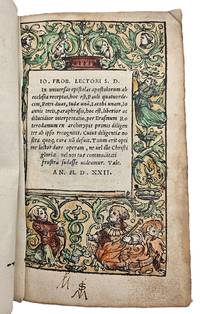
1520ref. ABC_49896Basel 1520. Small 8vo 10.1 x 15.3 cm. Hieronymus Froben Contemporary blind-tooled pigskin sewn on three supports with corresponding raised bands on the spine author and title lettered on a separated paper label at the head of the spine and with remnants of four pairs of red closing ties. With 5 woodcut frames on the title page and at the start of each text Corinthians in two parts 10 woodcut decorated initials 3 woodcut ornaments and a small woodcut illustration incorporating Frobens device above the colophon on the last page. "465" = 495 1 pp. First edition of Erasmus collected Paraphrases on the Pauline Epistles Romans 1 Corinthians 2 Corinthians and Galatians. Each paraphrase had appeared separately between 1517 and 1519 and this collected edition printed at Basel presented them together for the first time in a single work. Erasmus paraphrase on Romans was the earliest of the four. Completed during the summer of 1517 he initially intended it for publication by Froben in Basel. Concerned however that Frobens press was overburdened Erasmus entrusted the work instead to Dirk Martens in Louvain where he was then residing. Shortly thereafter Froben produced his own Basel edition in January 1518 and the work was an immediate success with further editions appearing in November 1518 and April 1519. The paraphrases on 1 and 2 Corinthians followed in early 1519. Once again Martens handled the first printing releasing it in February that year. However Froben was never far behind and brought out his own Basel edition the following month.The paraphrase on Galatians completed the present Pauline collection later that same year. The Louvain first edition appeared in May 1519 and was quickly followed by Frobens edition in August. Finally in January 1520 Froben gathered these works together into one volume.With a purple round stamp .bibliothek. on the title page and one blue round stamp from the same library on p. 97. With some contemporary underlinings and annotations primarily consisting of corrections textual additions and markings of notable passages. A difficult to read manuscript note on the last leaf a theological note on Paul's co-workers Epaphroditus and Tychicus written partly in Greek for the original terms and partly in Latin as explanatory glosses and on the back pastedown. Front pastedown detached from the boards revealing the printers waste likely a biblical commentary with references to Exodus and Genesis used in the binding. The binding is somewhat stained and rubbed affecting the clarity of some of the stamps on the front board. Some occasional water staining in the margins. Otherwise in good condition.l Adams E 790; Bezzel 1163; BM STC German p. 115; Sider Collected works of Erasmus volume 42 p. XXI; USTC 682544 6 copies; Vander Haeghen I 144; VD16 E 3060; not in De Reuck. EARLY PRINTING & MANUSCRIPTS RELIGION & DEVOTION Church History & Missions Early Printing - 16th century Erasmus Humanism & Reformation Philosophy & Humanism Religion 16th Century hardcover
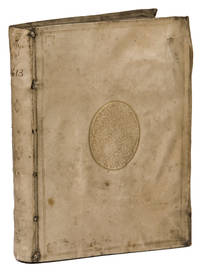
1613ref. ABC_49605Utrecht 1613. 4to. Jan Amelisz Contemporary gold-tooled overlapping vellum sewn on 4 supports laced through the joints both boards show a double fillet frame with small ornamental cornerpieces in the inside corners and a large ornamental oval centrepiece on both boards and with small ornaments slightly faded and the manuscript title on the spine. With a woodcut printers device on the title page and the rare full-page engraved portrait of Erasmus which is lacking in at least 2 of the 4 copies known in an oval lettered: "Magnus ille Erasmus Roterodamus natus Roterdami Octobr. Ao 1467" with emblems in the corners ink pot trumpets hourglass and Bible and a Latin poem of 4 lines underneath "Post cineres vivo doctis tuta manet". This portrait of Erasmus on leaf p1r half to the left and seated his hands resting on an open book is apparently engraved after the portrait by Frans Huys of 1555 which he engraved after the painted portrait by Hans Holbein the Younger Hollstein Dutch & Flemish engr. and etches 132. On the verso of this portrait is a laudatory "Klanck-Ghedicht" sonnet for Erasmus between typographical borders; the same borders on leaf. p2r: the privilege by the States General verso blank. 18 141 3 ll. Very rare first and only edition of a collection of 27 colloquia dialogues by Erasmus and 13 by Lucian of Samosata ca. 125-after 180 CE. The colloquia were translated into Dutch by Andreas van Oosterbeeck fl. 1584-ca. 1620 a minister in Abcoude 1590 and Montfoort 1616. The 27 dialogues by Erasmus include Proci & Puella Virgo Misogamos Virgo poenitens Coniugium Adolescentis & Scorti Abbatis & Eruditae Puerpera Convivium Fabulorum Absurda Opulentia sordida Naufragium Charon Coniugium impar Inquisition de Fide Exorcismus sive Spectrum Peregrinatio Religionis ergo and others.The Colloquia familiaria is one of the main works by Desiderius Erasmus first published in 1518 as Latin dialogues for school exercises and expanded over the following decades with witty - albeit serious - and often controversial content including contemporary religious practises treated in a pervasively ironic tone. After Cornelis Crul's translations of a number of dialogues published between 1530 and 1545 these annotated translations by Andreas van Oosterbeeck are the first 17th-century edition followed in 1622 and 1634 by translation of the colloquia by Dirck Pietersz. Pers.After Erasmus' dialogues follow after a separate title page the 13 highly ironical dialogues originally written in Greek by Lucian: Gallus Toxaris Cnemon Zenophantes Tantalus Menippus Trophonius Charon Crates Nireus Mausolus Polystratus and Diogenes. These are all translated in Dutch by Andreas van Oosterbeeck after the Latin translations made by Erasmus from the original Greek. Lucian of Samosata - a town in Syria - was a Greek writer and satirist who lived in the 2nd century CE. He invented the genre of comic dialogue a parody of the traditional Socratic dialogues and wrote numerous satires about the Gods and public figures.With later annotations in pencil on the front pastedown and flyleave the fore-edge and the bottom outer corner of the back board are somewhat stained and soiled a water stain in the upper outer corner throughout. Otherwise in good condition.l Van der Aa 14 1867; Gheerebaert Lijst p. 57 LVI: Lucianus no. 1 First translation of a work by Lucianus in Dutch!; STCN 169198340 4 copies; USTC 1019209 4 copies same as STCN. ART ARCHITECTURE & PHOTOGRAPHY EDUCATION & LEARNING LITERATURE & LINGUISTICS RELIGION & DEVOTION Caricature & Satire Education & Pedagogy Greek & Roman Classics Religion 17th Century hardcover
1523ref. 44374Cologne, Eucharius Cervicornus pour Gottfried Hittorp, s.d. , (1523). In-8 de 139-(13) ff., (sign. a-s8, *8), table, titre à encadrement gravé, bois gravé, caractères grecs et romains.ÉRASME. Parabolarum, seu Similium liber elegantissimus. Argentinae, apud J. Knoblouchum (Strasbourg, Johann Knobloch) 1521. 103-(5) ff., (sign. A-O8), titre à encadrement gravé, caractères italiques.ÉRASME. Opus de conscribendis epistolis, quod quidam & mendosum & mutilum ediderant, recognitum ab authore, & locupletatum. Argentorati (Strasbourg) Knobloch, 1522. 178 (i.e. 180) ff., (sign. A-Y8, Z4), titre à encadrement gravé, caractères italiques.3 pièces reliées en 1 vol. in-8 (105 x 170 mm), peau de truie sur ais de bois biseautés, décor estampé à froid à encadrement de motifs floraux et animaliers, dos à trois nerfs, titre manuscrit au dos, deux fermoirs (reliure de l'époque).
1523ref. 104094Argentorati [Strasbourg] apud Johannem Hervagium 1523 In-12, plein veau, dos à nerfs rel. XVIII, blanc déchiré, sans titre, 5 premiers ff. avec accrocs angulaires et atteintes du texte, 20 pp. pour le Paraclesis, avec léger accroc marginal, sans atteinte, 14 pp. de table sous colonnades gravées, 152 ff. ch.- 135 ff. ch.- 2 ff. Accrocs en marge sans atteinte. Lettrines gravées. Reliure post. un peu gauchie, coiffe usée en tête, titre à froid : “Novum testamentum secundum”. Etiquette de classement. Tampons bibliothèque capucine.
1522ref. 032982Coloniae: Heronem Alopeciu 1522 An extremely scarce early edition published in September 1522 - a month after the authorised Basel edition - by Hero Alopecius in Cologne. We have only been able to find one reference to it University of Toronto. Erasmus arranged publication of the Basel edition in August 1522 in response to the appearance of an unauthorised version in Cambridge in 1521. He had originally worked on the content in 1509-1511 and this work developed from his earlier writing and lectures became a popular and important text book on the writing of letters. It was much reprinted. This copy is newly rebound in full calf with panelled design to boards and gilt titles to spine. The page edges are red although this may not be contemporary. New endpapers. Contents with 2 initial blanks - the first with ink notation on the edition - this looks likely to be 1800's in date and the paper does not look contemporary. Title with elaborate design including 2 cherubs holding a shield with 3 crowns with contemporary latin note at the top; letter from Erasmus to Nicolao Beraldo pp 2-4; text with beautiful decorative initial capitals pp 5-414 Finis. No final blanks. There is some scholarly annotation in latin and gentle underlining - this could be contemporary. There are a number of mispaginations but the ties work in all cases: 47-74-75-50; 51-78-79-54; 55-82-83-58; 59-98-87-62-63-90-65; 170-117-172; 177-168-179; 192-191-192-193. There are a number of professional paper repairs: to the side of the title page and page 13/14; from p 357 onwards where the top corner tips had been burnt out - this begins with the just the tip but towards the end of the work includes some page numbers and just clips a couple of margin notes - the final 2 leaves have repair to sides. These corners do not have the red edges. Towards the end of the work there are a few pages with some grubbiness at the bottom corners. Otherwise the work is very clean with high quality paper. Please enquire if you would like to see additional images Heronem Alopeciu hardcover
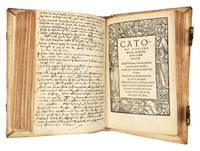
1522ref. 5333Mainz: Johann Schöffer February 1522. Hardcover. Fine. Bound with: Erasmus Desiderius 1466-1536; Cato Dionysius ca. 3rd c.; Colet John 1467-1519 et al. Catonis disticha moralia cum scholiis auctis Erasmi Roterodam. Isocratis paraenesis ad Demonicum. dennuo cum Graecis collata per Erasmum Strasbourg: Johann Knobloch 1523 Octavo: 15.5 x 10.1 cm. I. Adagia: 8 lvs 234 pp. 15 lvs. Collation: A-R8 S4 with final blank leaf present. II. Disticha: 56 lvs. Collation: A-G8 Bound with: Erasmus Desiderius 1466-1536; Cato Dionysius ca. 3rd c.; Colet John 1467-1519 et al. Catonis disticha moralia cum scholiis auctis Erasmi Roterodam. Isocratis paraenesis ad Demonicum. dennuo cum Graecis collata per Erasmum Strasbourg: Johann Knobloch 1523 Octavo: 15.5 x 10.1 cm. I. Adagia: 8 lvs 234 pp. 15 lvs. Collation: A-R8 S4 with final blank leaf present. II. Disticha: 56 lvs. Collation: A-G8 Bound in contemporary blind-stamped pigskin with a very early paper label to the spine. In fine condition. The text bound a bit tight. Minor soiling and a few marginal tears or worming. First t.p. working loose at foot. With fine woodcut borders to the title pages of both works woodcut initials. Knobloch's device on the final leaf of the second work. The leaf between the two volumes has handwritten German translations or German equivalents of certain adages. There are about 25 other translations in the course of the text. See below. This rare edition of the Erasmus' "Adagiorum Collectanea"Collection of Adages was printed by Johann Schöffer grandson of Gutenberg's backer Johann Fust and son of Fust's partner Peter Schöffer. The fine woodcut border on the title page incorporates Schöffer's arms. The book is bound with Erasmus' edition of the "Distichs of Cato" the "Apothegms of the Greek Sages" and other moralizing texts for use in schools. An unidentified 16th c. reader has provided German renderings for approximately 65 adages some within the text but the majority written -densely- on both sides of a blank leaf. These are not literal translations but idiomatic equivalents - German sayings and turns of phrase that the reader judged to carry the same sense as the Latin in the way a modern annotator might pair "actions speak louder than words" with "facta non verba" lit. deeds not words rather than translate it word for word. Here are five examples: 1. Ultra septa transilire is glossed in German as "das heist zu vil machen" "To leap over the fences" i.e. to overshoot the bounds. 2. Oculatus testis unus pluris est quam decem auriti is glossed in German as "von hörensagen leugt man gern" "One eyewitness is worth more than ten ear-witnesses". 3. Genu sura propius is glossed in German as "ich schau auff mein spill" "The knee is nearer than the shin" i.e. one's own concerns come first - "I mind my own game." 4. Arcus non semper feriet quod minabitur is glossed in German as "alle tag ist jagtag aber nit fangtag" Adapted from Horace Ars poetica "nec semper feriet quodcumque minabitur arcus". Not everything one undertakes comes off - "every day is hunting day but not catching day." 5. The Latin lemma In lapidicinas / ad corvos is glossed in German as "zum galgen mit dir" Both classical imprecations "to the quarries!" / "to the crows!" i.e. "go hang" rendered literally in the German as "to the gallows with you." 6. Haec Helena est - "das ist die praut darumb man dantzt" "this is the bride around whom the dance goes". 7. Homo effreni oris - "sein zung schneidt wie ein messer" "his tongue cuts like a knife". There is also a long marginal note explaining the adage "Cave Thoracem" "Beware of the Thorax" - Erasmus Adagia 2.4.52. It refers to Mount Thorax near Magnesia-on-the-Maeander where the grammarian Daphitas is said to have been crucified after mocking the Attalid kings in a scurrilous couplet this exact episode is told by Strabo Geography 14.1.39 and an oracle had reportedly warned Daphitas to "beware of the Thorax" - a pun since thorax also means "breastplate" in Greek. THE ADAGES: The "Adagia" one of Erasmus' greatest achievements is a collection of proverbs taken from both Latin and Greek authors. The work was already conceived during his first stay in England and was first printed at Paris in 1500. The present edition is a reprint of the 1506 edition which had been expanded by 18 adages. It retains however the dedication letter to William Blount Lord Mountjoy Allen 126 from the first edition. Although it was eclipsed by the massively expanded Aldine edition that was to follow in 1508 the "Adagiorum Chiliades" "Thousands of Adages" to which Erasmus would add up until his death in 1536 the much shorter "Collectanea Adagiorum" would continue to be printed as well. "Erasmus' 'Adagiorum Collectanea' is a collection of about eight hundred proverbial sayings drawn from the Latin authors of antiquity and elucidated for the use of those who aspired to write an elegant Latin style. In the dedication Erasmus pointed out the profit an author may derive both in ornamenting his style and in strengthening his argumentation from having at his disposal a good supply of sentences hallowed by their antiquity. He proposes to offer such a help to his readers. What he actually gave was much more. He familiarized a much wider circle than the earlier humanists had reached with the spirit of antiquity. "Until this time the humanists had to some extent monopolized the treasures of classic culture in order to parade their knowledge of which the multitude remained destitute and so to become strange prodigies of learning and elegance. With his irresistible need of teaching and his sincere love for humanity and its general culture Erasmus introduced the classic spirit in so far as it could be reflected in the soul of a sixteenth-century Christian among the people. Not he alone; but none more extensively and more effectively. Not among all the people it is true for by writing in Latin he limited his direct influence to the educated classes which in those days were the upper classes. "Erasmus made current the classic spirit. Humanism ceased to be the exclusive privilege of a few. According to Beatus Rhenanus he had been reproached by some humanists when about to publish the Adagia for divulging the mysteries of their craft. But he desired that the book of antiquity should be open to all." Huizinga p. 39-40 THE DISTICHS OF CATO: The literature of edifying proverbs and "sententiae" enjoyed enormous success during the early Middle Ages. The "Distichs of Cato" were a particularly successful example of this genre being read widely from the Carolingian period up to the 16th century. The book's misattributed to the great Roman statesman Cato the Elder the book is now believed to be a late antique work by a Dionysius Cato gave the book the weight of authority. From the 12th century onward the readership broadened and it began to be used outside of the "collective" settings of the schools and universities as edifying reading for private personal contemplation. "Erasmus would return to the subjects taught in his own education through his publications on childhood education. One of these topics would be the Distichs of Cato. Although he had been working with dicta over several years in the beginning of the 16th century Erasmus claimed that his actual writing of his version of the Distichs took significantly less time. Its first edition was published around 1514 in a book which also included the sayings of Mimus Publianus Publilius Syrus and the seven sages and Erasmus' translation of the poem Institutum christiani hominis by John Colet. Once published the edition quickly spread to schools in both England and the Low Countries. "Erasmus began his edition of the Distichs of Cato with an address to the educator Jean de Nève. In this letter he criticized two earlier commentaries on the Distichs one by Robert of Euremodio ca. 1375 and the other by Philip of Bergamo also late 14th c. He believed that Robert's version was excessively rhetorical in fact it reflects Robert's Cistercian intellectual milieu. Philip he chastised for pointless philosophizing. Erasmus wrote in a straightforward classicizing style without adducing parallels to scripture and patristic and medieval theologians so that students could easily comprehend the text. Erasmus focused on the ethical and linguistic education of the student. "Although his edition of the Distichs was a smaller work than his other publications Erasmus valued its widespread usefulness in early childhood education. In addition to his polemics against earlier editions and corrections to the text Erasmus also included aphorisms often taken from his magnum opus the Adagia. He also briefly clarified historical context but this often was used to criticize the present rather than provide an understanding of the past. His criticism of errant laity and churchmen and a general suspicion of his sympathy for the Reformation led to the censuring of his commentary which nonetheless prospered."Ortega DSB -Digital School Book- online. Johann Schöffer, February hardcover
1522ref. 5333Mainz: Johann Schöffer February 1522. Hardcover. Fine. Bound with: Erasmus Desiderius 1466-1536; Cato Dionysius ca. 3rd c.; Colet John 1467-1519 et al. Catonis disticha moralia cum scholiis auctis Erasmi Roterodam. Isocratis paraenesis ad Demonicum. dennuo cum Graecis collata per Erasmum Strasbourg: Johann Knobloch 1523 Octavo: 15.5 x 10.1 cm. I. Adagia: 8 lvs 234 pp. 15 lvs. Collation: A-R8 S4 with final blank leaf present. II. Disticha: 56 lvs. Collation: A-G8 Bound with: Erasmus Desiderius 1466-1536; Cato Dionysius ca. 3rd c.; Colet John 1467-1519 et al. Catonis disticha moralia cum scholiis auctis Erasmi Roterodam. Isocratis paraenesis ad Demonicum. dennuo cum Graecis collata per Erasmum Strasbourg: Johann Knobloch 1523 Octavo: 15.5 x 10.1 cm. I. Adagia: 8 lvs 234 pp. 15 lvs. Collation: A-R8 S4 with final blank leaf present. II. Disticha: 56 lvs. Collation: A-G8 Bound in contemporary blind-stamped pigskin with a very early paper label to the spine. In fine condition. The text bound a bit tight. Minor soiling and a few marginal tears or worming. First t.p. working loose at foot. With fine woodcut borders to the title pages of both works woodcut initials. Knobloch's device on the final leaf of the second work. The leaf between the two volumes has handwritten German translations or German equivalents of certain adages. There are about 25 other translations in the course of the text. See below. This rare edition of the Erasmus' "Adagiorum Collectanea"Collection of Adages was printed by Johann Schöffer grandson of Gutenberg's backer Johann Fust and son of Fust's partner Peter Schöffer. The fine woodcut border on the title page incorporates Schöffer's arms. The book is bound with Erasmus' edition of the "Distichs of Cato" the "Apothegms of the Greek Sages" and other moralizing texts for use in schools. An unidentified 16th c. reader has provided German renderings for approximately 65 adages some within the text but the majority written -densely- on both sides of a blank leaf. These are not literal translations but idiomatic equivalents - German sayings and turns of phrase that the reader judged to carry the same sense as the Latin in the way a modern annotator might pair "actions speak louder than words" with "facta non verba" lit. deeds not words rather than translate it word for word. Here are five examples: 1. Ultra septa transilire is glossed in German as "das heist zu vil machen" "To leap over the fences" i.e. to overshoot the bounds. 2. Oculatus testis unus pluris est quam decem auriti is glossed in German as "von hörensagen leugt man gern" "One eyewitness is worth more than ten ear-witnesses". 3. Genu sura propius is glossed in German as "ich schau auff mein spill" "The knee is nearer than the shin" i.e. one's own concerns come first - "I mind my own game." 4. Arcus non semper feriet quod minabitur is glossed in German as "alle tag ist jagtag aber nit fangtag" Adapted from Horace Ars poetica "nec semper feriet quodcumque minabitur arcus". Not everything one undertakes comes off - "every day is hunting day but not catching day." 5. The Latin lemma In lapidicinas / ad corvos is glossed in German as "zum galgen mit dir" Both classical imprecations "to the quarries!" / "to the crows!" i.e. "go hang" rendered literally in the German as "to the gallows with you." 6. Haec Helena est - "das ist die praut darumb man dantzt" "this is the bride around whom the dance goes". 7. Homo effreni oris - "sein zung schneidt wie ein messer" "his tongue cuts like a knife". There is also a long marginal note explaining the adage "Cave Thoracem" "Beware of the Thorax" - Erasmus Adagia 2.4.52. It refers to Mount Thorax near Magnesia-on-the-Maeander where the grammarian Daphitas is said to have been crucified after mocking the Attalid kings in a scurrilous couplet this exact episode is told by Strabo Geography 14.1.39 and an oracle had reportedly warned Daphitas to "beware of the Thorax" - a pun since thorax also means "breastplate" in Greek. THE ADAGES: The "Adagia" one of Erasmus' greatest achievements is a collection of proverbs taken from both Latin and Greek authors. The work was already conceived during his first stay in England and was first printed at Paris in 1500. The present edition is a reprint of the 1506 edition which had been expanded by 18 adages. It retains however the dedication letter to William Blount Lord Mountjoy Allen 126 from the first edition. Although it was eclipsed by the massively expanded Aldine edition that was to follow in 1508 the "Adagiorum Chiliades" "Thousands of Adages" to which Erasmus would add up until his death in 1536 the much shorter "Collectanea Adagiorum" would continue to be printed as well. "Erasmus' 'Adagiorum Collectanea' is a collection of about eight hundred proverbial sayings drawn from the Latin authors of antiquity and elucidated for the use of those who aspired to write an elegant Latin style. In the dedication Erasmus pointed out the profit an author may derive both in ornamenting his style and in strengthening his argumentation from having at his disposal a good supply of sentences hallowed by their antiquity. He proposes to offer such a help to his readers. What he actually gave was much more. He familiarized a much wider circle than the earlier humanists had reached with the spirit of antiquity. "Until this time the humanists had to some extent monopolized the treasures of classic culture in order to parade their knowledge of which the multitude remained destitute and so to become strange prodigies of learning and elegance. With his irresistible need of teaching and his sincere love for humanity and its general culture Erasmus introduced the classic spirit in so far as it could be reflected in the soul of a sixteenth-century Christian among the people. Not he alone; but none more extensively and more effectively. Not among all the people it is true for by writing in Latin he limited his direct influence to the educated classes which in those days were the upper classes. "Erasmus made current the classic spirit. Humanism ceased to be the exclusive privilege of a few. According to Beatus Rhenanus he had been reproached by some humanists when about to publish the Adagia for divulging the mysteries of their craft. But he desired that the book of antiquity should be open to all." Huizinga p. 39-40 THE DISTICHS OF CATO: The literature of edifying proverbs and "sententiae" enjoyed enormous success during the early Middle Ages. The "Distichs of Cato" were a particularly successful example of this genre being read widely from the Carolingian period up to the 16th century. The book's misattributed to the great Roman statesman Cato the Elder the book is now believed to be a late antique work by a Dionysius Cato gave the book the weight of authority. From the 12th century onward the readership broadened and it began to be used outside of the "collective" settings of the schools and universities as edifying reading for private personal contemplation. "Erasmus would return to the subjects taught in his own education through his publications on childhood education. One of these topics would be the Distichs of Cato. Although he had been working with dicta over several years in the beginning of the 16th century Erasmus claimed that his actual writing of his version of the Distichs took significantly less time. Its first edition was published around 1514 in a book which also included the sayings of Mimus Publianus Publilius Syrus and the seven sages and Erasmus' translation of the poem Institutum christiani hominis by John Colet. Once published the edition quickly spread to schools in both England and the Low Countries. "Erasmus began his edition of the Distichs of Cato with an address to the educator Jean de Nève. In this letter he criticized two earlier commentaries on the Distichs one by Robert of Euremodio ca. 1375 and the other by Philip of Bergamo also late 14th c. He believed that Robert's version was excessively rhetorical in fact it reflects Robert's Cistercian intellectual milieu. Philip he chastised for pointless philosophizing. Erasmus wrote in a straightforward classicizing style without adducing parallels to scripture and patristic and medieval theologians so that students could easily comprehend the text. Erasmus focused on the ethical and linguistic education of the student. "Although his edition of the Distichs was a smaller work than his other publications Erasmus valued its widespread usefulness in early childhood education. In addition to his polemics against earlier editions and corrections to the text Erasmus also included aphorisms often taken from his magnum opus the Adagia. He also briefly clarified historical context but this often was used to criticize the present rather than provide an understanding of the past. His criticism of errant laity and churchmen and a general suspicion of his sympathy for the Reformation led to the censuring of his commentary which nonetheless prospered."Ortega DSB -Digital School Book- online. Johann Schöffer, February hardcover books
1529ref. 1832Coloniae: Iohannem Gymnicum 1529. Rare edition a sound complete copy lacking only the final blank. Title within pictorial woodcut border. Octavo contemporary blind-tooled calf over wooden boards dated 1534 in blind brass clasps minor statins and soiling and some early penned marginalia. Also bound in are three additional works De Civilitate Morum Puerilium; Plutarch. De Liberis Educandis; and Horatius Flaccus. Iohannem Gymnicum hardcover
1521ref. 33059-66Mainz Johann Schöffer 1521. Full woodcut historiated title-border and typographic title. 3 ff. Sm.-4to. 19th century morocco Hans Asper Geneva. From the library of Gaspard Ernest Stroehlin 1844-1907 a Swiss minister and professor at the University of Geneva with his bookplate "Mente Libera" showing Calvin preaching with the St. Pierre Cathedral in Geneva in the background. Mainz Johann Schöffer 1521. First edition. In addition to the Greek and Latin writings of Erasmus' 1467-1536 we know a small number in German language. The humanist's paraphrases of the Evangelists were greeted with immediate popularity and received numerous reprintings. The seven woes to the Scribes and Pharisees in Matthew 23 are a list of critical words by Jesus against the religious leaders as hypocrisy and perjury. Because of Erasmus' critique of the Roman Catholic Church in the first edition of the Index Librorum Prohibitorum 1564 his writings were more severely condemned than the works of Luther or Calvin. - A nice copy of a rare booklet seldom found in a library outside Germany. - VD 16 E 3123; Vander Haegen I 149 assigns this edition as the first one and printed by Johann Schöffer in Mainz; Bezzel 1239; not in Pegg Swiss. REFORMATION ; HELVETICA ; HUMANISM ; BINDINGS ; (Mainz, Johann Schöffer) unknown
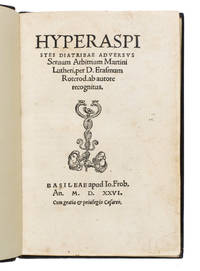
1526ref. ABC_49737Basel: Johann Froben 1526. Modern calf with the author title and year of publication lettered in gold on the spine. Small 8vo. With a woodcut printer's device on the title page and final leaf and 2 decorated woodcut initials. First revised edition of Erasmus' response to Martin Luther which is part of their famous theological debate that took place in the 1520s. Erasmus received Luther's work in February 1526. The Hyperaspistes is his first reply to it which he composed within a few days in March 1526. The present edition revised by Erasmus himself and published in July of the same year supplies a more correct text of this famous refutation.The Hyperaspistes first published in March 1526 deals with the question of free will and was written in response to Luthers De servo arbitrio On enslaved willl 1525 which in turn was written in reply to Erasmuss De libero arbitrio On free will 1524. Luther argued that humans could not achieve salvation through good deeds as they could not choose between good and evil and so could only be redeemed through the will of God. Erasmus on the other hand believed that each individual had the freedom to accept Gods grace and turn towards a Christian life and salvation could be reached through good deeds. The confrontation between Erasmus and Luther was a duel of major importance for Europe in the first half of the 16th century as two visions of man history and faith clashed.The second part of the Hyperaspistes appeared in September 1527 continuing the exegetical controversy with Luther. The present edition however was published before the second part was written.With near- contemporary annotations in the margins of some of the leaves. The work is lightly browned and foxed throughout. Otherwise in good condition.l Adams E-675; Bezzel 1117; BM STC German p. 281; Erasmus Online 2230; USTC 664562; Vander Haeghen I 110; VD16 E 3029; cf. De Reuck 236 other issue. Johann Froben, unknown
2010ref. SBBIH-NKIEG56LDI7FOUP Southern Africa 2010. paperback. Good. Our good condition books are generally good for reading but not for gifting or collecting. They could have imperfections such as creasing fanning inscriptions margin notes yellowing staining on edge or cover or pages bumps scuffs etc etc sometimes multiple of these. It's a wide category that encompasses anything that isn't almost-new down to anything that is slightly better than poor. We would NOT recommend gifting Good books - these should be considered reading copies. Our books are dispatched from a Yorkshire former cotton mill. We list via barcode/ISBN so please note that the images are stock images and may not be the exact copy you receive furthermore the details about edition and year might not be accurate as many publishers reuse the same ISBN for multiple editions and as we simply scan a barcode or enter an ISBN we do not check the validity of the edition data when listing. If you're looking for an exact edition please don't order at least not without checking with us first although we don't always have time to check. We aim to dispatch prompty the service used will depend on order value and book size. We can ship to most countries see our shipping policies. Payment is via Abe only. OUP Southern Africa paperback
1522ref. 12717Basel Johannes Froben 1522. Two parts in one 484 folio. Tall octavo H. 185 x W. 11.5 cm. contemporary binding in blindstamped brown leather over wooden boards. Title on the lower cover: ""In Epistola S. Pauli Can. RC."" The blind impression on the front cover faded but still visible is: ""ROTEROD"" as for ""Roterodami"" so from Rotterdam Erasmus' place of birth and ""WSKB"" possibly the initials of the owner. Second edition in an attractive binding the first in 8vo format. Two months before the first edition was edited in Folio. Each part has a woodcut title page. Lacking clasps some light waterstains wide margins with early manuscript annotations and thin strips of medieval manuscripts sewn inside the boards. A good copy. Literature: VD 16 E-3377; Bezzel I. Erasmusdrucke Nr. 1529. Van der Haeghen I 147 Basel, Johannes Froben hardcover
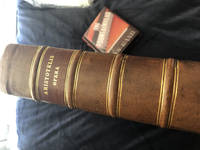
1550ref. P8126The Works of Aristotle "per Des. Eras Roterordamvm" 1550. 2 volumes in one folio 323 x 192mm. Third Edition of The Works of Aristotle of the original text in 1831 prepared by Simon Grynaeus. This edition retains the original letter from Erasmus to Thomas More's son John. Woodcut initials a few woodcut illustrations old calf a few early annotations numerous notes in Latin Greek and English on front and rear flyleaves probably nineteenth-century and in text in ink pencil and red crayon neat annotations in Greek in second volume Greek quotation from Aristotle written on first title-page occasional light staining T5 torn in margin binding rubbed rebacked. Two of history's greatest minds converge. Book #P8126. $6500. We specialize in Rare Ayn rand erotica history and science. Johann Bebel and Michael Isengrin, 1550 hardcover
1962ref. 146903London: Gregg Press 1962. Hardcover. Prof. Schoeck's tidy ownership information in each volume and very minor pencil markings light cover soil and wear corners lightly bumped and several have corner protectors V.1: crumpled and torn back flyleaf V.6: front cover board bent small tear to top of spine V.7: back hinge just beginning to crack but still sturdy V.8: front hinge just beginning to crack but still sturdy V.9: front and back hinges just beginning to crack but still sturdy V.10: pale splatters to bottom of front cover and fore-edge not affecting the interior all volumes in very good sound condition. From the library of Prof. Richard J. Schoeck. Size: 10.5"x15.5" 10 vols in 11 sturdy tan cloth bindings with red spine labels. Gregg Press hardcover
1789ref. 1014H20Lichfield; London: J. Johnson; Printed by J. Jackson 1789-1791. First edition. Leather. Very Good. 11" by 9". William Blake; John Henry Fuseli. A particularly desirable pairing of the first editions of Erasmus Darwin"s complete Botanic Garden transforming botanical science into verse illustrated with engravings by William Blake after Fuseli. In a contemporary half calf binding with marbled paper boards later rebacked and recornered with spine labels. First editions of both parts: The Loves of the Plants although designated Part II was published first in 1789; The Economy of Vegetation followed in 1791 completing The Botanic Garden. The second volume is slightly taller than the first. Part II is seldom encountered in its first edition making its presence here particularly desirable. A fantastic poetic rendering of contemporary botany and science in which Erasmus Darwin 1731-1802 physician naturalist inventor and grandfather of Charles Darwin. In The Economy of Vegetation Darwin celebrates natural philosophy invention and technological progress; in The Loves of the Plants he popularises the Linnaean sexual system of botanical classification through the romances of personified flowers stamens and pistils. The verse is accompanied throughout by extensive philosophical and scientific notes. Volume I is illustrated with an engraved frontispiece engraved by Anker Smith after Henry Fuseli and nine further plates one of which is folding. This copy includes William Blake"s engraving "The Fertilization of Egypt" after a design by Henry Fuseli depicting Anubis and the Nile; the British Museum identifies the plate as Blake"s work. The four Portland Vase engravings are also by Blake produced for The Economy of Vegetation. The four Portland Vase plates are bound at variance with the directions to the binder at the rear: "The Whole Vase" facing p. 53 "The First Compartment" facing p. 54 "The Second Compartment" facing p. 55 and "The Handles" facing p. 58 rather than all four facing p. 88 as called for. Volume II is illustrated with aesigned by Emma Crewe and engraved by Samuel Alken seven further engraved plates and a vignette. The directions to the binder and errata leaf at the end of volume II have been neatly cut down and pasted to the foot of page 184. The first part also includes Darwin"s abolitionist passage inspired by Josiah Wedgwood"s celebrated medallion of the kneeling chained slave invoking the appeal: "Are we not Brethren" Collated complete. Volume I ESTC No.: T82160 Volume II: ESTC No.: T82159 4 b2 B4-2E4 A4-S4; 7 B4-Z4 2A2-2B2 In a contemporary half calf binding with marbled paper boards later rebacked and recornered with spine labels. Externally a little worn. Slight rubbing and bumping to extremities. Rubbing to boards resulting slight surface loss to paper. Worcester Library bookplate to front pastedowns with contemporary ink annotations marked "Fourteen Days" to the first volume. Hinges reinforced. Slight ink offsetting to front free endpaper of volume II. Slight discolouration from binder's glue and light scattered spotting to endpapers. Small ink mark to fore edge of front free endpaper of volume I. Internally firmly bound. Pages characteristically age toned with light scattered spotting heavier to fore edge margins of plates and first and last few leaves more pronounced to volume I notably to the frontispiece and pp. 184-202. Discreet archival repairs to the margins of the plates and first leaves of volume I; slight cropping to the margins of the Portland Vase plates. Small closed tear to lower margins of plates facing pp. 58 and 54 in the additional notes of volume I. Slight cockling to fore edge. Minor edge wear resulting in one or two very small closed tears and chips. Directions to the binder and errata leaf to end of volume II laid down to the foot of pp. 184. Very Good J. Johnson; Printed by J. Jackson hardcover
1668ref. V70496Nurnberg: Johann Andreas Endter & heirs of Wolfgang 1668. Hardcover. Good. Fine full-page engraved plates 65 numbered 1-63 with 2 bis plates 45 & 47 1 text illustration full page elaborate copperplate coat of arms of Leopold I by C.N. Schurtz. Folio old vellum spine split repaired front cover nearly detached. Bookplate of Bibliotheca Prieseriana showing books on shelves and small library stamp on pastedown. Titlepage in red and black with printer's mark of 2 female supporters with sun shining on clasped book with monogram AEW. Titlepage 36pp including full page copperplate coat of arms of Leopold I by C.N.Schurtz 1762pp 34pp indices 2pp errata with a few part-lines of loss to lower outer corner & tatty edges. Double column Gothic type with shoulder notes throughout. Two marginal tears with loss hardly touching print & first page of dedication with cropping to outer edge some corner creases else clean and no worming/no foxing/no ink marks. Despite its huge bulk the book block is square and tight. A fascinating early German account of travels and curisoties and one of the most famous illustrated natural history books of the 17th century Nissen 648; Sabin 25463. Johann Andreas Endter & heirs of Wolfgang hardcover
1528ref. CLL-140Lyon, Gryphe, 1528-1529 In-12 de 160 pp., (4) ff. - (16) ff. - (40) ff., veau blond, trois filets dorés en encadrement, dos à nerfs orné de filets et d'un décor à la grotesque doré, pièces de titre et de tomaison de maroquin havane et vert, coupes filetées or, bordures décorées, tranches dorées (Niédrée).
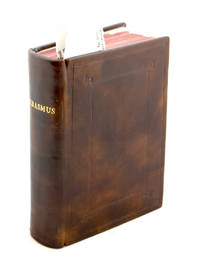
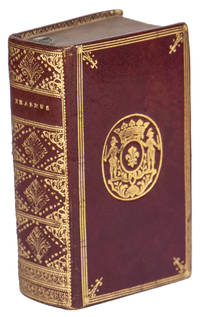
1658ref. 18897Amsterdam: Joannes Janssonius 1658. 18th-century richly gold-tooled red morocco both boards show a triple fillet frame with small cornerpieces in the inside corners and an oval armorial centrepiece crowned fleur-de-lis flanked by two knights gold-tooled spine with "Erasmus" lettered in gold gold-tooled board edges and turn ins gilt edges marbled endpapers. 12mo. With an engraved title page a full-page engraving showing Erasmus woodcut decorated initials and several woodcut head- and tailpieces. Including: Coronis apologetica pro colloquiis Erasmi ex ipsius scriptis quantum per otium licuit fideliter collecta à P.S. accedit ejusdem De Collequiorum utilitate dissertatio. Montanus' edition of a renowned famous Latin schoolbook written by Erasmus one of the most used Latin schoolbooks for centuries as it discusses all basic scholarly and moral issues. With Erasmus' preface-letter to Froben at Basel dated 1524 and the Vita Erasmi preceding the Colloquia as well as two indices of authors and dialogues. Included at the end is a short essay explaining the usefulness of the book.With a few 17th-century annotations on the engraved and letterpress title pages resp. "1662" and "Besnier". The engraved title page is cut slightly short not affecting the engraving. Otherwise in very good condition.l Bibl. Belg. II E 572; Erasmus Coll. City Library Rotterdam p. 50; STCN 850071909 9 copies; Vander Haeghen p. 40. Joannes Janssonius, hardcover
ref. LCS-18181Précieux volume conservé dans son élégante et intéressante reliure parisienne strictement de l’époque, très proche des reliures alors réalisées pour le bibliophile de la Renaissance Marcus Fugger (1529-1597). Paris, Jean Longis, 1553. In-8 de (8), 191 ff. Les gardes et les contreplats sont couvertes d’annotations manuscrites anciennes. Veau blond, double encadrement de trois filets à froid avec petits fleurons dorés aux angles, fleuron central argenté, dos à nerfs orné de filets à froid et d’un petit fer répété, mors et coiffes restaurés. Reliure parisienne de l’époque de belle facture proche de celles réalisées pour Marcus Fugger. 166 x 102 mm.
1668ref. 4248Nuremberg, Johann A. Endters and Wolfgang Sel, 1668. 1668 3 parties reliées en 2 vol. in-folio (318 x 202 mm. de: [20] ff. (frontispice gravé, titre en rouge et noir, armes de Leopold I gravées par C.N. Schurtz, dédicace, liste des auteur), 1762 pp. ; [18] ff. (tables) ; 65 gravures à pleine page numérotées de 1 à 63, avec les planches 45 et 47 doublées (titre et feuillet de dédicace rognés courts, petite découpe comblée dans la marge du titre). Reliure à paneaux mosaïqués d'époque, dos à nerfs orné, titres de maroquin rouge, tranches marbrées ( dos restauré avec dos ancien conservé).
ref. 32693Deux textes dans une même reliure de l'époque, vélin estampé à froid. Grand in-4. - Witichindi Saxonis rerum ab Henrico et Ottone I. impp. gestarum libri III, una cum aliis quibusdam raris et antehac non lectis diversorum autorum historiis, ab Anno salutis DCCC usque ad praesentem aetatem: quorum catalogus proxima patebit pagina. Huc accessit rerum scitu dignarum copiosus index. Froben, Basileae 1532. 393 pages. - Beati Rhenani Selestadiensis rerum Germanicarum libri tres, ab ipso autore diligenter revisi ,emendati, addito memorabilium rerum Indice accuratissimo. Quibus praemissa est Vita Beati Rhenani, à Ioanne Sturmio eleganter conscripta. Froben . Basileae, 1551. 206 pages. Ouvrage rare. Bel état. (quelques soulignures et notes anciennes à l'encre rouge). De la révolte des Saxons contre Charlemagne à l'amitié d'Erasme.
1523ref. 8509Argentorati Strasburg: Iohannes Cnobloch execudebat Quinto Idus Iunias Anno. M.D.XXIII. 1523. 1523 20 130 i.e. 120; 107 1 leaves ; 16 cm. Collates Aa8 Bb4CC8 a-p8 A-N8 O4. D&M 6103a. Recently bound in calf to style with blind decoration to the boards. The spine has raised bands and is titled in gilt. Marginal annotations thoughout. Part title to Epistolae Apostolicae and Cnobloch's device printed at the end of both parts. The imprint and date are supplied from the colophon. The text of each book begins with a 14 line rubricated initial including one decorated with three parrots at the start of Evangelium Secundum Ioannem. PROVENANCE: The title page verso has the bookplate of the Nuremburg bookseller collector and bibliographer of alchemical literature Friedrich Roth-Scholtz 1687-1736. The title page and part title have a neat 19th century stamp of the Univerity of Erlangen now Erlangen-Nuremberg. an excellent early printing of Erasmus' important NT. Argentorati (Strasburg): Iohannes Cnobloch execudebat Quinto Idus Iunias Anno. M.D.XXIII. hardcover
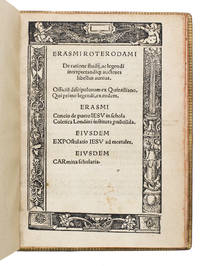
1516ref. ABC_49694Colophon Strasbourg: Matthias Schürer 1516. Modern brown pigskin with a blind-tooled single fillet frame on both boards gold-tooled turn-ins red edges in a beige paperboard slipcase. 4to. With a woodcut decorated title frame and 3 woodcut decorated initials. Early edition of Erasmus seminal educational treatise De ratione studii here presented alongside several other influential pedagogical and devotional texts. It further includes: Officium discipulorum ex Quintiliano The duties of students according to Quintilian including a section on the first stages of learning to read also derived from Quintilian a sermon on the child Jesus by Erasmus intended for delivery at the Colet School in London a lament of Jesus addressed to mankind and a collection of school poems.The opening dedication addressed to Peter Viterius a professor of liberal arts sets the tone for this work: Erasmus praises his friends discernment and judgment in matters of education using vivid comparisons drawn from military strategy and classical mythology to underscore the importance of order and method in learning. Without it he argues even the most gifted minds may falter. Of particular note is Erasmus endorsement of an instructional technique that became central to Renaissance humanist pedagogy: the use of structured annotation. In De ratione studii he recommends that students classify selected passages under thematic headings a mnemonic device that aids both retention and retrieval. This principle would go on to shape the methods of early modern teaching and note-taking. It also reflects Erasmus' broader educational reforms where rhetoric and moral philosophy intersect. His engagement with progymnasmata preliminary rhetorical exercises especially those of Aphthonius favoured for their clear organisation into theory and examples demonstrates his commitment to practical and accessible instruction for young learners.With some contemporary and later underlining and annotations in red and brown ink mainly consisting of corrections additions to the text and markings of significant passages. Two minor worm holes througout barely affecting the text. The gutters between leaves V-VI; VII-VIII; XX-XXI; and after leaf XXIII have been reinforced in the gutter with linen tape slightly browned throughout. Otherwise in good condition.l Adams E 346; Bezzel 1709; USTC 653250 9 copies; Vander Haeghen I 169; VD16 E 3534; not in BM STC German; De Reuck; Kossmann. Matthias Schürer, hardcover