Rotterdam, Erasmo deBiblio.com
4758 resultados
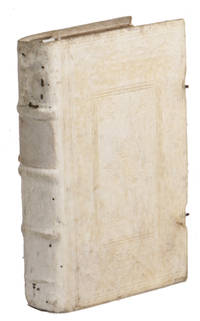
1956ref. 3829141Madrid.: Aguilar. 1956. Hardcover. Good. 18 cm. 1917 p. Encuadernación en tapa blanda en plena piel. Erasmus Desiderius ca. 1466-1536. Forma parte de la Colección Burucúa-Schreiber . Aguilar. hardcover
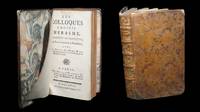
ref. 32222A Paris chez Brocas & Humblot 1763. Un vol. au format gd in-16 147 x 88 mm de 1 f. bl. 2 ff. n.fol. 233 pp. 1 f. n.fol. et 1 f. bl. Reliure de l'poque de pleine basane glace et marbre havane plats jansnistes dos nerfs orn de filets gras froid caissons d'encadrement dors filets verticaux dors fleurons dors titre dor palette dore en queue tranches rouges. Texte en latin avec traduction franÂaise en regard par Dumas. ''Par l'importance de leur auteur par leur genre et leur objectif les ÇÊColloquesÊÈ d'rasme sont les textes les plus reprsentatifs de l'esprit des humanistes du XVIe siÂcle. rasme n'est-il pas le plus connu de ces intellectuels chrtiens la fois critiques et idalistes qui croient en la force de l'ducation Ces dialogues prsents sous une forme pseudo-thtrale et inspirs de l'Antiquit sont destins faire rflchir sans ennuyer. Savoureux ces textes ne sont pas non plus dnus d'humour. Leur succÂs fut grand malgr les rticences marques de quelques esprits sourcilleux. Qurard III La France littraire p. 27 pour une dition de 1762. Dfaut affectant chacune des coiffes. Deux angles lims. DiscrÂtes altrations superficielles affectant par ailleurs la reliure. Quelques claires rousseurs ou tches dans le corps d'ouvrage Cerne claire en marge suprieure des feuillets. Du reste bonne condition. b42961 unknown
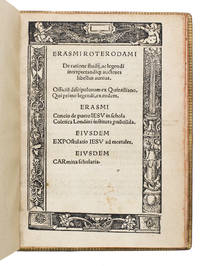
1516ref. ABC_49694Colophon Strasbourg: Matthias Schürer 1516. Modern brown pigskin with a blind-tooled single fillet frame on both boards gold-tooled turn-ins red edges in a beige paperboard slipcase. 4to. With a woodcut decorated title frame and 3 woodcut decorated initials. Early edition of Erasmus seminal educational treatise De ratione studii here presented alongside several other influential pedagogical and devotional texts. It further includes: Officium discipulorum ex Quintiliano The duties of students according to Quintilian including a section on the first stages of learning to read also derived from Quintilian a sermon on the child Jesus by Erasmus intended for delivery at the Colet School in London a lament of Jesus addressed to mankind and a collection of school poems.The opening dedication addressed to Peter Viterius a professor of liberal arts sets the tone for this work: Erasmus praises his friends discernment and judgment in matters of education using vivid comparisons drawn from military strategy and classical mythology to underscore the importance of order and method in learning. Without it he argues even the most gifted minds may falter. Of particular note is Erasmus endorsement of an instructional technique that became central to Renaissance humanist pedagogy: the use of structured annotation. In De ratione studii he recommends that students classify selected passages under thematic headings a mnemonic device that aids both retention and retrieval. This principle would go on to shape the methods of early modern teaching and note-taking. It also reflects Erasmus' broader educational reforms where rhetoric and moral philosophy intersect. His engagement with progymnasmata preliminary rhetorical exercises especially those of Aphthonius favoured for their clear organisation into theory and examples demonstrates his commitment to practical and accessible instruction for young learners.With some contemporary and later underlining and annotations in red and brown ink mainly consisting of corrections additions to the text and markings of significant passages. Two minor worm holes througout barely affecting the text. The gutters between leaves V-VI; VII-VIII; XX-XXI; and after leaf XXIII have been reinforced in the gutter with linen tape slightly browned throughout. Otherwise in good condition.l Adams E 346; Bezzel 1709; USTC 653250 9 copies; Vander Haeghen I 169; VD16 E 3534; not in BM STC German; De Reuck; Kossmann. Matthias Schürer, hardcover
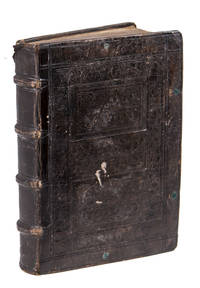
1522ref. ABC_49903Cologne: Eucharius Cervicornus 1522. Contemporary blind-tooled calf with armorial panel-stamps. Sewn on 4 supports with corresponding raised bands on the spine with remnants of 4 pairs of green closing ties re-backed. 4to. With an elaborate woodcut frame on the title page and 2 smaller woodcut frames on the first pages of the texts and 5 woodcut decorated initials. 2 parts in 1 volume. Including: ERASMUS Desiderius. Commentarius in psalmum quare fremuerunt gentes. Second edition printed in the same year as the first of Erasmus version of the Commentaries on the psalms attributed to Arnobius the Younger a Christian priest active in 5th-century Gaul. Arnobius interprets the psalms allegorically relating their content to Christ and the Church. First printed in folio by Froben in Basel in September 1522 the present 4to edition was published shortly after that same year in Cologne by Eucharius Cervicornus. It contains Erasmus preface addressed to Pope Adrian VI the commentary of Arnobius on the psalms and Erasmus own extensive commentary on psalm 2 Quare fremuerunt gentes. The present copy is bound in a contemporary Cologne binding attributed to an anonymous binder active circa 1510. Both boards feature a panel-stamped frame including three armorial shields of the city arms of Cologne ermine field with three open crowns the arms of the Archbishopric of Cologne a black cross on a silver field and a diagonally banded shield likely the binders own mark. Inside there are two identical rectangular panels made up of a stamp with bird motifs and the motto Clamo ad te Domine "I call to you Lord".With two book plates mounted on the front pastedown Thomas Brooke F.S.A. Armitage Bridge and one with the motto Pro viribus summis contendo a small manuscript cypher CP on the title page and Erasmus commentary contains manuscript annotations in the margins and on the final blank page by a near-contemporary hand. The binding has been re-backed the head of the spine is slightly damaged the corners of the boards are slightly damaged the original blind-tooled leather on the boards is somewhat dry and cracked affecting the clarity of the stamps and with some small scratched in the leather on the front board. Some occasional browning and water- staining in the margins. Otherwise in good condition.l Bezzel 554; Goldschmidt 57; Jenkins 2.1; USTC 613135; Vander Haeghen II 10; VD 16 B 3132 and VD 16 E 2460; not in: BM STC German De Reuck. Eucharius Cervicornus, hardcover
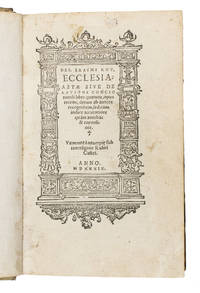
1539ref. ABC_49727Antwerp: sub intersignio Rubri Castri = Guilielmus Montanus 1539. 18th-century half vellum with a brown paper title label on the spine lettered in black the manuscript year of publication at the foot of the spine decorated paper sides with a hand drawn floral design in red and blue ink red edges. Small 8vo. With an architectural woodcut border on the title page 7 decorated metalcut initials 5 woodcut headpieces 7 woodcut tailpieces and a woodcut printer's device at the end of the work. Scarce early edition of an influential manual on preaching. It was one of the last major works which Erasmus produced and is considered one of his most significant treatises on theology. The work was incredibly popular in his own time as Erasmus had been pressured for many years to write it. The present edition which is the first by Montanus and the third authorised edition is relatively scarce however with only two other copies recorded in sales records of the 21st century."The Ecclesiastes is really a collection of three works: a theological treatise on the importance of preaching and the role of the preacher in the church Book I a textbook on homiletics and hermeneutics which provides the preacher with the basic tools necessary for both the interpretation of scripture and the construction and delivery of sermons based on biblical terms Books II and III and a list of sermon topics with an explanation of how some of them should be developed. From this organization it is clear that Erasmus attempted to provide his contemporaries with both a theology of preaching and clear and precise advice on the art of preaching" Kleinhans.With 18th-century annotations on the front pastedown and in the margins of some of the leaves several portions of text are underlined. The edges and corners of the boards are somewhat scuffed the vellum is somewhat soiled and stained. The work is somewhat browned throughout with brown ink stains on a few leaves affecting a few words minor loss of material in the lower margin of a7 and a8 without affecting the text. Otherwise in good condition.l Adams E-631; De Reuck 179; Erasmus Online 1682; Nijhoff & Kronenberg 2923; STCV 12926615; USTC 440876; Vander Haeghen I 78; not in Bezzel; cf. Kleinhans R.G. "Erasmus Ecclesiastes and the Church of England" in Historical Magazine of the Protestant Episcopal Church 39 3 1970 pp. 307-14; Rouzet Dictionnaire des imprimeurs belges p. 153. sub intersignio Rubri Castri (= Guilielmus Montanus), hardcover
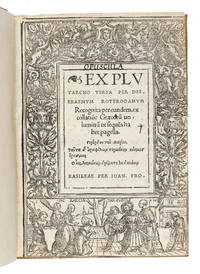
1520ref. ABC_49876Basel: Johann Froben 1520. Modern gold-tooled half calf and marbled paper sides with the author title and year of publication lettered in gold on the spine red sprinkled edges. 4to. With the title set within an elaborate woodcut frame a smaller woodcut frame on the verso of the title page and the first page of the first text. Further with 9 woodcut decorated initials woodcut headpieces and a small woodcut illustration incorporating Frobens device on the last page. This finely printed 1520 Basel edition presents a collection of Erasmus earliest translations from the works of the Greek moral philosopher Plutarch. The volume presents eight of Plutarch's shorter treatises addressing themes such as friendship health and the nature of the human soul.One of the most notable inclusions is De discrimine adulatoris et amici How to tell a flatterer from a friend a treatise Erasmus translated during his time in Cambridge and dedicated to King Henry VIII. The text which explores the subtle art of distinguishing true friendship from sycophancy resonated in an era when rulers were often surrounded by flattering courtiers. With characteristic tact Erasmus hoped the work might serve both as philosophical instruction and as a gentle warning to the young English king particularly in light of those who had encouraged Henrys war with France.Furthermore the present work includes two of Plutarchs important medical treatises in Erasmus translation: De tuenda bona valetudine Advice on keeping well and Utrum graviores sint animi morbi quam corporis Are diseases of the soul more serious than those of the body. The latter contains strikingly early and thoughtful reflections on what we now recognise as mental illness. Other works included in this volume are: Quo pacto quis efficere possit ut capiat utilitatem ab inimico reflections on transforming enmity into wisdom and personal growth. In principe requiri doctrinam on the necessity of wisdom and education in a prince. Cum principibus maxime philosophum debere disputare a meditation on the philosophers role in advising those in power. Num recte dictum sit e ßsa on the meaning of the maxim lathe biosas: to live quietly and modestly. De cupiditate divitiarum a discourse on avarice and the moral corruption born of greed.With a small manuscript note added above the title opuscula and a 17th- or 18th-century owners inscription by an otherwise unidentified Johannes below the colophon on the final page. Slightly foxed and browned throughout the fore-edge and lower margins are cut slightly short barely affecting the printed marginalia. Otherwise in good condition.l Adams p. 654; Ledo pp. 260-66; USTC 655014 6 copies; Vander Haeghen II 46; VD 16 P 3718; not in BM STC German; De Reuck. Johann Froben, unknown
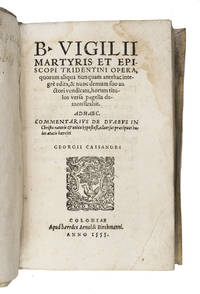
1535ref. ABC_49895Cologne: printed by Jaspar von Gennep for Peter Quentel 1535. Limp overlapping vellum with ties. 8vo. With an elaborate woodcut border on the title page of ad 1 several decorated woodcut initials and Quentels woodcut device at the end. 2 works in 1 volume ad 2 in 2 parts. With bound before ad 1:2 VIGILIUS. Opera .Including: CASSANDER Georg. Commentarius de duabus in Christo naturis .Cologne Arnold Birckman 1555. A rare and significant edition of De veritate corporis et sanguinis Domini by Alger of Liège Algerus ca. 1060-ca. 1131 Benedictine monk of Cluny and one of the most influential medieval theologians on the Eucharist. This major treatise composed during the so-called second Eucharistic controversy defends the doctrine of the real presence of Christ in the Eucharist against the teachings of Berengarius of Tours. Admired by both medieval scholars and later by Erasmus Algers work remained central to Catholic theology well into the sixteenth century.This copy represents the Erasmian edition prepared under Erasmuss supervision with his corrections and editorial guidance. His involvement gave the text a new humanist form and authority making Algers theology newly relevant at a time when Eucharistic doctrine was again fiercely debated during the Reformation. Erasmuss careful attention to clarity and Latinity situates this edition within his broader humanist programme of restoring theological texts to philological precision and doctrinal coherence.Only a handful of copies of this edition are known and no record of it appears in recent sales databases underlining its rarity on the market. It is the second edition overall following the first printing in Freiburg im Breisgau 1530 and the first to be issued by Peter Quentel in Cologne.Bound together with the Opera of Vigilius 1555 and a Commentarius opposing the Christological views of Georg Cassander 1555 this important Sammelband reflects the continuing Catholic polemic against Reformation-era innovations in both Eucharistic theology and Christology.The vellum is slightly dampstained lacking part of the bottom closing tie on the front. Some stains and browning throughout. Otherwise in good condition.l Ad 1: BM STC German p. 20; USTC 626331; Vander Haeghen II 6; VD 16 A 1871; cf. Adams 173 1530 ed.; Ad 2: Adams V 748; BM STC German p. 893; USTC 615055; VD 16 V 1184. [printed by Jaspar von Gennep for] Peter Quentel, hardcover
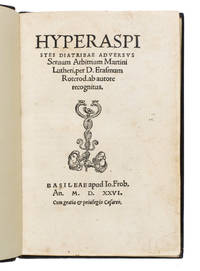
1526ref. ABC_49737Basel: Johann Froben 1526. Modern calf with the author title and year of publication lettered in gold on the spine. Small 8vo. With a woodcut printer's device on the title page and final leaf and 2 decorated woodcut initials. First revised edition of Erasmus' response to Martin Luther which is part of their famous theological debate that took place in the 1520s. Erasmus received Luther's work in February 1526. The Hyperaspistes is his first reply to it which he composed within a few days in March 1526. The present edition revised by Erasmus himself and published in July of the same year supplies a more correct text of this famous refutation.The Hyperaspistes first published in March 1526 deals with the question of free will and was written in response to Luthers De servo arbitrio On enslaved willl 1525 which in turn was written in reply to Erasmuss De libero arbitrio On free will 1524. Luther argued that humans could not achieve salvation through good deeds as they could not choose between good and evil and so could only be redeemed through the will of God. Erasmus on the other hand believed that each individual had the freedom to accept Gods grace and turn towards a Christian life and salvation could be reached through good deeds. The confrontation between Erasmus and Luther was a duel of major importance for Europe in the first half of the 16th century as two visions of man history and faith clashed.The second part of the Hyperaspistes appeared in September 1527 continuing the exegetical controversy with Luther. The present edition however was published before the second part was written.With near- contemporary annotations in the margins of some of the leaves. The work is lightly browned and foxed throughout. Otherwise in good condition.l Adams E-675; Bezzel 1117; BM STC German p. 281; Erasmus Online 2230; USTC 664562; Vander Haeghen I 110; VD16 E 3029; cf. De Reuck 236 other issue. Johann Froben, unknown
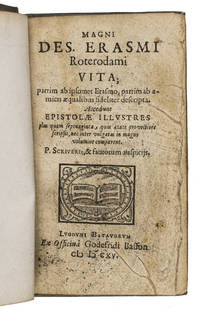
1615ref. AAVD49P5O5GWLeiden: Govert Basson 1615. Contemporary vellum sewn on 3 vellum tapes laced through the joints with the manuscript title on the spine red edges. 12mo. With a woodcut printer's device on the title page a woodcut roundel with portrait of Erasmus on leaf 5 a divisional title page for Erasmus' letters and a few woodcut decorated initials. Important collection of sources for the biography of Desiderius Erasmus 1469-1536 put together and edited by Petrus Scriverius on the basis of the 1607 edition by Merula of the Compendium vitae including a number of new sources and four hitherto unpublished letters by Erasmus. The humanist and independent scholar Petrus Scriverius 1576-1660 worked in Leiden outside the University but he was in continuous contact with the most famous Leiden professors. Scriverius added commentaries and connecting texts by which the collection gained weight as materials for Erasmus' biography. Also through the later editions edited by Thysius and published by Joannes Maire in 1642 and 1649 the collection became very influential regarding Erasmus' "image" before the first critical biography of Erasmus was published by Joannes Clericus in 1705.With a few near-contemporary manuscript annotations and markings in the margins. The vellum and the title page are slightly dust soiled the pastedowns have detached from the inside of the boards and the front pastedown is lacking the upper outer corner the bottom outer corner of leaf C6 is sligthly damaged not affecting the text some occasional very slight foxing. Otherwise in good condition.l Knaake II 355a; STCN 832265039; Tuynman 'Petrus Scriverius 1576-1660' in: Quaerendo 7 1977 pp. 4-45 esp. 23-4; USTC 1027478; Vander Haeghen 182. Govert Basson, hardcover
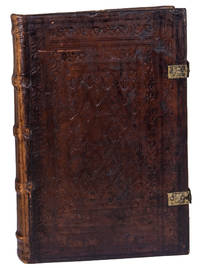
1515ref. ABC_49919Basel: Johann Froben 1515. Contemporary blind-tooled calf over wooden boards with brass and leather clasps along the fore edge professionally re-backed with later blank pastedowns. Folio. With the title set in a splendid woodcut frame by Urs Graf including Froben's small woodcut device woodcut decorations in the fore-edge and gutter margins of the table of contents verso of the title page and another elaborate woodcut frame on the first page of the dedication. Further with some woodcut initials and Froben's large woodcut device below the colophon on the last page. Senecas complete works here carefully prepared by Erasmus and printed by the renowned Basel publisher Johann Froben are remarkable both for its scholarly rigor and its historical significance. The present work represents one of the earliest Renaissance printings of Senecas writings presenting essays letters and philosophical dialogues that guide the reader toward virtue wisdom and a well-examined life. Erasmus thorough editorial care ensured that the texts were largely purged of errors making this edition an important reference for both humanist scholars and students of classical literature.In addition to the main works this volume includes a number of supplementary writings added by Erasmus reflecting his deep engagement with Senecas philosophy and his commitment to moral and linguistic improvement. The preface encourages attentive reading promising both the refinement of language and the betterment of ones life.The work entitled Ludus de morte Claudii Caesaris includes marginal commentary by Beatus Rhenanus a German humanist and reformer who was a friend of Erasmus and actively involved in the publishing activities of Johann Froben.With printed ex libris bookplate mounted on the front pastedown manuscript waste visible between the front and back endpapers a few manuscript annotations in the margins and some of the text underlined. The binding shows signs of wear the boards have been rubbed some loss of material a small worm hole in the back board the pages are cut slightly short at the head not affecting the text and some occasional slight staining and browning. Otherwise in good condition.l BM STC German p. 808; USTC 667432; Vander Haeghen II 49; VD 16 S5758; not in Bezzel; De Reuck. Johann Froben, hardcover
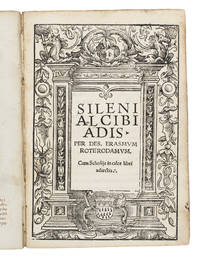
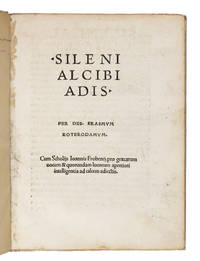
1520ref. ABC_49888Colophon: Cologne: Servas Kruffter 1520. 19th-century marbled boards with a blue paper manuscript title label on the front board. 4to. With an elaborate woodcut border on the title page and a decorated woodcut initial. Rare early edition of an influential work by Desiderius Erasmus which is a call for reform of the Catholic Church. It uses the Ancient Greek figure Alcibiades ca. 450-404 BC and the mythical characters known as the Sileni as an allegory for looking beyond appearances in order to perceive someone's or the Church's true nature. Erasmus wrote the text as part of his compilation of proverbs the Adagia in particular for the revised 1515 edition where it became one of the most popular entries. It was then published by Froben as a separate work in 1517 with his scholia. The present edition is the fourth or fifth overall but the first by Servas Kruffter fl. ca. 1520-1538 and is of considerable scarcity with only five copies recorded in institutions and none in sales records. The Cologne printer Kruffter was repeatedly restricted by censorship and even put in jail several times. Only a comparatively small number of books from his limited production has survived.With the bookplate of the Oberherrlingen Library dated 1839 mounted on the verso of the front board together with two typed descriptions of the work. The boards are somewhat rubbed lacking most of the spine. The work is somewhat browned throughout with a water stain in the inner margin not affecting the text. Otherwise in good condition.l Bibl. Belgica E 261; Erasmus Online 3582; USTC 693956 4 copies; Vander Haeghen I 176; VD 16 E 1991; WorldCat 763214270 150404098 5 copies; not in Adams; Bezzel; BM STC German; De Reuck. Servas Kruffter, hardcover
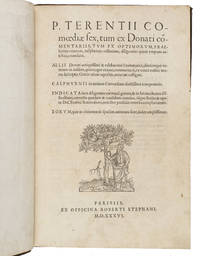
1536ref. ABC_49923Paris: Robert Estienne 1536. Late 17th-century calf sewn on five supports with corresponding raised bands richly gold-tooled spine with the author title and year lettered in gold and red and-brown sprinkled edges. Small folio 20.2 x 30.3 cm. With Estiennes small woodcut device ona small woodcut the title page. Second edition of Terences Comoediae published by the French humanist and printer Robert Estienne 1503-1599. Publius Terentius Afer also known as Terence ca. 195-ca. 159 BCE was a Roman playwright of North African origin and one of the foremost authors of Latin comedy. The present work includes the commentary of Aelius Donatus 4th century CE based on a manuscript provided by Estiennes father-in-law Josse Bade 1462-1535. Donatus was a Roman grammarian and teacher of rhetoric best known for his grammatical works Ars Minor and Ars Maior. Building on Estiennes earlier 1529 folio edition this one was printed in the new Roman types and divided into acts and scenes a notable innovation. In addition Estienne incorporated Erasmus treatise on comedic metres which provided a scholarly analysis of the rhythmic and metric structures of classical comedies enhancing readers understanding of Terences original cadence and comedic effect.The boards are severely rubbed light foxing and staining throughout the title page is very slightly browned the head margin is cut slightly short. Otherwise in good condition.l Adams T 326; BM STC French p. 416; De Reuck 512; Inventaire chronologique des editions Parisiennes du XVIe siecle V 314; Renouard Estienne I 43 no. 15; Schreiber 52; USTC 147028 9 copies; Vander Haeghen II 55. Robert Estienne, hardcover
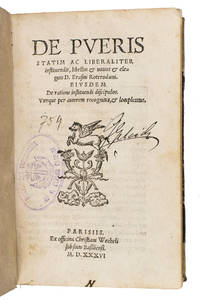
1536ref. ABC_49637Paris: Chrétien Wechel 1536. Half vellum and brown sprinkled paper sides with the faded manuscript title on the spine red edges. 8vo. Ad 1 with Wechels woodcut device on the title page and 3 woodcut decorated initials. Ad 2 with Wechels woodcut device on the title page and the verso of the blank last leaf and 1 woodcut decorated initial. Ad 3 with a woodcut architectural frame on the title page and 2 woodcut decorated initials. Ad 4 with Frobens woodcut device on the title page and the verso of the last blank leaf. 4 works in 1 volume. With:2 ERASMUS Desiderius. Responsio ad Petri Cursii defensionem nullo adversario bellacem.Paris Chrétien Wechel 1535.3 ERASMUS Desiderius. Responsio ad epistolam paraeneticam clarissimi doctissimicque viri. Alberti Pii carporum principis. Paris Pierre Vidoux April 1529.4 ERASMUS Desiderius. Purgatio adversus epistolam non sobriam Martini Luteri.Basel colophon: Hieronymus Froben and Nikolaus Episcopius April 1534. Together these four works capture the remarkable breadth of Erasmuss influence from his visionary humanist pedagogy to his forceful engagement in the theological controversies of the Reformation. Brought together in this volume they reflect both the moral urgency and intellectual sharpness that defined his contribution to early modern thought.Ad 1: First published in September 1529 De pueris statim ac liberaliter instituendis and De ratione instituendi discipulos represent Erasmus principal contribution to Renaissance pedagogy. He argues for the early and liberal education of children stressing mildness rather than severity moral formation alongside learning and the formative power of classical texts. Ad 2: An exceptionally rare edition of a polemic against the Louvain theologian Petrus Curtius in which Erasmus defends his humanist theology whilst ridiculing Curtius as a fighter without an adversary. First issued by Froben and Episcopius earlier that year with only that edition and the present Wechel edition extant; the text was not reprinted until the Opera omnia.Ad 3: A spirited reply to the accusations of Alberto Pio Prince of Carpi coupled with sharp extemporaneous notes against Edward Lee Beda. This double defence displays Erasmus wit and sharpness at the height of the Reformation debates. A very scarce edition; the editio princeps had appeared from Froben in March of the same year.Ad 4: An early witness to the high demand in 1534. Erasmus rejoinder to Luthers intemperate letter written in the wake of De servo arbitrio. Here Erasmus defends himself against charges of paganism whilst censuring Luthers furious and mendacious tone. After 1534 the text was no longer issued separately.With a manuscript owners inscription and a later purple stamp of the library of the Franciscan church and convent of Saint Clare in Kotor Montenegro on the title page of the ad 1. Further with a few manuscript annotations in the margins and some of the text underlined and crossed out throughout the work. The binding shows signs of wear the boards have been rubbed with some loss of material some occasional slight browning. Otherwise in good condition.l Ad 1: Adams 338; Inventaire chronologique des editions Parisiennes du XVIe siecle V no. 144; USTC 185690 1 copy; Vander Haeghen I 164; not in BM STC German; Ad 2: Inventaire chronologique des editions Parisiennes du XVIe siecle IV no. 1299; USTC 185562 1 copy lost; Vander Haeghen I 174; WorldCat 492052585 1 copy; cf. for the 1535 Froben edition see: Bezzel 1782; USTC 635442; VD16E3622; not in Adams; BM STC German; Ad 3: Adams 828; Inventaire chronologique des editions Parisiennes du XVIe siecle III no. 1758; USTC 181160; not in Vander Haeghen; BM ST C German; Ad 4: Vander Haeghen I 164; cf. Adams 809 later edition; USTC 635432 6 copies; VD 16 E 3481; not in BM STC German. Chrétien Wechel, hardcover
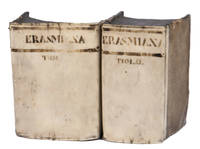
1642ref. AB6GB5JMB8EQLeiden: Joannes Maire 1642. Contemporary half vellum paper sides with "Erasmiana tom. I or II" in manuscript on the spine blue edges. 12mo. Ad 1 with an engraved title page by C. van Dalen showing Erasmus standing in a church with a book in his left hand pointing to three other men. All title pages contain Maire's woodcut device see Breugelmans nr. 13 and a woodcut portrait of Erasmus in a roundel on leaf 8r in ad 1 and his device in a roundel in the text on leaf 25v in ad 1. Further with several woodcut decorated initials throughout. 14 works in 2 volumes. With:2 ERASMUS Desiderius. Lingua sive de linguae usu atque abusu liber utilissimus.Leiden Joannes Maire 1649.3 ERASMUS Desiderius. Moriae encomium cum Gerradi Listriis commentariis. Epistolae aliqut in fine additae. Leiden Joannes Maire 1648.4 ERASMUS Desiderius. Dialogus Ciceronianus: sive de optimo genere dicendi. Leiden Joannes Maire 1643.5 ERASMUS Desiderius. Dialogus de recta Latini Graecique sermonis pronuntiatione. Leiden Joannes Maire 1643.6 ERASMUS Desiderius. De contemptu mundi liber. Leiden Joannes Maire 1641.7 ERASMUS Desiderius. Querela pacis undique gentium ejectae profligataeque. Leiden Joannes Maire 1641.8 ERASMUS Desiderius. De immensa Dei misericordia. Leiden Joannes Maire 1641.9 ERASMUS Desiderius. Modus orandi Deum. Leiden Joannes Maire 1641.10 ERASMUS Desiderius. Precationes quibus homines assuescant cum Deo loqui.Leiden Joannes. Maire 1641.11 ERASMUS Desiderius. Enarratio in Psalmum I.Leiden Joannes Maire 1644.12 ERASMUS Desiderius. Enarratio triplex in Psalmum XXII. Leiden Joannes Maire 1645.13 ERASMUS Desiderius. Enarratio pia juxta ac docta in Psalmum XXXIV.Leiden Joannes Maire 1652.14 ERASMUS Desiderius. Concionalis interpretatio plena pietatis in Psalmum LXXXVI.Leiden Joannes Maire 1652. These 14 important works by Erasmus - the edition of his most important letters after the Vita edited by Petrus Scriverius 1576-1660 his famous Laus stultitiae and 3 of his linguistic works in the first volume and 9 theological works in volume 2 - belong to a project of the Leiden publisher printer and bookseller Joannes Maire 1603-1657. This project that can be seen as a series of editions that together represent Erasmus' collected works ensured Maire's stellar reputation through the ages. 23 different works appeared between 1641 and 1652. It has long been thought that Petrus Scriverius was the editor but now there is proof that in fact Willem Henricus Vorstius a learned Remonstrant minister in the village of Warmond near Leiden did the job Breugelmans p. 24.11 works were published in 1641 5 of which in the present collection; 2 in 1642 1 present 3 in 1643 2 present 1 in 1644 also present 3 in 1645 1 present 1 in 1648 also present 1 in 1649 also present 1 in 1650 also present and 2 in 1652 both present. The whole collection brings together a representative selection of Erasmus' spiritual moral and exegetical writings - as it includes treatises on Christian prayer and devotion moral and ascetical reflections expositions of the Creed the Ten Commandments and the Lord's Prayer and commentaries on select psalms. It is presented together with Sriverius' edition of the Vita a biography of Erasmus.Printed in compact duodecimo format with Maires characteristic typographic elegance these Leiden editions form one of the most coherent 17th-century series of Erasmus spiritual writings.With a manuscript owner's inscription on the title pages of ads 1 and 6 a small manuscript inscription on the title page of ad 2 and a small manuscript inscription on the title pages of ads 3 5 and 6-14. Further with two library stamps of the Nordelbische Kirchenbibliothek in Hamburg incl. "Gelöscht" stamps on the versos of the title pages of ads 1 and 6. The bindings are dust soiled and slightly damaged along the extremities but the structural integrity of both bindings remains fine slight foxing and browning throughout. Otherwise in good condition.l Ad 1: Breugelmans Fac et spera. Joannes Maire 2003 1642:7; STCN 840230303; USTC 1028900; Van der Haeghen I 182; Ad 2: Breugelmans 1649:3; Overzicht werken Erasmus Rotterdam 1936 934; STCN 840230753; USTC 1028906; Van der Haeghen I 118; Ad 3: Breugelmans 1648:3A; Overzicht werken Erasmus Rotterdam 1936 990; STCN 840230621 9 copies incl. 1 incomplete; USTC 1028905 9 copies same as STCN; Van der Haeghen I 124; Ad 4: Breugelmans 1643:4; Overzicht werken Erasmus Rotterdam 1936 663; STCN 84023127X; USTC 1028908; Van der Haeghen I 75; Ad 5: Breugelmans 1643:5; Overzicht werken Erasmus Rotterdam 1936 671; STCN 840231237; USTC 1028907; Van der Haeghen I 242; Ad 6: Breugelmans 1641:3B; Overzicht werken Erasmus Rotterdam 1936 556; STCN 840238592 7 copies; USTC 1028914 7 copies same as STCN; Van der Haeghen I 7; Ad 7: Breugelmans 1641:13B; STCN 840227620 5 copies; USTC 1028897 5 copies same as STCN; Van der Haeghen I 167; Ad 8: Breugelmans 1641:4B; STCN 840238479 7 copies; USTC 1028912; Van der Haeghen I 73; Ad 9: Breugelmans 1641:10B; STCN 06126220X 6 copies; USTC 1011884; Van der Haeghen I 121; Ad 10: Breugelmans 1641:11A; Overzicht werken Erasmus Rotterdam 1936 1033; STCN 061215252; USTC 1011798; Van der Haeghen I 160; Ad 11: Breugelmans 1644:2; Overzicht werken Erasmus Rotterdam 1936 1340; STCN 061265306; USTC 1011896; Van der Haeghen I 162; Ad 12: Breugelmans 1645:4; Overzicht werken Erasmus Rotterdam 1936 1345; STCN 113911165; USTC 1015819; Van der Haeghen I 162; Ad 13: Breugelmans 1652:3; Overzicht werken Erasmus Rotterdam 1936 1347; STCN 061377597; USTC 1801991; Van der Haeghen I 162; Ad 14: Breugelmans1652:2; Overzicht werken Erasmus Rotterdam 1936 1350; STCN 061377473; USTC 1802003; Van der Haeghen I 162. Joannes Maire, hardcover
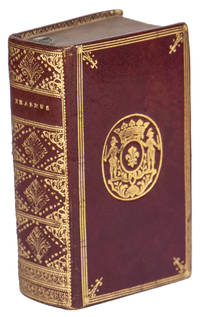
1658ref. 18897Amsterdam: Joannes Janssonius 1658. 18th-century richly gold-tooled red morocco both boards show a triple fillet frame with small cornerpieces in the inside corners and an oval armorial centrepiece crowned fleur-de-lis flanked by two knights gold-tooled spine with "Erasmus" lettered in gold gold-tooled board edges and turn ins gilt edges marbled endpapers. 12mo. With an engraved title page a full-page engraving showing Erasmus woodcut decorated initials and several woodcut head- and tailpieces. Including: Coronis apologetica pro colloquiis Erasmi ex ipsius scriptis quantum per otium licuit fideliter collecta à P.S. accedit ejusdem De Collequiorum utilitate dissertatio. Montanus' edition of a renowned famous Latin schoolbook written by Erasmus one of the most used Latin schoolbooks for centuries as it discusses all basic scholarly and moral issues. With Erasmus' preface-letter to Froben at Basel dated 1524 and the Vita Erasmi preceding the Colloquia as well as two indices of authors and dialogues. Included at the end is a short essay explaining the usefulness of the book.With a few 17th-century annotations on the engraved and letterpress title pages resp. "1662" and "Besnier". The engraved title page is cut slightly short not affecting the engraving. Otherwise in very good condition.l Bibl. Belg. II E 572; Erasmus Coll. City Library Rotterdam p. 50; STCN 850071909 9 copies; Vander Haeghen p. 40. Joannes Janssonius, hardcover
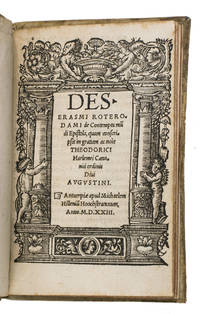
1523ref. ABC_50124Antwerp: Michiel Hillen van Hoogstraten 1523. Later vellum with the manuscript title and year of publication on the spine red sprinkled edges. 8vo. With a decorative woodcut border on the title page and 2 decorated woodcut initials. Very rare early edition of Erasmus first written work a letter in praise of monastic life which was only published later in his career. Erasmus wrote it in 1488 or 1489 when he was 20 years old at the request of Theodoricus of Haarlem a fellow canon at the Augustine monastery at Steyn in order to persuade his nephew to join the order. It circulated in manuscript form for many years and was likely used to entice prospective candidates to enter the order of Canons Regular of St. Augustine.The work is divided into three parts: the first seven chapters focus on the evils of this world; chapter eight through eleven on the pleasures of the religious life; and chapter twelve on the ultimate choice between the material world or the religious state. This final chapter appears to counteract the rest of the work as it advises Theodoricus' nephew to carefully consider whether he truly wanted to enter a religious order since being a Christian is enough in itself. As such it has been suggested that Erasmus rewrote the text before its publication adding the 12th chapter but as he apologises for his adolescent writing style in the preface the work was likely mostly unedited.The first edition was published in Louvain in 1521 more than 30 years after it was written. The present edition is the first by Michiel Hillen van Hoogstraten and one of four printed in 1523. It is exceptionally rare on both the market and in institutions as only four copies have been recorded in libraries and we have not been able to find any others in sales records of the past century.The vellum is slightly soiled. The work is slightly browned throughout. Otherwise in good condition.l Adams E-569; Erasmus Online 1383; Nijhoff & Kronenberg 804; USTC 403708 4 copies; Vander Haeghen p. 64; WorldCat 71746606 2 copies; cf. De Molen R. "First fruits. The place of Antibarbarorum Liber and De contemptu mundi in the formulation of Erasmus Philosophia Christi" in: Colloque érasmien de Liège 1986 pp. 177-196; not in Bezzel; De Reuck; STCV. Michiel Hillen van Hoogstraten, hardcover
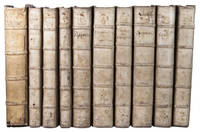
1569ref. ABC_49477Basel: Ambrosius & Aurelius Froben 1569. Contemporary half elaborately blind-tooled pigskin over wooden boards sewn on 5 supports volume 1 on 4 with two brass clasps on the fore edge leather anchor plate brass clasp and catch plate. With the manuscript titles on the spines and the contents of each volume in manuscript on the bottom edge of all but one volume. Probably bound by Michael Hermann in Stuttgart before 1580. See for the workshop einbanddatenbank no. 502297b the rolls used: nos. r004651 and r003964. Folio 38 x 25.5 cm. With the general title page in volume 1 set within an elaborate woodcut frame all other title pages show the large woodcut Froben printer's device repeated on all but one verso of the final page in each part. Further with woodcut decorated initials. 11 parts in 10 volumes. A complete and uniformly bound set of the monumental edition of the complete works of Saint Augustine of Hippo printed by the celebrated Froben press. This edition follows the editorial tradition established by Erasmus and Johann Froben in the early 16th century and reflects the enduring influence of Augustines thought on early modern theology. The present work includes a broad range of Augustines writings: his dogmatic treatises De Trinitate De civitate Dei polemical works notably against Pelagianism and Manichaeism exegetical texts Enarrationes in Psalmos Gospel homilies ascetic and moral discourses and the Epistolae. This edition represents an early attempt to consolidate Augustines vast corpus for academic and ecclesiastical use during period following the Council of Trent. It demonstrates the persistence of Augustinian authority in Reformation-era intellectual life as well as the role of the Swiss printing houses in disseminating patristic texts throughout Europe.Aurelius Augustine 354-430 CE commonly known as Augustine of Hippo was a North African bishop theologian and philosopher widely regarded as one of the most influential figures in Western Christianity and Latin patristic thought. Born in Thagaste modern-day Souk Ahras Algeria Augustine received a classical education in rhetoric and philosophy before embracing Manichaeism and later Neoplatonism.After a period of moral and spiritual searching chronicled in his Confessiones he converted to Christianity in 386 CE under the influence of Ambrose of Milan. He was baptised in 387 ordained a priest in 391 and became bishop of Hippo Regius in 395 a position he held until his death.Augustines vast body of work addresses themes such as original sin grace free will the nature of the Church and the interpretation of Scripture. His most notable writings include Confessiones De civitate Dei the City of God and De Trinitate. His thought shaped the theological foundations of both medieval Catholicism and later Protestant traditions particularly through his doctrines of grace and predestination. He died in 430 CE during the Vandal siege of Hippo. Augustine was later declared a Doctor of the Church and his intellectual legacy remains foundational to Western theology and philosophy.With a manuscript inscription on each of the title pages and a small printed book plate mounted on the front pastedown of volume 1. The bindings are slightly stained and are occasionally slightly bumped and rubbed. The front hinge of volume one is slightly weakened lacking the upper clasp and anchor plate of volume 7 and the front board of volume 9 is slightly damaged along the fore edge. Internally the volumes are variably slightly foxed and/or browned some volumes show very minor water staining most volumes contain some minor worm holes which affect small parts of the letters. A more detailed condition report including collations etc. per volume is available upon request. The 10 volumes are overall in very good condition. A handsome and important Renaissance printing of one of the most significant corpora of Christian antiquity. Rare complete in all ten volumes here uniformly bound.l USTC 686573; VD 16 A 4153; WorldCat 1828402 1406901978 1090145458 1002789099 35656998 222081178 1322263024 1114269923; cf. for the binder see Einbanddatenbank no. 502297b rolls nos. r004651 and r003964. Ambrosius & Aurelius Froben, hardcover
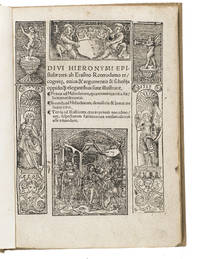
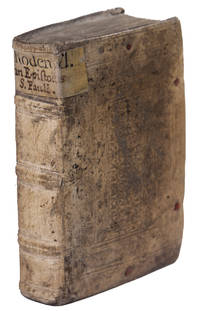
1518ref. ABC_49875Cologne: Johann Gymnic 1518. Modern faux-leather-patterned paper with a grey paper label on the spine with the authors name lettered in silver Erasmus v. Rotterdam. 4to. With the title set with in a frame built up from 4 or possibly 6 woodcut illustrations including printer's initials and the date 1518 and 10 woodcut decorated initials. Selection of three letters by the Church Father Jerome of Stridon Saint Jerome ca. 342/47-420 CE edited and annotated by Erasmus. Erasmus felt a profound connection to Jerome. He saw in the ancient Church Father not only a kindred spirit but also a mirror for his own intellectual and spiritual journey. Included in this volume are three letters: first the epistle to Heliodorus on the praise of the solitary life de vita solitaria a stirring defence of ascetic withdrawal from the world; second the epistle to Heliodorus on the misery of human life de miseria vitae humanae a sombre reflection on the fleeting nature of earthly existence; and third the epistle to the monk Rusticus on avoiding familiarity with women de mulieribus evitandis a warning shaped by both monastic ideals and Jeromes personal convictions. Additionally a short fourth letter addressed to Onasus is included at the end of the volume though it does not appear on the title page. In this letter he satirically addresses the priest Onasus who had a deformed nose and his feeling of being unjustly attacked and being made a fool of in other letters and writings by Jerome.With early manuscript annotations corrections etc. of the printed text in the margins and occasional underlining of the text mainly concerning the third letter written in three different hands in both brown and black ink. With a 0.5 cm worm hole in the gutter margin not affecting the text. Occasional foxing and browning and some water staining in the fore-edge margin of several leaves. Overall a good copy.l BM STC German p. 440; USTC 640603 3 copies; Vander Haeghen II 29; VD 16 ZV 7938; not in Adams; De Reuck. Johann Gymnic, hardcover
1520ref. ABC_49896Basel 1520. Small 8vo 10.1 x 15.3 cm. Hieronymus Froben Contemporary blind-tooled pigskin sewn on three supports with corresponding raised bands on the spine author and title lettered on a separated paper label at the head of the spine and with remnants of four pairs of red closing ties. With 5 woodcut frames on the title page and at the start of each text Corinthians in two parts 10 woodcut decorated initials 3 woodcut ornaments and a small woodcut illustration incorporating Frobens device above the colophon on the last page. "465" = 495 1 pp. First edition of Erasmus collected Paraphrases on the Pauline Epistles Romans 1 Corinthians 2 Corinthians and Galatians. Each paraphrase had appeared separately between 1517 and 1519 and this collected edition printed at Basel presented them together for the first time in a single work. Erasmus paraphrase on Romans was the earliest of the four. Completed during the summer of 1517 he initially intended it for publication by Froben in Basel. Concerned however that Frobens press was overburdened Erasmus entrusted the work instead to Dirk Martens in Louvain where he was then residing. Shortly thereafter Froben produced his own Basel edition in January 1518 and the work was an immediate success with further editions appearing in November 1518 and April 1519. The paraphrases on 1 and 2 Corinthians followed in early 1519. Once again Martens handled the first printing releasing it in February that year. However Froben was never far behind and brought out his own Basel edition the following month.The paraphrase on Galatians completed the present Pauline collection later that same year. The Louvain first edition appeared in May 1519 and was quickly followed by Frobens edition in August. Finally in January 1520 Froben gathered these works together into one volume.With a purple round stamp .bibliothek. on the title page and one blue round stamp from the same library on p. 97. With some contemporary underlinings and annotations primarily consisting of corrections textual additions and markings of notable passages. A difficult to read manuscript note on the last leaf a theological note on Paul's co-workers Epaphroditus and Tychicus written partly in Greek for the original terms and partly in Latin as explanatory glosses and on the back pastedown. Front pastedown detached from the boards revealing the printers waste likely a biblical commentary with references to Exodus and Genesis used in the binding. The binding is somewhat stained and rubbed affecting the clarity of some of the stamps on the front board. Some occasional water staining in the margins. Otherwise in good condition.l Adams E 790; Bezzel 1163; BM STC German p. 115; Sider Collected works of Erasmus volume 42 p. XXI; USTC 682544 6 copies; Vander Haeghen I 144; VD16 E 3060; not in De Reuck. hardcover
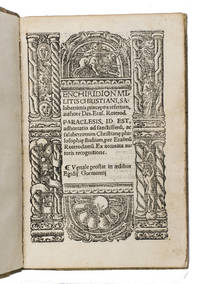
1522ref. ABC_49728Paris 1522. 8vo 10.3x16.2. Gilles de Gourmont Modern half vellum and sprinkled paper sides sewn on 5 supports with the corresponding raised bands on the spine the manuscript author title and supposed year of publication 1522 on the spine. With both titles set within an identical woodcut architectural frame and several woodcut decorated initials. 106 10 ll. Very rare Paris edition of Erasmus Enchiridion militis Christiani including a short text urging readers to study Christian philosophy. Before Erasmus became a household name for his satire The Praise of Folly or for his Latin translation of the New Testament he authored a lesser-known yet deeply personal work: Enchiridion militis Christiani The handbook of the Christian soldier.Written in 1501 the Enchiridion is a passionate call to return to a pure Christ-centred faith one grounded not in ritual or church hierarchy but in inner devotion and practical piety. With urgency and sincerity Erasmus wrote not for scholars or clergy but for ordinary believers striving to live a holy life.Between its first publication and Erasmuss death in 1536 the Enchiridion was printed in over fifty Latin editions becoming one of his most widely read works across Europe. This relatively early French edition is rare with few known copies surviving. We have traced only two other copies in sales records of the past 100 years one sold in 1920 and the other in 1980.With occasional near- contemporary manuscript annotations in the margins and underlining of some text indicating text improvements and highlighting important passages and in the same hand a short note on the blank verso of the last leaf most likely a philosophical reflection or content-related note. Most pages contain a simple frame ruled in red after printing the edges of the last quarter of leaves are slightly frayed minor water staining in the fore-edge margin and somewhat browned throughout. Otherwise in good condition.l Renouard inventaire chronologique des editions Parisiennes III 318; Renouard & Moreau II 1812; USTC 183822 lost book; Vander Haeghen I 84; not in Adams; Bezzel; BM STC French; De Reuck; Kossmann; WorldCat; cf. . Bibliotheca Belgica E 1023 ca. 1522 ed. with different impressum. hardcover
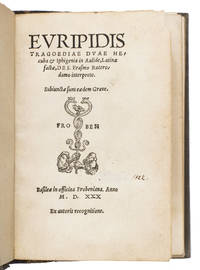
1530ref. ABC_49914Basel 1530. 8vo 10.4 x 15.4 cm. Froben Office heirs of Johann Froben 19th-century half brown calf and grey paper sides. With a woodcut printer's device on the title page and final page and 7 decorated woodcut initials. 293 1 1 blank 1 pp. This volume brings together Erasmus renditions in Latin of two of Euripides most enduring tragedies titled Hecuba and Iphigenia in Aulis presented alongside the original Greek texts beginning on page 169. Euripides ca. 480-ca. 406 BCE was a Greek tragedian of classical Athens. He is one of only three Greek tragedians whose plays have survived in full the others being Aeschylus and Sophocles.Both plays in the present work explore the devastating costs of war through the eyes of women caught in its aftermath. In Hecuba the former queen of Troy endures unspeakable losses the sacrifice of her daughter Polyxena the murder of her son Polydorus and ultimately a brutal act of revenge that leads to her mythical transformation into a howling dog symbolising her complete descent into grief and rage.Iphigenia in Aulis is set on the eve of the Trojan War focusing on Agamemnons impossible decision to sacrifice his daughter Iphigenia to appease the goddess Artemis and allow the Greek fleet to sail. The play confronts themes of duty honour and the personal costs of collective ambition. These themes echo tragically in Hecuba which portrays the wars bitter consequences. Together these tragedies form a poignant narrative arc from the sacrifices made to start a war to the wreckage and human suffering left in its wake.With a partially erased manuscript note on the title page 1822. Some water staining in the margins and a few small holes in the inner margin not affecting the text. Otherwise in good condition.l Adams E 1042; BM STC German p. 289; De Reuck 425; Erasmus Online 4215; Vander Haeghen II 25; VD 16 E 4231; USTC 654881; not in Kossmann. unknown
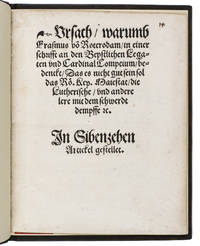
1531ref. ABC_49886Strasbourg or Nuremberg 1531. 4to. Georg Ulricher or Wolfgang Heußler Modern blind-tooled mottled calf with a double fillet border on both boards. 3 1 blank ll. Rare German edition of a letter Erasmus sent to the papal legate Lorenzo Campeggi 1474-1539 on August 18 1530. In this letter Erasmus expresses his fear that the Holy Roman Emperor would declare war to the Protestant German princes and explains in 17 articles why violence is not the answer. He never printed the letter himself and it probably never reached Campeggi. According to Allen Erasmus wrote that "it was intercepted by the treachery of some unnamed 'evangelical' and printed without authority in Strasburg". The letter was translated into German and indeed published several times in Strasbourg Wittenberg Magdenburg and Nuremberg in 1531. The present edition does not have an imprint but was either printed in 1531 in Strasbourg by Georg Ulricher or in 1546 in Nuremberg by Wolfgang Heußler. It is quite rare as we not been able to find any other copies of the present edition in sales records of the past hundred years.With a red bookbinder's label "Period Bookbinders Bath England" mounted on the recto of the last free flyleaf. The work is lightly browned and foxed the inner margins have been reinforced. Otherwise in good condition.l Bezzel 26; Erasmus Online 1874; USTC 704493 and 704494; VD16 E 1881 and VD16 E 1882; Vander Haeghen I 88; not in Adams; BM STC German; De Reuck; cf. Allen Opus Epistolarum Erasmi vol. IX intro. to Ep. 2366. hardcover
1520ref. ABC_49643Colophon: Basel 1520. Small 8vo. Johann Froben Later blind-tooled pigskin over bevelled wooden boards each board in a panel design with a lozenge-shaped ornament and cornerpieces in the central panel surrounded by a decorative border 2 metal clasps and catches the manuscript title at the head edge a blank paper label on the spine and 4 pigskin tabs. With a decorative woodcut border on the title page of each work a woodcut printer's device at the end of the first 2 works 9 decorative woodcut borders in the text 16 decorative woodcut initials and 4 woodcut headpieces. 4 works in 1 volume. 141 3; 167 1; 91 1 blank; 14 2 blank pp. Compilation of first or early editions of four of the most important religious works by Desiderius Erasmus all printed during his lifetime. The texts which were incredibly popular in his own time were written to promote a more accurate understanding of the scriptures and make them more accessible to the public. Lifetime editions of these four works are quite rare on the market.In 1516 Erasmus published his revolutionary Latin edition of the Greek New Testament. It was not so much a translation but more a correction as Erasmus intended to free the text of the imperfections that had built up over time. When finished he began working on other parts of the scriptures with the same goal. The first two works in the present volume include his paraphrases of the letters of Paul. They were first issued separately in 4 parts starting in 1517. The present works are part of the first collected edition of the Pauline letters published by Froben in 1520 and 1521. This edition is praised for the fine title borders and initials some of them are known to have been cut by Johann Faber after drawings by the renowned artist Hans Holbein the Younger who often worked for Froben. The beautiful border on fol. 2A1 has been monogrammed by Ursus Graf "VG".The third work of this collection Modus orandi Deum is considered a centrepiece of Erasmus teachings on prayer. In it he explains the importance of prayer and provides a manual for how one should pray. He criticises monastic prayer long church services and practices that place the focus on the number of psalms said rather than their content. Instead he emphasises inner devotion and personal communication with God. The work was first published in October 1524 by Froben and in December 1524 by Knobloch. The present March 1525 edition is the second by Knobloch.The final work of the compilation was first published anonymously in 1520 as Consilium cujusdam . cupientis esse consultum & R. Pontificis dignitati & christianae religionis tranquillitati. Only two Latin editions and two German translations of it have been recorded by Vander Haeghen.With a contemporary ownership annotation at the head of the title page "Martini i iouilliami Vinter" a later annotation at the foot "Bernardhus Chymel alias Thalheuser" and a faded library stamp a few contemporary annotations and nota signs in the margins in 2 different hands. The pigskin has been washed with later clasps a few worm holes on the spine. The work is lightly browned throughout with water stains on some of the leaves mostly in the margins a brown stain on the title-page of ad 3. Otherwise in good condition.l Ad 1: Adams E 791; BM STC German p. 115; Erasmus Online 2919; USTC 682536 11 copies; Vander Haeghen I 144; VD16 E 3329; Ad 2: Adams E 792; BM STC German p. 115; Erasmus Online 2914; Vander Haeghen I 144; this ed. not in the USTC; VD 16; Ad 3: Adams E 697; Erasmus Online 2427; USTC 676364 10 copies; Vander Haeghen I 120; VD16 E 3176; not in BM STC German; Ad 4: Erasmus Online 5731; USTC 623273 3 copies; Vander Haeghen I 59; VD16 E 2542; not in Adams; BM STC German. hardcover
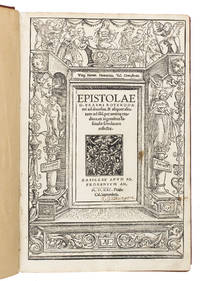
1521ref. ABC_49922Basel 1521. Folio. Johann Froben Modern blind-tooled red morocco with the author title and year of publication lettered in gold on the spine a single fillet border on both boards red edges. With a decorative woodcut border on the title page by Urs Graf 2 decorative woodcut borders in the text by Ambrosius Holbein numerous decorated woodcut initials and a woodcut printer's device at the end of the work. 12 "668" =618 6 pp First complete edition of the letters of Desiderius Erasmus containing 171 letters which had never been published before with correspondence with many of the most prominent figures of the 16th century. The work has been beautifully illustrated with a splendid large woodcut title border by Urs Graf ca. 1485-1528 known as "The triumph of Humanitas" and two fine borders by Ambrosius Holbein ca. 1494-1519. The present copy has been annotated in several contemporary hands and was owned by Ralph Widdrinton d. 1688 the Regius professor of Greek at Cambridge University.The Epistolae ad diversos contains 617 letters in total and is far larger than any of the earlier collections of Erasmus' correspondence namely the Epistolae aliquot of January 1518 52 letters the Auctarium of October 1518 63 letters and the Farrago of November 1519 333 letters. The present letter collection is also the first with a preface by Erasmus. The majority of the letters date to 1519-1521 but some are earlier with the first dated to 11 July 1513. They reflect Erasmus' changing stance towards Luther and Protestantism but also continue his attacks on friars and the theologians of Louvain. Among the authors correspondents are prominent humanists and other important figures including Beatus Rhenanus Ulrich Zasius Johann Eck Guillaume Budé Jean Grolier Georg Spalatin Hermann von dem Busche Konrad Peutinger John Colet Thomas More John Fisher Thomas Linacre William Grocyn Luther Melanchton Pope Leo X and Henry VIII King of England. Erasmus later made many editorial changes to the letters making the present edition of particular importance.With a later ownership annotation "R. Widdrington" on the title page. The binding is very lightly soiled. The work is slightly browned throughout with contemporary and later manuscript annotations in the margins in three different hands a vertical tear in the upper part of the first errata leaf without loss of text. Otherwise a very good copy with ample margins.l Adams E 852; BM STC German p. 276; Erasmus Online 2069; USTC 651629 34 copies; Vander Haeghen I 99; VD 16 VD16 E 2925. hardcover
1517ref. ABC_49731Colophon: Basel 1517. 4to. Johann Froben Late 19th-century or early 20th-century boards red edges. With 4 decorated woodcut initials and a woodcut printer's device at the end of each part. 2 parts in 1 volume. 42 ll. First separate edition of an influential work by Desiderius Erasmus which is a call for reform of the Catholic Church. It uses the Ancient Greek figure Alcibiades ca. 450-404 BC and the mythical characters known as the Sileni as an allegory for looking beyond appearances in order to perceive someone's or the Church's true nature. Erasmus wrote the text as part of his compilation of proverbs the Adagia in particular for the revised 1515 edition where it became one of the most popular entries. It was then published by Froben as a separate work in 1517 together with his scholia. The present copy also includes the Scarabeus a similar essay from the Adagia with scholia from Beatus Rhenanus. Although these two works are now rarely found together on the market the Scarabeus was clearly intended as the second part of the Sileni Alcibiades for the present edition as both the pagination and collation continue between the two works.The boards are slightly soiled. The work is slightly browned throughout with water stains in the margins of some of the leaves and numerous near contemporary academic annotations in the margins of the first part by at least 2 different hands. Otherwise in good condition.l Bibl. Belgica E 259; BM STC German p. 277; USTC 693955; ad 1: Adams E 833; Erasmus Online 3579; Vander Haeghen I 176; VD16 E 1990; Ad 2: Adams E 830; Erasmus Online 3574; Vander Haeghen I 175; VD 16 E 1986. hardcover