4758 resultados
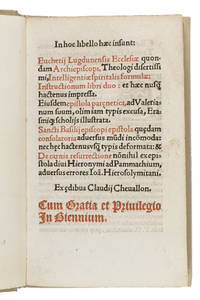
1523ref. ABC_49898Colophon: Paris 1523. 8vo. Claude Chevallon Modern half vellum and beige paper sides blue sprinkled head- and fore-edge manuscript author and title on the spine in brown ink. With Cevallons woodcut device on the verso of the final leaf the title is printed in red and black and 10 woodcut decorated initials. 6 CVII 1 ll. Collection of patristic writings many of which appear here in print for the first time. The book opens with the spiritual writings of Eucherius ca. 380-ca. 449 CE Archbishop of Lyon including his Intelligentiae spiritalis formulae and two instructional treatises both of which are printed here for the first time.At the heart of the volume is Eucherius paraenetic letter to Valerianus a moral exhortation encouraging the rejection of worldly distractions and the pursuit of true Christian wisdom. Although this letter had been printed previously it is presented here together with annotations by Erasmus.Also included is a consolatory letter by Basil the Great Bishop of Caesarea 330-379 CE intended to support believers facing the hardships of earthly life. Like the instructional works of Eucherius this letter also appears here in print for the first time. The final text is a fragment from a letter by Saint Jerome ca. 342/7-420 CE to Pammachius d. 410 CE defending the doctrine of the resurrection of the flesh and refuting the teachings of John of Jerusalem.The exact date of publication remains uncertain but it is unlikely that the book appeared before 1520 the year when Chevallon first began using his soleil dor printers device.The pages show some browning and water staining throughout. Overall in good condition.l BM STC French p. 157; Erasmus Online 4203; Vander Haeghen II 25; Moreau & Renouard III 498; Renouard P. Marques 176; USTC 184320; not in Adams; De Reuck; Kossmann; Meyers. hardcover
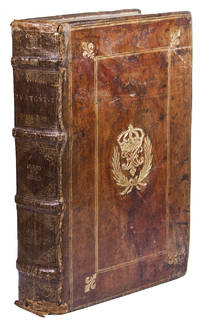
1533ref. ABC_49917Basel 1533. Small folio 21.5 x 31.8cm. colophon Hieronymus Froben & Nicolaus Episcopius 17th-century gold-tooled mottled calf sewn on 4 supports with corresponding raised bands on the spine. Both boards show two triple fillet frames the smaller frame with four fleurs-de-lis cornerpieces on each outer corner and within the smaller frame a centrepiece containing the monogram of the Collège Royal de Navarre in Paris a crown a fleur-de-lis and a laurel wreath can be found. 4 of the 5 compartments on the spine show the same gold-tooled monogram of the College the second compartment from the top contains Svetoniuvs lettered in gold. Further with marbled endpapers gold-tooled board edges and gilt edges. With Frobens large woodcut device on the title page repeated on the final page and several large woodcut initials after Holbein. 2 parts in 1 volume 44 786 2 blank 84 pp. Beautifully bound copy of a collection of Roman imperial biographies known as the Historia Augusta which was supposedly written by 6 authors of the late Roman Empire: Aelius Spartianus Julius Capitolinus Vulcacius Gallicanus Aelius Lampridius Trebellius Pollio and Flavius Vopiscus collectively known as the Scriptores Historiae Augustae. Although modern scholarship questions the authenticity and authorship of these texts they remain a crucial source for understanding the history politics and personalities of the Roman emperors from Hadrian r. 117-138 CE to Numerian r. 283-284 CE.The present edition of the Historia Augusta was edited and annotated by Erasmus alongside several notable scholars including Giovanni Battista Egnazio or Egnatius 1478-1553. Additionally this volume contains a second part with a divisional title page on p. 545: Rerum gestarum libri XVII written by Ammianus Marcellinus ca. 330-ca. 400 CE the last major historian of the Roman Empire. As a former soldier and eyewitness to many events he describes Ammianus essentially wrote a continuation of the history of Tacitus offering vivid accounts of military campaigns court politics and the slow unravelling of Roman power in the West.This version of the Historia Augusta was already printed in 1518 by the Basel publisher Johann Froben. For that edition Erasmus contributed an edited version of Suetonius along with a preface although the title page misleadingly implied that he had also edited Ammianus work. The present edition followed in July 1533 issued by Hieronymus Froben in partnership with Nicolaus Episcopius which incorporated the recently discovered Books 27-30 of Ammianus. Contrary to some claims the editor of that 1533 edition was not Conradus Goclenius but Sigismundus Gelenius. It appears that Erasmus perhaps distracted or misremembering once confused the two names.On the title page surrounding the Froben device there is an ownership inscription reading: DVJON - JVNIVS. This could refer either to Franciscus Junius the Elder François du Jon 1 May 1545 - 23 October 1602 a prominent Huguenot theologian or more likely to his son Franciscus Junius the Younger François du Jon 29 January 1591-1677 the noted philologist and pioneering scholar of Germanic languages known for his extensive collection of ancient manuscripts. With underlinings and marginal annotations throughout including brief notes on the text as well as references to related materials. In a few places the outer margins have been slightly trimmed affecting only a small number of annotations. The spine shows light rubbing with some wear to the spine ends the text is lightly browned throughout. Overall a very good copy.l Adams S 2025; BM STC German p. 842; Clarence H. Miller The Correspondence of Erasmus: Letters 2635 to 2802 volume 19 2019; Erasmus Online 4325; USTC 679548; VD16 E 3647; not in De Reuck; cf. for the monogram of the College de Navarre see: Archives de la Société des collectionneurs dex-libris Paris: 1895 2d Année No. 1 Janvier pp. 66-69. hardcover
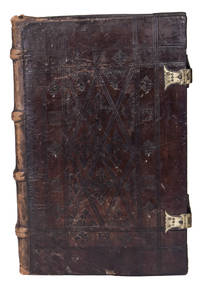
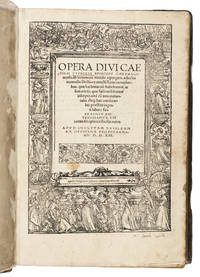
1520ref. ABC_49926Basel 1520. Folio. Johann Froben Contemporary richly blind-tooled calf over wooden boards with brass clasps catch- and anchor plates along the fore-edge and brass edge guards around the corners and on the bottom board edge near the spine manuscript waste pastedowns re-backed. With an elaborate woodcut border on the title page and on the first page of the dedication. Further with a small woodcut illustration incorporating Frobens device on the verso of the last leaf numerous woodcut decorated initials by Ambrosius Holbein throughout and some ornamental woodcut headpieces. 24 515 1 blank 32 pp. First edition of the works of Thascius Caecilius Cyprianus Saint Cyprian ca. 210-258 CE edited by Erasmus. The present work is a landmark in the history of humanist scholarship and a cornerstone of Erasmuss lifelong effort to restore the authentic voice of the Early Church Fathers. Working in Basel Erasmus devoted himself to what he regarded as his highest calling: presenting these foundational Christian sources to a wider audience and revealing the truth of the Gospel in its original simplicity.In this edition Erasmus rescued Cyprians writings from centuries of textual corruption carefully correcting medieval errors and adding several minor treatises from ancient manuscripts that had never previously been printed. It includes Cyprians pastoral letters and doctrinal works arranged by theme and reflects the bishops deep concern with church unity moral discipline and the challenges of the early Christian community.This 1520 edition of Cyprians works marks the true beginning of Erasmus great Basel enterprise: a series of monumental editions that would soon include works by Arnobius 1522 Hilary 1523 Jerome 1524 Irenaeus 1526 Ambrose 1527 Augustine 1528-29 and Chrysostom 1530. This rapid succession of vast editorial projects reveals both Erasmuss astonishing intellectual energy and his conviction that the wisdom of these Church-Fathers could renew Christian life.More than a critical edition the present work embodies the spirit of Christian humanism itself: rigorous scholarship in the service of faith. It stands as one of Erasmus' most significant achievements and a defining moment in the recovery of patristic learning in the Renaissance.With manuscript waste pastedowns three stamps of the Roman Catholic Saint Maria-Magdalena church in Zaandam on the title page occasionally some near contemporary manuscript annotations in the margins and some of the text has been underlined. The work has been re-backed lacking the backstrip of the original binding the edges of the leather around both boards is slightly damaged revealing the wooden boards below the spine is somewhat rubbed. The edges of the first and last few leaves are slightly frayed some occasional water staining in the fore-edge margin not affecting the text some slight staining and dust soiling throughout. Otherwise in good condition.l Allen 1000; De Reuck 416; Huizinga VI p. 148; USTC 679667; Vander Haeghen II 23; VD 16 C 6508; not in Adams; Bezzel; BM STC German. hardcover
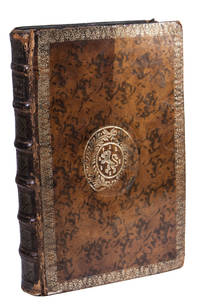
1514ref. ABC_49925Paris 1514. Folio. Jodocus Badius 18th-century gold-tooled mottled calf sewn on 6 supports with corresponding raised bands on the spine the author and title lettered in gold on the spine both boards show a gold-tooled armorial centre piece incorporating the arms of the city of Nevers or the arms of the Conflans family from the Champagne region Rietstap I plate CXVIII within a gold-tooled floral frame blind-tooled board edges marbled edges. With a woodcut border and printers device on the title page printed in red and black along with numerous woodcut decorated initials throughout. 6 CCLXVII 1 ll. 1514 Paris edition of Senecas tragedies printed and edited by the humanist printer Jodocus Badius 1462-1535 with contributions from Erasmus and others. Although Erasmus had permitted Badius to use his preparatory work in his autobiographical letter to Botzheim he reflects on the painstaking effort that went into this preparation and subtly expresses his irritation at seeing Badius nostra cum alienis miscuisse that is having mixed Erasmus contributions with those of others. The present work comprises nine dramatic works and extensive scholarly commentary by leading Renaissance philologists.With a printed book plate of the Fossé d'Arcosse family and a manuscript presentation note dated 1828 Emilien Fossé Darcosse donné par Mr B. V. le 10 septembre 1828 on the front pastedown. On the first free endpaper an 18th-century Latin manuscript inscription records the awarding of a prize to Franciscus Vermeil a noble student at the Jesuit College of Nevers in France for his scholarly achievements. The prize which included an award for a Latin oration was granted on 4 September 1746 by virtue of a perpetual endowment from the city of Nevers. The award is formally attested by the Praefectus Studiorum director of studies J. Petrus Coriou whose autograph and the official seal of the college are present. The corners of the boards are bumped the front hinge is weakened the ends of the spine are slightly damaged with some minor loss of material and with some minor loss of material on the back board. The front board is slightly rubbed the outer half of both boards is slightly faded from sun exposure. The lower margin of the title page and the outer margin of the sixth preliminary leaf have been reinforced. The final privilege leaf blank on the verso except for some manuscript annotations has been mounted on the recto of the adjacent blank flyleaf. The first and last leaves are slightly water stained and the upper margins have been cut somewhat short. Otherwise in good condition.l De Reuck 497; Moreau and Renouard 967; Renouard Badius III 252-53; USTC 144361; Vander Haeghen II 49; not in Kossmann. hardcover
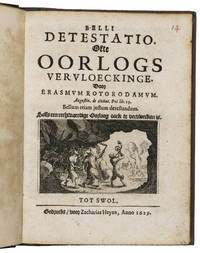
1629ref. 2941Zwolle 1629. 4to. for Zacharias Heyns colophon: printed by Frans Jorrijaensz 19th century half brown morocco with the author title and imprint lettered in gold on the spine brown cloth sides. With a large engraved emblem on the title page 5 decorated woodcut initials a woodcut headpiece 2 headpieces built up from typographical ornaments a woodcut tailpiece and a tailpiece built up from typographical ornaments. 28 ll. First edition of Zacharias Heyns' new Dutch translation of Erasmus' famous anti-war essay Dulce bellum inexpertis. This essay was originally part of the 1515 edition of the Adagia but was first published as an independent work by Johann Froben in 1517 with the title Bellum. The present Dutch edition is quite rare as we have not been able to find any other copies in sales records of the past hundred years.The Adagia was first published in 1500 but Erasmus continued to edit the work until his death. The 1515 edition published by Froben was greatly expanded but the essay for the proverb Dulce bellum inexpertis war is sweet to the inexperienced was the longest and most remarkable addition. In the essay Erasmus argues that war is senseless unchristian and contrary to human nature. He also critiques the militaristic culture of his time which glorified violence and aggression and advocates instead for diplomacy and negotiation. The essay became so popular that Froben published it separately. Within ten years it had been reissued at Louvain twice at Strasbourg twice at Mainz at Leipzig twice at Paris twice at Cologne at Antwerp and at Venice. German translations of it were published at Basel and at Strasbourg in 1519 and 1520 and an English translation followed in 1533. The first Dutch translation was made in 1622. The present second Dutch translation made during the Eighty Years' War shows how the work continued to inspire more than a hundred years after it was first written.The spine has been slightly rubbed. The end paper are browned the work is lightly browned throughout. Otherwise in good condition.l Knuttel 3921; Bibl. Belgica E 247; Erasmus Bibl. Rotterdam p. 29; Erasmus Online 465; STCN 831153881; USTC 1026760; Vander Haeghen I p. 22. hardcover
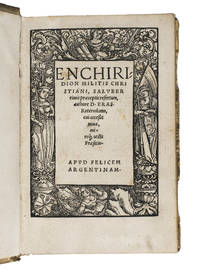
1523ref. ABC_49639Strassburg 1523. 8vo. Colophon: Johann Knobloch Contemporary elaborately blind-tooled pigskin over wooden boards remnants of brass anchor plates. Ad 1 with a woodcut frame on the title page 1 woodcut decorated initial and Knoblochs large woodcut device on the verso of the last blank leaf. Ads 2 and 3 with 1 woodcut decorated initial each. Ad 4 with a woodcut architectural frame on the title page and 1 large woodcut decorated initial. 4 works in 1 volume. 106; 57 1 blank; 49 1 blank ll.;158 pp. Four significant early 16th-century works that illuminate the intellectual and theological tensions of the Reformation. Ad 1: The Enchiridion militis christiani Poinard of the Christian Knight one of Erasmus most influential writings serves as a practical manual for inner reform and devout living. Emphasising moral integrity over ritual this widely reprinted work became a cornerstone of Christian humanist thought.Ad 2: The two homilies in De immensa Dei misericordia include a sermon on divine mercy likely composed for the dedication of a chapel in Basel and a second comparing virginity and martyrdom written for the Benedictine nuns of Cologne. Both reflect Erasmuss pastoral sensibilities and rhetorical skill.Ad 3: In De libero arbitrio Erasmus directly challenges Luthers doctrine of predestination in a pivotal treatise on free will. This foundational text marking the definitive break between the two reformers is one of the periods most significant theological works.Ad 4: The volume concludes with an early -and apparently rare- edition of Henry VIIIs Assertio septem sacramentorum a fierce rebuttal of Luthers De captivitate Babylonica. This work earned the English king the title Fidei Defensor from Pope Leo X. A splendid collection that captures the core tensions of the Reformation and the humanist response to it.Ad 1 with some of the text underlined. Ad 2 with manuscript annotations in the margins. Ad 3 with some marginal annotations and some of the text underlined. Ad 4 with a manuscript inscription on the title page and a few annotations in the margins. The binding shows signs of wear some small pieces of leather missing on the back board revealing the wood below remnants of fastenings along the fore-edge ads 2 and 3 with some minor worm holes in the paper barely affecting the text some staining and browning in places. Otherwise in good condition.l Ad 1: USTC 650175 7 copies; Vander Haeghen I 80; VD 16 E 2772; Ad 2: Bezzel 1131; VD 16 E 3041 and VD 16 E 3659; not in the USTC; Ad 3: VD 16 E 3151; not in the USTC; Ad 4: VD 16 H 2166; this ed. not in USTC. hardcover
1641ref. 8AGGC6NMSWHRLeiden 1641. 12mo. Joannes Maire Contemporary overlapping vellum sewn on 3 supports laced through the joints blue edges. With Maire's woodcut devices on all four title pages several woodcut decorated initials throughout. 4 works in 1 volume. 264; 330 2 blank; 144; 1 1 blank 6 4 blank 176 2 blank pp. Fine Sammelband with four theological works by Desiderius Erasmus all published by the well-known Leiden printer Joannes Maire. The present work containing four 17th-century editions reflects the enduring popularity of Erasmus' didactic and theological writings nearly a century after his death.Ad 1: Maire's 1641 his only edition of this compact Latin devotional treatise by Erasmus offering a concise moral and theological commentary on two foundational elements of Christian doctrine: the Apostles' Creed and the Ten Commandments. The work was intended for private reflection or instructional use and it is a good example of Erasmus' characteristic blend of lucid humanist prose and practical Christian ethics urging readers toward sincere faith and virtuous conduct.Ad 2: A finely printed Latin edition of one of Erasmus' most celebrated devotional treatises "The Handbook of the Christian Soldier". The work serves as a practical guide to inner piety and spiritual discipline advocating a faith grounded not in ritual or external observance but in the renewal of the heart and the imitation of Christ. It is preceded by a letter of Erasmus to Paulus Volsius dated Basel 15 August 1518.Ad 3: A succinct yet profound devotional treatise by Erasmus offering guidance on the true manner of prayer and the cultivation of inward piety. The present work distils Erasmus' humanist spirituality into a meditative discourse on sincerity humility and the necessity of aligning one's will with divine purpose. It rejects rote recitation and superstition in favour of heartfelt communion with God reflecting the author's lifelong concern with the reform of Christian practice through education and interior devotion. It was written in the form of a letter to the Polish diplomat and palatine voivode of Inowroclaw and of Sieradz Hieronymus Jaroslaw Laski 1496-1542.Ad 4: A thoughtful and conciliatory treatise by Erasmus addressing the urgent need for unity and peace within a divided Christendom. Originally written and published in the aftermath of the early Reformation it embodies the author's lifelong plea for moderation mutual understanding and the healing of ecclesiastical discord through charity and reason rather than dogmatic strife. The present work shows Erasmus' conviction that genuine reform must begin with the renewal of hearts and minds not the multiplication of schisms a message that remained relevant amid the theological turbulence of the 17th century. The work is preceded by a letter written by Erasmus to the last Catholic bishop of the Diocese of Naumburg Julius von Pflug 1499-1564.With an annotation in Latin on the front pastedown 3 owner's inscriptions on the title page of ad 1 ''Sum Justi Caspari Scherii Berol. Marchici'' Justus Caspar Scher ca. 1700; "Johannes .man. 1651." and "constat 32. gl" and marginal annotations and underlining of the text in ad 2. The binding is somewhat dust soiled slight foxing throughout. Otherwise in good condition.l Ad 1: Breugelmans Fac et spera p. 475; Catalogue of the Erasmus collection in the City Library of Rotterdam p. 128; STCN 840230494; USTC 1028902; Vander Haeghen Bibliotheca Erasmiana p. 105; ad 2: Breugelmans Fac et spera p. 473; Catalogue of the Erasmus collection in the City Library of Rotterdam p. 98; STCN 114270627; USTC 1015925; Vander Haeghen Bibliotheca Erasmiana p. 83; cf. STCN 840231318; USTC 1028909 both ref. for different issue same ed.; ad 3: Breugelmans Fac et spera p. 477; Catalogue of the Erasmus collection in the City Library of Rotterdam p. 148; STCN 840230583; USTC 1028904; Vander Haeghen Bibliotheca Erasmiana p. 121; cf. STCN 06126220X; USTC 1011884 both ref. for different issue same ed.; ad 4: Breugelmans Fac et spera p. 493; Catalogue of the Erasmus collection in the City Library of Rotterdam p. 140; STCN 840230362; USTC 1028901; not in Vander Haeghen Bibliotheca Erasmiana. hardcover
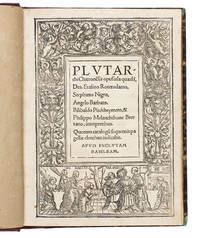
1518ref. ABC_49754Colophon: Basel 1518. 4to. Johann Froben 19th-century richly gold-tooled quarter red morocco and decorated paper sides bound by Gardien in 1863 sewn on 4 supports with corresponding raised bands on the spine with the author title and year lettered in gold on the spine marbled endpapers the whole covered with protective plastic red sprinkled edges and with a green ribbon marker. With a woodcut decorated frame on the title page the first page of the dedication the first page of the text A3r and the first page of the text by Stephanus Niger H2r 18 woodcut decorated initials and a small woodcut illustration incorporating Frobens device. 194 2 pp. An early edition of selected opuscula short philosophical and moral treatises by the Greek author Plutarch of Chaeronea ca. 46-120 CE best known for his Moralia and Parallel lives. The present work brings together Latin translations by multiple Renaissance scholars Erasmus Philipp Melanchthon 1497-1560 Willibald Pirckheimer 1470-1530 Angelo Barbato and Stephanus Niger. It forms part of the earliest wave of humanist publications aiming to make classical Greek thought accessible to Latin readers.Included are four treatises translated by Erasmus himself including his famous version of De tuenda bona valetudine praecepta On the preservation of good health. Particularly notable is Melanchthon's translation of the Convivialem quaestiunculam de notis Pythagoricis a short platonic dialogue dealing with Pythagorean symbols and moral enigmas.With a small catalogue excerpt mounted on the front pastedown including a small modern manuscript note Ex M. Abel le franc an oval black stamp F. Fasting Ex Libris No. added in manuscript: 5080 Rio de Janeiro on the verso of the first free flyleaf and the small stamp of the binder Gardien 1863 on the recto of the second free flyleaf. With some contemporary marginal annotation and underlining of the text. The binding shows slight signs of wear mainly around the corners of the boards slightly browned throughout with minor water stains in the upper outer margins towards the end and brown staining in the upper margins from pages 115 to 169. 3 of the 4 woodcut frames are slightly shaved at the lower margin. Further with a small wormhole in the outer margin from page 127 onward not affecting the text. Overall in good condition.l Adams p. 1653; BM STC German p. 706 ; Vander Haeghen II 46; USTC 684264; VD 16 P 3748; not in: Kossmann; Meyers; De Reuck. hardcover
1613ref. ABC_49605Utrecht 1613. 4to. Jan Amelisz Contemporary gold-tooled overlapping vellum sewn on 4 supports laced through the joints both boards show a double fillet frame with small ornamental cornerpieces in the inside corners and a large ornamental oval centrepiece on both boards and with small ornaments slightly faded and the manuscript title on the spine. With a woodcut printers device on the title page and the rare full-page engraved portrait of Erasmus which is lacking in at least 2 of the 4 copies known in an oval lettered: "Magnus ille Erasmus Roterodamus natus Roterdami Octobr. Ao 1467" with emblems in the corners ink pot trumpets hourglass and Bible and a Latin poem of 4 lines underneath "Post cineres vivo doctis tuta manet". This portrait of Erasmus on leaf p1r half to the left and seated his hands resting on an open book is apparently engraved after the portrait by Frans Huys of 1555 which he engraved after the painted portrait by Hans Holbein the Younger Hollstein Dutch & Flemish engr. and etches 132. On the verso of this portrait is a laudatory "Klanck-Ghedicht" sonnet for Erasmus between typographical borders; the same borders on leaf. p2r: the privilege by the States General verso blank. 18 141 3 ll. Very rare first and only edition of a collection of 27 colloquia dialogues by Erasmus and 13 by Lucian of Samosata ca. 125-after 180 CE. The colloquia were translated into Dutch by Andreas van Oosterbeeck fl. 1584-ca. 1620 a minister in Abcoude 1590 and Montfoort 1616. The 27 dialogues by Erasmus include Proci & Puella Virgo Misogamos Virgo poenitens Coniugium Adolescentis & Scorti Abbatis & Eruditae Puerpera Convivium Fabulorum Absurda Opulentia sordida Naufragium Charon Coniugium impar Inquisition de Fide Exorcismus sive Spectrum Peregrinatio Religionis ergo and others.The Colloquia familiaria is one of the main works by Desiderius Erasmus first published in 1518 as Latin dialogues for school exercises and expanded over the following decades with witty - albeit serious - and often controversial content including contemporary religious practises treated in a pervasively ironic tone. After Cornelis Crul's translations of a number of dialogues published between 1530 and 1545 these annotated translations by Andreas van Oosterbeeck are the first 17th-century edition followed in 1622 and 1634 by translation of the colloquia by Dirck Pietersz. Pers.After Erasmus' dialogues follow after a separate title page the 13 highly ironical dialogues originally written in Greek by Lucian: Gallus Toxaris Cnemon Zenophantes Tantalus Menippus Trophonius Charon Crates Nireus Mausolus Polystratus and Diogenes. These are all translated in Dutch by Andreas van Oosterbeeck after the Latin translations made by Erasmus from the original Greek. Lucian of Samosata - a town in Syria - was a Greek writer and satirist who lived in the 2nd century CE. He invented the genre of comic dialogue a parody of the traditional Socratic dialogues and wrote numerous satires about the Gods and public figures.With later annotations in pencil on the front pastedown and flyleave the fore-edge and the bottom outer corner of the back board are somewhat stained and soiled a water stain in the upper outer corner throughout. Otherwise in good condition.l Van der Aa 14 1867; Gheerebaert Lijst p. 57 LVI: Lucianus no. 1 First translation of a work by Lucianus in Dutch!; STCN 169198340 4 copies; USTC 1019209 4 copies same as STCN. hardcover
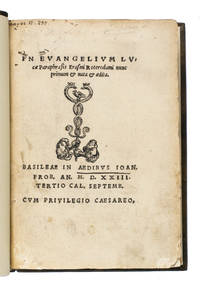
1523ref. ABC_49899Basel 1523. Small 8vo 10.7 x 15.2 cm. Johann Froben Modern blind-tooled marbled calf bound by Period Bookbinders from Bath England with the author and title lettered in gold at the head of the spine the year at the foot of the spine. With 2 small woodcut illustrations incorporating Frobens device on the title page and the verso of the final leaf a woodcut headpiece above the dedication and two woodcut decorated initials. 275 ll. First edition of Erasmus Paraphrase on the gospel of Luke. Unlike his paraphrases on the gospels of Matthew Mark and John each dedicated to rulers of France or the Holy Roman Empire this work was addressed to King Henry VIII of England. The lengthy dedicatory preface which spans the first twelve leaves takes the form of a personal letter from Erasmus to the king. The Paraphrase on Luke was also unique in its format: it was the only one of the gospel paraphrases to be first published in octavo. The Paraphrases themselves were a novel form of literature at the time: more than mere translations or commentaries they were interpretative retellings of the gospels aiming to clarify the theological and moral meaning of Scripture for a wider audience. Despite Erasmus towering knowledge of the Church Fathers and his editorial work on patristic texts his method in the Paraphrase on Luke was not one of direct quotation from memory. Instead as Jan Bloemendal states Erasmus likely worked with various compilatory sources on his desk texts such as Bedes commentary on Luke the Glossa Ordinaria a medieval annotated Bible and Aquinas Catena Aurea which gathered together centuries of Christian interpretation. Through these sources Erasmus was able to channel the voice of the early Church while crafting something new and distinctly his own.Modern scholarship has also examined the layered narrative voices in the paraphrase on Luke. According to Bloemendal Erasmus plays with the roles of paraphrast narrator and evangelist creating a subtle interplay between himself and the biblical Luke. This device allowed Erasmus to offer veiled critiques on the abuses and moral failings of his own time under the guise of Lukes voice while also inviting his readers into a deeper more personal engagement with Scripture.With some contemporary underlining and annotations primarily consisting of corrections textual additions and markings of notable passages; a later bibliographical annotation in brown ink at the head of the title page "Panzer VI 237" and a small bookbinders label mounted in the bottom inner corner of the recto of the final blank flyleaf Period Bookbinders Bath England Tel 0225 20698. Some small wormholes in the first 5 leaves slightly affecting the text the title page is slightly dust soiled. Otherwise in good condition.l Adams E 755; Bezzel 1164; Bloemendal Collected Works of Erasmus vol. 47: Paraphrase on Luke 1-10 edited by Jane E. Phillips Erasmus Studies 37 2 2017 pp. 217-222 see p. 218; Bloemendal Exegesis and Hermeneutics in Erasmus Paraphrase on Luke Erasmus studies 36 2 2016 pp. 148-162; BM STC German p. 119; USTC 665710; Vander Haeghen I 148; VD16 E 3061; not in De Reuck. unknown
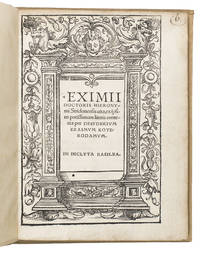
1519ref. ABC_49873Basel 1519. 4to. Colophon Johann Froben Modern beige paper boards with a later paper label on the spine the author title and incorrect publication date in black. With a woodcut decorated frame on the title page and on page 3 a small woodcut illustration incorporating Frobens device on the verso of the last leaf and with 1 woodcut decorated initial. 70 2 pp. Second edition of Erasmus Vita The life of the excellent doctor Jerome of Stridon this work introduced the monumental edition of Saint Jeromes Opera omnia. It was Erasmus attempt to present Jerome as a relevant historical and intellectual figure instead of him remaining a remote saint cloaked in legend.Rather than relying on apocryphal sources or pious legend Erasmus built this work almost exclusively from Jeromes authentic correspondence. This method marked a clear break with traditional hagiography. He rejected fictitious episodes attributed to figures like Cyril of Jerusalem ca. 315-386 CE Eusebius of Cremona 5th century CE and pseudo-Augustine which had long coloured the popular image of Jerome. Instead Erasmus offered a critical and philologically grounded portrait both admiring and analytical aligning Jerome with the ideals of Christian humanism.Erasmus fascination with Jerome had deep roots. As a young man in the monastery at Steyn near Gouda in the Netherlands where he studied under the Hieronymite order he was seen copying Jeromes letters. His early reverence developed into critical engagement: at Cambridge Erasmus worked meticulously to identify and eliminate inauthentic letters attributed to Jerome and he was profoundly inspired by Jeromes linguistic rigour and exegetical method. It was during his time in England that Erasmus also undertook his pioneering revision of the New Testament. All of these efforts culminated in Basel in 1516 where Frobens press published not only the first edition of Erasmus Novum Instrumentum a new Latin translation of the New Testament alongside the Greek text but also his complete edition of Jeromes works prefaced by the Vita. With a small wormhole affecting all leaves though without significant impact on the text a small hole in the outer margin of pp. 45-46 not affecting the text light marginal water-staining and some browning throughout. Overall in good condition.l Béné Marulic et Erasme lecteurs de saint Jérôme Colloquia Maruliana Vol. 10 2001 pp. 29-45 see p. 31; Bezzel 1058; BM STC German p. 282; De Reuck 362; Julián Erasmo biógrafo de san Jerónimo: Hieronymi Stridonensis Vita 1516 Mirabilia: electronic journal of antiquity and middle ages 31 2020 pp. 411-443 see pp. 412-3; USTC: 655432; Vander Haeghen I 182; VD 16 E 2968; not in Adams. hardcover
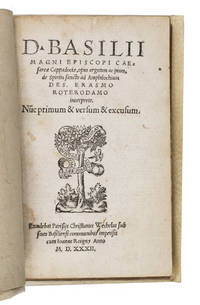
1532ref. ABC_49897Paris 1532. Small 8vo 9.5 x 14.9 cm. Chréstien Wechel and Jean Roigny Modern limp overlapping vellum sewn on 3 supports laced through the joints red edges and with 2 sets of green cloth ties. With Wechels woodcut printers device on the title page and the verso of the otherwise blank last leaf and 2 woodcut decorated initials. 124 3 blank1 pp. Very rare second edition of Erasmus translation of a theological treatise attributed to Basil of Caesarea 330-379 CE.It was published shortly after the first edition published in May of the same year by Froben and Episcopius in Basel May 1532. The work is very rare we have traced only one other copy in sales records of the past 100 years. Erasmus' translation is accompanied by a dedicatory epistle to Joannes Dantiscus 1485-1548 Bishop of Culm and a prominent diplomat of the Polish court. The letter dated April 30 1532 reflects Erasmus conviction that direct engagement with the texts of the Church Fathers rather than with flawed Latin intermediaries was vital for the renewal of Christian piety. As Erasmus himself declared: "It would be of great benefit to sacred letters and Christian devotion if Basil himself in Greek and not the shadow of Basil a Latin translation were made available to all."His source text was a Greek edition he had published just two months prior. According to Julián 2022 Erasmus wanted to publish everything they could find from Basil lamenting that in the existing Latin versions "the greater part of him is missing." Interestingly the legacy of this work can be traced further back to the 15th century when George of Trebizond 1395-1486 a Greek scholar from Crete was commissioned by Cardinal Bessarion 1403-1472 in 1440 to translate both De spiritu sancto and Contra eunomium into Latin. George struggled with the theological complexity of the material confessing in his preface 1442 that he lacked the necessary theological training and fluency in Latin. Erasmus' later effort can be seen as a corrective and a fulfilment of that earlier humanist ambition to make the Greek Church Fathers accessible to a Western audience in an accurate and readable form.Small tear in title page not affecting the text lightly water-stained margin and slightly browned throughout. Overall in very good.l Colón 11; no. 158; Vander Haeghen II 13; Moreau IV 338; V.P. Julián Erasmo traductor y editor de los Padres de la Iglesia: Crisóstomo Basilio y Orígenes. Salmanticensis 691-22022 039-075; USTC 185205 lost book; WorldCat 150413518 913004144 3 copies; not in Adams BM STC German De Reuck; Index Aureliensis; cf. for the Basel 1532 edition: USTC 640558 1 copy; WorldCat 257292311 1374477181 150413518 3 copies. hardcover
1521ref. ABC_49920Basel 1521. Folio. Johann Froben Contemporary blind-tooled pigskin over wooden boards with brass catch- and anchor plates along the fore-edge of the boards lacking the clasps. With a detailed woodcut border on the title page and the first page of the dedication. Further with a small woodcut illustration incorporating Frobens device on the verso of the last leaf and with woodcut decorated initials throughout. 24 515 1 blank 32 pp. Second edition of Saint Cyprians works as edited by Erasmus published by Froben one year after their first edition. Between 1516 and 1521 Erasmus worked closely with Johann Froben the humanist printer in Basel on a series of editions of the Latin Church Fathers: Jerome Augustine Ambrose Hilary and Cyprian. Erasmus aim was to purify the texts of the Fathers from medieval corruptions to restore their authentic doctrine by returning to the original sources and to present the Early Church as a model for a purer form of Christianity a theme that directly reflected his theological-humanist ideal.Erasmus states that he has cleansed the text of errors added a few minor treatises from ancient manuscripts and removed the works that seemed to have been falsely attributed to Cyprian. Thascius Caecilius Cyprianus ca. 210-258 CE later known as Saint Cyprian was an influential Church Father of the early Latin Christian tradition. Shortly after his baptism he became bishop of Carthage one of the most important Christian centres in the Roman Empire. Most of his works are pastoral letters and treatises here arranged in the index by type. The manuscript appears to have been used for study as the annotations highlight portions of the text and draw comparisons between Augustine and Cyprian.With small strips of manuscript waste visible in the gutters of the pastedowns a small owners inscription H. Reimers Erlang. 1899 in the upper outer corner of the first blank flyleaf along with elaborate manuscript annotations on the recto of that same leaf numerous contemporary and later annotations in three different hands throughout and some of the text underlined. The leather around the top and fore-edge of the front board has been restored the leather on the back board is somewhat damaged some small worm holes in the leather reveal the wooden boards below. The binding is rubbed the clasps are lacking and the head and foot of the spine are somewhat damaged the structural integrity of the binding nevertheless remains intact. The first blank flyleaf has been restored in the gutter margin the last leaf has been restored in the fore-edge margin the edges of the leaves are somewhat browned. Otherwise in good condition.l Adams C3150; BM STC German p. 234; De Reuck 417; USTC 679668; Vander Haeghen II 23; Huizinga VI p. 148; VD 16 C 6509; not in Bezzel. hardcover
ref. DADAX1851964096New unknown
ref. DADAX1170714463New unknown
ref. DADAX1170667651New unknown
1996ref. 1-0898705584Ignatius Pr 1996. Paperback. New. 746 pages. 9.25x6.25x1.75 inches. Ignatius Pr paperback
1523ref. ABC_50186Antwerp: Michiel Hillen van Hoochstraten 1523. Modern boards covered with a leaf from a Latin incunable probably part of a commentary on the Song of Solomon red sprinkled edges. 8vo. With a full-page woodcut illustration incorporating Hillen van Hoochstratens device on the last page and 3 woodcut decorated initials. First Antwerp edition published in the same year as the first Froben edition in Basel of Erasmus De sarcienda ecclesiae concordia. Dedicated to Julius Pflug of Eytra 1499-1564 later the last Catholic Bishop of Naumburg the work sets out Erasmus most urgent appeal for unity at a moment when the fractures of the Reformation were widening by the month. Pflug who valued peace and moderation shared Erasmus unease about the increasingly bitter debates dividing Western Christendom.De sarcienda ecclesiae concordia opens as a commentary on psalm 83 in which Erasmus underscores the spiritual necessity of harmony within the Church. From this biblical foundation he advances his lifelong conviction: that a polarised Christendom is fundamentally at odds with the teaching and example of Christ. In passages marked by clarity moral urgency and classical poise Erasmus argues that contentious theology has little to do with genuine faith and everything to do with human pride.Appended to the treatise is the brief Precatio pro pace ecclesiae addressed to the Cologne jurist Johann Rinck further underlining Erasmus conviction that peace moderation and the diligent search for concord must prevail over doctrinal intransigence.With very minor underlining on three pages and one tiny marginal annotation a small ink stain in the upper margin of the title page a small wormhole running from leaves A6 to B6 and some occasional water staining confined to the margins. Otherwise in good condition.l Adams E 387; De Reuck 248; Erasmus online 2340; Nijhoff & Kronenberg 798; STCV 12920380; USTC 403885; Vanderhaeghen I 117. Michiel Hillen van Hoochstraten, hardcover
ref. ria9781487559250_inpHardback. New. New Book; Fast Shipping from UK; Not signed; Not First Edition; The latest volume in the Collected Works of Erasmus series sheds light on the controversy between sixteenth-century biblical translations and the ensuing clash between scholastics and humanists. hardcover
1813ref. 57194Kiøbenhavn 1813. 8vo. Nyere helshirtingbind. 14 206 2 s. Trykt hos Sebastian Popp. Dansk. Historisk-Philosophiske Samlinger. Udgivne af Det kongelige Selskab for Nrges Vel. Fierde Deels første Bind.Tidligere eiernavn. unknown
1963ref. 78653Oxonii: In Typographeo Clarendoniano 1963. 23.5 x 15 cm. original cloth with gilt lettering with dust jackets. 12 volumes. Over 6000 pages illustrated with plates. Text in Latin. Some edges with few stains; paper browned due to aging; dust jackets slightly damaged price clipped dust-jackets. Previous owner's names in first volume; some notes and underlinings in pencil and some notes in ink in the margins not very disturbing. Still good set see pictures. ¶ P.S. Allen began to work on his edition of Erasmus' correspondence in 1893 and the first volume was published in 1906. He died in 1933 with the edition more than half complete. His wife the late Mrs. H.M. Allen and his friend Professor Garrod continued the work; and the last volume of the text Volume XI appeared in 1947. - Reprinted lithographically in Great Britain at the University Press Oxford. In Typographeo Clarendoniano hardcover
2021ref. 1-1621641228Ignatius Pr 2021. Paperback. New. 684 pages. 8.75x6.00x1.50 inches. Ignatius Pr paperback
1985ref. 78724Amsterdam / New York / Oxford: North-Holland Publishing Company 1985. 25.5 x 17.5 cm. Later black cloth hardcover. x400 pp. some ill. Int. in French text in Latin. Cloth with some stains first 20 pages with some notes and underlinings in pencil. Otherwise very good see picture. This volume contains Erasmus' Enarrationes in Psalmos. Pars Prior which includes six detailed exegeses on selected Psalms. The text reflects Erasmus' humanist approach to biblical interpretation emphasizing moral and theological lessons within the broader context of Christian thought. The structure of the volume is as follows 1. Preface 2. Introduction Générale by Ch. Béné 3. Enarratio Allegorica in Primum Psalmum Beatus Vir edited by A. Godin 4. Commentarius in Psalmum II Quare Fremuerunt Gentes edited by S. Dresden 5. Paraphrasis in Tertium Psalmum Domine Quid Multiplicati edited by S. Dresden 6. In Psalmum Quartum Concio edited by Ch. Béné 7. Enarratio Psalmi XIV Qui Est De Puritate Tabernaculi Sive Ecclesiae Christianae edited by Ch. Béné 8. In Psalmum XXII Enarratio Triplex edited by Ch. Béné 9. Liste des abréviations 10. Index nominum. These commentaries provide insight into Erasmus' engagement with both patristic sources and contemporary religious debates offering a critical perspective on late medieval and early Reformation theology. North-Holland Publishing Company hardcover
2013ref. 1-3659356190LAP LAMBERT Academic Publishing 2013. Paperback. New. 264 pages. 8.66x5.91x0.60 inches. LAP LAMBERT Academic Publishing paperback
2019ref. 1-3319892487Springer Verlag 2019. Paperback. New. reprint edition. 200 pages. 9.25x6.10x0.55 inches. Springer Verlag paperback