ERASMUS, DesideriusBiblio.com
4819 resultados
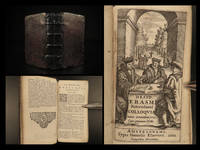
1668ref. 204991668 Erasmus Colloquies Humanism Rhetoric Philosophy War Latin Elzevier RARE "When I have a little money I buy books; and if I have any left I buy food and clothes." ― Erasmus Erasmus's famous 'Colloquies' is a collection of humanistic dialogues on a wide variety of subjects most of which explore man's reactions to other men through conversation. Erasmus and his pupils wrote on war travel religion sleep beggars funerals literature and other topics. According to one expert 'Colloquies' "held up contemporary religious practices for examination in a more serious but still pervasively ironic tone." Coffin This work exposed some of Erasmus's humor through the invention of word games and rhetoric exercises used for education. He wanted culture to serve as a model for those living during the Renaissance. This 1668 edition was published by the famed Elzevier house in Amsterdam. Item number: #20499 Price: $550 ERASMUS Desiderius Desid. Erasmi Roterodami Colloquia Amstelodami : Typis Danielis Elzevirii 1668. Details: · Collation: Complete with all pages o 8 589 3 o Engraved title page · References: Willems 440; Coffin Western Civilizations II p463 · Language: Latin · Binding: Leather; tight and secure · Size: ~4.75in X 2.5in 12cm x 6.5cm Our Guarantee: Very Fast. Very Safe. Free Shipping Worldwide. Customer satisfaction is our priority! Notify us with 7 days of receiving and we will offer a full refund without reservation! 20499 Photos available upon request. Danielis Elzevirii hardcover
ref. 30656Coloniæ: Martinus Gymnicus excudebat 1545. 8vo 16 632 78 pp. lprinter's woodcut device on title showing a sea horse holding a mast on the top of which is perched a crane and above the crane are the words "Discite Ivsticiam Moniti" contemporary ink signature on fly-leaf and erased early signature on title touching 2 letters occasional ink underscoring some light damp staining later vellum with yapp fore-edges upper cover slightly marked a very good copy. Bibliographie des oeuvres d'Erasme pp.299-300; Not listed in Bibliotheca Erasmiana Bruxellensis. Coloniæ: Martinus Gymnicus excudebat, 1545 hardcover
ref. 27215B. de Graaf Nieuwkoop. Reprint of the 1893 Edition 1961. 3 parts in 2 186; 68; 65pp. orig. cloth. B. de Graaf, Nieuwkoop. (Reprint of the 1893 Edition) 1961 hardcover
ref. 2500621 March 1882; on letterhead of The Avenue 76 Fulham Road S.W. London. See his entry in the Oxford DNB. 3pp 12mo. On bifolium. In good condition lightly aged. He thanks him for ‘letting me try the little horse which I returned to Banks’s. I wrote to them to say that I found him too small for the Victoria. This & his taking too much interest in the subterranian openings alone prevented me from keeping him at once for a hack as his paces & temper seemed to me perfect.’ He sends his compliments to Bristow’s family ‘if they should still recollect me - and the terrible ascent on the “Monks cap” - never to be attempted again by me -’. 21 March 1882; on letterhead of The Avenue, 76 Fulham Road, S.W. [London] unknown
ref. 1020278773.Ghardcover. Good. Access codes and supplements are not guaranteed with used items. May be an ex-library book. hardcover
ref. 9353977355.Gpaperback. Good. Access codes and supplements are not guaranteed with used items. May be an ex-library book. paperback
ref. 1164185128.Gpaperback. Good. Access codes and supplements are not guaranteed with used items. May be an ex-library book. paperback
ref. 1163429678.Ghardcover. Good. Access codes and supplements are not guaranteed with used items. May be an ex-library book. hardcover
ref. 1166492249.Gpaperback. Good. Access codes and supplements are not guaranteed with used items. May be an ex-library book. paperback
ref. 1165951762.Gpaperback. Good. Access codes and supplements are not guaranteed with used items. May be an ex-library book. paperback
ref. 1166070034.Gpaperback. Good. Access codes and supplements are not guaranteed with used items. May be an ex-library book. paperback
ref. 1165866676.Ghardcover. Good. Access codes and supplements are not guaranteed with used items. May be an ex-library book. hardcover
ref. 1166492672.Gpaperback. Good. Access codes and supplements are not guaranteed with used items. May be an ex-library book. paperback
ref. 1166214311.Gpaperback. Good. Access codes and supplements are not guaranteed with used items. May be an ex-library book. paperback
ref. 1165950693.Gpaperback. Good. Access codes and supplements are not guaranteed with used items. May be an ex-library book. paperback
ref. 1170714463.Gpaperback. Good. Access codes and supplements are not guaranteed with used items. May be an ex-library book. paperback
ref. 1120024668.Gpaperback. Good. Access codes and supplements are not guaranteed with used items. May be an ex-library book. paperback
1521ref. 33059-66Mainz Johann Schöffer 1521. Full woodcut historiated title-border and typographic title. 3 ff. Sm.-4to. 19th century morocco Hans Asper Geneva. From the library of Gaspard Ernest Stroehlin 1844-1907 a Swiss minister and professor at the University of Geneva with his bookplate "Mente Libera" showing Calvin preaching with the St. Pierre Cathedral in Geneva in the background. Mainz Johann Schöffer 1521. First edition. In addition to the Greek and Latin writings of Erasmus' 1467-1536 we know a small number in German language. The humanist's paraphrases of the Evangelists were greeted with immediate popularity and received numerous reprintings. The seven woes to the Scribes and Pharisees in Matthew 23 are a list of critical words by Jesus against the religious leaders as hypocrisy and perjury. Because of Erasmus' critique of the Roman Catholic Church in the first edition of the Index Librorum Prohibitorum 1564 his writings were more severely condemned than the works of Luther or Calvin. - A nice copy of a rare booklet seldom found in a library outside Germany. - VD 16 E 3123; Vander Haegen I 149 assigns this edition as the first one and printed by Johann Schöffer in Mainz; Bezzel 1239; not in Pegg Swiss. REFORMATION ; HELVETICA ; HUMANISM ; BINDINGS ; (Mainz, Johann Schöffer) unknown
1527ref. 33077-1245Basel Joh. Froben Febr. 1527. Half-title with woodcut printer's device title-page within woodcut architectural border 2nd title-page fol. 1v. with different figured woodcut border different printer's device on last leaf verso and at the end numerous large and small figured woodcut initials in the text by Urs Graf Ambrosius Holbein and Hans Frank. 4 leaves 710 1 pp.; 28 leaves index. Folio. 17th century calf back gilt joints and foot of spine somewhat restored. Old ms. name on title. Basel Joh. Froben Febr. 1527. An important document of the humanistic spirit and remarkably beautifully printed with outstanding book decoration during Erasmus' lifetime. In the early years of the 16th century the demand for the original text of the New Testament began to mount and Erasmus 1467-1536 soon saw the necessity to translate the original Greek text into Latin. His first text-critical edition of the New Testament was one of the important foundations for Reformation theology. These present Erasmus commentaries were the first ferment of theological discussion at that time and are of great value. This is the 4th printing of the additional text notes contributed by Erasmus. They show mistakes that ancient theologians had made during their translation and revealed misunderstandings that had arisen due to the lack of knowledge of the text copyists. The first separate printing of this work was done by Froben at Basel in 1519 Bezzel 1212 as an indepent work. Through the years probably altogether a total of eight editions appeared as listed by most of the bibliographers. Numerous excerpts and vernacular versions circulated later.- Some little wormholes in the last 30 leaves some spots otherwise with wide margins and still a good copy. - VD 16 E 3096; Adams E-891; Vander Haeghen II 58; Bezzel 1215; Hieronymus Oberrhein. Buchillustration II 302 detailed; cf. Knaake II 302. BIBLES ; HELVETICA: ALLGEMEIN ; BIBELN RELIGION ; HUMANISM ; REFORMATION ; Basel, Joh. Froben unknown
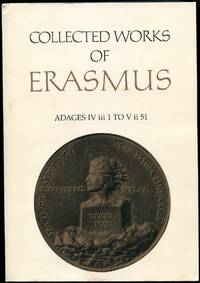
2006ref. 12754Toronto; Buffalo; London: University of Toronto Press. Very Good with no dust jacket. 2006. Softcover. 1487520751 . KB65.x 677 i pp. Works cited table of adages. Tall octavo. Cream card covers with Erasmus medallion to the front cover. Minor shelf wear small bump at top front near spine small pencil erasure on the half title otherwise clean and nice. Very good copy. In English. Each adage itself is in Latin or occasionally Greek with a translation of the adage and then an explanation in English. This is the softcover edition. The hardcover of No. 36 is very hard to find. ; Collected Works; Vol. 36; Large 8vo 9" - 10" tall; 677 pages . University of Toronto Press paperback
1975ref. 11090Amsterdam: North-Holland Publishing Company 1975. Hardcover. Good. Gray publisher's cloth ex library with the standard library matter including ink stamps on the closed page edges and a partially removed spine label 26 x 18.5 cm 10 1/4 x 7 1/4 inches tight. VI 432 clean pages. Page edges with dust spots. Shipped US meda rate as quoted at checkout; Priority Mail or International orders will require extra postage. The text is in Latin; the notes are in French. This volume includes Parabolae sive Similia; Encomivm Matrimoni.Desiderius Erasmus 1467-1536 �born at Rotterdam�educated at Daventer. Entered among the canons regular 1486. Ordained a priest 1492. Visited England 1497. Resided at Louvain Padua and Rome 1501 to 1510 when he returned to England and obtained the Margaret Professorship of Divinity and the Greek Lectureship at Cambridge. Went to Basil 1514 where he edited the Greek New Testament the works of St. Jerome and other works�He was considered the glory of his age and country and contributed more than any other to the restoration of learning in Europe and to the Reformation although he did not join the Reformers.� � Darling Cyclopedia Bibliographia. North-Holland Publishing Company hardcover
1973ref. 11097Amsterdam: North-Holland Publishing Company 1973. Hardcover. Good. Gray publisher's cloth ex library with the standard library matter including ink stamps on the closed page edges and a partially removed spine label 26 x 18.5 cm 10 1/4 x 7 1/4 inches tight. VIII 362 clean pages. Page edges with dust spots. Shipped US meda rate as quoted at checkout; Priority Mail or International orders will require extra postage. The text is in Latin; the notes are in French. This volume of the Amsterdam edition of the Latin texts of Erasmus contains several works intended for scholarship in Classics. It includes discourse on the correct pronunciation of Latin and Greek rhetoric and Classical Latin in a compendium of the handbook by Lorenzo Valla as well as a declamation in praise of medicine. The volume offers a critical edition of the Latin text with introductions and commentaries in French and in English explaining the philological linguistic and historical problems the reader could meet.Desiderius Erasmus 1467-1536 �born at Rotterdam�educated at Daventer. Entered among the canons regular 1486. Ordained a priest 1492. Visited England 1497. Resided at Louvain Padua and Rome 1501 to 1510 when he returned to England and obtained the Margaret Professorship of Divinity and the Greek Lectureship at Cambridge. Went to Basil 1514 where he edited the Greek New Testament the works of St. Jerome and other works�He was considered the glory of his age and country and contributed more than any other to the restoration of learning in Europe and to the Reformation although he did not join the Reformers.� � Darling Cyclopedia Bibliographia. North-Holland Publishing Company hardcover
1969ref. 11089Amsterdam: North-Holland Publishing Company 1969. Hardcover. Good. Gray publisher's cloth ex library with the standard library matter including ink stamps on the closed page edges and a partially removed spine label 26 x 18.5 cm 10 1/4 x 7 1/4 inches tight. XXI 681 clean pages. Page edges with dust spots. Shipped US meda rate as quoted at checkout; Priority Mail or International orders will require extra postage. The text is in Latin; the notes are in English. This volume includes Antibarborvm Liber; Commentarivs Erasmi in Nvcem Ovidii; Libanii Aliqvot Declamativncvlae Euripidis Hecvba et Iphigenia Latinae Factae Erasmo Interprete; Lvciani Complvria Opvscvla ab Erasmo et Thoma Moro Interpretibvs Optimis in Latinorvm Lingvam Tradvcta; Galini Exhortatio ad Bonas Arteis Praesertim Medcinam de Optimo Docendi Genere et Qvalem Oporteat esse Medicvm Erasmo Interprete.Desiderius Erasmus 1467-1536 �born at Rotterdam�educated at Daventer. Entered among the canons regular 1486. Ordained a priest 1492. Visited England 1497. Resided at Louvain Padua and Rome 1501 to 1510 when he returned to England and obtained the Margaret Professorship of Divinity and the Greek Lectureship at Cambridge. Went to Basil 1514 where he edited the Greek New Testament the works of St. Jerome and other works�He was considered the glory of his age and country and contributed more than any other to the restoration of learning in Europe and to the Reformation although he did not join the Reformers.� � Darling Cyclopedia Bibliographia. North-Holland Publishing Company hardcover
ref. 1421803321.Ghardcover. Good. Access codes and supplements are not guaranteed with used items. May be an ex-library book. hardcover
1524ref. 2455Paris: Jodocus Badius Ascensius 1524. THE 1524 BADIUS ASCENSIUS EDITION. Written in 1509 as a visitor's gift to Thomas More whose name -Morus- was so aptly similar to the Greek "moros" folly the "Moriae Encomium" was first printed by Gilles de Gourmont at Paris probably in 1511. Hardcover. Fine. Bound in contemporary limp vellum lightly soiled. The contents are in very good condition with a few pencil annotations and light soiling to the title page. With Badius' device of his print shop the “Praelum Ascensianum” showing printers working a press on the title page. With large attractive crible initials and smaller charming historiated initials. Passages in Greek. A fine unsophisticated copy of this rare edition. From the personal library of Bob and Emily De Graaf. The rare 1524 Parisian “Praise of Folly” printed by Erasmus’ friend the scholar-printer Badius Ascensius who printed the first authorized edition in 1512. This edition contains all of the supplementary texts found in the Froben edition of 1519 see the note “additional Moria texts” below including the dedicatory letter to Thomas More and the letter to Martin Dorp in which Erasmus explains his motives for writing the “Moria”: “My aim in the ‘Folly’ was exactly the same as in my other works. Only the presentation was different. In the ‘Enchiridion’ I simply outlined the pattern of a Christian life. In my little book the ‘Education of a Christian Prince’ I offered plain advice on how to instruct a prince. In my ‘Panegyric’ I did the same under the veil of eulogy as I had done elsewhere explicitly. And in the ‘Folly’ I expressed the same ideas as in the ‘Enchiridion’ but in the form of a joke.” “The ‘Praise of Folly’ is Erasmus’ most famous and controversial work… In Erasmus’ lifetime the ‘Moria’ was condemned in 1527 by the theologians of Paris for its attacks on faith and morality and again in 1533 by the Franciscans who found it full of heresies. The officials of the Sorbonne put it on the list of condemned books in 1542 and 1543 a list that was the basis of the Tridentine Index of 1564… “The ‘Moria’ may start as a learned joke to amuse a fellow humanist Thomas More but it moves into sharp criticism of contemporary mores and ends with a plea for a return to the Christianity of the Gospels… Erasmus writes in a Lucianic spirit of irreverent burlesque of the gods of classical mythology and light-hearted amusement at the irrationality of mankind. Folly argues that she is all that is natural youthful fecund and happy and that life would be intolerable if it were not ruled by civilized conventions which necessitate a degree of humbug and illusion. By contrast the Stoic ideal rational man is a ‘kind of marble statue of a man devoid of sense and any sort of human feeling.’ She then shifts her viewpoint and lists the people who enjoy her benefits insofar as they try to preserve their illusions or are happy in their ignorance self-deception or self-love. She even adds superstitious piety to alchemy gambling and the nobility’s obsession with hunting and extravagant building… “Next Erasmus starts to deliver a sharp and often bitter attack on all the victims of blind folly those who are deaf to the voice of true religion and lacking the gentler Christian virtues among whom are sycophants self-seekers money-makers pedants scholastics lawyers theologians superstitious worshippers of images and relics courtiers and kings worldly monks and irreligious pontiffs. This section culminates in a savage thrust at Pope Julius II the bellicose pope. The keen wit and ingenuity of the satire can be highly entertaining but there is no note of gaiety now. As Erasmus surveys the gulf between the Church and the ‘true philosophy of Christ’ he moves into the final section where the alternative offered to barren scholasticism is the vision of reality taken from Plato and folly in the sense used by Saint Paul that of receptivity to the Christian message by the ‘fool in Christ.’ All irony is dropped until the final short epilogue when Folly light-heartedly cuts short her ‘hotch-potch of words’; this is a direct and simply worded account of Erasmus’ personal belief moving into an exposition of the Neoplatonist concept that the soul’s ascent to beatitude ends in ecstasy a form of folly which is its supreme fulfillment.”Betty Radice Collected Works of Erasmus Vol. 27 pp. 78 ff. Additional Moria Texts: In addition to Erasmus' main text this edition includes two ancient examples of the mock-encomium Seneca's "Ludus de Morte Claudii Caesaris" and Synesius of Cyrene's "De Laudibus Calvitii" "In Praise of Baldness" translated from the Greek by the Englishman John Phreas d. 1465. In his introductory letter to Thomas More Erasmus cites both the "Ludus" and the "Praise of Baldness" in a pre-emptive defense against those who will object to his literary frivolity "levitas et ludicrum argumenti" pp. 102-104 in this edition. The text of the "Moria" is accompanied by the commentary of Gerard Listrius with assistance from Erasmus. Jodocus Badius Ascensius hardcover