BERKELEY, GeorgeBiblio.com
3 657 résultats
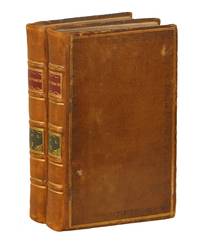
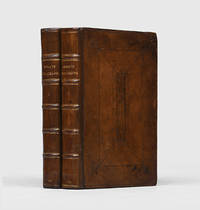
1732réf. 170650London: Printed by J. Tonson 1732. The idealist philosopher's most substantial work First edition of Berkeley's defence of traditional Anglicanism against the nascent secularism of the early Enlightenment: a major work of 18th-century Christian apologetics. Alciphron is a critical source for Berkeley's wider philosophy of language. Berkeley 1685-1753 defends the Theist position that the world is dependent on an interventionist God providing religious knowledge through miracles and divine revelation. Enlightenment thinkers increasingly argued that a non-interventionist deity had created the universe to operate autonomously on machine-like principles and laws. In such a scenario the miracles and revelations of an interventionist God were of little use as a source of religious knowledge which was possible only through rational reflection. In challenging these ideas Berkeley collectively represents their chief exponents Locke Mandeville and the third Earl of Shaftesbury as the conceited free thinkers Alciphron and Lysicles. Volume II includes a revised edition of Berkeley's An Essay towards a New Theory of Vision first published in 1709 with a new title page and continuous register. In the Advertisement Berkeley notes that his earlier work is included as an addendum to the fourth dialogue which concerns the function of the senses in deriving knowledge of God. 2 vols octavo 194 x 120 mm. Wood engraving to title pages of both vols. Contemporary panelled calf neatly rebacked and recornered spines ruled and lettered in gilt raised bands edges sprinkled red. 18th-century signature of "William McGuire" to title page of vol. II. Light rubbing cosmetic splits to inner hinges minor browning and foxing to endpapers and edges loss to upper outer corner of title page vol. I small hole in F8 vol. I: a very good copy. Jessop 121a; Keynes 15. hardcover
1803réf. 333Octavo 388 2 ads pp. 200 x 121 mm. Contemporary mottled sheep rebacked to style gilt spine with burgundy morocco label. Some light foxing & browning to text due to paper quality. Old ink signature on front free endpaper marginal chip in a preliminary blank. Overall an unusually nice attractive copy now Housed in a custom clamshell box with a red leather label. First American edition originally published in the UK in 1732. Berkeley 1685-1753 wrote the Alciphron during the years 1729 to 1731 while relaxing in Newport Rhode Island where he was awaiting funds which never came for his projected college in the Bermudas. This this is the first major philosophical work to be written in America though published in London first. The book attracted more attention than any of his previous works. The dialogues it contains constitute a defense of Christianity from the point of view of an Anglican divine. Alciphron is regarded as an outstanding example of English literature among works on philosophy. It is described on the title-page as an Apology for the Christian Religion against those who are called Free-Thinkers and the Dialogues defend revealed religion against the current beliefs of the Deists. Luce places Alciphron with Joseph Butler s Analogy 1736 as the only comparable book on Christian apologetics in the eighteenth century Keynes p. 37 Sidney's Press, for Increase Cooke & Co. hardcover
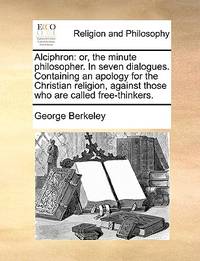
réf. 1140929798.Gpaperback. Good. Access codes and supplements are not guaranteed with used items. May be an ex-library book. paperback
réf. 1140795376.Gpaperback. Good. Access codes and supplements are not guaranteed with used items. May be an ex-library book. paperback
réf. 1148011862.Gpaperback. Good. Access codes and supplements are not guaranteed with used items. May be an ex-library book. paperback
réf. 1379545676.Ghardcover. Good. Access codes and supplements are not guaranteed with used items. May be an ex-library book. hardcover
réf. 1379420326.Ghardcover. Good. Access codes and supplements are not guaranteed with used items. May be an ex-library book. hardcover
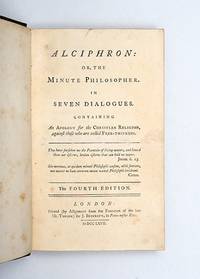
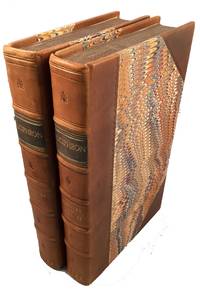
1767réf. 158145London: Printed by assignment from the executors of the late Mr. Tonson for J. Beecroft 1767. Stated fourth edition though in fact a re-issue of the third edition sheets of 1752 with a cancel title page. In Alciphron first published in 1732 Berkeley rebuts the insurgent secular intellectual trends of the early Enlightenment. Countering the views of Locke Mandeville and the third Earl of Shaftesbury who collectively manifest as the conceited free thinkers Lysicles and Alciphron Berkeley defends traditional Christianity and his own idealist epistemology. Octavo 206 x 129 mm. Nineteenth-century half calf green calf label marbled sides sprinkled edges. 19th-century bookplate of one Daniel Frazer to front pastedown. A little rubbed small chip at foot of rear joint binding firm scattered light foxing else clean slight paper fault to A8 not affecting text; a very good copy. ESTC N15774; Keynes 25; Jessop 169. unknown
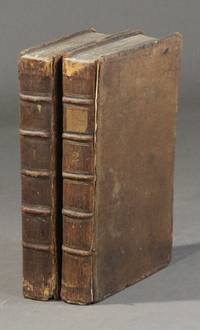
1732réf. 000010926London: J. Tonson 1732. First edition. Hardcover. Very Good. 2 vol. 8vo. 13 2-350 2; 9 2-358 2 pp. Full sheep ca. 1800 with twin gold borders on each board spines in six compartments with later red and green morocco labels lettered and bordered in gold on each spine; all edges decoratively sprinkled. Bound with a later edition of Berkeley's Theory of Vision. Illustrated with two small woodcuts on the title pages and several wood-cut initials head and tailpieces. The Theory of Vision contains a few in-text diagrams. Contains one of the mispaginations in volume II but not the other. Honderich 89. Jessop 16a. Keynes 15. Mead 10. Written in colonial America Berkeley's Alciphron is a vigorous defense of Christianity against the atheists deists and skeptics of his day. It elicited several responses from other theologians and would help Berkeley shape his later views concerning philosophy of language. According to Honderich "Berkeley is a most striking and even unique phenomenon in the history of philosophy. There have been many philosophers who have constructed bold and sweeping . metaphysical systems . have been devoted to the clarification and defence of 'common sense' . some have made it their chief concern to defend religious faith and doctrine against their perceived enemies. It is the peculiar achievement of Berkeley that with high virtuosity and skill he contrived to present himself in all these roles at once" Honderich 89. The volumes rebacked in later sheep the reverse of the front flyleaf of volume one has a pre-20th century inscription citing a 1746 publication each title page has a pre-20th century name in its margin. J. Tonson hardcover
1732réf. 00008013London: J. Tonson 1732. Second edition. Hardcover. Near Fine. 2 vol. 8vo. 15 2-356 4; 9 2-351 3 pp. Recent half brown calf over marbled paper boards spine in six compartments with gold lettering and gold rules; brown topstain and red speckled fore-edge and bottom edge. Recent endpapers and pastedowns. Volume 1 missing the A4 blank the blank leaf called for between the errata and the contents has been excised otherwise both volumes collate complete. Keynes A17. A handsome set of two of Berkeley's principal works. Bindings are about Fine contents Very Good or better leaves very clean with occasional light wear Volume 1: bottom corner of L1 missing; Volume 2: the first three or so gatherings show minor loss at the front gutter. J. Tonson hardcover
1732réf. 26337London: J. Tonson 1732. 2 vols. 8vo pp. 14 356; 8 218; engraved vignette title-pp.; bound with as issued An Essay towards a New Theory of Vision pp. 12 215-351; several woodcuts in the text; full contemporary calf double gilt rules on covers unlettered spines in 6 compartments volume designations in 1; some moderate chipping and cracking of the spines but all in all a good and reasonably sound set. Rothschild 372 citing the first edition of the same year: "Alciphron was written in America where Berkeley had gone to await funds which never came for his projected College in the Bermudas. J. Tonson unknown
1732réf. 1024F13London: J. Tonson 1732 . Leather. Good Only. 8.5" by 5.5". None. The second edition of Bishop Berkeley's fascinating philosophical dialogue about the Christian religion complete in two volumes. The second edition of this work published in the same year as the first edition. Complete in two volumes. Illustrated with engraved title page vignettes. A philosophical dialogue by the Irish philosopher George Berkeley in which he combats the arguments of free-thinkers such as Mandeville and Shaftesbury against the Christian religion. The dialogue is primarily between four characters the free-thinkers Alciphron and Lysicles Berkeley's spokesman Euphranor and Crito who serves as a spokesman for traditional Christianity. ESTC T86055 A3 a4 B-Z8 2A2; A4 B-2A8. Collated complete. Bookplate of Henry Fowler Broadwood to front pastedowns inscriptions to title page heads. Rebacked with endpapers renewed. Bishop Berkeley is regarded as the founder of immaterialism a philosophical theory he developed which later came to be known as subjective idealism. Rebacked in full calf bindings with endpapers renewed. Volume I joint heads and tails are starting but boards are firmly held. Rear joint head of volume II starting but firmly held. Front board of volume II detached but present. Internally firmly bound. Inscriptions to title page heads. Pages clean and bright. Good Only J. Tonson hardcover
1732réf. 049753London: J. Tonson 1732. First Edition. Hardcover Full Leather. Very Good Condition. Two volumes in paneled calf worn at edges neatly rebacked. Minor foxing internally title pages and final leaves a touch soiled endpapers browned; quite fresh overall. The first edition published the same year as the second. of Berkely's work of Christian apologetics. 12 350pp; 8 358pp Size: Octavo 8vo. Quantity Available: 1. Shipped Weight: Under 1 kilo. Category: Reference; Philosophy. Inventory No: 049753. J. Tonson hardcover
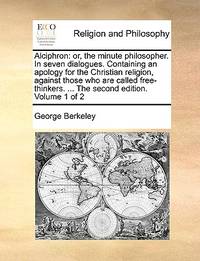
2024réf. Gyan-9789370735187Facsimile Publisher 2024. Vol. 1. Hardcover. New. 22.59 x 14.34 x 3.74 cm. English Facsimile Publisher hardcover
2024réf. Gyan-9789370735187Facsimile Publisher 2024. Vol. 1. Hardcover. New. 22.59 x 14.34 x 3.74 cm. English Facsimile Publisher hardcover
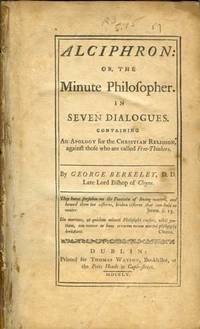
1755réf. 15970Dublin: Thomas Watson 1755. Hard Cover. Fair/No Jacket. Thomas Watson1755. Leather binding. Front board missing back board partially detached 1/3 loss on spine. 370 pages 2 pages of advertisement 7 page table of contents. Pages are clean and unmarked moderately foxed throughout. Good reading/research copy. Thomas Watson hardcover
réf. 35600482, La Haye, Gibert, 1734. 2 vol. in-12, veau blond, encadr. fil. dor., dos ornés, tr. jasp. (Rel. de l'ép.) Edition originale en français. La traduction est de P. de Joncourt. Ecrit sous forme de dialogues, sur le modèle de ceux de Platon, l'auteur favori de Berkeley, Alciphron est une réfutation des divers systèmes de l'athéisme. 1 planche dépliante de géométrie au tome I.
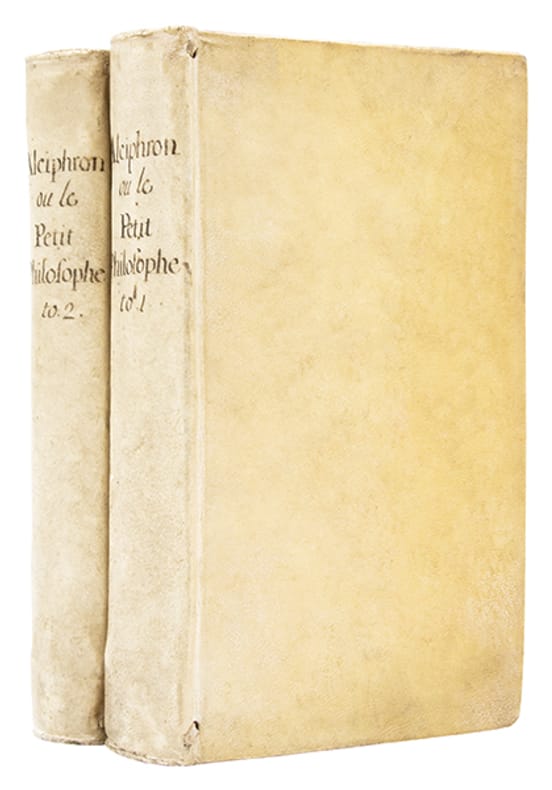
réf. 388732 volumes in-12 (168 x 98 mm), plein vélin rigide de l'époque, dos titrés à la plume, (8), 372, (10) p. et (2), 218, (6), 133, (15) p., planche gravée dépliante de figures géométriques au tome I. La Haye, P. Gosse & J. Neaulme, 1734.
1952réf. RO20193426AUBIER - MONTAIGNE. 1952. In-8. Broché. Bon état, Couv. convenable, Dos satisfaisant, Intérieur frais. 343 pages .. . . . Classification Dewey : 100-PHILOSOPHIE ET DISCIPLINES CONNEXES
1732réf. 2329641London: Printed for J. Tonson in the Strand 1732. Second Edition. Full-Leather. Good/No Jacket. Second edition. Neatly rebacked with new gilt titles original boards and endsheets retained. Discolored 2 inch declivity on front board boards rubbed with corners exposed first volume lacks leaf A4 ink owner stamps on front endpapers William Harris Mar 1944 light stain to marginal edges of first gathering in volume two front and end matter lightly foxed rear free endpaper of first volume loosening. 1732 Full-Leather. 356; 351 pp. Alciphron is a Christian apologetic in answer to the 'minute philosophers' of Berkeley's day who sought to minimize the the dignity of man. Berkeley is known as an advocate of subjective idealism which he called immaterialism which states that objects do not exist unless they are perceived. "A Treatise Concerning the Principles of Human Knowledge 1710 is the classic exposition of his philosophy of immaterialism as an antidote to infidelity prefaced with an influential essay in the philosophy of language; part two was later lost in manuscript with other papers in Italy." - Oxford Dictionary of National Biography Perhaps his most well-known work is Three Dialogues between Hylas and Philonous in which two characters representing himself and John Locke discuss various philosophical questions. Berkeley was a fellow at Trinity College and in the 1720s turned his attention to the project of opening St. Paul's College in Bermuda though skepticism about the chances of success in this endeavor caused the funding to come into question. "To prevent a threatening decline in private support Berkeley sailed for Newport Rhode Island with a small advance party on 6 September 1728; this included Smibert who painted several well-known portraits of Berkeley and of his party before settling for life in Boston. The journey was hazardous and protracted. They made an unscheduled landfall on the Virginia coast about the turn of the year and were officially received at Williamsburg before reaching Rhode Island on 23 January 1729. By the spring Berkeley had bought a farm of 96 acres at Middletown 'with two fine groves and winding rivulet upon it' Works 8.194 whose produce would support the college. He employed slaves and was apparently indifferent to the institution of slavery provided that it was humane seeing the moral need rather as one of conversion and baptism. He built a new house Whitehall which is now maintained as a historic site although the adjoining farmland has given way to urban development. Berkeley often preached at Newport Rhode Island in the winter and in remoter outposts in the summer. The strongest and longest friendship he established among New England churchmen was with Samuel Johnson 1696 - 1772 of Stratford Connecticut a refugee from Calvinism who later became first president of King's College New York later Columbia University and lent support to Berkeley's philosophy through his Elementa philosophica 1752 and other writings. Throughout his career Berkeley had little time for dissenters although he abhorred the use of violence against them. The religious tolerance characteristic of Rhode Island induced a degree of ecumenicism in his social practice that was not always maintained in the pulpit. Reports of growing infidelity in English society to which he was always liable to give credence were fuelled by the continuing bad faith of the government in failing to lodge the funds he considered legally his. This was a factor in his writing Alciphron a set of dialogues located notionally in England but drawing much of the landscape description from Rhode Island which was to sell well and stimulate controversy after his return. In this theist and immaterialist combine their defences against a medley of intellectual trends derived primarily but not exclusively from Locke Bernard Mandeville and the third earl of Shaftesbury that Berkeley regarded as obstructive to religion. The work includes Berkeley's second foray into moral philosophy." - Oxford Dictionary of National Biography Printed for J. Tonson in the Strand hardcover books
1803réf. 2353260New-Haven Connecticut: For Increase Cooke & Co 1803. First American Edition. Full-Leather. Fair/No Jacket. First American edition from the fourth London edition. Lacks front board spine and rear board rubbed and drying two light spots on fore edge ink name and date on front endpaper brief pencil notes on rear endpaper. 1803 Full-Leather. xiii 2 16-388 2 pp. Complete in one volume. Alciphron is a Christian apologetic in answer to the 'minute philosophers' of Berkeley's day who sought to minimize the the dignity of man. Berkeley is known as an advocate of subjective idealism which he called immaterialism which states that objects do not exist unless they are perceived. "A Treatise Concerning the Principles of Human Knowledge 1710 is the classic exposition of his philosophy of immaterialism as an antidote to infidelity prefaced with an influential essay in the philosophy of language; part two was later lost in manuscript with other papers in Italy." - Oxford Dictionary of National Biography Perhaps his most well-known work is Three Dialogues between Hylas and Philonous in which two characters representing himself and John Locke discuss various philosophical questions. Berkeley was a fellow at Trinity College and in the 1720s turned his attention to the project of opening St. Paul's College in Bermuda though skepticism about the chances of success in this endeavor caused the funding to come into question. "To prevent a threatening decline in private support Berkeley sailed for Newport Rhode Island with a small advance party on 6 September 1728; this included Smibert who painted several well-known portraits of Berkeley and of his party before settling for life in Boston. The journey was hazardous and protracted. They made an unscheduled landfall on the Virginia coast about the turn of the year and were officially received at Williamsburg before reaching Rhode Island on 23 January 1729. By the spring Berkeley had bought a farm of 96 acres at Middletown 'with two fine groves and winding rivulet upon it' Works 8.194 whose produce would support the college. He employed slaves and was apparently indifferent to the institution of slavery provided that it was humane seeing the moral need rather as one of conversion and baptism. He built a new house Whitehall which is now maintained as a historic site although the adjoining farmland has given way to urban development. Berkeley often preached at Newport Rhode Island in the winter and in remoter outposts in the summer. The strongest and longest friendship he established among New England churchmen was with Samuel Johnson 1696 - 1772 of Stratford Connecticut a refugee from Calvinism who later became first president of King's College New York later Columbia University and lent support to Berkeley's philosophy through his Elementa philosophica 1752 and other writings. Throughout his career Berkeley had little time for dissenters although he abhorred the use of violence against them. The religious tolerance characteristic of Rhode Island induced a degree of ecumenicism in his social practice that was not always maintained in the pulpit. Reports of growing infidelity in English society to which he was always liable to give credence were fuelled by the continuing bad faith of the government in failing to lodge the funds he considered legally his. This was a factor in his writing Alciphron a set of dialogues located notionally in England but drawing much of the landscape description from Rhode Island which was to sell well and stimulate controversy after his return. In this theist and immaterialist combine their defences against a medley of intellectual trends derived primarily but not exclusively from Locke Bernard Mandeville and the third earl of Shaftesbury that Berkeley regarded as obstructive to religion. The work includes Berkeley's second foray into moral philosophy." - Oxford Dictionary of National Biography For Increase Cooke & Co hardcover books
2010réf. NF3401Alciphron or The Minute Philosopher. In Seven Dialogues. Containing an Apology for the Christian Religion against those who are called Free-thinkers From Sidney's Press for Increase Cooke & Co. 1803 first American edition both covers detached spine starting to join them staining to the text block but with all contents still easily readable else there in what most certainly looks like the original leather binding speaking of which a new one here vouldn't hurt. An important book in the Philosophy Canon by this author from which came the name of a certain city in Northern California not to mention an university of some renown as well. From the library of the former premier Walt Whitman collector bibliophile and philanthropist Charles Feinberg. From Sidney's Press, for Increase Cooke & Co. hardcover books
1732réf. 2329641London: Printed for J. Tonson in the Strand 1732. Second Edition. Full-Leather. Good/No Jacket. Second edition. Neatly rebacked with new gilt titles original boards and endsheets retained. Discolored 2 inch declivity on front board boards rubbed with corners exposed first volume lacks leaf A4 ink owner stamps on front endpapers William Harris Mar 1944 light stain to marginal edges of first gathering in volume two front and end matter lightly foxed rear free endpaper of first volume loosening. 1732 Full-Leather. 356; 351 pp. Alciphron is a Christian apologetic in answer to the 'minute philosophers' of Berkeley's day who sought to minimize the the dignity of man. Berkeley is known as an advocate of subjective idealism which he called immaterialism which states that objects do not exist unless they are perceived. "A Treatise Concerning the Principles of Human Knowledge 1710 is the classic exposition of his philosophy of immaterialism as an antidote to infidelity prefaced with an influential essay in the philosophy of language; part two was later lost in manuscript with other papers in Italy." - Oxford Dictionary of National Biography Perhaps his most well-known work is Three Dialogues between Hylas and Philonous in which two characters representing himself and John Locke discuss various philosophical questions. Berkeley was a fellow at Trinity College and in the 1720s turned his attention to the project of opening St. Paul's College in Bermuda though skepticism about the chances of success in this endeavor caused the funding to come into question. "To prevent a threatening decline in private support Berkeley sailed for Newport Rhode Island with a small advance party on 6 September 1728; this included Smibert who painted several well-known portraits of Berkeley and of his party before settling for life in Boston. The journey was hazardous and protracted. They made an unscheduled landfall on the Virginia coast about the turn of the year and were officially received at Williamsburg before reaching Rhode Island on 23 January 1729. By the spring Berkeley had bought a farm of 96 acres at Middletown 'with two fine groves and winding rivulet upon it' Works 8.194 whose produce would support the college. He employed slaves and was apparently indifferent to the institution of slavery provided that it was humane seeing the moral need rather as one of conversion and baptism. He built a new house Whitehall which is now maintained as a historic site although the adjoining farmland has given way to urban development. Berkeley often preached at Newport Rhode Island in the winter and in remoter outposts in the summer. The strongest and longest friendship he established among New England churchmen was with Samuel Johnson 1696 - 1772 of Stratford Connecticut a refugee from Calvinism who later became first president of King's College New York later Columbia University and lent support to Berkeley's philosophy through his Elementa philosophica 1752 and other writings. Throughout his career Berkeley had little time for dissenters although he abhorred the use of violence against them. The religious tolerance characteristic of Rhode Island induced a degree of ecumenicism in his social practice that was not always maintained in the pulpit. Reports of growing infidelity in English society to which he was always liable to give credence were fuelled by the continuing bad faith of the government in failing to lodge the funds he considered legally his. This was a factor in his writing Alciphron a set of dialogues located notionally in England but drawing much of the landscape description from Rhode Island which was to sell well and stimulate controversy after his return. In this theist and immaterialist combine their defences against a medley of intellectual trends derived primarily but not exclusively from Locke Bernard Mandeville and the third earl of Shaftesbury that Berkeley regarded as obstructive to religion. The work includes Berkeley's second foray into moral philosophy." - Oxford Dictionary of National Biography Printed for J. Tonson in the Strand hardcover
2024réf. Gyan-9789370730427Facsimile Publisher 2024. Vol. 2. Hardcover. New. 22.59 x 14.34 x 3.79 cm. English Facsimile Publisher hardcover
2024réf. Gyan-9789370730427Facsimile Publisher 2024. Vol. 2. Hardcover. New. 22.59 x 14.34 x 3.79 cm. English Facsimile Publisher hardcover