LOCKE, JohnBiblio.com
5430 risultati
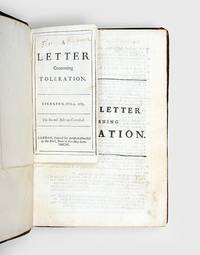
1690rif. 187184London: first: Printed for Awnsham Churchill 1690; second & third: Printed for Awnsham and John Churchill 1690 & 1692. Locke's three letters on toleration in a single volume with a probable connection to Locke's Somerset friends First editions of the Second and Third Letters second edition in English of the First collecting in a single volume all the works on toleration published by Locke in his lifetime. Following Louis XIV's revocation of the Edict of Nantes in 1685 Locke was moved to publish views he had previously circulated only in manuscript. Although intended primarily for Christians and particularly for dissenting Protestants the three Letters outline a hugely influential conception of the proper relationship between government and religion. For Locke the state cannot and should not compel individuals to adopt particular faiths. Churches are re-conceived as voluntary societies which can be joined or left without incurring civil penalties - subject to the concerns of civil society and foreign influence. Locke's original Epistola de tolerantia 1689 was swiftly translated into English by his friend William Popple who was responsible for the phrase often attributed to Locke himself "Absolute Liberty Just and True Liberty Equal and Impartial Liberty is the thing that we stand in need of" p. iv. In April 1690 an Oxford clergyman disputed the Letter's rejection of force which prompted Locke to reply that summer under an assumed identity with the Second Letter and then under his own identity with the much longer Third Letter of 1692. A fourth was left in manuscript at Locke's death in 1702; it was first published in the Posthumous Works 1706. The first and second Letters bear the contemporary ink signature of Thomas Musgrave on their title pages. This is probably a member of the Musgrave family of Nettlecombe Somerset whom Locke knew well. William Musgrave 1655-1721 was a fellow member of the Royal Society while Dr George Musgrave d. 1721 a country physician married the daughter of Edward Clarke one of Locke's closest friends. Locke himself a trained physician knew George Musgrave well enough to write letters praising his medical skills: the latter returned the compliment by providing some of the first admiring reviews of Locke's Essay Concerning Human Understanding 1694. The Somerset archives contain the 1723 will of one Thomas Musgrave of Nettlecombe. A similar hand possibly that of Musgrave has made a further annotation on the rear free endpaper verso. 3 works bound in 1 vol. the first duodecimo 139 x 70 mm the others quarto 205 x 142 mm; pp. iv 87 5; pp. iv 68; pp. iv 350 2. Contemporary panelled calf edges sprinkled red. Joints and extremities restored spot of wear to corners light bumping faint offsetting to several leaves Third Letter with minor loss to upper outer corner of half-title and short closed tears to outer margins of Gg4 & Yy1 each just touching text: still a very good volume indeed. ESTC R21477; R5484; R5673; Printing and the Mind of Man 163; Wing L2748 L2755 L2765; Yolton 4; 25; 27. See Sowerby 1338. unknown
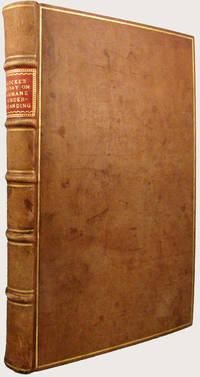
1690rif. 31842London: by Eliz. Holt for Thomas Basset 1690. First edition first issue with the Undated Dedication with the title-page listing Eliz. Holt the Properly Positioned “SS” the first imprint and all points called for typographical ornaments line 3 has them upside down in columns 2 through 6 while in line 4 all ornaments are upside down with five of the six possible misnumbered pages for this issue: "85" as "83" "287" as "269" "296" as "294" "303" as "230" and "319" as "327" page 55 with "Underwandings" as called for with the incorrect Roman numerals to pp. 57 and 263 and the deleted 24 paragraph indicator at page 90. With contemporaneous signature “J Locke” on the title page and three handwritten corrections "in" “extremely” and the insert “some” which may be in Locke's hand in the preliminaries. Folio 320 x 195 mm. full polished calf to style handsomely and discreetly double lined in gilt on the covers and the spine with raised bands ruled in gilt with red morocco lettering label gilt in best style on the spine. In beautiful condition. title 10 1-362 22 Contents pp. A handsome and pleasing and crisp copy in lovely condition some quite unobtrusive evidence of age mellowing or toning to the lower edges of the leaves probably from old damp. FIRST EDITION FIRST ISSUE OF THIS SINGULARLY IMPORTANT WORK IN THE HISTORY OF PHILOSOPHY AND EPISTEMOLOGY. Locke's ESSAY was the "first attempt on a great scale and in the Baconian spirit to estimate critically the certainty and the adequacy of human knowledge when confronted with God and the universe" EB. It served as the most concrete manifestation of a new empiricist spirit in contrast to the metaphysical philosophies of Descartes Spinoza and Leibniz. Locke was inspired to write the ESSAY in 1671 after a philosophical discussion with friends in which he realized that no progress could be made before they had examined the mind's capacities and seen "what objects our understandings were or were not fitted to deal with" from the "Epistle to the Reader". "Other philosophers had reflected on and written about human knowledge.But Locke was the first philosopher to devote his main work to an inquiry into human understanding its scope and its limits. And we can say that the prominent place occupied in modern philosophy by the theory of knowledge is in large measure due to him." Copleston A HISTORY OF PHILOSOPHY. Locke's influence was widespread and was not strictly limited to pure philosophical enquiry. In America his emphasis on rational thought versus "enthusiasm" provided ammunition and philosophical grounding to opponents of the revivalist and itinerant preachers of the Great Awakening and in the nineteenth century the "nature versus nurture" thesis was employed by Unitarians and other anti-Calvinist factions to argue that human nature was improvable through nurture and self-culture rather than corrupt beyond hope without conversion through a special act of divine grace. In England Locke had a strong influence on the literature of the Augustan Age Sterne Addison and the members of the Scriblerus Club all acknowledging the currency of his ideas. "The art of education political thought theology and philosophy especially in Britain France and America long bore the stamp of the ESSAY or of reaction against it" Fraser quoted in Grolier. Locke's ESSAY has passed through more editions than any classic in modern philosophical literature and remains a cornerstone in the history of human thought. by Eliz. Holt for Thomas Basset hardcover
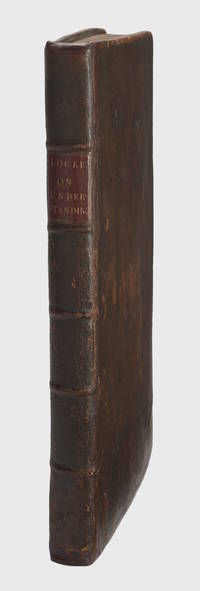
1690rif. 168757London: by Eliz. Holt for Thomas Basset 1690. One of the principal sources of empiricism in modern philosophy First edition first issue with the Holt imprint. Locke worked for nearly two decades on his investigation of "the certainty and the adequacy of human knowledge" PMM and the resulting landmark work influenced many Enlightenment philosophers. Locke argued that all our knowledge comes from experience and through our senses rather than innate ideas. The mind is at birth a clean sheet a tabula rasa; since only material things can affect our sense we can know nothing but matter and must accept a materialistic philosophy. Locke concluded that "though knowledge must necessarily fall short of complete comprehension it can at least be 'sufficient'; enough to convince us that we are not at the mercy of pure chance and can to some extent control our own destiny" ODNB. Locke's Essay quickly ran to several editions and was popularized on the continent through French translations. "Few books in the literature of philosophy have so widely represented the spirit of the age and country in which they appeared or have so influenced opinion afterwards. The art of education political thought theology and philosophy especially in Britain France and America long bore the stamp of the Essay or of reaction against it" Grolier. Voltaire and Diderot accepted Locke with little question Hume and Kant continued the investigation and Bishop Berkeley rejected it with his own immaterialism. The edition was reissued with a cancel title bearing an Edward Mory imprint. Provenance: inscription to front free endpaper "Robert Kirktowne London: 1698" a Robert Kirktowne is recorded as a naval surgeon in the period 18th-century inscription to the front pastedown "Ex libris Gulielmi Byrd MTS". This is possibly William Byrd II 1674-1744 a large landowner in Virginia who studied at Middle Temple in London explaining the MTS Middle Temple School initials. Folio 318 x 192 mm pp. xii 362 22. Contemporary speckled calf red morocco label covers bordered in blind edges speckled red. Housed in a dark blue quarter morocco solander box by the Chelsea Bindery. Ninteenth-century shelf label at head of spine. Skilful restoration at extremities leaf D2 with defective inner margin resulting in a number of missing words supplied in manuscript in early hand. A few splashes and scratches to covers else well-preserved contents a little toned else clean: a very good copy. Attig 228; ESTC R22993; Garrison-Morton 4967; Grolier English 100 72; Pforzheimer 599; Printing and the Mind of Man 164; Hook & Norman 1380; Wing L-2738; Yolton 61A. unknown
1690rif. 32820531FIRST EDITION FIRST ISSUE with the integral Eliz. Holt title-page. An excellent fresh copy of this classic of philosophy the first modern attempt to analyze knowledge. "Few books in the literature of philosophy have so widely represented the spirit of the age and country in which they have appeared or have so influenced opinion afterwards" Fraser. "The Essay has long been recognized as one of the great works of English literature of the 17th century and one of the epoch-making works in the history of philosophy. It has been one of the most repeatedly reprinted widely disseminated and read and profoundly influential books of the past three centuries" Nidditch. "Locke is often classified as the first of the great English empiricists ignoring the claims of Bacon and Hobbes. This reputation rests on Locke's greatest work the monumental An Essay Concerning Human Understanding" Stanford Encyclopedia of Philosophy. Locke sold the copyright to the publisher Thomas Basset for thirty pounds plus six bound copies of every later edition and ten shillings for every sheet of additions to later printings. By 1800 twenty editions had appeared indicating work's great influence. Locke's intellectual heirs include Berkeley Hume and Bentham and the Radicals. "Locke was the first to take up the challenge of Bacon and to attempt to estimate critically the certainty and the adequacy of human knowledge when confronted with God and the universe. In the past similar enquiries had been vitiated by the human propensity to extend them beyond the range of human understanding and to invent causes for what it cannot explain. Therefore Locke's first task was to ascertain 'the original certainty and extent of human knowledge' and excluding 'the physical consideration of the mind to show how far it can comprehend the universe.' His conclusion is that though knowledge must necessarily fall short of complete comprehension it can at least be 'sufficient'; enough to convince us that we are not at the mercy of pure chance and can to some extent control our own destiny" Printing and the Mind of Man 164. Folio. Contemporary paneled calf red leather label. Rebacked preserving spine old endpapers. Manuscript correction on A3v. A very good fresh copy. Liz Holt
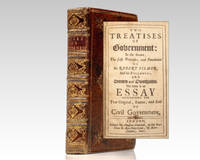
1690rif. 151350London: Printed for Awnsham Churchill 1690. Exceptionally rare first edition published at the end of 1689 in an edition of likely only 1000 copies with quire Q in second of two settings. Octavo bound in full calf morocco spine label gilt tooling to the spine blind stamped to the front and rear panels. Title-page within double rule. In very good condition. Rare and desirable. “In Two Treatises on Government… John Locke developed what he considered the ‘true original extent and end of civil government.’ The First Treatise was devoted to a refutation of the theory of divine right monarchy expounded by Sir Robert Filmer in his Patriarcha published in 1680. In his Second Treatise Locke presented his positive views on the origins of the social order. Civil society and government Locke argued were founded on an original social compact entered into by autonomous individuals in a state of nature. The powers of government Locke contended were limited by the authority granted by the free consent of the individuals subscribing to the social compact. Locke’s Second Treatise has been credited with great influence on American constitutionalism… Locke had a profound impact…. on the theoretical basis for forming new governments… Locke had a formative influence on the principles of the Declaration of Independence and on the early state constitutions” A Covenanted People 37. “The Second Treatise contains a plain statement of the principles of democracy. In an age and country in which the practice of democracy had just been triumphantly vindicated Locke’s theories… had all the freshness of novelty… civil rulers hold their power not absolutely but conditionally; government being essentially a moral trust which lapses if the trustees fail to maintain their side of the contract… The Treatises of Government provide a classic example of the empirical approach to social and political economy which has remained ever since the basis of the principles of democracy” PMM 163. Printed for Awnsham Churchill unknown