6 302 résultats
1773réf. 5488Troyes: chez Jean-Antoine Garnier ca. 1766 to 1773. Hardcover. Fine. Bound with: Le Grand Calendrier et Compost des bergers composé par le berger de la Grande Montagne Avec le Compôt naturel reformé selon le retranchement des dix jours par le Pape Gregoire III. Ensemble la manière comme se doit gouverner le Berger pour empêcher qu'aucun Sorciers ne fassent mourir leurs troupeaux avec toutes choses nécessaire pour se régler en leur art. Troyes: Chez Jean-A. Garnier Imp. Lib. No date ca. 1776 Quarto: II. 144 pp. A-S4. TWO RARE EDITIONS. Bound in contemporary tanned sheep the boards framed by a triple gold rule the spine ruled in gold and with rampant lions tooled in the compartments. The Privilege at end is granted to Pierre Garnier and dated 21 May 1728. It gives also a list of his other publications. Unusually fine copies printed on delicate paper of these works which are rarely found in such nice condition bound in a strictly contemporary binding. The bottom line of the first t.p. "avec permission" has been shaved off. In the second work leaf N1 has marginal stains; the last few leaves are lightly foxed. The Dance of Death "Les trois vifs et les Trois Morts" and the other accompanying texts are illustrated with 60 woodcuts of the Dance of Death copied from the original designs which appeared in the edition of the Danse Macabre of G. Marchant 1490. That of the Moor on p. 32 may be a very close copy of the same subject in the Compost. Another version of it appears on p. 27 and is a very close copy of that in the Bradwardine No. 64. N. B. - the two blocks of this subject appearing respectively on pp. 24 & 27 of the present Danse Macabre are not identical. Two works bound together both examples of important literary genres dating to the late-Medieval and early-Renaissance periods. The "Danse macabre" is a pictorial cycle and poem first painted at a Paris cemetery about 1425. Woodcuts copied from the Paris fresco along with the accompanying verses were first printed by Guy Marchant at Paris in 1485. "Le Grand Calendrier" an illustrated almanac and calendar was first printed in 1491 by Guy Marchant. The book remarkable for both its text and its illustrations was a kind of encyclopedia of meteorological agricultural hygienic and moral knowledge. I. The Dance of Death One of the earliest examples of the pictorial cycle and poem known as the Danse Macabre was painted between August 1424 and Lent 1425 in the arcades of the Cimetière des Saints-Innocents Cemetery of the Holy Innocents in Paris. These arcades constructed as charniers to house bones from earlier mass burials were demolished in 1669 along with their frescoes. The images of the Danse in this book were directly inspired by the Paris Danse. Woodcuts of the Danse copied from the Paris fresco along with the 67 verses that accompanied the images were first printed by Guy Marchant at Paris in 1485 with woodcuts designed by Pierre le Rouge. While there were no women in the original Danse in 1486 Marchant published an all-female version "La Danse Macabre des Femmes". Later Marchant united these two texts in the two-volume "Miroer Salutaire". While Marchant followed the sequence from the Cimetière des Saints-Innocents he introduced numerous changes adding new pictorial elements and verses including 20 additional dancers and the woodcut of the four skeleton musicians. From the 16th through the 18th centuries editions of the Danse appeared outside of Paris printed -with various changes- by French provincial printers in Lyon Rouen and Troyes. Over the years the woodblocks used to print the illustrations in the various Paris editions worn or damaged from repeated use and in some instances lost were re-cut with the images reproduced with varying degrees of fidelity to the originals. The printing history of the Danse in Troyes began in 1493 when Pierre le Rouge's woodblocks were acquired by his nephew Nicolas le Rouge who printed editions of the text into the 1530s. It is in Troyes that the woodcuts were first copied and further changes were introduced by successive printers. In 1610 the Troyes printer Noël Moreau began printing editions of the Danse using copies of the woodcuts from the Parisian edition published by Marchant 1490. Moreau added several new images at this point including the Black man blowing a horn and carrying a spear. According to Mortimer Moreau also used several original 15th c. blocks in this edition e.g. p. 26 the Punishment of the Sin of Luxury also used in the "Compost et kalendrier des bergiers" of 1497. and one of the Occupations of the Months May from the "Compost" of 1499. In 1641 Nicolas Oudot's son Nicolas Oudot II printed a new edition using Moreau's woodcuts. The last Oudot edition with the text largely re-written was printed by Nicolas II's son and widow in 1729 under the title "La Grande Danse Macabée sic!". It is this edition that would set the template for the next publishers the Garniers. The dating of this edition /- 1773 is based on the dates during which the publisher is known to have been active. A number of early bibliographers following the printed privilege on the last page dated this edition to 1728 and numerous cataloguing records have this date. However the publisher to whom the privilege was granted Pierre Garnier died in 1738. Further Jean-Antoine Garnier who is named as publisher on the title page was active between 1766 and 1773. Alexis Socard "Livres Populaires de Troyes" 1864 p. 126-127 tells us that the Garniers continued to print the book up until 1820 with the same imprint and privilege. See also: Corrard de Breban "Recherches sur l'établissement et l'exercice de l'imprimerie à Troyes" Paris 1873 4th ed. p.73-74. The additional texts: Already in the late 15th c. editions of the Danse had begun to include supplemental texts. Those included in this edition are: "Le débat du corps et de l'ame" "La complainte de l'ame damnée" "L'exhortation de bien vivre et de bien mourir" "La vie du mauvais Antechrist" and "Les quinze signes du jugement." Of these "La Vie du mauvais Antechrist" pp. 70-72 is antisemitic. The Antichrist is born of incest by "Un paillard Juif abominable" who knows his own daughter carnally is nursed by a whore before embarking on his career of destroying Christianity. He comes to Jerusalem where the Jews adore him he himself is circumcised but when he attempts a second Ascension from the Mount of Olives he is cast down into a sepulchre at the bottom of hell and "dix millions . De ces Juifs l'accompagneront". Marquand Library Notes: Fairfax Murray 108; see a reproduction of one of J.A. Marchant's editions in Claudin's Hist. de l'Impr. I. 339 sq. A brief description of those editions with some reproductions is found in Nisard Hist. des Livres populaires 1854 II 303 sq. A few of the images in these editions are new e.g. p. 26 the Punishment of the Sin of Luxury which originated in the Compost of 1497 see No. 103 and reproduction in Claudin I. 375 and one of the Occupations of the Months May from the Compost & Kal. Des Bergères 1499 see note to No. 103 and Claudin I. 379 sq. Langlois Essai Historique Philosophique et Pittoresque sur les Danses des Morts I p.340 31; Douce p.60 26; Reichelt 96 II. The Shepherd's Calendar and Compost Le Grand Calendrier et Compost des bergers A Troyes chés P. Garnier s.d. ca. 1776 Illustrated with 49 woodcuts including 12 full-page cuts one for each month of the calendar. Like the Danse Macabre many popular editions of this calendar were printed into the 18th c. particularly in Troyes and Paris. The Kalendrier des Bergiers an illustrated almanac and calendar was first printed on 2 May 1491 by Guy Marchant. On 18 April 1493 he printed an entirely new edition under the title: "Compost et Kalendrier des Bergiers" and on 18 July Marchant completed yet another edition further expanded in both text and illustrations: "Here is the Compost et Kalendrier des Bergiers. to which many new items have been added as those who look at it will be able to discover." The book remarkable for both its text and its illustrations was a kind of encyclopedia of meteorological agricultural hygienic and moral knowledge. "What we have here" says Monceaux "is the first almanac ever printed in France and one can readily understand the appeal of a work that addressed itself to the rural and popular masses and gave them advice of every kind on the health and hygiene of men and animals on agriculture on how to conduct oneself in this world with a view to arriving safely in the next - while at the same time giving those who could not read some basic knowledge of astronomy and the measurement of time via explanatory images." The beautiful incunabula editions of the Shepherd's Calendar were transformed into popular booklets in the mid-17th century notably by Nicolas Oudot. All the printers of the Bibliothèque bleue Blue Library published an edition of this Compost. "This undoubtedly means that the Compost was to be considered an introduction to popular literature because it contained presented-one might even say in their purest form the essential themes of the popular library." G. Bollème Les almanachs populaires p. 41. The book opens with a brief verse to the reader explaining the Gregorian calendar reform followed by a prologue in which the shepherd-author presents his central argument: that the natural human lifespan is seventy-two years demonstrable through a parallel between the twelve months of the year and twelve successive stages of human life six years to each month. The heart of the book is the compost and the almanac proper. The compost material includes mnemonic verses and tables for calculating the moveable feasts of the church year - Easter Pentecost and the rest - along with the Golden Number a nineteen-year cycle used to predict the date of the new moon the Dominical Letter a device for finding the day of the week on which any given feast falls and Epact tables the Epact being a number expressing the age of the moon on 1 January used to calculate Easter under the Gregorian reform. The almanac proper gives each month its own full-page woodcut a verse in the month's own voice describing its character and principal feasts and a calendar table. Part Two is devoted to the vices and the torments of Hell. It opens with the "Exhortation pour le Salut de l'Ame faite par maniere de double ballade" a poem calling the reader to repentance. The moral center of this section is an extended account of the punishments awaiting sinners in Hell introduced through the figure of Lazarus. It is illustrated with seven woodcuts depicting the punishments of the damned one for each of the deadly sins - the proud hung from spinning wheels fitted with iron cramps; the envious plunged to the waist in a freezing river; the wrathful pierced by swords in a dark and blood-soaked hall; the slothful assailed by serpents; the avaricious submerged in cauldrons of boiling oil and molten metal; the gluttonous forced to eat toads and drink from a foetid river; the lustful tormented in pits of fire and sulphur. Part Three - headed "La Troisième Partie du Compost des Bergers qui est science salutaire ou champ des vertus" - is devoted to religious and moral instruction. One notable section is the Field of Virtues "Jardin ou Champ des Vertus" which contains a poem of the soul adrift at sea guided by God to port two shepherd songs a verse catalogue of the pains of Hell a long poem in the voice of a rotting corpse meditating on the vanity of earthly honor a poem spoken by Death mounted on the pale horse of the Apocalypse and the Tree of Virtues with Humility as root and seven cardinal virtues - Charity Faith Hope Prudence Temperance Justice and Force - as its branches each with named sub-branches. Immediately following and without a new Part heading comes the Anatomical Man - a figure illustrated with a woodcut showing which of the twelve zodiac signs governs which part of the body with the practical implication that one should not apply a surgical instrument to any part of the body while the moon is passing through its governing sign - followed by the four human complexions or temperaments choleric sanguine phlegmatic and melancholic a month-by-month health regimen giving dietary and practical advice for each season and a comprehensive phlebotomy guide treating every vein in the body from forehead to groin. The book closes with the comic poem "Les débats des Gens d'Armes & d'une Femme contre un Limaçon" in which a woman armed with her distaff and two soldiers with their swords attempt to drive away a snail that has been eating her garden while the snail defies them all by threatening them with its horns. chez Jean-Antoine Garnier, ca. 1766 to hardcover books
1862réf. 9095Paris Baillieu 1862 -in-4 bradel demi-chagrin un volume, reliure bradel demi-chagrin rouge (binding half morocco) grand in-quarto, dos long (spine without raised band) décoré or (gilt decoration)- titre frappé or (gilt title) - papier peigné aux plats (cover with marbled paper) (papier peigné du 1er plat légèrement insolé), tête lisse (top edge smooth), gouttière et tranche de queue non rognées (no smooth fore-edge), long papier (fore-edge - great papier), couverture imprimée et illustrée en noir conservée (cover preserved - library edition) , tiré sur papier vergé, orné de 56 superbes gravures sur bois (engraving-wood) in-texte, les bois (reproduisant les xylographies du XVème siècle) sont ceux qui ont été gravés pour les éditions populaires publiées à Troyes par Oudot et Garnier au XVI ème et au XVIIème siècles, le texte est lui conforme à l'édition de 1486, cette impression du XIXème est bien supérieure en qualité que l'édition du XVème,3 feuillets + 67 pages (en réalité 66, saut de pagination de 64 à 66 - erreur d'imposition [voir GALLICA]), sans date (1862) Paris Baillieu (Lille Imprimerie Horemans) Editeur,
1853réf. 19918Syracuse: E.H. Babcock & Co 1853. A typical but uncommon example of nineteenth century sentimental mourning literature. Reverend Davis a Methodist minister reflects on the frailty of mankind and the particular heartbreak of losing a child. He offers comfort to the bereaved through scriptural evidence that a deceased child goes to a better place and will be reunited with loved ones in eternity. First and only edition. 12mo 148 pp in publisher's blind-stamped plum cloth. Wood-engraved vignette of a family scene on title page. Inscribed on the front pastedown "Mrs. Clement Dale the Author L.D. Davis a Cousin of my Mama." Some staining to boards internals clean; very good. Four copies located in OCLC. A typical but uncommon example of nineteenth century sentimental mourning literature. Reverend Davis a Methodist minister reflects on the frailty of mankind and the particular heartbreak of losing a child. He offers comfort to the bereaved through scriptural evidence that a deceased child goes to a better place and will be reunited with loved ones in eternity. E.H. Babcock & Co hardcover
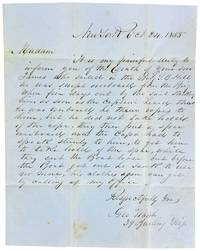
1855réf. 50015New York 1855. Very Good. New York 1855. Bifolium 25x19.5cm written on first page only with original mailing envelope. Letter shows mail folds and light wear from handling. Envelope is addressed to Mrs Ellis Warehouse Point Connecticut and is heavily worn with staining losses to edges and a few tears. Very Good in a Good only envelope. Mid-19th century maritime death notification written from Burling Slip in New York City informing a mother of the death of her son at sea. The letter reports that her son James aboard the brig S.B. Hill was swept overboard and despite attempts by the crew to save him sank before the rescue boat could be launched. Full transcription reads New York Oct. 24 1855 Madam It is my painful duty to inform you of the death of your son James who sailed in the Brig S.B. Hill. He was swept overboard from the Brig when five days out by the sail striking him. As soon as the Captain heard that he was overboard he threw ropes to him but he did not take hold of the rope. They then put a spar overboard and the Capt. had to speak sternly to him to get him to take hold of the spar while they cut the boat loose but before the boat got out he sank to rise no more. His clothes you can get by calling by office. Respectfully Yours Geo. Walsh 39 Burling Slip. unknown
1855réf. 50015New York 1855. Very Good. New York 1855. Bifolium 25x19.5cm written on first page only with original mailing envelope. Letter shows mail folds and light wear from handling. Envelope is addressed to Mrs Ellis Warehouse Point Connecticut and is heavily worn with staining losses to edges and a few tears. Very Good in a Good only envelope. Mid-19th century maritime death notification written from Burling Slip in New York City informing a mother of the death of her son at sea. The letter reports that her son James aboard the brig S.B. Hill was swept overboard and despite attempts by the crew to save him sank before the rescue boat could be launched. Full transcription reads New York Oct. 24 1855 Madam It is my painful duty to inform you of the death of your son James who sailed in the Brig S.B. Hill. He was swept overboard from the Brig when five days out by the sail striking him. As soon as the Captain heard that he was overboard he threw ropes to him but he did not take hold of the rope. They then put a spar overboard and the Capt. had to speak sternly to him to get him to take hold of the spar while they cut the boat loose but before the boat got out he sank to rise no more. His clothes you can get by calling by office. Respectfully Yours Geo. Walsh 39 Burling Slip. unknown books
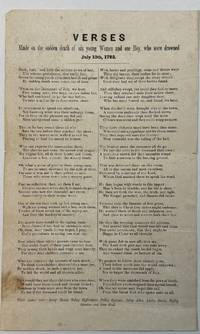
1815réf. 42321Rhode Island 1815. Folio broadside 8-1/2" x 14." Twenty-four four line stanzas printed in two twelve-stanza columns separated by a rule. Names of the dead children printed in italics at the bottom . No imprint. One spot. Else Very Good. This is a later printing of a 1782 tragedy originally printed at Newport in 1782. The tragedy occurred in Jamestown Rhode Island; its initial printings included illustrations of seven coffins. unknown
1815réf. 42321Rhode Island 1815. Folio broadside 8-1/2" x 14." Twenty-four four line stanzas printed in two twelve-stanza columns separated by a rule. Names of the dead children printed in italics at the bottom . No imprint. One spot. Else Very Good. This is a later printing of a 1782 tragedy originally printed at Newport in 1782. The tragedy occurred in Jamestown Rhode Island; its initial printings included illustrations of seven coffins. unknown books
1945réf. 45972Seattle Washington: Seattle Post-Intelligencer. Very Good. First Edition. Newspaper. Seattle Post-Intelligencer; Oblong folio; 24 pages; Seattle Post-Intelligencer. Vol. CXXVIII No. 42. Entire issue three sections 24 pages. One horizontal fold as issued. This is an 81 year-old newspaper in its natural state not removed from a volume etc. The pages are very lightly toned but not brittle. A photo of the late President within a banner wreath fills the front page Apart from the simple statement of dates of birth and death: "1882 -- Franklin Delano Roosevelt -- 1945." The editors evidently decided that headlines or even extra words were superfluous. "6 AM FINAL." . 1945. Seattle Post-Intelligencer unknown
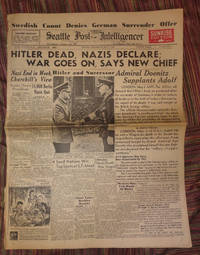
1945réf. 45969Seattle Washington: Seattle Post-Intelligencer. Very Good. First Edition. Newspaper. Seattle Post-Intelligencer; Oblong folio; 16 pages; Seattle Post-Intelligencer. Vol. CXXVIII No. 61. Entire issue two sections 16 pages. One horizontal fold as issued. This is an- 81 year-old newspaper in its natural state not removed from a volume etc. The pages are toned but not brittle; a few leaves in the second section are separated but present. The Front page displays a large b/w image in half-tones depicting Adolf Hitler shaking hands with his eventual successor: Admiral Doenitz. A smaller banner headline at the top of the page reads: "Swedish Count Denies German Surrender Offer." . 1945. Seattle Post-Intelligencer unknown
réf. 21504'Published by Authority. Monday January 31 1820.' Niumb. 17559. London: 'Printed by Robert George Clarke Cannon-Row Parliament-Street.'. 3pp small 4to. Bifolium on wove paper. In fair condition lightly aged and worn with closed tear at head of gutter. Customary tax stamp in red on first page. Each page with mourning border. In small print and double column. The first page carries the report of the King's death dated from Whitehall 31 January 1820 beginning: 'On Saturday afternoon at thirty-five minutes past eight o'clock Our late Most Gracious Sovereign King George the Third whose strength had gradually declined for some weeks expired without the least apparent suffering at His Castle of Windsor in the eighty-second year of His age and the sixtieth of His reign.' A declaration of allegiance by the new king's brothers and others follows with two reports of meetings of the Court. The London Gazette founded in 1665 as the Oxford Gazette is the most important among the official journals of record of the British government. 'Published by Authority. | Monday, January 31, 1820.' [Niumb. 17559.] London: 'Printed by Robert George Clarke, Cannon-Row, Parl unknown
réf. 66229New York: Henry C. Bowen Publisher. Ephemera. Good. Side folding tabloid journal. Disbound from a larger work. 32pp. "The Independent" was a long running newspaper that promoted Congregationalism and advocated for abolition and women's suffrage among other social issues. Of note in this issue are two somewhat lengthy pieces on Mormons Mormonism and Brigham Young. The first titled "The Latter Day Saints" opens with the death of Brigham Young and focuses primarily on the religious practices and beliefs of the Mormon community as well as its use of trials and other things to govern its adherents. The second article "Brigham Young and Mormonism" rails against Brigham Young and urges the government to pass a law against polygamy. Binding holes along left edge. General toning minor soiling and foxing to the paper. Some spotting/staining to the front page. Paper a bit brittle. Haphazard fold crease present. Mormon content: P. 13 and P. 16. Henry C. Bowen Publisher unknown
réf. 66229New York: Henry C. Bowen Publisher. Ephemera. Good. Side folding tabloid journal. Disbound from a larger work. 32pp. "The Independent" was a long running newspaper that promoted Congregationalism and advocated for abolition and women's suffrage among other social issues. Of note in this issue are two somewhat lengthy pieces on Mormons Mormonism and Brigham Young. The first titled "The Latter Day Saints" opens with the death of Brigham Young and focuses primarily on the religious practices and beliefs of the Mormon community as well as its use of trials and other things to govern its adherents. The second article "Brigham Young and Mormonism" rails against Brigham Young and urges the government to pass a law against polygamy. Binding holes along left edge. General toning minor soiling and foxing to the paper. Some spotting/staining to the front page. Paper a bit brittle. Haphazard fold crease present. Mormon content: P. 13 and P. 16. Henry C. Bowen Publisher unknown books
1935réf. 9397New York: Charles Scribner's Sons 1935. First edition. Hardcover in illustrated jacket signed by Lamson and dated in the year of publication on the title page. Few charts and tables in the text. Publisher's gray cloth boards lettered in black and white. Near fine copy with some rubbing to rear panel of jacket. Beautiful signed first edition of this memoir by the Stanford University executive who was convicted of the murder of his wife in 1933 and sentenced to hang. He spent time in San Quentin prison before the case was overturned by the California Supreme Court. The second trial resulted in a hung jury and after about 3 more attempts at a trial which were unsuccessful for various reasons the DA Fred Thomas ultimately gave up and Lamson went free. In all 30 of the 36 jurors which heard the case in the various trials were convinced of his guilt. The book was adapted into a film in 1937 directed by Christy Cabanne and Starring Preston Foster Ann Dvorak and John Beal. An exemplary signed copy of this prison memoir which marks one of the early "trials of the century" in California. Charles Scribner's Sons hardcover
réf. 5765N.p. N.d. Good. Small broadside approximately 7.75 x 3.25 inches. Mounted on later paper. Contemporary ink signature at foot. Light tanning and scattered staining. A printed invitation from Serapia Rivas for the funeral of her sister Teresa with a small woodcut vignette of a skull and crossbones at the head. Potential attendees had very short notice -- the invitation notes that the burial will take place "Tomorrow the 5th of this month at four in the afternoon. unknown
réf. 5765N.p. N.d. Good. Small broadside approximately 7.75 x 3.25 inches. Mounted on later paper. Contemporary ink signature at foot. Light tanning and scattered staining. A printed invitation from Serapia Rivas for the funeral of her sister Teresa with a small woodcut vignette of a skull and crossbones at the head. Potential attendees had very short notice -- the invitation notes that the burial will take place "Tomorrow the 5th of this month at four in the afternoon. unknown books
1930réf. 1180Paris, Editions EOS, 1930 ; in-4 en feuillets, couverture rempliée rouge-brique, sous chemise cartonnée à larges rabats et lacets de soie de même couleur et illustrée d’un grand bois gravé bistre, dos en percaline bistre ; (4) feuillets, 88 pages, (4) feuillets ; 20 bois gravés en couleurs dont dix hors-texte, six vignettes et culs-de-lampe et un grand bois illustrant l’étui et la couverture.
1966réf. LFA01b06N° 212 - Novembre 1966, de la revue "Ecclesia - Lectures Chrétiennes", dirigée par Daniel-Rops : 215 pages, format 130 x 185 mm, illustrée, brochée
1976réf. 63553Seattle WA: Peanut Butter Partners Epicure 1976. 4to. 160 pp. printed on tan-tinted paper illustrations throughout 1 map. Colour-illustrated softcovers wraparound cover art photo birdseye view of Portland OR by Jan Jackson shot from Washington Park slight shelfwear very slight scuffing back cover NF copy. First edition thus of this installment in the noted Epicure menu guidebook for Portland OR purportedly issued biannually from 1976 through 1983 by the entrepreneurial Mort Cone partner with his brother Gerald Cone in Cone Company Printers and later editor and publisher for Epicure menu guides in Portland Seattle Sun Valley Aspen Vail St. Louis and even Hawaii. Featuring a blizzard of original restaurant menus in the Bicentennial Year with all their original cover art this guidebook covering Portland Vancouver and environs includes such noted local staples as Asparro’s Union Ave. Social Club the Dan & Louis Oyster Bar the Fish Grotto Henry Thiele’s London Grill Mr. C’s Hippopotamus Old Spaghetti Factory The Ringside Trader Vic’s and any others. Also included are a significant number of Asian and Hispanic ethnic restaurants including Casa Molina The Chili Pepper Hong’s Cantonese Pavilion Benihana of Tokyo Paco’s Sang’s Chinatown Zen and others. Worldcat locates 3 copies Multnomah Co. U of W State Lib. of OR. Peanut Butter Partners], Epicure, paperback
réf. 10850Wien / Baden bei Wien, Gesellschaft für vervielfältigende Kunst / Verlag Rudolf Rohrer, 1889 bis 1938. 39 volumes (36 in-folio et 3 in-4). Les 5 premiers pleine percaline brune, titre et décors dorés et noirs aux dos, premiers plats richement décorés (doré, noir et à froid), plats biseautés, tranches dorées pour le volume 5. Du 6e au 36e, pleine toile grège d'éditeur, titre et décors rouges jusqu'au 23e, vert pour les suivants, tranches marbrées ou teintées. Les 3 volumes in-4 sont reliés pleine percaline bordeaux, titre doré aux dos, têtes dorées (plats un peu tachés). La toile de certains volumes est un peu poussiéreuse. Intérieur très frais, quelques rousseurs extrêmement rares, 1 planche et 1 cahier déboîtés. Les années 1909, 1917 et 1918 non reliées mais sous cartonnage toilé normal, 1917 en 3 numéros / 2 cahiers (sur 4 / 3), 1918 en 3 numéros / 2 cahiers (sur 4 / 3).
1992réf. 77066United Kingdom: Peaceville 1992. From the personal collection of Fenriz one half of the revered Norwegian black metal duo Darkthrone accompanied by his extensive album-specific DJ notes handwritten on the verso of a slip printed by the Norwegian post office. In a September 29 2011 interview with Last Rites Fenriz reflected on the tendency towards a more commercial sound in the late 1980s: "the near death of DEATH metal luckily saved by Autopsy and other organic heads." Acts of the Unspeakable is the third album by California death metal band Autopsy who are credited with pioneering death-doom. Previously drummer and vocalist Chris Reifert was a member of Death performing on their debut album Scream Bloody Gore 1987. He formed Autopsy after Chuck Schuldiner decided to move back to Florida. Compact disc CD accompanied by the printed album inserts and housed in the clear plastic jewel case. Provenance: From the personal collection of Fenriz acquired in September 2018 from Helvete / Neseblod Records in Oslo. Peaceville unknown
2013réf. 77063Vodnany Czech Republic: Doomentia Records 2013. Presentation copy with a handwritten note on Machetazo letterhead from drummer and vocalist J.M. "Dopi" Dopico to Fenriz one half of the revered Norwegian black metal duo Darkthrone: "Here it is another raw piece of sonic meat." Accompanied by a handbill advertisement for Machetazo's album "Live at CBGB - New York City" 2011 and the Fenriz's album-specific DJ notes handwritten on the verso of a slip printed by the Norwegian post office. In a March 10 2015 article for Vice Fenriz acknowledged Dopi's influence on the "Full Speed Ahead Vol. II" mixtape: "Dopi from Spanish grindcore band Machetazo sent me a whole bunch of old Spanish metal from the 80s and I picked out my favourites from that and put them on this compilation." The fifth and final full-length album from Machetazo among the most prominent bands to emerge from Spain's underground extreme music scene. Formed in A Coruña in 1994 the grindcore trio was initially the side project of two death metal bands. After a series of lineup changes they released Trono de Huesos 2002 which embraces crust death grind and doom and remains one of the great "if you know you know" albums. Compact disc CD accompanied by the printed album inserts and housed in the clear plastic jewel case. Provenance: From the personal collection of Fenriz acquired in September 2018 from Helvete / Neseblod Records in Oslo. Doomentia Records unknown
1586réf. 28795St MAUR DES FOSSES 1586 une copie de lettre d'EPOQUE , manuscrite de 8 pages, écrite à l'encre brune sur papier vergé crème ligné et filigrané : "chandelier surmonté d'une croix", trace d'humidité claires anciennes mais le document reste bien lisible, St Maur , le dixième jour de juin 1586 [Saint-Maur-des-Fossés (Val-de-Marne)], signé : HENRY,
1998réf. LFA-126722771Revue de 144 pages, format 170 x 240 mm, illustrée, brochée couverture couleurs, publiée en 1998, bon état
réf. 218298Issue Number 7730. September 71969. Six page newspaper featuring the death of Ho Chi Minh 51.5 x 37.2cm. Paper browned some edges strengthened with washi. Report on page one relates that Zhou Enlai Chen Boda Kang Sheng and others went to the Vietnamese Embassy in China to mourn the death of Chairman Ho Chi Minh. A photographic illustration shows the wreaths put in front of the image of Ho Chi Minh by Chairman Mao and Lin Biao. A crowd of over 15000 also went to the Embassy in Beijing to mourn. Another article on the front page appeals to the whole country to continue the socialist revolution and promote the war of resistance against the American invaders in the name of Chairman Ho. . unknown
18561 22x13.5 cm., [48] cc., incisione al frontespizio; capilettera di Hans Lutzelburger da Holbein; testo in cornici figurate dalle "Heures" di Simon Vostre incise da L?on Le Maire di Parigi, legatura cartonata, rossa; titoli in oro al dorso e, in motivo ornamentale, al piatto anteriore, intonso, macchie alle sguardie, in francese bella edizione, su v?lin, ben marginata; in ottime condizioni