Nietzsche, Friedrich & Alan SchriftBiblio.com

5 323 résultats
2019réf. 129546Stanford University Press. New. Paperback. FREE UPGRADE to Courier/Priority Shipping Upon Request – - IN STOCK AND IMMEDIATELY AVAILABLE FOR SHIPMENT - Flawless copy brand new pristine never opened -- -- with a bonus offer--; Spring 1885–Spring 1886; 7.4 X 4.8 X 1.3 inches; 616 pages; A sumptuously illustrated and richly detailed catalog of enormous appeal to anyone interested in fashion lifestyle the history of costume and applied arts. Thanks to a prestigious private collection this book explains how from the Napoleonic era onwards the clothing of men women and children acquired a social cultural and economic importance it had never had before in the history of the Western world. From this moment on we may rightly talk about fashion in the sense we understand it today. Dress evolved year after year. It reflected historical and political events industrial advances and technical development influences of the arts and culture and the taste of the rich and powerful.This unique catalog presents more than 100 perfectly preserved and restored articles of clothing including day dresses bridal and evening gowns embroidered slips and petticoats shawls and cloaks men’s jackets and topcoats walking sticks and scarves and collars all teamed with shoes handbags hats and costume jewelry. . 2019. 1503608727 . Stanford University Press paperback
1968réf. 39081Penguin. As New. Paperback. FREE UPGRADE to Courier/Priority Shipping Upon Request – – IN STOCK AND IMMEDIATELY AVAILABLE FOR SHIPMENT - -- with a bonus offer--; T-Nietidol . 1968. Penguin paperback
2006réf. 91631Continuum. New. Hardcover. FREE UPGRADE to Courier/Priority Shipping Upon Request - IN STOCK AND IMMEDIATELY AVAILABLE FOR SHIPMENT - Flawless copy brand new pristine never opened -- 192 pages. Description: "Dale Wilkerson's book shows how like many of his contemporaries Nietzsche looked to the Greeks in an attempt to alleviate Europe's woes. His work in this area resembles that of the cultural anthropologist who uncovers formal differences in social manners that might explain the development of humankind's most important instincts-those for carving out personal identity and for forging social unity. Nietzsche and the Greeks is a much needed guide to this fascinating subject matter." -- with a bonus offer--; Continuum Studies In Philosophy; Dale Wilkerson's book shows how like many of his contemporaries Nietzsche looked to the Greeks in an attempt to alleviate Europe's woes. His work in this area resembles that of the cultural anthropologist who uncovers formal differences in social manners that might explain the development of humankind's most important instincts-those for carving out personal identity and for forging social unity. Nietzsche argues that recognizing such formal differences is what makes cultural evaluations and even normative judgments possible. Nietzsche acknowledges important likenesses between Western society in the nineteenth century and the Greek world during the time of the Pre-Platonic philosophers. Both societies were increasingly secular wealthy and focused politically on securing order in the city-states at home and on establishing colonies abroad. Similarly the changing social landscapes in the sixth and fifth centuries B.C.E. were linked to a developing interest in the natural world to humanistic notions of the individual's place in it and to principles of rational and mathematical calculation. Despite acknowledging such commonalities Nietzsche's examination of the Greeks is founded upon the notion that the distance between the Greeks and modernity could offer a new perspective from which to understand the "inner-workings" of culture. With a strategy that highlights this distance Nietzsche analyzes how culture forms and breaks apart how it is effective and how cultural institutions structure the lives of all individuals the exceptional and the ordinary. "Nietzsche and the Greeks" is a much needed guide to this fascinating subject matter. . 2006. 0826489036 . Continuum hardcover
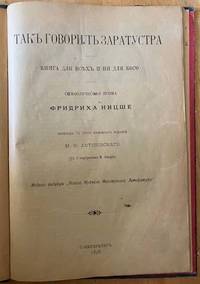
1898réf. 886Petersburg: New Journal of Foreign Literature 1898. First Edition. Hardcover. Very good. First Russian Translation of Nietzsche NIETZSCHE Friedrich Tak govoril Zaratustra Also Sprach Zarathustra New Journal of Foreign Literature St Petersburg 1898. Blank leaf TP 3 - 5 = translators introduction 6 - 90 1 leaf = advertisements 1 blank leaf thin octavo. First Russian translation of Nietzsches Also Sprach Zarathustra translated by Yu Antonovsky. This is the very first translation of Zarathustra in Russian written by Yu Antonovsky in 1898 just really a few months before a second bilingual edition translated by Nani. With so much censorship in Russia any translation was really an art form creatively trying to communicate Nietzsches or any philosophers! ideas into a voice acceptable to the heightened sensitivities of the authorities under both Tsars Alexander III and Nicholas II. Hence the incomplete translations of both Antonovsky in 1898 and Nani in 1899. This first Russian translation based on the 10th German edition comprises all but part IV. Perhaps there were contents of part IV that ruffled the feathers of the censors; perhaps Antonovsky actually relied upon the 1886 German edition which only included parts I - III as part IV was not published publicly in Germany until 1892. Thus Spoke Zarathustra is one of Nietzsche's most famous works and Nietzsche regarded it as among his most significant. Thoroughly studied and re-studied by scholars throughout the 20th century the character of Zarathustra stands as a figure marking the end of Modernity by some i.e. Heidegger the beginning of Post-Modernity by others i.e. Derrida; the text a personal soteriological narrative of Nietzsches own self-overcoming and a parable for others towards the same transformation. Though Thus Spoke Zarathustra attempts to destroy and replace the Judeo-Christian world-view Nietzsches style borrows heavily from the Old and New Testament. Nietzsche also adopts myriad metaphors invoking animals earth air fire water celestial bodies plants all in the service of describing the spiritual transformation of Zarathustra a solitary reflective exceedingly strong-willed sage-like laughing and dancing voice of self-mastery who accompanied by a proud sharp-eyed eagle and a wise snake believed in a mode of being beyond the common human condition but without the need to posit a transcendent other world. Nietzsche refers to this higher mode of being as superhuman übermenschlich one that embraces the doctrine of eternal recurrence a doctrine for only the strongest who can love life in its entirety who embrace their suffering and would only again will it to be thus! CONDITION: Very good in original quarter cloth with purple boards. Light edgewear. Pages 11 - 14 with small erasure mark that wore through the paper. A few scattered pencil marks otherwise an excellent well-preserved copy all in original condition. New Journal of Foreign Literature hardcover
1876réf. 326Schloss-Chemnitz:: Schmeitzner 1876. First edition. Hardcover. Very Good. NIETZSCHE Friedrich. Unzeitgemässe Betrachtungen IV: Richard Wagner in Bayreuth 1876 Schloss-Chemnitz: Schmeitzner 1876 First Edition. TP 3-98 1 pp. Of the first edition only 700 copies were printed. Beautiful contemporary halfcloth with brown marbled boards. Minor browning as usual. Interior exceptionally clean and well preserved. Quite rare due to small printrun. The 1st copies became available just before the Bayreuther Festspiele. Wagner had invited Helen Zimmern based on his favorable opinion on her biography of Schopenhauer. Nietzsche also attended and their meeting resulted in later invitations. Zimmern spent a few weeks in Sils Maria in the summer of 1886 where Nietzsche used to reside in the summer months in those years. Their discussions in this summer must have helped Zimmern quite a lot when later translating Jenseits of which she got 2 presentation copies. The last favorable publication of Nietzsche on Wagner followed by bitter attacks in FALL WAGNER and NIETZSCHE CONTRA WAGNER. The 4th and last Observation a series originally. CONDITION: Beautiful contemporary halfcloth with brown marbled boards. Minor browning as usual. Interior exceptionally clean and well preserved. Very Good PHOTOS AVAILABLE UPON REQUEST Schmeitzner hardcover
1977réf. LIQ-1234P. La Diane Française 1977. Grand in-f° en ff, sous chemise decorée et étui de l'éditeur.
1895réf. 49025Pan Couverture souple Berlin 1895
réf. 10833Collection complète, du n° 1 (été 1924) au n° 29 (printemps 1932). Nous joignons l'Index des années 1924-1928, paru sous forme de tiré-à-part joint au n° 22 (Hiver 1929). TOUS LES NUMEROS FONT PARTIE DU TIRAGE SUR VELIN PUR FIL LAFUMA (2e papier dont le nombre d'exemplaires est compris entre 150 et 300) et sont tous en bon ou très bon état. // Le n° 1 porte la mention manuscrite " Exemplaire sur Lafuma ", apposée par Auguste Morel qui a également signé cet exemplaire de ses initiales ; ce détail fait de cet exemplaire une belle pièce joycienne puisque dans ce premier numéro de " Commerce " paraît la première traduction en français d'un extrait d'ULYSSE de Joyce - traduction justement due au même Auguste Morel et à Valery Larbaud. // Rare et belle collection sur grand papier.
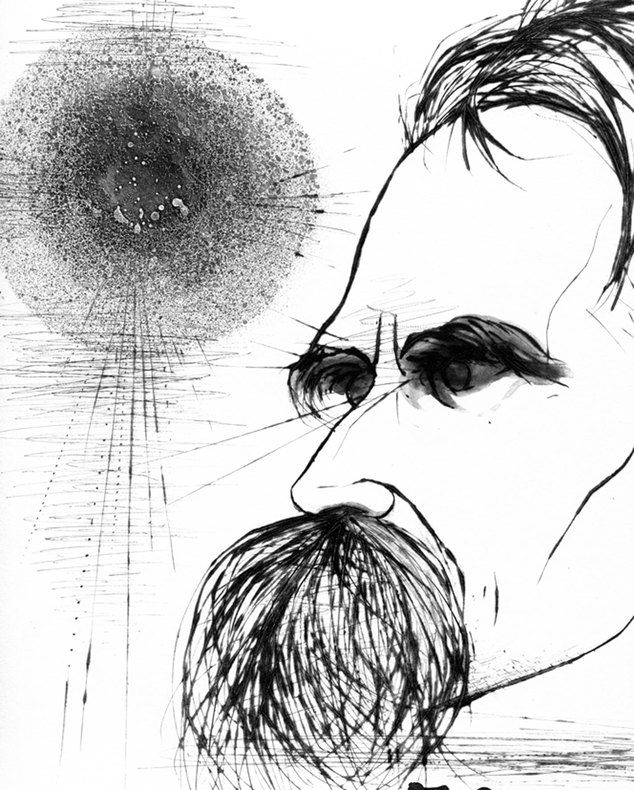
1977réf. 51912Paris La Diane Franaise 1977 In-folio, en feuilles, couverture imprime. Chemise de veau noir orne sur le premier plat d'un important dcor typographique dor, tui ajour (embotage de l'diteur).12 gravures originales au burin et l'eau-forte de Pierre-Yves Trmois, dont une sur double page et 11 se dpliant en triptyque. Tirage limit 190 exemplaires numrots. Un des 25 exemplaires sur vlin de Rives, accompagns d'une suite des 12 gravures.
1999réf. 51529Stanford University CA: Stanford University Press. New. 1999. Paperback. 0804736480 . FREE UPGRADE to Courier/Priority Shipping Upon Request IN STOCK AND IMMEDIATELY AVAILABLE FOR SHIPMENT - Flawless copy brand new pristine never opened - 515 pages. Stanford University Press paperback
2000réf. 51530Stanford CA: Stanford University Press. New. 2000. Paperback. 0804741719 . FREE UPGRADE to Courier/Priority Shipping Upon Request IN STOCK AND IMMEDIATELY AVAILABLE FOR SHIPMENT - Flawless copy brand new pristine never opened - 386 pages Stanford University Press paperback
1924réf. 93894New York: The Macmillan Company. As New. 1924. Hardcover. FREE UPGRADE to Courier/Priority Shipping Upon Request - IN STOCK AND IMMEDIATELY AVAILABLE FOR SHIPMENT - AS NEW THE TEXT BLOCK IS PRISTINE CLEAN UNMARKED AND IN EXCELLENT CONDITION - - - Numbered copy of a limited edition The Macmillan Company hardcover
1998réf. 51525Stanford University CA: Stanford University Press. New. 1998. Paperback. 0804734038 . FREE UPGRADE to Courier/Priority Shipping Upon Request IN STOCK AND IMMEDIATELY AVAILABLE FOR SHIPMENT - Flawless copy brand new pristine never opened - 428 pages. Stanford University Press paperback
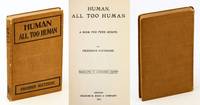
1915réf. 566j2993Chicago: Charles H. Kerr & Company. Very Good No dust jacket as issued. Reprint. Hardcover. "Nietzsche's first book in the aphoristic style that would come to dominate his writings discussing a variety of concepts in short paragraphs or sayings. Highly influenced by Afrikan Spir's Thought and Reality and reacting against the pessimistic philosophy of Wagner and Schopenhauer." - Wikipedia. "This book is enlightening rather than a strict code; and it is also for that reason a little dark in that it tells us what we perhaps don't want to know about ourselves or at least admit. As a piece of intellectual capital it is invaluable." - online review by G.K. Friedrich Nietzsche 1844-1900 was a very influential German philosopher and writer. 1915 Reprint of the 1908 Kerr first American edition. First published in German in 1878 as Menschliches Allzumenschliches: Ein Buch für freie Geister. 4-182 p. Clean tight and unmarked with moderate wear to original light brown cloth ruled and lettered in black. A rare and tidy vintage example. 17.1 x 10.8cm; 16mo . 1915. Charles H. Kerr & Company hardcover
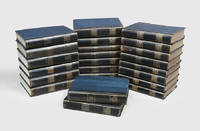
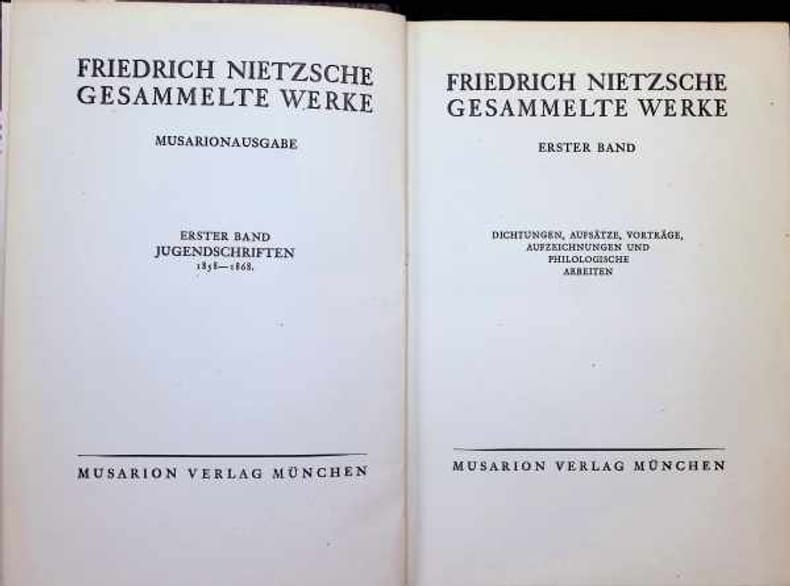
1920réf. 192127Munich: Musarion 1920-29. Nietzsche's complete works First complete collected edition of Nietzsche's works in the original German number 221 of 1300 sets in half calf from a total edition of 1600. Arranged chronologically with an introduction by Richardo Oehler notes and indexes this was the first edition to claim completeness and has only been surpassed by the Colli and Montinari edition still in progress. 23 vols large octavo. Original black half calf spines lettered in gilt blue paper-covered sides top edges gilt. With 4 photographic portraits and 7 facsimiles in volume 21. Contemporary bookplate of the Bauer family designed by Otto Hupp to front pastedowns. Rubbed and worn: a good set. Ziegenfuss 2 216. unknown
1887réf. 927Leipzig: E.W. Fritzsch 1887. First Thus. Hardcover. Very good. First complete edition of one of Nietzsches most important texts! NIETZSCHE Friedrich. Die Frohliche Wissenschaft "la gaya scienza". Neue Ausgabe mit einem Anhange: Lieder des Prinsen Vogelfrei The Gay Science . E.W. Fritzsch Leipzig 1887. III XII = Vorrede 1 leaf = Half-title 5 350 1 leaf = Berichtigungen; Octavo. First Edition Second Issue Definitive. Schaberg 51. A must have for any Nietzsche collection. This Neue Ausgabe consisted of the 788 unsold sheets from the first edition of 1882 with the addition of a new title page Nietzsches new 10-page Vorrede Preface 2 new half-title pages and a new 5th book "Wir Furchtlosen" We Fearless Ones. Thus 75 new pages along with fourteen pages of poetry appear here for the first time. While the first edition appeared in 1882 it was incomplete. This is truly the first edition of the complete and definitive text of what is today read as The Gay Science. Nietzsche felt that the Vorrede to this and the other reissues of 1886/7 were among the best things that he ever wrote. The Gay Science which is the final and culminating volume of Nietzsches aphoristic works contains the first instance of his famous statement Gott ist tot! God is Dead first in section 108 then more elaborately detailed in the Parable of the Madman in section 125 and for a third time in section 343. It also contains the first appearance of the doctrine of the "Eternal Return of the Same" which plays such a prominent role in Zarathustra and even includes the Nietzsches first mention of the Uebermensch. CONDITION: Very good in a quarter leather contemporary binding with marbled boards gilt lettering to the spine. Some wear to spine leather. Minor rubbing to marbling on front cover. Small bookseller sticker to inside corner of rear free endpaper PHOTOS AVAILABLE UPON REQUEST E.W. Fritzsch hardcover
1878réf. 928Chemnitz: Schmeitzner 1878. Second Edition. Hardcover. Very good. NIETZSCHE Friedrich Die Geburt der Tragödie The Birth of Tragedy. Schmeitzner Chemnitz 1878. TP III-IV 1-144 Octavo. The famous Second Edition First Issue of Nietzsche's first book. Schaberg 30. The publication history of Nietzsche s Birth of Tragedy is about as complicated as any. The 143-page first edition appeared in 1872 published by E.W. Fritzsch. Shortly after its release Fritzsch printed a second edition that included Nietzsche s corrections extending the text to 144 pages. This was completed by March of 1874 yet because of some conflicts between Nietzsche and Fritzsch and the financial difficulties Fritzsch was experiencing the 750 copies of this 144-page second edition were never available for sale. They sat in a warehouse for 4 years until Schmeitzner Nietzsche s new publisher acquired the copies. Schmeitzner affixed his own label on top of the original publisher s information and made the books available for sale. Very few sold no more than 175. In 1886 the unsold copies of both the 143-page first edition and the 144-page second edition ended up back with the original publisher Fritzsch who added Nietzsche s new preface along with a new title page for the "Neue Ausgabe" edition the definitive edition if the 144-page copy!. Thus fewer than 175 copies in this state 144-pages with the original title page and Schmeitzner label extant. A rare find and a must-have for any Nietzsche collection to be complete.Printing and the Mind of Man notes "Nietzsche's principle work during the Wagner period 1868-1878 was Die Geburt der Tragodie aus dem Geist der Musik 1872. In this he adopted a tragico-pessimistic conceptions of Greek civilization like Burckhardt but contrary to Grote. This started his career as a critic of modern civilization based on disgust with imperial Germany Christianity bourgeois ethics and so on." PMM 224. In this his first book Nietzsche theorized that Greek tragedy was built upon a wedding of two principles that he associated with the deities Apollo and Dionysus. The Apollonian principle is the principle of order static beauty and clear boundaries. The Dionysian principle in contrast is the principle of frenzy excess and the demolition of boundaries. It is in the subtle interaction of these disparate principles that the greatness of Greek tragedy resides and by extension in which the creative spirit still finds its proper soil. The book ended with a long section devoted to Richard Wagner and the importance of his music. When first released it met with only limited success. Despite Nietzsche's eventual near contempt for the book - from the perspective naturally of his later unequalled masterpieces of German prose - it must be considered along with Aristotle and Hegel among the greatest contributions to the understanding of Greek tragedy and in fact to the Greek way of life in general. CONDITION: Very Good in contemporary half-calf and marbled boards. Light wear. Gilt lettering. Light foxing. Former owners name neatly inscribed to upper corner of front free endpaper. As issued with Schmeitzner's label canceling out Fritzsch's imprint. A very good copy of a very rare book. Schmeitzner hardcover
1878réf. 952Chemnitz: Schmeitzner 1878. First Edition. Hardcover. Very good. Nietzsches First Aphoristic Work and His Introduction of Perspectivism NIETZSCHE Friedrich. Menschliches Allzumenschliches. Ein Buch für freie Geister Human all too Human. A Book for Free Spirits. Schmeitzner Chemnitz 1878. 1 blank leaf half title TP 1 leaf = Vorrede 1 leaf = Inhalt 1 leaf = half title 3 377 378= Printers information 1 leaf = publisher's advertisements 1 blank leaf. Octavo. First Edition First Issue Schaberg 29. Includes initial half title before the full title page and the eere correction cut and pasted by Schmeitzner over menon a non-word to create meere sea on p290 aphorism 431 and advertisements. Only 489 copies of this first edition first issue as the remaining 511 of the original 1000 first edition copies were sold to E. W. Fritzsch in 1886 for use in a new edition with new title page and without the ads. Thus this copy is extremely rare in any state. This is the first book by Nietzsche where he is listed simply as Friedrich Nietzsche rather than as prof. In fact Human All Too Human constituted such a radical departure in style and content for Nietzsche that he first proposed to his publisher that it be released anonymously or with a pseudonym. Schmeitzner however would not allow it. Reluctant to construct a philosophical system and sensitive to the importance of style in philosophic writing Nietzsche composed these works as a series of several hundred aphorisms a departure from his style up to this point. Much of the work is devoted to what one might now call "psychoanalytical" insights into the nature of common human experience and the origins of our human valuations. At the time serious inquiry into such things as the nature of dreams the meaning of pity or the phenomenon of laughter had no place in the field of philosophy. Human All Too Human also contains Nietzsches reflections upon cultural and psychological phenomena in reference to individuals' organic and physiological constitutions. The idea of power sporadically appears as an explanatory principle but Nietzsche tends at this time to invoke hedonistic considerations of pleasure and pain in his explanations of cultural and psychological phenomena. It is here too that Nietzsche's famous epistemological "perspectivism" is first broached: the view that "truths" are nothing more than interpretations of reality formed from different perspectives and more or less successful in their struggle against competing "truths." Like the four books to follow the present work is addressed to the "free spirits of Europe." It was the present work that finally divided Nietzsche from his greatest friend Richard Wagner more and more in Nietzsche's mind motivated by only the most simplistic greed for power and betraying the promise of his art. CONDITION: Very good in somewhat later boards with cloth spine. Origiinal front wrapper affixed to front board slightly browned. Internally bright and clean with a couple pages of some spotting along edges. One page of publisher's ads present but seeminly repaired along fore edge . Sunning to rear board. PHOTOS AVAILABLE UPON REQUEST Schmeitzner hardcover
1920réf. 022981Munchen 1920 Musarion Verlag Half-Leather
1968réf. SBBI-mon0000017821HarperCollins Publishers Ltd 1968. textbook. Good. Our good condition books are generally good for reading but not for gifting or collecting. They could have imperfections such as creasing fanning inscriptions margin notes yellowing staining on edge or cover or pages bumps scuffs etc etc sometimes multiple of these. It's a wide category that encompasses anything that isn't almost-new down to anything that is slightly better than poor. We would NOT recommend gifting Good books - these should be considered reading copies. Our books are dispatched from a Yorkshire former cotton mill. We list via barcode/ISBN so please note that the images are stock images and may not be the exact copy you receive furthermore the details about edition and year might not be accurate as many publishers reuse the same ISBN for multiple editions and as we simply scan a barcode or enter an ISBN we do not check the validity of the edition data when listing. If you're looking for an exact edition please don't order at least not without checking with us first although we don't always have time to check. We aim to dispatch prompty the service used will depend on order value and book size. We can ship to most countries see our shipping policies. Payment is via Abe only. HarperCollins Publishers Ltd unknown
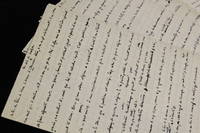
1946réf. 483421946. Fine. 1946 21.70 x 11.50 cm 7 feuillets foliotés Autograph manuscript by the author 14 pages in octavo published in issue no. 12 December 1945January 1946 of L'Arche. A complete recto-verso manuscript in a densely written hand with numerous deletions corrections and additions. Essay published on the occasion of the release of Father du Lubacs Le Drame de lhumanisme athée. After the war the place of Friedrich Nietzschealongside the Marquis de Sade and Søren Kierkegaardin Maurice Blanchots thought reflects the decisive influence of Georges Bataille and the philosophers he held in highest regard. From this point on Blanchot devoted many texts to these figures and Du côté de Nietzsche stands as a key testimony of that engagement. The very title of his forthcoming collection La Part du feu to be published in 1949 including this article in a slightly revised form is itself a Bataillean reference. For Blanchot Nietzsches power through his use of language and style lies less in his most explicit and oft-commented theses than in the crucible of a more fluid and sometimes self-contradictory discourse: « L'influence de Nietzsche ne se réduit pas aux formes extérieures qu'elle a prises ; c'est probablement au contraire ce qui de Nietzsche a échappé à toute transmission manifeste cette part de lui étrangère aux influences directes qui a exercé l'influence la plus profonde. » This idea would remain central to Blanchots reading of the German philosopher. Nietzsches inconsistency and ambiguity are embodied in the theme of the death of God central to his work: « En aucune façon le thème de la Mort de Dieu ne peut être l'expression d'un savoir définitif ou l'esquisse d'une proposition stable » Blanchot observes. And he famously adds: « Se contredire est le mouvement essentiel d'une telle pensée. » In LEntretien infini 1969 Blanchot would once again revisit the Nietzschean question of the death of God where it meets that of the unity of man. A remarkable text by Maurice Blanchot on Friedrich Nietzsche illustrating the profound influence of Georges Bataille on his thought. unknown
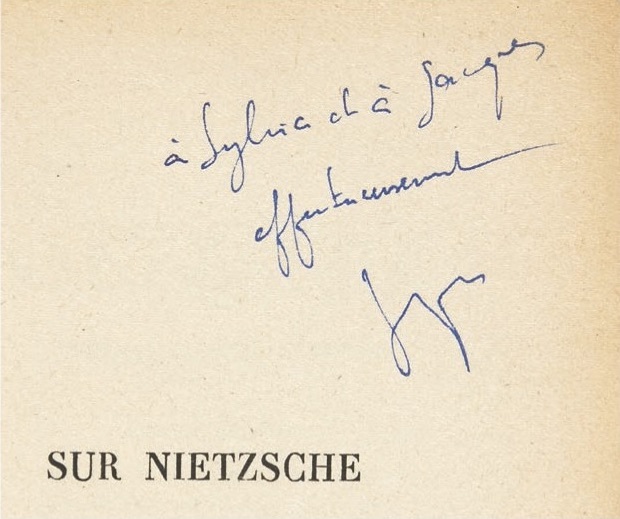
1945réf. YQV-52In-12 (186 × 118 mm) de 284-[4] pp. ; broché, couverture imprimée.
1887réf. 1031"Gott ist tot!" God is dead! NIETZSCHE Friedrich. Die Fröhliche Wissenschaft "la gaya scienza". Neue Ausgabe mit einem Anhange: Lieder des Prinsen Vogelfrei The Gay Science. E.W. Fritzsch Leipzig 1887. 1 misbound half-title leaf = "Scherz List und Rache" TP III –XII = Vorrede 5 –350 1 leaf = Berichtigungen. First Edition Second Issue Definitive. Schaberg 51. BOUND WITH Jenseits von Gute und Bose Beyond Good and Evil Dritte Auflage C.G. Naumann Leipzig 1894. TP Half-title 3 - 5 = Vorrede 1 leaf = Inhalt Half-title 11 - 285 287 - 292 = Register 2 leaves = advertisements. Third Edition. Octavo. The Gay Science which is the final and culminating volume of Nietzsche's aphoristic workscontains the first instance of his famous statement "Gott ist tot!" God is Dead –first in section 108 then more elaborately detailed in the Parable of the Madman in section 125 and for a third time in section 343. It also contains the first appearance of the doctrine of the "Eternal Return of the Same" which plays such a prominent role in Zarathustra and even includes Nietzsche's first mention of the Uebermensch. This Neue Ausgabe consisted of the 788 unsold sheets from the first edition of 1882 with the addition of a new title page Nietzsche's new 10-page Vorrede Preface 2 new half-title pages and a new 5th book "Wir Furchtlosen" "We Fearless Ones". Thus 75 new pages along with fourteen pages of poetry appear here for the first time. Nietzsche felt that the Vorrede to this and the other reissues of 1886/7 were among the best things that he ever wrote. Considered by most to be Nietzsche's most important philosophical work Beyond Good and Evil was the first of Nietzsche's "self-published" books. The work consists of nine interlocking chapters that delineate the profile and the task of the "free spirit" and the "philosopher of the future" and contains some of Nietzsche's most insightful and barbed attacks on previous philosophers as well as many of his most powerfully and elegantly formulated analyses. As perhaps nowhere else the Nietzsche of Beyond Good and Evil fulfilled his own criterion of literary greatness: "To say in one sentence what others have required a book to say –and then to say what they did not say as well!" By any standard Beyond Good and Evil is among the greatest books in Western Culture. It is difficult to imagine another in which one can find so much. Here for the first time Nietzsche proposes a "natural history of morals" and proposes that the revaluation of former values is the central task to be accomplished by the philosopher of the future –this indeed would be the primary task of his own final works. He begins: "If a person should regard even the effects of hatred envy covetousness and the lust to rule as conditions of life as factors which fundamentally and essentially must be present in the general economy of life and must therefore be further enhanced if life is to be further enhanced –he will suffer from such a view of things as from seasickness. And yet even this hypothesis is far from being the strangest and most painful in this immense and almost new domain of dangerous insights." CONDITION: Good or better in original quarter leather with marbled boards. Much wear to spine but well preserved. Scuffing to covers. Spine with original handscripted label. Contemporary annotations to front and rear endpapers with scattered marginalia throughout all in pencil and could be erased but left preserved. First half-title is mis-bound ahead of the main title page. E.W. Fritzsch and C.G. Naumann hardcover
réf. alb9573b40146646682Nietzsche Fr. Collection of Works. (Vol. 1-9-Sekt) In Russian (ask us if in doubt)/Nitsshe Fr. Sobranie sochineniy. (T. 1-9-Komplekt) Short description: In Russian (ask us if in doubt).Moscow Warehouse at D. P. Efimov's bookstore. Type: Chicherin Blvd. 1900-1903. So Zaratustra used to say. Vol. 2. Beyond Good and Evil. Vol. 3. The Darkness of Idols. Vol. 4. The Origin of Tragedy. Vol. 5. Human Too Human. Vol. 6. Man as He Is. Vol. 7. The Wanderer and His Shadow. Vol. 8. Morning Dawn. Vol. 9. Merry Science. Rare the Complete Collection. We have thousands of titles and often several copies of each title may be available. Please feel free to contact us for a detailed description of the copies available. SKUalb9573b40146646682
réf. alb8f25e6044c267e6dNietzsche Fr. Complete collection of works. In four volumes: Vol. 1 2 3 9 Complete set In Russian (ask us if in doubt)/Nitsshe Fr. Polnoe sobranie sochineniy. V chetyrekh tomakh: Tt. 1 2 3 9 Polnyy komplekt Short description: In Russian (ask us if in doubt).Translation under the general editorship of Prof. F. Zielinsky S. Frank G. Rachinsky and J. Berman: Moscow Book Publishing House A.A. Levenson Press Association 1909-1912 LVI 412 p. We have thousands of titles and often several copies of each title may be available. Please feel free to contact us for a detailed description of the copies available. SKUalb8f25e6044c267e6d