Nietzsche, Friedrich WilhelmBiblio.com

5 519 résultats
réf. 1145740367.Gpaperback. Good. Access codes and supplements are not guaranteed with used items. May be an ex-library book. paperback
réf. 1142764192.Gpaperback. Good. Access codes and supplements are not guaranteed with used items. May be an ex-library book. paperback
réf. 1147075824.Gpaperback. Good. Access codes and supplements are not guaranteed with used items. May be an ex-library book. paperback
réf. 1774769107.Ghardcover. Good. Access codes and supplements are not guaranteed with used items. May be an ex-library book. hardcover
réf. 114555265X.Gpaperback. Good. Access codes and supplements are not guaranteed with used items. May be an ex-library book. paperback
réf. 1146786263.Gpaperback. Good. Access codes and supplements are not guaranteed with used items. May be an ex-library book. paperback
réf. 3423307331.Gpaperback. Good. Access codes and supplements are not guaranteed with used items. May be an ex-library book. paperback
réf. 9523186566.Gpaperback. Good. Access codes and supplements are not guaranteed with used items. May be an ex-library book. paperback
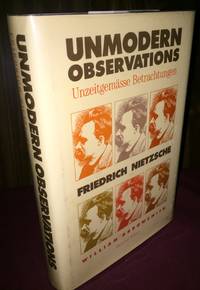
1990réf. PB364First printing. Volume is bound in brown cloth with bright stamped gilt lettering to spine. Book and dust jacket are in excellent condition. 402 pages. Publisher's description: "This translation of Nietzsche's early "Unzeitgemässe Betrachtungen" consists of four long essays and notes for a fifth. Nietzsche planned these works as part of an extremely ambitious critique of German culture. Although the project was never completed the essays thematically linked and should be considered as a whole. This book which presents these important works together in English for the first time unifies the essays provides introductions and annotations to each and translates them in a way that does justice to the brilliance and versatility of Nietzsche's style. The dominant idea of Nietzsche's project is the regeneration of culture through a radical reshaping of modern educational institutions. Nietzsche believed that philosophy the arts and the ennobling study of antiquity had all been corrupted by systematic miseducation the work of so-called educators who as culture-philistines had disgraced the highest of vocations. In response to this fragmented modern world Nietzsche argues for the creation of a "manworthy" culture with a single unifying style-a style that integrated theology philosophy education classical scholarship journalism and art in a seamless dynamic whole. This style Nietzsche contends can best be realized by heeding the great creative examples of the pre-Socratic philosophers Schopenhauer and Wagner and by reforming education above all the study of history and the archaic culture of Greece so that it serves rather than obstructs the needs of human life. The essays include "David Strauss: Writer and Confessor" introduced and translated by Herbert Golder; "History in the Service and Disservice of Life" introduced by Werner Dannhauser and translated by Gary Brown; "Schopenhauer as Educator" introduced by Richard Schacht and translated by William Arrowsmith; "Richard Wagner in Bayreuth" introduced and translated by Gary Brown; and "We Classicists" introduced and translated by William Arrowsmith." Yale University Press hardcover
réf. 0331746425.Ghardcover. Good. Access codes and supplements are not guaranteed with used items. May be an ex-library book. hardcover
réf. 1334291691.Gpaperback. Good. Access codes and supplements are not guaranteed with used items. May be an ex-library book. paperback
réf. 1334539502.Gpaperback. Good. Access codes and supplements are not guaranteed with used items. May be an ex-library book. paperback
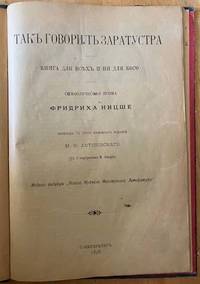
1898réf. 886Petersburg: New Journal of Foreign Literature 1898. First Edition. Hardcover. Very good. First Russian Translation of Nietzsche NIETZSCHE Friedrich Tak govoril Zaratustra Also Sprach Zarathustra New Journal of Foreign Literature St Petersburg 1898. Blank leaf TP 3 - 5 = translators introduction 6 - 90 1 leaf = advertisements 1 blank leaf thin octavo. First Russian translation of Nietzsches Also Sprach Zarathustra translated by Yu Antonovsky. This is the very first translation of Zarathustra in Russian written by Yu Antonovsky in 1898 just really a few months before a second bilingual edition translated by Nani. With so much censorship in Russia any translation was really an art form creatively trying to communicate Nietzsches or any philosophers! ideas into a voice acceptable to the heightened sensitivities of the authorities under both Tsars Alexander III and Nicholas II. Hence the incomplete translations of both Antonovsky in 1898 and Nani in 1899. This first Russian translation based on the 10th German edition comprises all but part IV. Perhaps there were contents of part IV that ruffled the feathers of the censors; perhaps Antonovsky actually relied upon the 1886 German edition which only included parts I - III as part IV was not published publicly in Germany until 1892. Thus Spoke Zarathustra is one of Nietzsche's most famous works and Nietzsche regarded it as among his most significant. Thoroughly studied and re-studied by scholars throughout the 20th century the character of Zarathustra stands as a figure marking the end of Modernity by some i.e. Heidegger the beginning of Post-Modernity by others i.e. Derrida; the text a personal soteriological narrative of Nietzsches own self-overcoming and a parable for others towards the same transformation. Though Thus Spoke Zarathustra attempts to destroy and replace the Judeo-Christian world-view Nietzsches style borrows heavily from the Old and New Testament. Nietzsche also adopts myriad metaphors invoking animals earth air fire water celestial bodies plants all in the service of describing the spiritual transformation of Zarathustra a solitary reflective exceedingly strong-willed sage-like laughing and dancing voice of self-mastery who accompanied by a proud sharp-eyed eagle and a wise snake believed in a mode of being beyond the common human condition but without the need to posit a transcendent other world. Nietzsche refers to this higher mode of being as superhuman übermenschlich one that embraces the doctrine of eternal recurrence a doctrine for only the strongest who can love life in its entirety who embrace their suffering and would only again will it to be thus! CONDITION: Very good in original quarter cloth with purple boards. Light edgewear. Pages 11 - 14 with small erasure mark that wore through the paper. A few scattered pencil marks otherwise an excellent well-preserved copy all in original condition. New Journal of Foreign Literature hardcover
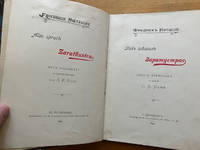
1899réf. 887Petersburg: M.M. Stasyulevicha 1899. First Thus. Hardcover. Very good. First Bilingual German-Russian Edition of Nietzsches Zarathustra NIETZSCHE Friedrich Tak govoril Zaratustra / Also Sprach Zarathustra Bilingual edition in German and Russian M.M. Stasyulevicha Petersburg 1899. Blank leaf half-title TP 1 leaf = dedication vii - xiv = translators forward half title half-title 2 - 103 1 leaf = contents blank leaf octavo. First Russian-German Dual-Language. First edition of the second translation of Thus Spoke Zarathustra. Translated from German by S. Nani. Bilingual edition in both German and Russian of nine selected excerpts printed side-by-side: the Night-Song the Grave-Song the Academic Chairs of Virtue the Soothsayer the Three Metamorphoses Scholars the Way of the Creating One Reading and Writing and the Three Evil Things. Thus Spoke Zarathustra is one of Nietzsche's most famous works and Nietzsche regarded it as among his most significant. Thoroughly studied and re-studied by scholars throughout the 20th century the character of Zarathustra stands as a figure marking the end of Modernity by some i.e. Heidegger the beginning of Post-Modernity by others i.e. Derrida; the text a personal soteriological narrative of Nietzsches own self-overcoming and a parable for others towards the same transformation. Though Thus Spoke Zarathustra attempts to destroy and replace the Judeo-Christian world-view Nietzsches style borrows heavily from the Old and New Testament. Nietzsche also adopts myriad metaphors invoking animals earth air fire water celestial bodies plants all in the service of describing the spiritual transformation of Zarathustra a solitary reflective exceedingly strong-willed sage-like laughing and dancing voice of self-mastery who accompanied by a proud sharp-eyed eagle and a wise snake believed in a mode of being beyond the common human condition but without the need to posit a transcendent other world. Nietzsche refers to this higher mode of being as superhuman übermenschlich one that embraces the doctrine of eternal recurrence a doctrine for only the strongest who can love life in its entirety who embrace their suffering and would only again will it to be thus! The first translation of Zarathustra was done by Yu Antonovsky in 1898 just really a few months before this bilingual edition translated by Nani. With so much censorship in Russia any translation was really an art form creatively trying to communicate Nietzsches or any philosophers! ideas into a voice acceptable to the heightened sensitivities of the authorities under both Tsars Alexander III and Nicholas II. Hence the incomplete translations of both Antonovsky in 1898 and Nani in 1899. CONDITION: Very good in original quarter leather with marbled boards. Light edgewear. Former owners name in ink to top edge of half-title page. Text block coming loose from front cover along inner hinge but holding along bottom. Rear hinge firm. One leaf xiii - xiv loose. Blank rear endpaper with small tear in center. A very nice untouched copy all in original condition. M.M. Stasyulevicha hardcover
réf. alb786ab89aeecfdb3aKharkov: Folio 2013. 560 p.Please contact us for details on condition of available copies of the book.� SKUalb786ab89aeecfdb3a. unknown
réf. albebff86dc460456acComplete collection of works new design M Exmo 2023. 768s.Please contact us for details on condition of available copies of the book.� SKUalbebff86dc460456ac. unknown
réf. alb9991c60d62700a00Kharkiv: Folio 2013. 224 p.Please contact us for details on condition of available copies of the book.� SKUalb9991c60d62700a00. unknown
réf. albbb6aec6671db0211Moscow Motherland 2021. 240 p.Please contact us for details on condition of available copies of the book.� SKUalbbb6aec6671db0211. unknown
réf. alb548dc77fa3dc87ceTomsk: TomSouvenir 2011. 224 p.Please contact us for details on condition of available copies of the book.� SKUalb548dc77fa3dc87ce. unknown
réf. alb381bf783862a838aSeries: Non-Fiction. Big Books. S.Pb.ABC. 2023. 832 p.Please contact us for details on condition of available copies of the book.� SKUalb381bf783862a838a. unknown
réf. alb126738dbd0215fecSpb.Series : Philosophy. Translated from German by S.E. Vershinin.Please contact us for details on condition of available copies of the book.� SKUalb126738dbd0215fec. unknown
réf. albd1bd6defff275666Series of Classics and Contemporary M AST-Astrel 2011 640c.Please contact us for details on condition of available copies of the book.� SKUalbd1bd6defff275666. unknown
réf. alb1dc2b0b1412b3592Kharkiv: Folio 2013. 448 p.Please contact us for details on condition of available copies of the book.� SKUalb1dc2b0b1412b3592. unknown
réf. alb04fc33ab132bc129Kharkiv: Folio 2010. 320 p.Please contact us for details on condition of available copies of the book.� SKUalb04fc33ab132bc129. unknown
réf. albd725c7a53c7d026cComplete illustrated translations. Series: Library of World Literature. SPb CSEA 2021. 768c.Please contact us for details on condition of available copies of the book.� SKUalbd725c7a53c7d026c. paperback