Nietzsche, FriedrichBiblio.com

rif. 3110042274.Ghardcover. Good. Access codes and supplements are not guaranteed with used items. May be an ex-library book. hardcover
rif. 1168492157.Gpaperback. Good. Access codes and supplements are not guaranteed with used items. May be an ex-library book. paperback
rif. 3368604228.Gpaperback. Good. Access codes and supplements are not guaranteed with used items. May be an ex-library book. paperback
rif. 3843045631.Ghardcover. Good. Access codes and supplements are not guaranteed with used items. May be an ex-library book. hardcover
rif. 3846026409.Gpaperback. Good. Access codes and supplements are not guaranteed with used items. May be an ex-library book. paperback
rif. 3849528812.Gpaperback. Good. Access codes and supplements are not guaranteed with used items. May be an ex-library book. paperback
rif. 3847835866.Ghardcover. Good. Access codes and supplements are not guaranteed with used items. May be an ex-library book. hardcover
rif. 3849536009.Ghardcover. Good. Access codes and supplements are not guaranteed with used items. May be an ex-library book. hardcover
rif. 3843064083.Ghardcover. Good. Access codes and supplements are not guaranteed with used items. May be an ex-library book. hardcover
rif. 3958012507.Gpaperback. Good. Access codes and supplements are not guaranteed with used items. May be an ex-library book. paperback
rif. 3734045932.Ghardcover. Good. Access codes and supplements are not guaranteed with used items. May be an ex-library book. hardcover
rif. 1108015425.Gpaperback. Good. Access codes and supplements are not guaranteed with used items. May be an ex-library book. paperback
2010rif. x-1108015425Cambridge Univ Pr 2010. Paperback. New. reissue edition. 143 pages. German language. 8.25x5.50x0.50 inches. Cambridge Univ Pr paperback
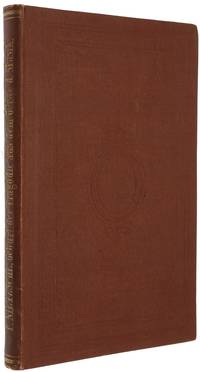
1872rif. 4535Leipzig: E.W. Fritzsch 1872. First edition. First edition in exceptionally rare original publisher's cloth binding. This copy previously handled by Bill Schaberg: "When I wrote The Nietzsche Canon: A Publication History and Bibliography 1995 I had never even heard of these cloth copies of Nietzsche's first book put out by his publisher Fritzsch. So it was quite a shock when someone offered this copy to me. It turns out that Fritzsch's contemporary advertisements for the book mention a cloth binding so this is not just a figment of some bookseller's imagination." This Nietzsche's first book is a compelling argument for the necessity for art in life. It is fueled by his enthusiasms for Greek tragedy for the philosophy of Schopenhauer and for the music of Wagner to whom this work was dedicated. . Hardcover. IN THE EXCEPTIONALY RARE PUBLISHER'S BINDING. First edition in exceptionally rare original publisher's cloth binding. This copy previously handled by Bill Schaberg: "When I wrote The Nietzsche Canon: A Publication History and Bibliography The University of Chicago Press 1995 I had never even heard of these cloth copies of Nietzsche's first book put out by his publisher Fritzsch. So it was quite a shock when someone offered this copy to me. It turns out that Fritzsch's contemporary advertisements for the book mention a cloth binding so this is not just a figment of some bookseller's imagination." This Nietzsche's first book is a compelling argument for the necessity for art in life. It is fueled by his enthusiasms for Greek tragedy for the philosophy of Schopenhauer and for the music of Wagner to whom this work was dedicated. Nietzsche argues that the tragedy of Ancient Greece was the highest form of art due to its mixture of both Apollonian and Dionysian elements into one seamless whole allowing the spectator to experience the full spectrum of the human condition. The Dionysian element was to be found in the music of the chorus while the Apollonian element was found in the dialogue which gave a concrete symbolism that balanced the Dionysiac revelry. Basically the Apollonian spirit was able to give form to the abstract Dionysian. In contrast to the typical Enlightenment view of ancient Greek culture as noble simple elegant and grandiose Nietzsche believed the Greeks were grappling with pessimism. The universe in which we live is the product of great interacting forces; but we neither observe nor know these as such. What we put together as our conceptions of the world Nietzsche thought never actually addresses the underlying realities. It is human destiny to be controlled by the darkest universal realities and at the same time to live life in a human-dreamt world of illusions. The issue then or so Nietzsche thought is how to experience and understand the Dionysian side of life without destroying the obvious values of the Apollonian side. It is not healthy for an individual or for a whole society to become entirely absorbed in the rule of one or the other. The soundest healthiest foothold is in both. Nietzsche's theory of Athenian tragic drama suggests exactly how before Euripides and Socrates the Dionysian and Apollonian elements of life were artistically woven together. The Greek spectator became healthy through direct experience of the Dionysian within the protective spirit-of-tragedy on the Apollonian stage. The Birth of Tragedy was the best selling book that Nietzsche ever published; still it did not sell quickly. The Wagners had feared that there might not be an audience for the work and their apprehensions proved to be well-founded. A prediction that Nietzsche had once made to Rohde proved true: "The philologists won't read it on account of the music the musicians won't read it on account of the philology and the philosophers won't read it on account of the music and the philology." False hopes for brisk sales plagued the first half-year. In mid-April Nietzsche was writing home that "a new edition of my book will be needed soon"34 but the necessity of printing a second edition did not materialize quickly. By 20 July Fritzsch complained that there had been "no results" even though he had "sent out a fair number of copies." Schaberg The Nietzsche Canon p. 27 8vo 216 x 138 mm pp. i-iii iv 1 2-143 144. Original publisher's dark-rust binding with an ornate blind-stamped design on the front and rear covers and the spine lettered and filleted in gilt. There is some light browning to the edges of the page margins and light foxing throughout. Rear hinge with a 10 cm split. Entirely unrestored copy in its original state. An extremely well preserved copy of this unusual and all-but-unobtainable original publisher's cloth binding. / Hardcover. E.W. Fritzsch unknown
1894rif. 424Leipzig: C.G. Naumann 1894. Third edition. Hardcover. Very Good . NIETZSCHE Friedrich. Die Geburt der Tragödie The Birth of Tragedy 1894 C.G. naumann Leipzig: 1894. TP Half-title 1 172 I XII Octavo. THIRD EDITION. The third edition of Nietzsches look at art aesthetics and the aesthetic existence. Last leaves with three column register comparing the first three editions.CONDITION: Very good. Contemporary marbled boards with cloth spine. ORIGINAL FRONT WRAPPER affixed to front board. Clean pages throughout. PHOTOS AVAILABLE UPON REQUEST C.G. Naumann hardcover
1959rif. V35844München (Wilhelm Goldmann) 1959 (= Goldmanns Gelbe Taschenbücher 569 / 570, Erste Auflage). 8°, Originalbroschur mit Leinenrücken ( Paperback ) 359 S., 1
rif. 0366097857.Ghardcover. Good. Access codes and supplements are not guaranteed with used items. May be an ex-library book. hardcover
rif. 0366037137.Gpaperback. Good. Access codes and supplements are not guaranteed with used items. May be an ex-library book. paperback
rif. 0331266806.Ghardcover. Good. Access codes and supplements are not guaranteed with used items. May be an ex-library book. hardcover
rif. 0332297136.Ghardcover. Good. Access codes and supplements are not guaranteed with used items. May be an ex-library book. hardcover
rif. Q-3150071151Philipp Reclam Jun Verlag GmbH. Paperback. New. In shrink wrap. Looks like an interesting title! Philipp Reclam Jun Verlag GmbH paperback
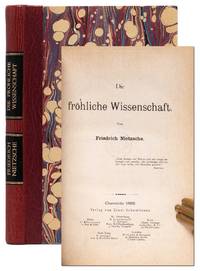
1882rif. 8129Chemnitz: Verlag von Ernst Schmeitzner 1882. First edition. Very Good. A Very Good copy of a scarce work. Octavo. Modern red morocco-backed marbled boards leaves measuring 220 x 137 mm. Twin black morocco spine labels lettered in gilt. 255 pp. leaf size 220 x 137 mm. Circular ownership stamps of Austrian bibliophile Dr. Moriz Grolig to verso of title-page original upper free endpaper and blank verso of final text leaf. Some toning to title-page and first and last few leaves otherwise quite clean throughout. Better known as "The Gay Science" in English Die fröhliche Wissenschaft is Nietzsche's key work on the relationship between art and science. Famously the book includes Nietzsche's first use of the "God is dead" "Gott is todt" metaphor p. 137. Against what Nietzsche saw as the pedestrian fact-gathering of contemporary scholarship his "Gay Science" advocates a deliberately lighthearted approach to the study of human experience. The work anticipates many aspects of the following year's Also sprach Zarathustra Thus Spoke Zarathustra not least the concept of eternal recurrence. Provenance: Dr. Moriz Grolig 1873-1949 Austrian librarian book historian and bibliography. Schaberg 35. Very Good. Verlag von Ernst Schmeitzner unknown
1887rif. 1031"Gott ist tot!" God is dead! NIETZSCHE Friedrich. Die Fröhliche Wissenschaft "la gaya scienza". Neue Ausgabe mit einem Anhange: Lieder des Prinsen Vogelfrei The Gay Science. E.W. Fritzsch Leipzig 1887. 1 misbound half-title leaf = "Scherz List und Rache" TP III –XII = Vorrede 5 –350 1 leaf = Berichtigungen. First Edition Second Issue Definitive. Schaberg 51. BOUND WITH Jenseits von Gute und Bose Beyond Good and Evil Dritte Auflage C.G. Naumann Leipzig 1894. TP Half-title 3 - 5 = Vorrede 1 leaf = Inhalt Half-title 11 - 285 287 - 292 = Register 2 leaves = advertisements. Third Edition. Octavo. The Gay Science which is the final and culminating volume of Nietzsche's aphoristic workscontains the first instance of his famous statement "Gott ist tot!" God is Dead –first in section 108 then more elaborately detailed in the Parable of the Madman in section 125 and for a third time in section 343. It also contains the first appearance of the doctrine of the "Eternal Return of the Same" which plays such a prominent role in Zarathustra and even includes Nietzsche's first mention of the Uebermensch. This Neue Ausgabe consisted of the 788 unsold sheets from the first edition of 1882 with the addition of a new title page Nietzsche's new 10-page Vorrede Preface 2 new half-title pages and a new 5th book "Wir Furchtlosen" "We Fearless Ones". Thus 75 new pages along with fourteen pages of poetry appear here for the first time. Nietzsche felt that the Vorrede to this and the other reissues of 1886/7 were among the best things that he ever wrote. Considered by most to be Nietzsche's most important philosophical work Beyond Good and Evil was the first of Nietzsche's "self-published" books. The work consists of nine interlocking chapters that delineate the profile and the task of the "free spirit" and the "philosopher of the future" and contains some of Nietzsche's most insightful and barbed attacks on previous philosophers as well as many of his most powerfully and elegantly formulated analyses. As perhaps nowhere else the Nietzsche of Beyond Good and Evil fulfilled his own criterion of literary greatness: "To say in one sentence what others have required a book to say –and then to say what they did not say as well!" By any standard Beyond Good and Evil is among the greatest books in Western Culture. It is difficult to imagine another in which one can find so much. Here for the first time Nietzsche proposes a "natural history of morals" and proposes that the revaluation of former values is the central task to be accomplished by the philosopher of the future –this indeed would be the primary task of his own final works. He begins: "If a person should regard even the effects of hatred envy covetousness and the lust to rule as conditions of life as factors which fundamentally and essentially must be present in the general economy of life and must therefore be further enhanced if life is to be further enhanced –he will suffer from such a view of things as from seasickness. And yet even this hypothesis is far from being the strangest and most painful in this immense and almost new domain of dangerous insights." CONDITION: Good or better in original quarter leather with marbled boards. Much wear to spine but well preserved. Scuffing to covers. Spine with original handscripted label. Contemporary annotations to front and rear endpapers with scattered marginalia throughout all in pencil and could be erased but left preserved. First half-title is mis-bound ahead of the main title page. E.W. Fritzsch and C.G. Naumann hardcover
rif. 026015556X.Ghardcover. Good. Access codes and supplements are not guaranteed with used items. May be an ex-library book. hardcover
rif. 374365525X.Gpaperback. Good. Access codes and supplements are not guaranteed with used items. May be an ex-library book. paperback