527 résultats
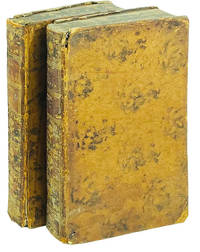
1758réf. 26171A Paris: chez Durand 1758. Due volumi di cm. 21 pp. 4 xiiii 318 2; xiii 1 334 2. Legatura strettamente coeva in cart. alla rustica con nervi passanti e titoli manoscritti ai dorsi. Esemplare freschissimo e particolarmente marginoso in barbe. In ottimo stato di conservazione. Edizione apparsa presso lo stesso editore e lo stesso anno dell'originale rara e non menzionata dalle principali bibliografie consultate. chez Durand unknown
1758réf. 52026Paris Durand 1758. Large 4to. Large-paper copy bound in a beautiful contemporary full calf binding with five raised bands to richly gilt spine. Triple gilt line-borders to boards all edges of boards gilt and inner gilt dentelles. All edges gilt. A stunning bright clean and fresh copy with minimal wear and no restorations of any kind. Presentation-inscriptions to front free end-paper and to verso of title-page see description in note below. Large woodcut title-vignette and many smaller vignettes throughout. 4 XXII 643 1 pp. 40 ff. i.e. the original uncorrected leaves: pp. 1-16; 35-38; 59-62; 67-70; 75-78; 139-142; 145-154; 169-176; 187-190; 233-34; 227-230; 459-462; 547-550; 603-606 2 extra leaves that were printed incorrectly namely p. 160 - reset & p. 239 - different vignette. Extremely rare first edition first issue with manuscript dedication-inscription from the author of this monumental work of the French Enlightenment. This magnum opus of modern thought is considered the founding work of modern Utilitarianism as it is here that Helvétius articulates the greatest happiness principle "the greatest happiness for the greatest number" for the first time and becomes the first to define social welfare upon this utilitarian maxim directly influencing Bentham and Mill.The materialistic philosophy of Helvétius' "De l'Esprit" also directly influenced Karl Marx who had studied the work while in Paris and called the ideas presented in it "the social basis of communism"."De l'Esprit" arguably constitutes the greatest "succès de scandale" of Western thought and one of the most influential works of Western philosophy.This magnificent copy is stunning in all ways. It contains all the extremely rare condemned and repressed leaves of the first issue bound in the back it is printed on large paper contemporarily bound presumably under instruction by Helvétius himself in a stunning full calf gift binding and with two manuscript ex-dono- presentation- inscriptions by Helvétius himself. One of them on the verso of the title-page is crossed out but is still legible reading "donum auctoris 17 avril 1760 Cl. Helvetius" the second on the front free end-paper reads "ex dono auctoris 1761" - thus indicating that Helvétius who had the copy in his possession to give away when he felt it appropriate had first intended to give it away - perhaps late in the year - in 1760 and then ended up giving it away in 1761. The work lost its privilege almost immediately and even though Hélvetius wrote three retractions it was still condemned and publicly burnt. In spite of this Helvétius still kept a few copies of the very first issue with all the original leaves. According to Smith 15 copies existed and as Jacques Guérin also notes these copies were all intended for his close friends and family we know for instance that Rousseau received one of the copies. These copies of which the present is one are thus of the utmost scarcity. Only one other has been on the market within the last 25 years namely that of Jacques Guérin which however did not have a dedication-inscription from Helvétius.As Tchermerzine describes the extremely rare copies of the first issue which are either without the newly formulated leaves or with the original leaves preserved our copy has them all! are between 10 and 60 times as valuable as the later issues depending on condition - these between 4 and 15 copies are the only ones to contain the 80 revolutionary pages that caused the work to be condemned and burnt and sent Helvétius into exile. Tchermerzine does not however account for copies with a presentation-inscription like the present. The work caused an immense uproar when it appeared. It was considered so heretical atheistic and immoral that it lost its privilege within a fortnight; it was heavily condemned by the Church and the State and was burnt by the Hangman the plan being to destroy all copies of it. Few books in the entire history of printing have been met with such opposition - it was condemned by both the son of Louis XV and the Sorbonne and the priests succeeded in convincing the court that the doctrines were so dangerous that even though Helvetius wrote three retractions the book was still publically burned; and when the Encyclopédie of Diderot and d'Alembert was suppressed for the second time this had much to do with Helvétius' De l'Esprit and the scandal it had caused.This scandalous work however gained so much attention that it was almost immediately translated into all European languages contributing to the immense influence it came to have on all European thought. "The history of Helvetius's De l'esprit 1758 his first major work is eventful complicated and paradoxical. No book during the eighteenth century except perhaps Rousseau's Emile evoked such an outcry from the religious and civil authorities or such universal public interest. Condemned as atheistic materialistic sacrilegious immoral and subversive it enjoyed a remarkable succes de scandale. The work lost its privilege within a fortnight of its publication. It was attacked in Church periodicals and in polemical pamphlets in the literary salons and in popular songs from bishops' pulpits and from the stage of the Théâtre francais. Though Helvetius retracted his book three times he was condemned by the Archbishop of Paris Nov. 1758 the Pope Jan. 1759 the Parlement of Paris Feb. 1759 the Sorbonne Apr. 1759 and by various bishops." Smith p. 332."In "De l'ésprit" 1758 Helvétius follows the Lockean sensationalism of Condillac and pairs it with the claim that human beings are motivated in their actions only by the natural desire to maximize their own pleasure and minimize their pain. "De l'ésprit" though widely read gives rise to strong negative reactions in the time both by political and religious authorities the Sorbonne the Pope and the Parlement of Paris all condemn the book and by prominent fellow philosophes in great part because Helvétius's psychology seems to critics to render moral imperatives and values without basis despite his best attempts to derive them. Helvétius attempts to ground the moral equality of all human beings by portraying all human beings whatever their standing in the social hierarchy whatever their special talents and gifts as equally products of the nature we share plus the variable influences of education and social environment." SEP.D. W. Smith The Publication of Helvetius's De l'esprit in French Studies 1968 p. 105.Tschermerzine III:672. hardcover
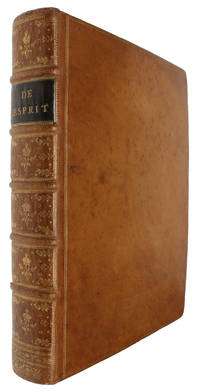
1759réf. 38286A La Haye: Chez Pierre Moetjens. Good with no dust jacket. 1759. Leather. Bound in full morocco leather. Three red and black title pages. Front cover attached by binding cords. Inside front cover scraped by removal of bookplate. An ideological work with heretical and subversive opinions. Possibly a pirate edition. . Chez Pierre Moetjens hardcover
réf. 46585084-nnew. unknown
réf. 46585084like new. unknown
réf. A9781340311582Hardback. New. hardcover
réf. B9781340311582Hardback. New. hardcover
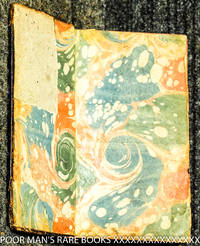
1774réf. 25060Amsterdam: Arkstee et Merkus 1774. Very Good. Amsterdam: Arkstée & Merkus 1774. Two volumes; 12mo; contemporary cats paw calf gilt spines marbled endpapers all edges marbled blue; 2viii384; 4392pp. collated complete including half titles; decorative head- and tail-pieces. Leather rather scuffed joints starting to crack but holding coin-sized loss to top fore-edge corner of first eight leaves of Vol. II not quite touching text else a Good to Very Good internally clean and fresh set. Arkstee et Merkus unknown
réf. elala2495Paris: Durand 1758. Second Quarto Edition. Conceived as a rival work to Montesquieu's L'Esprit des Lois this is Helvétius' principal work and the only one to be published in his lifetime. Helvetius' thought represents the extreme form attained by the sensationalist and utilitarian philosophy in eighteenth century France and his treatise had a wide and profound influence on Beccaria the Encyclopedist movement particularly Holbach the British Utilitarians especially Bentham and Mill as well as on Godwin who considered it to be one of the most influential books in his development. "No book during the eighteenth century except perhaps Rousseau's Émile evoked such an outcry from the religious and civil authorities or such universal public interest. Condemned as atheistic materialistic sacrilegious immoral and subversive it enjoyed a remarkable succès de scandale. The work lost its privilege within a fortnight of its publication." Smith Denounced by the Sorbonne as containing within its pages all of the poisons scattered through modern literature it was burned by order of the parlement at the beginning of 1759. Helvetius himself made three separate retractions but his work was widely reprinted translated and read throughout Europe. Smith E2A. Cioranescu III 33643. Goldsmiths' 9432. Kress 5710. Rand I 250. cfTchemerzine VI 188. 4to. pp. 2 p.l. xxii 643 1. complete with half-title. woodcut title vignette. contemporary mottled calf gilt back spinal extremities chipped small piece of calf missing from lower front cover; a nice crisp copy Paris: Durand, 1758 unknown
2019réf. Gyan-9789363099784Facsimile Publisher 2019. Hardcover. New. 25.13 x 18.78 x 5.52 cm. English Facsimile Publisher hardcover
réf. MA03OS-00071Albion Press. Collectible - Acceptable. Albion Press 1810. 8vo Hardcover. 4frontisxxxviii498pp4. Poor book. 1/4 leather backed marbled boards with decorative gilt compartments raised spine bands gilt spine lettering and green endpapers. Heavy edgewear. Boards rubbed. Pages age toned. Penciled notations to the verso front free endpaper and first blank. Bottom corner of page 409 torn away with some text missing. With typical period foxing throughout. philosophy enlightenment atheism Inquire if you need further information. Albion Press hardcover
réf. 139116511X.Ghardcover. Good. Access codes and supplements are not guaranteed with used items. May be an ex-library book. hardcover
réf. 0260504025.Ghardcover. Good. Access codes and supplements are not guaranteed with used items. May be an ex-library book. hardcover
réf. 1334934134.Gpaperback. Good. Access codes and supplements are not guaranteed with used items. May be an ex-library book. paperback
1759réf. 024098Amsterdam Leipsick: Arkstée & Merkus 1759. Due tomi in un volume 11x17 cm di XXVI-324 e 336 pagine. Una interessante nota manoscritta d'epoca alla prima pagina bianca. Legatura coeva in piena pelle dorso liscio ornato e dorato risguardie con carta marmorizzata; ex libris settecentesco con stemma eraso al retro del piatto. Condizioni molto buone. Arkstée & Merkus unknown
1772réf. 024099Amsterdam Leipsick: Arkstée & Merkus 1772. due volumi 10x17 cm di VIII-384 e 392 pagine. Bella legatura coeva in piena pelle qualche usura ai margini dorso a nervi ornato e dorato con motivi floreali tagli rossi testimoni. Una nota a penna alla prima pagina bianca dice: Quest'Elvezio comprato a Londra. è di Domenico Cayrela. 1776. Condizioni molto buone. Arkstée & Merkus unknown
1758réf. 024097Paris: Durand 1758. E.O. Un volume in quarto 21x26 cm di 4 XXII- 643 pagine. Seguito da: CENSURE de la Faculté de Theologie de Paris contre le livre qui a pour titre De lEsprit. Paris Garnier; 1758. Pp 79; testo e titolo anche in latino. ARRETS de la Cour de Parlement du 23 Janvier 1759. Paris Simon; 1759. Pp 31. Condamnation et prohibition. de la part du pape Clement XIII. Roma Camera apostolica; 1759. Pp4; testo in latino e francese. Mandement de Monseigneur lArcheveque de Paris. Paris Simon; 1758. Pp 28; seguito dallEstratto delle Nouvelles Ecclesiastiques. -Legatura coeva in piena pelle dorso a nervi ornato e dorato. Usure alla cuffia superiore a due angoli fenditure alla cerniere; tagli rossi risguardie in carta marmorizzata. Grandi margini. Condizioni molto buone per questa Edizione Originale first edition tiraggio C secondo lo studio di D.W. Smith. Tchemerzine: E.O. Dans beaucoup dexemplaires on trouve à la suite les pièces du procés. Malgrado i tentativi di ritrattazione e di ammenda dellautore lopera venne venne condannata dalla Facoltà di teologia di Parigi dal Papa Clemente XIII 31 gennaio 1759 quindi dal Parlamento. come contenente affermazioni empie blasfeme erronee ed eretiche. Durand unknown
réf. B9781015746008Hardback. New. hardcover
réf. 45467668-nnew. unknown
réf. 45467668like new. unknown
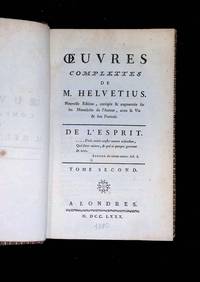
1780réf. 174645A Londres 1780. Relié. Etat moyen. in-8. Pleine reliure Charnières et coiffes accidentées Coins frottés unknown
réf. 0331850257.Ghardcover. Good. Access codes and supplements are not guaranteed with used items. May be an ex-library book. hardcover
réf. 0267750927.Gpaperback. Good. Access codes and supplements are not guaranteed with used items. May be an ex-library book. paperback
réf. 0267015003.Ghardcover. Good. Access codes and supplements are not guaranteed with used items. May be an ex-library book. hardcover