444 résultats
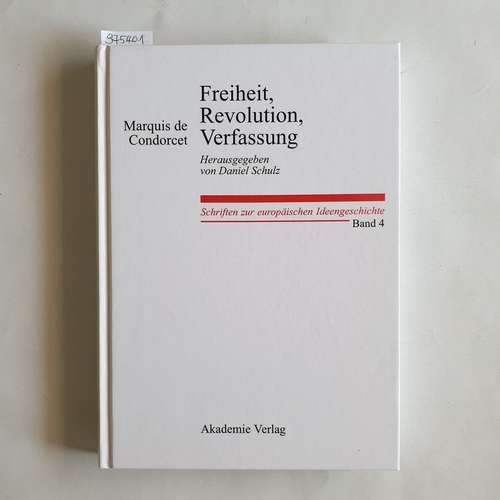
2010réf. 975401Berlin: Akad.-Verl.. 2010. 276 S. 25 cm. Zustand: Sehr Gut, eher ungelesen (Innen); Kleiner Schrifteintrag vor dem Titelblatt; Einband (Außen) hat min. Gebrauchsspuren; Schnitt oben ist min. fingerfleckig; Ppbd.
1983réf. 1212241(Neapel) / Bibliopolis, 1983. 166 Seiten; Illustr.; 23,5 cm; fadengeh. Orig.-Leinenband m. OUmschlag.
2019réf. 429062019. ISBN-13: 9781584776543; ISBN-10: 1584776544. Translated by Thomas Jefferson Destutt de Tracy Antoine Louis Claude Comte. Jefferson Thomas. A Commentary and Review of Montesquieu's Spirit of Laws Prepared For Press From the Original Manuscript in the Hands of the Publisher. To Which Are Annexed Observations on the Thirty-First Book by the Late M. Condorcet: And Two Letters of Helveticus on the Merits of the Same Work. Philadelphia: Duane 1811. viii 292 pp. Reprinted 2006 2019 by The Lawbook Exchange Ltd. ISBN-13: 9781584776543; ISBN-10: 1584776544. Hardcover. New. $75. Commentaire sur l'Esprit des Lois de Montesquieu 1806 is a critique of Montesquieu's pessimistic appraisal of democracy in De l'Esprit des Lois. While minister to France in the 1780s Jefferson saw this work in manuscript. It so impressed him that he arranged for its publication in France and translated it anonymously for publication in America. Looking back at this work in a letter from 1811 Jefferson commended it for correcting De l'Esprit des Lois. While other studies "nibbled only at its errors" he told his correspondent this work rebutted them "with a depth of thought precision of idea of language and of logic which will force conviction into every mind. I declare to you Sir in the spirit of truth and sincerity that I consider it the most precious gift the present age has received.": The Writings of Thomas Jefferson V:566-571. CONTENTS: Of laws in England; Of laws originating directly from the nature of the government; Of the principles of the three forms of government; The laws relating to education should be congenial with the principles of the government; Laws formed by the legislative should be consistent with the principles of the government; Consequences of the principles of different governments in relation to the simplicity of civil and criminal laws the forms of judicial proceedings and the apportionment of punishments; Consequences of the different principles of the three forms of government relative to sumptuary laws to luxury and to the condition of women; Of the corruption of the principle in each of the three forms of government -- Of laws relative to the defensive force; Of laws relative to the offensive force. unknown books
1785réf. 66958ìThe First Large-Scale Attempt to Apply Mathematics to Knowledge of Human Phenomenaî CONDORCET Marie Jean Antoine Nicolas Caritat Marquis de. Essai sur líapplication de líanalyse ‡ la probabilitÈ des dÈcisions rendues ‡ la pluralitÈ des voix. Paris: De líImprimerie Royale 1785. First edition.†Quarto. 2 cxci 1 blank 304 pp. Decorative woodcut head- and tail-pieces. Contemporary French mottled calf spine decorated in gilt with five raised bands. Marbled endpapers all edges red. First and last few pages browned at edges . gathering K is browned a Q and 2G is toned. Otherwise very good and very scarce. ìCondorcetís most significant and fruitful endeavor was in a field entirely new at the time. The subject was one that departed from the natural sciences and mathematics but nevertheless showed the way toward a scientific comprehension of human phenomena taking the empirical approach of natural science as its inspiration and employing mathematics as its tool. Condorcet called this new science ësocial mathematics.í It was apparently intended to comprise.a statistical description of society a theory of political economy inspired by the Physiocrats and a combinatorial theory of intellectual processes. The great work on the voting process published in 1785 is related to the latter. Condorcet there sought to construct a scheme for an electoral body the purpose of which would be to determine the truth about a given subject by the process of voting and in which each elector would have the same chance of voicing the truth.No doubt the results obtained in the Essai díapplication de líanalyse were modest ones. ëIn almost all casesí Condorcet said ëthe results are in conformity with what simple reason would have dictated; but it is so easy to obscure reason by sophistry and vain subtleties that I should feel rewarded if I had only founded a single useful truth on a mathematical demonstrationí Essai p. ii. One must nevertheless recognize in this work.the first large-scale attempt to apply mathematics to knowledge of human phenomenaî D.S.B. Brunet VI col. 472. HBS 66958. $7500 De k'Imprimerie Royale hardcover books
1795réf. 65358ìCan Man Become Perfectî CONDORCET Marie Jean Antoine Nicolas Caritat Marquis de. Esquisse díun tableau historique des progrËs de líesprit humain. Ouvrage posthume de Condorcet. Paris: Chez Agasse Lían III. de la RÈpublique 1795. First edition of Condorcetís philosophical masterpiece. Octavo 7 7/8 x 4 13/16 inches; 201 x 123 mm. viii 389 1 blank pp. Contemporary quarter calf over dark blue paste-paper boards spine gilt with dotted bands and ornaments gilt red morocco lettering piece. Old owner's signature on half-title. A quarter-inch marginal tear at the bottom of leaf M42 that does not affect the text. Light foxing throughout. A blue ink stain on top edge from signature Z to the end. Overall a clean and attractive copy. ìIt was the gospel of the nineteenth century that mankind is destined for indefinite future progress. Condorcet 1743-1794 looking back and then forward saw proof of this in the growing equality between classes and nations the intellectual physical and moral improvement of man; and he prophesied that popular education on correct principles would strengthen and assure this progress.In the Esquisse ëAn Historical Outline of the Progress of the Human Mindí published after his death Condorcet traces the history of man through epochs the first three covering his progress from savagery to pastoral community and thence to the agricultural state. The next five span the growth of civilizations and knowledge down to Descartes and the ninth describes the revolution of Condorcetís own lifetime from Newton to Rousseau. The prophetic view of the tenth epoch shows Condorcet at his most original. He forecasts the destruction of inequality between nations and classes and the improvement intellectual moral and physical of human nature.it is as the most fully developed exposition of the progress of man that Condorcetís work is now remembered and it is this which has given its lasting appealî Printing and the Mind of Man. Printing and the Mind of Man 246. HBS 65358. $2000 Chez Agasse hardcover books
1968réf. RH1440Paris:: A. Lahure 1968. 1968. Facsimile of the original 1773 edition. Sm. 8vo. 168 pp. Plain white wrappers spine title. Very good. Condorcet was secretary to the Paris Academy of Sciences. "His ideas and writings were said to embody the ideals of the Age of Enlightenment and rationalism and remain influential to this day. He died a mysterious death in prison after a period of being a fugitive from French Revolutionary authorities." – Wikipedia. A. Lahure, 1968. unknown books
1788réf. 264649Paris: Chez Froullé libraire quai des Augustins 1788. First edition. 4 xvi 383 1; 4 259 1; 4 292; 4 366 pp. 4 vols. 8vo. Contemporary quarter leather pastepaper boards french tips flat spines with red leather title and volume labels. Spines rubbed some minor starting of joints to two volumes small loss to head of vol. I a very good contemporary set. First edition. 4 xvi 383 1; 4 259 1; 4 292; 4 366 pp. 4 vols. 8vo. Mazzei emigrated to America from Italy in 1773 and introduced the cultivation of grapes and olives to the United States. He became a neighbor of Jefferson in Virginia settling near Monticello at Jefferson's request and this association led to their long friendship and the author's acquaintance with Franklin and Adams. A staunch Republican Mazzei took an active role in the Independence movement. In this work he outlines the history of the American colonies the causes of the Revolution and the economy and government of the United States. Also discussed are Indians slavery emigration and the Society of the Cincinnati. The book was a contemporary success and remains an important work which Malone characterizes as "probably the most reliable of all the works of the period on the United States" Thomas Jefferson 2:109-110. Jefferson aided Mazzei in the compilation of the work while acting as American minister in Paris. Sabin 47206; Leclerc 957; Howes M456; Monaghan 1052; Muller 1612; Fay 24; Einaudi 3807; Reese Revolutionary 87 Chez Froullé, libraire, quai des Augustins unknown books
1795réf. 25074Paris: Agasse ans III 1795. First edition 8vo pp. viii 389; contemporary full calf black morocco label on gilt-decorated spine; front joint cracked binding rubbed and scuffed; a good copy. See PMM 246: "It was the gospel of the nineteenth century that mankind is destined for indefinite future progress. Condorcet 1743-1794 looking back and then forward saw proof of this in the growing equality between classes and nations the intellectual physical and moral improvement of man; and he prophesied that popular education on correct principles would strengthen and assure this progress. In the Esquisse An Historical Outline of the Progress of the Human Mind published after his death Condorcet traces the history of man through epochs the first three covering his progress from savagery to pastoral community and thence to the agricultural state. The next five span the growth of civilizations and knowledge down to Descartes and the ninth describes the revolution of Condorcet's own lifetime from Newton to Rousseau. The prophetic view of the tenth epoch shows Condorcet at his most original. He forecasts the destruction of inequality between nations and classes and the improvement intellectual moral and physical of human nature it is as the most fully developed exposition of the progress of man that Condorcet's work is now remembered and it is this which has given its lasting appeal." Agasse, ans III unknown books
1968réf. BL3869Paris:: A. Lahure 1968. 1968. Facsimile reprint of the Paris 1773 ed. 12mo. viii 168 pp. White wrappers spine title. Very good. "Condorcet was a French philosopher mathematician and early political scientist whose Condorcet method in voting tally selects the candidate who would beat each of the other candidates in a run-off election. Unlike many of his contemporaries he advocated a liberal economy free and equal public education constitutionalism and equal rights for women and people of all races. His ideas and writings were said to embody the ideals of the Age of Enlightenment and rationalism and remain influential to this day. He died a mysterious death in prison after a period of flight from French Revolutionary authorities." A. Lahure, 1968. unknown books
1795réf. 168984Paris: Chez Agasse 1795. Second. hardcover. very good. 389pp. 4pp. of advertisments 8vo untrimmed rebound in cloth-backed marbled boards spine neatly repaired. Paris: Chez Agasse L'An III 1795. Second Edition. Very good . Printing and the Mind of Man 246; Robinet 382. Considered to be Condorcet's most original and most important work. Considered to be Condorcet's most original and most important work. In it he divided history into ten epochs the first nine dealing with history upto the time in which he himself lived whereas the tenth is his prophetic view of the future. It is the most original part of the book in which Condorcet forecasts among others the future moral intellectual and physical improvement of man. '. PMM Chez Agasse unknown books
1796réf. 262913Philadelphia: Lang and Ustick 1796. hardcover. good. Frontis. 293pp. 16mo contemporary calf covers detached spine worn edges of corners worn light foxing throughout many pages dampstained on top half many pages slightly wavy back cover dampstained. Philadelphia: Printed by Lang and Ustick for M. Carey. 1796. First American Edition Printing and the Mind of Man 246 "Considered to be Condorcet's most original and most important work. In it he divided history into ten epochs the first nine dealing with history up to the time in which he himself lived whereas the tenth is his prophetic view of the future. It is the most original part of the book in which Condorcet forecasts among others the future moral intellectual and physical improvement of man." Evans 30257 Lang and Ustick unknown books
1778réf. 263011Paris: Not Identified 1778. hardcover. near fine. Title with ornamental borders; title vignette and ornamental head/tail pieces throughout. Illustrated with a portrait of Pascal engraved by L. Demeuse. XII 316 pages. 8vo handsomely bound in full contemporary mottled calf with gilt decorated spine and marbled page edges. Paris i.e. Geneva: Publisher Not Identified Grasset 1778. Nouvelle edition. Scarce. According to BN the imprint is false; this edition was printed in Geneva by Grasset. A reprint of Condorcet's selection from the Pensees. he added to his own notes a selection from the "Remarques sur les Pensees de Pascal" by Voltaire who's notes are signed "Note du present editeur." -- Bengescu 1910; BN 5391. Page 163 is misnumbered 139; page 193 is misnumbered 391. Not Identified unknown books
Paris, Fayard, 1989. fort in-8, broché, 658 pp. Première édition. Bel exemplaire.
Mm 150x210 Collana "Breves Littérature". Brossura originale con copertina figurata, XL tavole in nero e a colori in aperura e 304 pagine di testo in lingua francese - french text. Buona copia, spedizione in 24 ore dalla conferma dell'ordine.
Mm 135x210 Due volumi di pagine rispettivamente 438 e 436, rilegatura in mezza pelle Un po' consumata quella del secondo volume). Titolo e fregi oro al dorso. Collection complémentaire des mémoires relatifs a la Révolution Française, tome I-II. Opera in buone condizioni. Spedizione in 24 ore dalla conferma dell'ordine.
Mm 125x205 Collana "Einaudi Paperbacks" - Brossura editoriale, xii-459 pagine. Copia ottima. SPEDIZIONE IN 24 ORE DALLA CONFERMA DELL'ORDINE.
Collana "Studi Testi Documenti", 2. Un volume di 160 pagine, brossura editoriale. Dimensioni: 14,5x22,5 cm. Minime tracce d'uso alla brossura, per il resto ottime condizioni.
No marks or inscriptions. No creasing to covers. A very clean very tight copy with bright unmarked boards and no bumping to corners. 69pp. Periodical magazine with feature articles on At the portrait's painter -18th century, Turgot and Condorcet, Manuel Chrysoloras, the Malayan Raj, the rise of Wessex from 5th to 11th centuries, Sir Frederick Trench and London improvements, Blockade running from Nassau - 1861-5, plus book reviews and letters.
2 pièces reliées en un volume in-8, broché, couverture de papier moderne. Ensemble de deux pièces distribuées séparément: le "Discours" ainsi que son minutieux plan de mise en application sous forme de "Projet de décret". L’un des projets les plus radicaux de réforme de l’éducation nationale pendant la Révolution. Bien que Girondin (député de Saône-et-Loire), Masuyer critique le plan de Condorcet et de Romme, jugé "destructeur de l’égalité et générateur de despotisme", pour proposer un projet global "d’éducation nationale". Si tous les hommes sont égaux en droit, l’instruction publique doit être commune à tous, gratuite et graduelle et les établissements d’enseignement proportionnellement répartis sur l'ensemble du territoire. La réforme est financée par le produit de la vente des biens ecclésiastiques. Cf. A. Soboul, 'Girondins et Montagnards', Actes du colloque, 1975, p. 38 sq. (Martin & Walter, III, 23372 et 23374). Bon exemplaire.
In-8, broché, viii, 178 p., qqs soulign. Bibliographie. Bon exemplaire.
In-4 (288 x 228 mm), broché, couverture verte imprimée. (1) f., 113 p. Edition originale de cette excellente biographie de Condorcet par François Arago, lue en séance et publiée par l’Institut. C’est elle qui figure en tête de l’édition des œuvres de Condorcet donnée par le même Arago (1847-49), qui demeure l’édition de référence. Quelques petits accrocs à la couverture. Très bon exemplaire très frais, tel que paru.
3 pièces reliées en un volume in-4, cartonnage à la Bradel ancien, pièce de titre de basane fauve, titre doré, tranches rouges. 1 - Edition originale. "Pièces justificatives" pages 21-28. (Goldsmiths'-Kress online, n°15706. Martin & Walter, 'Anonymes', 3677. Tourneux, 13416). 2 - Edition originale. Pièces justificatives pages 17-80. (Goldsmiths'-Kress online, n°15707). 3 - Edition originale. (Tourneux, 13416). Trois importants documents des Nouveaux Commissaires de la Trésorerie Nationale qui succèdent à l’administration pilotée par Lavoisier et Condorcet démissionnaires. Les noiuveaux commissaires dressent le bilan de la précédente administration. Parmi les Commissaires de la Trésorerie Nationale signataires de ces comptes rendus et mémoires: Jean Devaines, Michel Martin de Gaudin, Charles-Pierre-Paul de Langes marquis de Savalette, Lermina, Antoine Pierre Dutramblay de Rubelles, François Benoit Cornut de La Fontaine de Coincy. Pour les trois pièces, cf. Stourm, 'Bibliographie historique des finances de la France au XVIIIe s.', p. 221-222. Sur l'importance de ces documents, cf. Marcel Marion, ‘Histoire financière de la France depuis 1715’, III, 191, et passim. Provenance: le conventionnel Claude Antoine Rudel du Miral (1719-1807), avec sa signature ex-libris manuscrite sur les deux pièces et une table manuscrite sur le contre plat inférieur. Avocat auprès du Parlement de Paris, avant de venir s'établir à Thiers, il devint maire de cette ville pour la première fois de 1763, et occupa plusieurs fois ce poste jusqu'à la fin de l'Ancien Régime. Le 7 septembre 1792, il fut élu député du Puy-de-Dôme à la Convention et siégea avec les modérés de la Plaine. Bon exemplaire.
4 volumes in-8 (198 x 122 mm), plein veau moucheté de l'époque, dos lisses richement ornés de compartiments garnis d'un décor Empire de fers spéciaux, roulettes et filets dorés, pièces de titre et de tomaison rouge, tranches mouchetées jaunes. Edition originale enrichie d'un ex-dono de l'autrice manuscrit sur la page de titre: "De la part de l'aut[eur]". Dans cet ambitieux essai inspiré par "l'Esquisse d’un tableau des progrès de l’esprit humain" de Condorcet, l'autrice dresse un panorama érudit de la production artistique et littéraire des grandes civilisations de l'antiquité en relation avec le développent technique et moral des sociétés qui les ont portées en étendant son analyse aux civilisations extraeuropéennes: Perse, Egypte, Chine, etc. La critique de l'époque reçut le livre avec réserve; Dussault et Suard jugèrent un tel travail "au-dessus des forces d’une jeune femme". (Cordier, 'Bibliotheca Sinica', p. 69. France littéraire, XI, p. 101 'The Feminist Encyclopedia of French Literature', p. 88.). Louise-Marie-Victoire de Chastenay, dite "Victorine" (1771-1855) reçut une excellente éducation. Traductrice, musicienne, botaniste, elle fit partie des cercles littéraires, politiques et scientifiques de la capitale au lendemain de la Révolution et entra en relation avec les personnalités du moment: Bonaparte, Barras, Fouché, Arago, Cuvier, Félicité de Genlis qui fut sa tutrice et Germaine de Staël, elle dut se retirer précocement à la suite de graves problèmes de santé. Tache à un coin de la reliure du tome I. Petit accroc à un coin. Ex-dono manuscrit de l'autrice sur la page de titre du premier volume. Bel exemplaire, très frais, très bien relié à l'époque.
grand in-8 etroit, VIII-263 pages, broché, couvert Etat proche du NEUF. [TX-5]
grand in-8 etroit, VIII-263 pages, broché, couvert Tres bel exemplaire, tres frais. [CA-12]


