BACON, FrancisBiblio.com
8 902 résultats
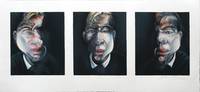
1981réf. 150382Paris: Editions de la Différence 1981. Edition of 150 signed by Bacon in pencil lower right numbered lower left. This lithograph is after a triptych oil painting on canvas 1979-80 currently held by the Metropolitan Museum of Art New York. Lithograph in colours on Arches wove paper right top and bottom deckle edged. Each image size: 32.5 x 28 cm. Sheet size: 47.3 x 103.5 cm. Framed size: 57.5 x 116.5 cm. Excellent condition. Presented in a dark brown stained wooden frame with conservation acrylic glazing. Sabatier 15. unknown
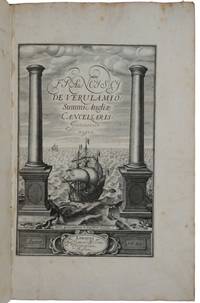
1620réf. 5962London: Joannem Billium 1620. First edition. First edition first issue the Devonshire-Horblit-Garden copy and one of approximately fifteen copies printed on large paper with the crown watermark - on present evidence one of only two first-issue large paper copies to have appeared in commerce. The Instauratio magna was Bacon's plan for the total reconstruction of human knowledge on experimental and inductive foundations projected in six parts of which only the first two were ever completed: the De Augmentis Scientiarum of 1623 and the Novum Organum offered here in which the method of the whole is set down. Against Aristotle's Organon Bacon opposed a new instrument: the purging of the four idola - of Tribe Cave Market-Place and Theatre - followed by the inductive ascent from designed experiment through Tables of Presence Absence and Comparison to the forms of simple natures and the ladder of axioms above them. The frontispiece a ship passing outward through the Pillars of Hercules is the book in miniature; Bacon's programme was institutionalised in 1662 as the Royal Society. . A Total Reconstruction of Sciences Arts and all Human Knowledge. First edition first issue of Bacon's plan for the total reconstruction of human knowledge on experimental and inductive foundations - the Devonshire-Horblit-Garden copy and one of approximately fifteen copies printed on large paper with the crown watermark. Of the six parts projected only the first two were ever completed; the present volume is the second in which the method of the whole is set down. The first issue published in October 1620 is rare in any paper and the large-paper state in the first issue rarer still. On the evidence presently available this is one of only two first-issue large-paper copies to have appeared in commerce in living memory. The book is dedicated to King James I to whom Bacon had presented a manuscript draft in October 1620 with a letter explaining that he had laboured at the work for almost thirty years and that the king's acceptance was the only reward he sought. James on receiving the volume is said to have remarked that it was 'like the peace of God which passeth all understanding'. The presentation copy to the king has not survived; the present copy is thus among the very small number of large-paper copies that did and the only one to have descended through Devonshire Horblit and Garden. The 1620 Instauratio magna appeared in two issues. The first issue of which the present copy is an example carries Bonham Norton's name in the colophon beside that of John Bill and retains an uncorrected pagination and a number of errors that the second issue would set right. Gibson records the existence of large-paper copies of both issues; ESTC specifies that roughly fifteen copies of the first issue were printed on large paper with a large crown watermark measuring about thirteen inches in height the remainder of the edition being printed on a smaller paper bearing a jug watermark and measuring about twelve inches. The large-paper copies were printed last in the sequence of the first issue so that all but one of the pagination errors were corrected in them together with two of the errors subsequently listed in the second-issue errata. In some large-paper first-issue copies - the present among them - leaf e3r beginning Non abs re fuerit admonere. is numbered 37; in others the numbering is suppressed. In the second issue leaf e3 is cancelled and the text reset on e4r an errata leaf is added and Norton's name is removed from the colophon. The present copy thus belongs to the latest-printed and best-corrected state of the first issue on the distinguishing paper stock with the full Norton imprint preserved. ESTC locates ten copies of the first issue in the United Kingdom and twelve in the United States without distinguishing paper stock. ABPC/RBH records since 1975 only two other copies of the first issue a large-paper copy in a presentation vellum binding at auction in 1996 and the Honeyman copy not stated to be large paper together with two large-paper copies of the second issue. Bacon's Instauratio magna - the Great Instauration or renewal - was conceived as the total reconstruction of human knowledge on experimental and inductive foundations in six parts of which only the first two were ever brought to completion. Part I a survey of existing knowledge and its gaps appeared in 1623 as the De Augmentis Scientiarum a greatly expanded Latin recasting of his English Advancement of Learning of 1605. Part II the book offered here under the running title Novum Organum - the New Instrument set deliberately against Aristotle's Organon - presented the new logical method by which true knowledge was to be acquired. Part III intended to collect the natural and experimental histories that would supply the raw material for inductive inference appears in the 1620 volume only as the prefatory Parasceve ad Historiam Naturalem et Experimentalem. Parts IV V and VI - worked examples preliminary speculations and the new philosophy itself - were never written. Bacon understood the Novum Organum as the working core of the entire programme: the part of the Instauratio in which the method of all the rest is laid down and without which the other parts cannot be attempted. The frontispiece engraved by Simon van de Passe places a ship in full sail passing outward through the Pillars of Hercules - the classical boundary of the known world - into open ocean. The device is the book in miniature: the old philosophy is the inland sea the new is the Atlantic. The Novum Organum proper is divided into two books of aphorisms. Book I opens with a diagnosis of the obstacles to true knowledge - the four classes of idola or illusions to which the unreformed intellect is natively prone. The idols of the Tribe arise from common features of human nature itself - the tendency to anthropomorphise to impose pattern on disorder to read purpose into process. The idols of the Cave arise from the peculiar history education and temperament of the individual. The idols of the Market-Place arise from the ambiguity and inadequacy of the words through which thought is transacted. The idols of the Theatre arise from received philosophical systems - Aristotelian Platonic Galenic - which impose a fictional dramaturgy on the world. Until the mind has been purged of the four Bacon argues it cannot receive truth from nature; the effort of the Instauratio is therefore at once logical psychological and religious a tabula abrasa on which nature itself may write. The theological motif is sustained: the reformation of the intellect reverses the effects of the Fall restoring the human capacity for dominion over creation that was forfeited in Eden. Book II of the Novum Organum presents Bacon's inductive method as applied by way of worked example to the investigation of heat. The aim of the method is to discover the form of a simple nature - by which Bacon means not an Aristotelian essence but what later philosophy would call an explanation or a reduction: the arrangement of primary qualities from which the secondary quality in question is generated. The form of heat Bacon concludes is a motion - expansive restrained and acting in its striving upon the smaller parts of bodies. The route to this conclusion runs through three tables. The Table of Presence collects instances in which heat is manifestly present - the rays of the sun flame boiling liquids - chosen to be as unlike one another as possible so that the nature they share may stand out against irrelevant commonalities. The Table of Absence collects matched instances in which heat is absent - the rays of the moon phosphorescence cool liquids - to eliminate candidate forms that fail the negative test. The Table of Comparison collects instances in which heat varies in degree requiring that the true form vary with it. Between them the three tables function as an analytic sieve: a putative form survives only if it is present when heat is present absent when heat is absent and co-variant with heat where heat is graded. The structure anticipates by two centuries John Stuart Mill's Joint Method of Agreement and Difference and is radically more discriminating than induction by simple enumeration. Construction of the tables demands not passive observation but the active interrogation of nature through designed experiment - nature in Bacon's phrase must be put to the question. Inference of the form from the tables is however only the first stage. Bacon envisages a progressive ascent from individual forms to what he calls the ladder of axioms - successive levels of generalisation that together compose the unified system of natural philosophy. The conception has something of Aristotelian classification genus species differentia about it and something of the later idea of a theoretical structure from which observations follow by deduction; but Bacon's ascent is emphatically not the hypothetico-deductive method. His axioms are the guaranteed products of properly conducted induction over properly contrived tables and the whole programme depends on his conviction that the simple natures of things are finite in number and exhaustively enumerable - that the primary qualities of bodies constitute a closed alphabet from which the variety of the world is assembled as a literature is assembled from letters. Where the senses cannot reach the relevant qualities directly Bacon commends what he calls aids to sense: instruments such as the telescope and what he terms fit and apposite experiments designed to bring hidden processes within observational range. Nor is the ascent to axioms the end of the labour. Bacon insists that the programme is sterile unless the axioms are returned to practice in what he calls the descent to works - the application of inductively secured knowledge to the amelioration of the human condition. Science is understanding but it is useless understanding unless it issues in dominion. The significance of the Novum Organum in the history of scientific method lies in its explicit commitment to observation and experiment as logically prior to theoretical construction rather than as downstream confirmation of conclusions already reached by deduction. The standard pre-Baconian practice widespread in Bacon's own time was to treat experiment as illustrative of a result antecedently established - Robert Boyle an admirer of Bacon would later note of Pascal's hydrostatical demonstrations that they are physically impossible to perform and were plainly conceived as thought experiments in service of an already-decided theory. Bacon inverts the sequence: the experiments come first the tables come next the axioms come only at the end. Not all the experiments reported in the Novum Organum are Bacon's own but a substantial number are carried out in the fields of chemistry and mechanics very likely after the manner of Boyle and other gentleman-philosophers through the physical labour of laboratory assistants under his direction. Bacon distinguishes carefully between experiments he has performed and accounts he has received at second hand and he engages directly with contemporary technology - the instance of experiments on compression and expansion in bells is linked openly in the text to the diving-bell technology then being deployed for salvage operations. This intimate engagement with applied science and craft practice is the practical counterpart to the theoretical methodology. Francis Bacon 1561-1626 statesman essayist and philosopher was the younger son of Sir Nicholas Bacon Lord Keeper of the Great Seal under Elizabeth I. He entered Trinity College Cambridge at the age of twelve and was admitted to Gray's Inn in 1576. A legal and parliamentary career under Elizabeth brought only modest advancement but under James I he rose through the offices of Solicitor-General and Attorney-General to become Lord Chancellor in 1618 with the titles Baron Verulam and Viscount St Albans in successive years. In 1621 he was impeached by the House of Commons for accepting gratuities from litigants stripped of his offices and confined briefly in the Tower; the last five years of his life spent in enforced retirement at Gorhambury were among the most productive of his career and saw the publication of the Historia Naturalis et Experimentalis 1622 the De Augmentis Scientiarum 1623 and the posthumous Sylva Sylvarum and New Atlantis both 1627. The Essays first published in 1597 and enlarged in 1612 and 1625 remain the aspect of his literary output most familiar to general readers. Bacon's direct scientific contributions are slight - he made no observation and proposed no result of enduring importance - and he was notably indifferent to the major discoveries of his contemporaries mentioning Gilbert Copernicus Galileo Kepler Napier and his own physician Harvey only glancingly or not at all. What he contributed was a programme and the programme proved decisive. His insistence on the priority of experiment over authority passed through his English admirers to Locke through Locke to the whole subsequent tradition of British empiricism and through the translation projects of the Encyclopédistes and the polemical essays of Voltaire into the intellectual armoury of the French Enlightenment. In 1660 one generation after his death his programme would be institutionalised in the founding of the Royal Society whose early fellows - Boyle above all - adopted him as their patron and methodological sponsor. Provenance: William Cavendish 2nd Duke of Devonshire 1672-1729 bookplate on the verso of the title; the Cavendish library at Chatsworth was among the foremost English collections of the eighteenth century and the volume is very probably the copy entered in the 1879 Chatsworth catalogue at 1:103. From Devonshire the book passed to Harrison D. Horblit 1912-1988 whose science collection - formed in the 1950s and 1960s and dispersed at Sotheby's London over 1974-1978 in five parts - was with the Honeyman the Norman and Streeter collections among the major twentieth-century American libraries of early science; the book appeared in his first sale 10-11 June 1974 as lot 68 with Horblit's book label. It was purchased there by Lew David Feldman 1906-1976 proprietor of the House of El Dieff named for his initials L. D. F. Feldman's successors sold the book in March 1977 to Haven O'More and Michael Davis who assembled over the following decade The Garden Ltd. - a library distinguished for the exceptional condition of its holdings described in the foreword to the Sotheby's catalogue as one of the finest of its kind to come to market in the twentieth century. The collapse of O'More's business arrangements forced the Garden sale at Sotheby's New York on 9-10 November 1989 at which the present Bacon was offered as lot 84. Beyond its contribution to scientific method the Novum Organum opened a political and institutional horizon for natural philosophy that its contemporaries read clearly. The New Atlantis of 1627 would extrapolate the Instauratio into fiction imagining Salomon's House as a state-supported research institution devoted to the enlargement of the boundaries of human empire; the Hartlib Circle and the group around Boyle and Wilkins that gathered in Oxford and London through the 1640s and 1650s drew directly on both texts in their own institutional plans; and the Royal Society chartered in 1662 took up Bacon as its presiding intellectual figure. Thomas Sprat's History of the Royal Society 1667 placed him at the head of its lineage. References: Dibner Heralds of Science 80 - PMM 119 - Norman 98 large paper second issue - Grolier/Horblit 8b - Pforzheimer App. 1 - ESTC S120789 - STC 1162 - Gibson Francis Bacon: A Bibliography 1950 103a - Jardine and Silverthorne eds. The New Organon Cambridge 2000 - Rees and Wakely eds. The Oxford Francis Bacon vol. XI The Instauratio Magna Part II: Novum organum and Associated Texts 2004 - Rossi Francis Bacon: From Magic to Science 1968 - Peltonen ed. The Cambridge Companion to Bacon 1996. Folio 334 × 208 mm xii 172 181-360 37 3 pp. including engraved title by Simon van de Passe woodcut headpieces and historiated initials; small cancel slip correcting a preposition de for de de in the last line of T1r; in the second set of numbered pages the misnumbering of pages 27 and 30 has been corrected; first issue with Bonham Norton's name in the colophon on the large paper with the crown watermark leaf e3r numbered 37; with blank c4 but without the first and last blanks some marginal soiling and spotting. Contemporary calf gilt neatly rebacked. Housed in a red cloth box with ties. An excellent copy in a contemporary binding. . Joannem Billium unknown