793 resultados
1777ref. PHO-2396Paris : chez Ph. -D. Pierres & Clousier, imprimeur-libraire, rue saint-Jacques, 1777-1785. 12 volumes in-4 (260x200mm), relié demi basane, dos à nerfs avec titre et tomaison. Page de titre du tome 8 détachée, plats frottés, quelques coiffes accidentées, petits manques aux dos (t4 &10), coins émoussés, quelques rousseurs en début et fin de volume. Illustré de 16 planches (complet) et 3 cartes dépliantes par Brion d’après le P. de Mailla et 5 tableaux dépliants.
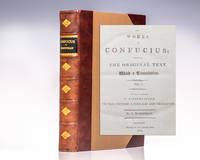
1724ref. 138719London: Printed for F. Fayram at the South Entrance into the Royal Exchange 1724. Rare third edition in English of The Morals of Confucius the first published work to introduce English readers to Confucianism. Small octavo bound in full period or period-style speckled calf with elaborate gilt tooling to the spine in six compartments within raised bands morocco spine label lettered in gilt elaborate gilt scrolling to the front and rear panels gilt turn-ins marbled endpapers all edges speckled red. Small bookplates to the pastedown. Stated second edition though actually the third edition a reissue of the edition of 1706 with a cancel title page. In very good condition. All early editions are very rare this in a particularly desirable binding. "Basically a translation of Le Morale de Confucius philosophe de la Chine" Savouret 1688 The Morals of Confucius was "translated and abridged from the Latin translation of Prospero Intorcetta Philippe Couplet and others or from an intervening French translation attributed to Louis Cousin or Jean de La Brune" ESTC T140229. Chinese philosopher Confucius’s principles had a commonality with earlier Chinese tradition with an emphasis on personal and governmental morality ancestral veneration respect for one’s elders and strong family loyalty. His teachings left a legacy of disciples and gained widespread prominence under the Han and Tang Dynasties became the official imperial philosophy of China after his death in 479 B.C.E. and remained the dominant philosophy in China until the early 20th century. Likely compiled and composed by his disciples after Confucius's death the Analects or Maxims grew to be one of the central texts of Confucianism by the end of the Han Dynasty. Printed for F. Fayram at the South Entrance into the Royal Exchange hardcover
1706ref. 107212London: T. Horne 1706. Rare second edition in English of The Morals of Confucius. Small octavo bound in full contemporary sheep contemporary sheep. In very good condition toning to the extremities. Basically a translation of Le Morale de Confucius philosophe de la Chine" Savouret 1688 The Morals of Confucius was "translated and abridged from the Latin translation of Prospero Intorcetta Philippe Couplet and others or from an intervening French translation attributed to Louis Cousin or Jean de La Brune" ESTC T140229. Chinese philosopher Confucius’s principles had a commonality with earlier Chinese tradition with an emphasis on personal and governmental morality ancestral veneration respect for one’s elders and strong family loyalty. His teachings left a legacy of disciples and gained widespread prominence under the Han and Tang Dynasties became the official imperial philosophy of China after his death in 479 B.C.E. and remained the dominant philosophy in China until the early 20th century. Likely compiled and composed by his disciples after Confucius's death the Analects or Maxims grew to be one of the central texts of Confucianism by the end of the Han Dynasty. T. Horne unknown
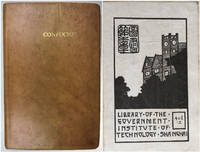
1898ref. ABE-1702118236014Shanghai: Kelly and Walsh 1898 1898 First edition. Octavo 24.515.6cm xii182pp. Contemporary full leather cover clean pages firm binding. Bookplate of The Library of the Government Institute of Technology Shanghai usual library markings and stamps. 1st Edition. Hardcover. Very Good/No Jacket. More photos available upon request. Shanghai: Kelly and Walsh, 1898 hardcover
1988ref. 3789NICE. EDITIONS D'ART SEFER. LE CHANT DES SPHERES. MONACO. EDITIONS ARTS ET COULEURS. 1988-1990. 2 VOLUMES IN-FOLIO DE 140 + (8) ET 134 + (8) PAGES, RELIURE DE L'EDITEUR PLEIN CHAGRIN NOIR, DIFFERENTE POUR CHACUN DES 2 VOLUMES (SEFER RELIEUR) :TOME I. DOS A NERFS ORNE D'UN DECOR A FROID ET EN DORE, TITRE DORE, PLATS BISEAUTES ORNES D'UN DECOR A FROID ET EN DORE, LETTRES CHINOISES METALLIQUES LAQUEES EN NOIR ET EN ROUGE AU CENTRE DU PLAT SUPERIEUR, DENTELLE INTERIEURE DOREE, TETE DOREE, NON ROGNE, SOUS EMBOITAGE 1/2 CHAGRIN NOIR (34 X 42,5 X 8,5 CENTIMETRES ENVIRON), DOS IDENTIQUE A CELUI DE L'OUVRAGE, LE RESTE RECOUVERT D'UNE SOIE MOIREE ROUGE. TOME II. DOS ORNE D'UN CAISSON EN CREUX AVEC DECOR FLORAL ET TITRE DORES, PLATS BISEAUTES, PLAT SUPERIEUR RICHEMENT ORNE D'UNE PAGODE EN RELIEF EN ROUGE ET EN DORE, AVEC INCRUSTATIONS DE PLAQUES EMAILLEES A DECOR POLYCHROME D'UNE PAGODE ET DE DRAGONS, TETE DOREE, NON ROGNE, SOUS EMBOITAGE 1/2 CHAGRIN NOIR (33,5 X 40 X 9,5 CENTIMETRES ENVIRON), DOS IDENTIQUE A CELUI DE L'OUVRAGE, LE RESTE RECOUVERT D'UNE SOIE MOIREE ROUGE.ILLUSTRE DE NOMBREUSES COMPOSITIONS IN ET HORS-TEXTE, DANS LE STYLE DE L'ENLUMINURE, MISES EN COULEURS A LA MAIN. PREMIER TIRAGE LIMITE A 1280 EXEMPLAIRES NUMEROTES, DONT 30 HORS-COMMERCE. UN DES 100 SUR VELIN D'ARCHES RESERVES AU CERCLE DES BIBLIOPHILES ARTS ET COULEURS NUMEROTES AC 1 A AC 100, CELUI-CI PORTANT LE NUMERO AC 10 DANS CHACUN DES VOLUMES, ET COMPORTANT 2 ILLUSTRATIONS ORIGINALES SIGNEES, UNE PLANCHE HORS-TEXTE, ENCADREE ET UNE SUITE EN COULEURS DES ILLUSTRATIONS HORS-TEXTE. ACCOMPAGNE DE SON CERTIFICAT D'AUTHENTICITE AU MEME NUMERO SIGNE PAR L'ARTISTE ET L'EDITEUR. LES ILLUSTRATIONS ORIGINALES ET LA SUITE SONT INSEREES DANS DEUX CHEMISES RECOUVERTES DE SUEDINE NOIRE AVEC LE PLAT SUPERIEUR ORNE D'IDEOGRAMMES CHINOIS DORES. INFIMES PETITS DEFAUTS EXTERIEURS SANS GRAVITE, SINON TRES BEL EXEMPLAIRE.
ref. 14666Nice, Le Chant des Sphères, Reliure d'Art Sefer, 1988-1989. 2 volumes in-folio, 140-(10) pp. et 134-(10) pp., plein cuir, noir pour le tome I, rouge pour le tome II avec le nom de l'auteur en caractères chinois en métal sur les premiers plats, encadrements des plats d'un quadruple filet en creux avec à l'intérieur de foisonnants motifs sinisants, dos lisse avec le nom de l'auteur encadré d'un motif doré (pagode), et de motifs poussés à froid (dragons, fleurs, oiseaux), tête dorée, contreplats en tissu moiré rouge et noir, étui du même tissu. (Parfait état)
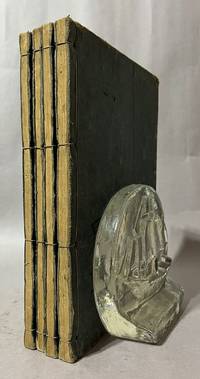
1800ref. 007240Japan 1800. Wraps. Very Good. Quarto. Japan Kyoto or Osaka late Edo period circa 1800-1835. Eight surviving fascicles from an original ten-volume woodblock edition in traditional fukuo-toji stab-sewn binding with original blue paper wrappers. Large format: approximately 11 x 7.5 inches 28 x 19 cm. A substantial and visually striking Japanese scholarly edition of the Analects of Confucius Rongo in Japanese; Lunyu in Chinese printed from finely cut woodblocks and issued in ten fascicles with the authoritative Neo-Confucian commentary of Zhu Xi 1130-1200 whose Collected Commentaries Shuchu/Jizhu formed the orthodox basis of Confucian education throughout Tokugawa Japan. The present survival comprises eight fascicles in four books from the original ten-volume set including volumes I II III V VI VII VIII and X with fascicles IV and IX lacking. Terminal leaves confirm the original structure through the imprint "End of Volume Ten." The edition was clearly intended for advanced scholastic use and is distinguished by extensive contemporary or near-contemporary red manuscript kundoku annotations throughout every page. These glosses written in kana and auxiliary notation supplied Japanese grammatical order and pronunciation for reading classical Chinese texts and constitute exceptionally rich evidence of actual Edo-period pedagogical practice. Printed in bold elegant Chinese characters within ruled borders on durable handmade washi paper the edition exhibits all the hallmarks of late Edo Confucian educational printing; right to left reading orientation fukuro-toji binding thick fibrous paper stock and systematic reading marks for Japanese students. The generous format is larger and more imposing than the small commercial school editions commonly encountered and suggests production for serious scholarly or academy use possibly in Kyoto or Osaka the principal centers of educational publishing during the late Tokugawa era. Although the publisher's colophon is not present the typography layout and manuscript annotation style strongly support a date circa 1800-1835. During the Edo period Neo-Cunfucian learning remained central to samurai and bureaucratic education. Condition: eight surviving fascicles from an original ten-volume set. Original blue paper wrappers lightly worn and rubbed with scattered edge wear. Thread bindings intact and sound. Internally remarkably well preserved overall with strong dark impressions and extensive red manuscript annotations throughout. Some light wear as expected from sustained scholarly use. An authentic and highly evocative survival of Tokugawa-period classroom culture. paperback
1988ref. 3444NICE. EDITIONS D'ART SEFER. LE CHANT DES SPHERES. MONACO. EDITIONS ARTS ET COULEURS. 1988-1990. 2 VOLUMES IN-FOLIO DE 140 + (8) ET 134 + (8) PAGES, DANS UNE MAGNIFIQUE RELIURE DE L'EDITEUR PLEIN CHAGRIN NOIR, DOS ORNE D'UN CAISSON EN CREUX AVEC DECOR FLORAL ET TITRE DORES, PLATS BISEAUTES, PLAT SUPERIEUR RICHEMENT ORNE D'UNE PAGODE EN RELIEF EN ROUGE ET EN DORE, AVEC INCRUSTATIONS DE PLAQUES EMAILLEES A DECOR POLYCHROME D'UNE PAGODE ET DE DRAGONS, TETE DOREE, NON ROGNES, SOUS EMBOITAGES 1/2 CHAGRIN NOIR (33,5 X 39,5 X 18,5 CENTIMETRES ENVIRON), DOS IDENTIQUES A CELUI DE L'OUVRAGE, LE RESTE RECOUVERT D'UNE SOIE MOIREE ROUGE (SEFER RELIEUR). ILLUSTRE DE NOMBREUSES COMPOSITIONS IN ET HORS-TEXTE, DANS LE STYLE DE L'ENLUMINURE, MISES EN COULEURS A LA MAIN. PREMIER TIRAGE LIMITE A 1280 EXEMPLAIRES NUMEROTES, DONT 30 HORS-COMMERCE. UN DES 150 SUR VELIN D'ARCHES COMPORTANT 2 ILLUSTRATIONS ORIGINALES SIGNEES, UNE PLANCHE HORS-TEXTE, ENCADREE ET UNE SUITE DU TRAIT EN LAQUE ROUGE DES ILLUSTRATIONS IN ET HORS-TEXTE, CELUI-CI PORTANT LE NUMERO 149 ET ACCOMPAGNE DE SON CERTIFICAT D'AUTHENTICITE AU MEME NUMERO SIGNE PAR L'ARTISTE ET L'EDITEUR. LES ILLUSTRATIONS ORIGINALES ET LA SUITE SONT INSEREES DANS UNE CHEMISE RECOUVERTE DE SUEDINE NOIRE AVEC LE PLAT SUPERIEUR ORNE D'IDEOGRAMMES CHINOIS DORES. INFIMES PETITS DEFAUTS EXTERIEURS SANS AUCUNE GRAVITE, SINON SUPERBE EXEMPLAIRE.
1785ref. 128821Paris: published by the author and M. Ponce c. 1785. A finely engraved tribute to the Master First edition one of an unstated number of large paper copies originally priced 18 livres and very much larger than the 12-livre quarto copies usually seen. "These hagiographic depictions show the sage as a semi-divine being chronicling significant events of his life and works from conception to death and later rituals in his honour" China on Paper. Helman 1743-1809 made the engravings illustrating the life of Confucius from a set of drawings sent from China to Paris by Jean-Joseph-Marie Amiot 1718-1793 the French Jesuit missionary. Amiot based his drawings on Zhang Kai's Shengji tu a famous Ming dynasty illustrated biography of Confucius. Large folio 416 x 283 mm. With 24 engraved plates 27 engraved text plates engraved title page. Contemporary green quarter calf spine lettered and decorated in gilt and in blind blue marbled paper sides vellum tips marbled endpapers. Light wear to extremities opening spread a little browned the occasional spot or light foxing elsewhere chiefly marginal final two engraved leaves a little loose at cords: a very good copy. China on Paper 21; Cordier 667; Lust 729. hardcover
1861ref. 5032Hong Kong : London Mission Society Press c1861 ; Shanghai : Shanghai Shangye Yingshuguan n.d. 1861. Hardcover. Very Good. 1 298 378 pp. ; bound in Chinese fashion with folded sheets right to left in a western-style mid-nineteenth century cloth board cover binding with decorations ; James Legge the famous Scottish sinologist and missionary of the London Missionary Society was born in Huntly Aberdeenshire Scotland on Dec 20th 1815. He graduated from Highbury Theological College in 1837 joined the London Missionary Society in 1838 and went to Malacca in 1839 as a missionary. In 1843 Legge arrived in Hong Kong and remained there until 1873 except for three short trips back to Scotland. In 1876 Legge became the first professor of Chinese at the University of Oxford and died in 1897 ; This is the first volume of Legge's monumental translation of nine sacred books of Chinese literature in a very probable 1st edition 1st Chinese printing with mixed asian and western binding materials and containing the texts of the da xue or Great Learning zhung yong Moderation or Doctrine of the Mean lung yü The Analects of Confucius and meng zi Mencius ; with Chinese text printed at top translation in the middle and commentary at bottom ; while this is clearly Legge's text the author's name is given in Chinese fashion as Gu Lu or loosely translated "Watchman Deer" which more probably and properly should be rendered "Lu Gu" for "Leg-ge" ; The difficulties of printing this first volume were recounted by the author's daughter: "The printing office being under his control he had to superintend the publication and binding of his works and to send to England for paper printing ink etc. Among his minor worries was the fact that the volumes of Classics had to come out in various bindings. Uniformity of binding could not be secured because materials were scanty in Hong Kong. Also owing to the lack of English booksellers he had to get the storekeepers to sell the Classics on commission among their other wares. On one occasion the ship containing all his printing paper and ink struck upon a rock and went down within sight of her anchorage in Hong Kong harbour. Her masts sticking up above the sea were visible from his verandah. 'It gave me quite a turn he said my first thought was that the fates were fighting against my getting oin with the publication of my volumes. I have since been able to look the event in the face. There must be some delay in the commencement of printing but I shall be so much more advanced with my manuscripts that we can start with five men instead of three. I had engaged Sow-lung and two other men to begin printing on the first of June. If he begins now in November or December with four other men we shall be in six months nearly as far as we should have been. In the meantime I telegraph by the mail--Replace invoice immediately sending one half by Suez Canal and one half round Cape--this will divide the risk.' After printing the books in Hong Kong he had to write to England for cases to be sent out in which to pack them and send them to England to his bookseller. 'Four hundred cases for one volume ought to be here any day and four hundred for the other volume next month. Those cases will cost me about fifty pounds.' .Another time certain cases of his books.arrived after having been for a long time under water in the hold. 'I insured them for £250--I shall claim for at least £80. Meantime the ruin of many books and the spoiling of others is a great vexation.' He sent several of his books to a friend to sell in Amoy and received the following letter: 'Alas for your Classics. Macgregor delivered them in the condition he got them out of the wreck. I had them put in the sun and thoroughly dried but I could not offer them to subscribers. The mould has got into the inside and even if rebound they will never be sightly. It is a sad loss.' ; after Legge's death in 1897 in a sermon given by Dr. Edkins at Shanghai Legge's work was described as: "His object was to unf [Hong Kong : London Mission Society Press, c1861] ; ??????? [Shanghai : Shanghai Shangye Yingshuguan, n.d. hardcover
1687ref. 123752Daniel Horthemels 1687 1687. leather_bound. Good. 9x7x2. Daniel Horthemels 1687 9" x 13" leather bound front board detached. Tiny bit of pencil to text. Light foxing. Illustrated. Text is in Latin. Please email for photos. Daniel Horthemels, 1687 hardcover
1687ref. 1691791687. CONFUCIUS. Confucius Sinarum Sive Scientia Sinensis Latine Exposita. cxxiv 108 160 xx 20 8 2 23-108 2 pp. Illustrated with engraved portrait of Confucius and a map of China engraved by François de Louvemont from a drawing by the Belgian missionary Philippe Couplet. Folio 335 x 225 mm bound in contemporary mottled calf spine gilt. Paris: Daniel Horthemels 1687. First western edition of the Latin Translation of Confucius's body of work a collective enterprise of a group of European Missionaries. With a dedication to Louis XIV preceded only by fragmentary translations. An early translation of Ta hsueh Chung yung and Lun yu three of the four Confucian texts chosen by the neo-Confucian philosopher Chu Hsi in 1190 to be included in the collection known as the SAshu 'Four Books'. The fourth book the works of Mencius and the reason for not printing it are discussed in a note printed on p. 159 at the end of book three. The translation was done under special license from Louis XIV by members of the Jesuit Society. In addition to the first three books of Confucius the work includes his biography valuable essays on Chinese history and culture and much factual information. Some text leaves toned overall a tall very good copy in a contemporary binding. Brunet II 2221. Cordier Sinica I 1389-1393. Lust 724. Morrison 438-439. Pei-tang 1358. Pfister 326-327. unknown
1687ref. 1691791687. CONFUCIUS. Confucius Sinarum Sive Scientia Sinensis Latine Exposita. cxxiv 108 160 xx 20 8 2 23-108 2 pp. Illustrated with engraved portrait of Confucius and a map of China engraved by François de Louvemont from a drawing by the Belgian missionary Philippe Couplet. Folio 335 x 225 mm bound in contemporary mottled calf spine gilt. Paris: Daniel Horthemels 1687. First western edition of the Latin Translation of Confucius's body of work a collective enterprise of a group of European Missionaries. With a dedication to Louis XIV preceded only by fragmentary translations. An early translation of Ta hsueh Chung yung and Lun yu three of the four Confucian texts chosen by the neo-Confucian philosopher Chu Hsi in 1190 to be included in the collection known as the SAshu 'Four Books'. The fourth book the works of Mencius and the reason for not printing it are discussed in a note printed on p. 159 at the end of book three. The translation was done under special license from Louis XIV by members of the Jesuit Society. In addition to the first three books of Confucius the work includes his biography valuable essays on Chinese history and culture and much factual information. Some text leaves toned overall a tall very good copy in a contemporary binding. Brunet II 2221. Cordier Sinica I 1389-1393. Lust 724. Morrison 438-439. Pei-tang 1358. Pfister 326-327. unknown books
1688ref. 135381Amsterdam: Pierre Savouret 1688. Rare first edition of The Morals of Confucius preceding the English translation regarded as the first work which introduced readers to Confucianism. Small octavo bound in half vellum over marbled boards. In near fine condition. An exceptional example scarce and desirable with only three examples appearing at auction in the last 90 years. "Basically a translation of Le Morale de Confucius philosophe de la Chine" Savouret 1688 The Morals of Confucius was "translated and abridged from the Latin translation of Prospero Intorcetta Philippe Couplet and others or from an intervening French translation attributed to Louis Cousin or Jean de La Brune" ESTC T140229. Chinese philosopher Confucius’s principles had a commonality with earlier Chinese tradition with an emphasis on personal and governmental morality ancestral veneration respect for one’s elders and strong family loyalty. His teachings left a legacy of disciples and gained widespread prominence under the Han and Tang Dynasties became the official imperial philosophy of China after his death in 479 B.C.E. and remained the dominant philosophy in China until the early 20th century. Likely compiled and composed by his disciples after Confucius's death the Analects or Maxims grew to be one of the central texts of Confucianism by the end of the Han Dynasty. Pierre Savouret hardcover
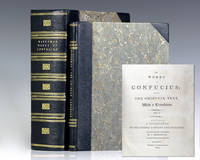
1809ref. 149588Serampore: Printed at the Mission Press 1809. First English translation of the Analects of Confucius printed at Serampore the first major center of English printing in Chinese. Quarto Vol. I all published bound in modern half calf gilt-lettered morocco spine label gilt stamping to the spine in six compartments within raised gilt bands half-title 4pp. errata Chinese and English text without the 'Dissertation on the Chinese Language and Character' and its four tables and the 17pp. postscript. In very good condition. A very nice example. The first English translation of the Analects Lunyu of Confucius Baptist missionary Marshman's translation contains the first five of twenty books and was printed at Serampore the first major center of English printing in Chinese. The first complete translation by James Legge was published decades later in 1861. A collection of sayings attributed to Confucius the Analects were likely compiled posthumously by his followers. The Analects' reputation grew to surpass that of the Five Classics and became one of the texts underpinning the Confucian system which held sway over China for two millennia. Joshua Marshman William Carey and William Ward established a Baptist mission and press at Danish-controlled Serampore in 1800 beyond the control of the East India Company. The Company discouraged missionary activity and maintained a policy of press censorship within its territories. Marshman and his fellow missionaries had ambitious plans for proselytizing across Asia and he had studied Arabic Greek Hebrew Latin and Syriac before he even reached India. In India he first learned Bangali and Sanskrit. Next he turned to Chinese which he studied intensively under the guidance of Johannes Lassar scion of a wealthy Armenian trading family in Macao and assisted by several Chinese tutors. This book dates from the first phase of Chinese language printing in Serampore with Chinese character printed using woodblock characters carved by Bengali textile workers whose carved woodblocks were employed to print patterns onto calico. The second phase would only being in 1813 when moveable metal type replaced woodblocks which enormously increased efficiently as it permitted many more impressions. The Chinese publications for the Mission Press were principally evangelical; Lassar and Marshman translated large sections of the Old and New Testaments into Chinese and saw Serampore as an ideal position from which to spread the Chinese gospel free from imperial Chinese censorship. The East India Company too was increasingly interested in the study of Chinese for political reasons. Their Indian territories abutted the Chinese forts in Tibet and the memory of Macartney's diplomatic failure in 1792 remained fresh. Another diplomatic mission would require translators and the Company had no competent Chinese interpreters in India at the turn of the century. Marshman dedicated this work toe the Governor-General of Bengal Lord Minto who subsidized the cost of printing in Chinese at Serampore despite his personal hostility to missionary activity with British India. Printed at the Mission Press unknown
ref. 46947Paris : Daniel Horthemels 1687. First edition. Folio contemporary speckled calf rebacked preserving the original spine in compartments with raised bands gilt ornamentation and lettering book labels for Levenside and H.P. Kraus to front pastedown front free endpaper detached pp. cxxiv; 108; 21; iii - blanks; 159; blank; xx; 108; 8; I - privilege blank copperplate map of China folding portrait of Confucius the first published in Europe engraved headpiece woodcut headpieces tail pieces and ornamental initials a fine copy. The first edition of Confucius published in Europe preceded only by fragmentary translations. Edited by Prospero Intorcetta 1626-1696 Chrétien Herdtrich 1625-1684 François de Rougemont 1624-1676 and Philippe Couplet 1623-1692 the translation was undertaken under special license from Louis XIV by members of the Jesuit Society. In addition to a translation of the three principal books of Confucius the work includes his biography valuable essays on Chinese history and culture and much other factual information on China. Brunet II 2221; Cordier Sinica I 1389-1393; Lust 724; Morrison 438-439; Pei-tang 1358; Pfister 326-327. hardcover
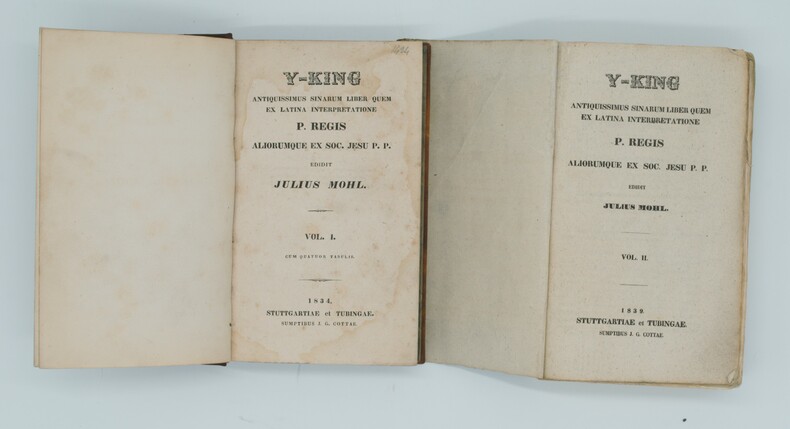
1834ref. PHO-1520Stuttgart & Tubingue, Cotta, 1834-1839. 2 volumes in-8 de [1] f., xvi-474-[1] pp., 4 planches dépliantes ; [1] f., 588 pp. Premier tome relié en demi-basane brune, dos lisse, titre doré, date en queue (reliure moderne) et second tome broché, couverture d’attente, inscriptions manuscrites sur la couverture ("à Monsieur M. Barucchi - Directeur du Musée égyptien, professeur d'histoire à l'Université de Turin), dos usé avec qqs fentes. Les deux volumes réunis dans un emboîtage toilé bleu moderne. Très légères mouillures claires par endroits.
1809ref. 131224Serampore: Printed at the Mission Press 1809. First English translation of the Analects of Confucius complete with the rare Dissertation on the Chinese Language and Character here bound in a separate volume. Quarto two volumes bound in three quarter morocco over marbled boards with gilt titles and tooling to the spine in six compartments within raised gilt bands illustrated with 2 folding charts on Chinese characters 4 further tables on 2 folding leaves postscript at rear. In fine condition. Exceptionally rare particularly with Marshman's separately printed dissertation present including the tables and charts. The first English translation of the Analects Lunyu of Confucius Baptist missionary Joshua Marshman's translation contains the first five of a projected series of twenty books and was printed at Serampore the first major center of English printing in Chinese. The first complete translation by James Legge was published decades later in 1861. A collection of sayings attributed to Confucius the Analects was one of the primary texts underpinning the Confucian system which held sway over China for two millennia. Confucius believed that the welfare of a country depended on the moral cultivation of its people beginning from the nation's leadership and taught that a ruler's sense of virtue was his primary prerequisite for leadership. His primary goal in educating his students was to produce ethically well-cultivated men who would carry themselves with gravity speak correctly and demonstrate consummate integrity in all things. Joshua Marshman William Carey and William Ward established a Baptist mission and press at Danish-controlled Serampore in 1800 beyond the control of the East India Company. The Company discouraged missionary activity and maintained a policy of press censorship within its territories. Marshman and his fellow missionaries had ambitious plans for proselytizing across Asia and he had studied Arabic Greek Hebrew Latin and Syriac before he even reached India. In India he first learned Bangali and Sanskrit. Next he turned to Chinese which he studied intensively under the guidance of Johannes Lassar scion of a wealthy Armenian trading family in Macao and assisted by several Chinese tutors. This book dates from the first phase of Chinese language printing in Serampore with Chinese characters printed using woodblocks carved by Bengali textile workers employed to print patterns onto calico. The Chinese publications for the Mission Press were principally evangelical; Lassar and Marshman translated large sections of the Old and New Testaments into Chinese and saw Serampore as an ideal position from which to spread the Chinese gospel free from imperial Chinese censorship. The East India Company too was increasingly interested in the study of Chinese for political reasons. Their Indian territories abutted the Chinese forts in Tibet and the memory of Macartney's diplomatic failure in 1792 remained fresh. Another diplomatic mission would require translators and the Company had no competent Chinese interpreters in India at the turn of the century. Marshman dedicated this work to the Governor-General of Bengal Lord Minto who subsidized the cost of printing in Chinese at Serampore despite his personal hostility to missionary activity with British India. Printed at the Mission Press hardcover