1976Best.-Nr. 2056003Indiana University Press 1976. Hardcover. Very Good. 8vo. Green cloth unjacketed. Seven volumes. Some rubbing and scuffing to cloth. Light bumping and edge wear to boards. A few faint damp-stains to fore-edges of text blocks presumably from coffee particularly that of volume 6 which is also stained at tail; texts themselves unaffected. Else fine. A very nice set with crisp clean internals. Indiana University Press hardcover
Best.-Nr. 3404200-6Princeton University Press. Used - Good. Former library copy. Pages intact with minimal writing/highlighting. The binding may be loose and creased. Dust jackets/supplements are not included. Includes library markings. Stock photo provided. Product includes identifying sticker. Better World Books: Buy Books. Do Good. Princeton University Press unknown
2016Best.-Nr. C202554Princeton University Press 2016. Hardcover Hardcover. Fine. Small octavo. xxxv 90pp. Original black cloth with silver spine titles. Fine and unread in fine dust jacket. Princeton University Press hardcover
Best.-Nr. 36950437like new. unknown
Best.-Nr. 5837855like new. unknown
Best.-Nr. 400586like new. unknown
Best.-Nr. 37883584-nnew. unknown
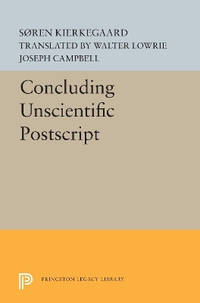
Best.-Nr. A9780691622330Paperback / softback. New. Contents include: Foreword Editor's Preface Introduction by the Editor Preface Introduction BOOK ONE: The Objective Problem Concerning the Truth of Christianity Introductory Remarks Chapter I: The Historical Point of View 1. The Holy Scriptures 2. The Church 3. The Proof of the Centuries for the Truth of Christianity Chapter II: The Speculative Point of View BOOK TWO: The Subjective Problem The Relation of the Subject to the Truth of Christianity The Problem of Becoming a Christian PART ONE: Something About Lessing Chapter I: An Expression of Gratitude Chapter II: Theses Possibly or Actually Attributable to Lessing 1. The subjective existing thinker has regard to the dialectics of the process of communication 2. The existing subjective thinker is in his existential relation to the truth as negative as he is positive; he has a much humor as he has essential pathos; and he is constantly in process of becoming i.e. he is always striving 3. Lessing has said that accidental historical truths can never serve as proofs for eternal truths of the reason; and that the transition by which it is proposed to base an eternal truth upon historical testimony is a leap 4. Lessing has said that if God held all truth in His right hand and in His left the lifelong pursuit of it he would choose the left hand A. A logical system is possible B. An existential system is possible PART TWO: How the Subjectivity of the Individual Must be Qualified in Order that the Problem May Exist for Him Chapter I: The Task of Becoming Subjective. The conclusion that would be forced upon ethics if the attainment of subjectivity were not the highest task confronting a human being-Considerations left out of account in connection with the closer understanding of this-Examples of thinking directed towards becoming subjective Chapter II: The Subjective Truth Inwardness; Truth is Subjectivity Appendix. A Glance at the Contemporary Effort in Danish Literature Chapter III: Real or Ethical Subjectivity-The Subjective Thinker 1. Existence and Reality 2. Possibility as higher than Reality-Reality as higher than Possibility-Poetic and Intellectual Ideality-Ethical Ideality 3. The Simultaneity of the Individual Factors of Subjectivity in the Existing Subject-The Constrast between this Simultaneity and the Speculative Process 4. The Subjective Thinker-his Task his Form his Style Chapter IV: The Problem of the Fragments: How can an Eternal Happiness be based upon Historical Knowledge Section I. For Orientation in the Plan of the Fragments 1. That the point of departure was taken in the pagan consciousness and why 2. The importance of a preliminary agreement concerning what Christianity is before there can be any question of mediating between Christianity and speculative thought. The absence of such an agreement favors the proposal of medication while at the same time making any mediation illusory; the presence of such an agreement precludes mediation 3. The problem of the Fragments viewed as a problem introductory not to Christianity but to becoming a Christian Section II. The Problem Itself. The eternal happiness of the individual is decided in time through the relationship to something historical which is furthermore of such a character as to oinclude in its composition that which by virtue of its essence cannot become historical and must therefore become such by virtue of the absurd A. Existential Pathos 1. The Initial Expression for Existential Pathos: the absolute direction respect toward the absolute telos expressed in action through the transformation of the individual's existence Aesthetic Pathos-The deceptiveness of the principle of mediation-The medieval monastic movement-The simultaneous maintenance of an absolute relationship to the absolute telos and a relative relationship to the relative ends 2. The Essential Expression for Existential pathos: Suffering-Fortune and misforutne as the expression for an aesthetic view of life in constradistinction to suffering as the expression of a religious view illustrated by reference to the religious discourse-The Reality of suffering humor-The reality of suffering in the last instance as evidence for the possession by the existing individual of a relationship to an eternal happiness-The illusion of religiosity-The category of Anfechtung-The primary ground and significance of the religious suffering: The dying away from the life of immediacy while still remaining in the finite-An edifying divertisement-Humor as an incognito for religiosity 3. The Decisive Expression for existential pathos: Guilt-That the investigation goes backward instead of forward-The eternal recollection of guilt is the highest expression for the relation between the consciousness of guilt and an eternal happiness-Lower expressions for the consciousness of guilt and corresponding forms of satisfaction-Self-imposted penance-Humor-The religiosity of hidden inwardness Intermediate Clause between A and B B. The Dilectical 1. The dialectical contradiction which constitutes the breach: to expect an eternal happiness in time through a relationship to something else in time 2. The dialectical constradiction that an eternal happiness is based upon something historical 3. The dialectical contradiction that the historical fact here in question is not a simple historical fact but is constituted by that which only against its nature can become historical hence by virtue of the absurd Appendix to B. The retroactive effect of the dialectical upon the pathetic and the factor simultaneously present in the pathos a The consciousness of sin b The possibililty of offense c The smart of sympathy Chapter V. Conclusion. About Childish Christianity Appendix. For an Understanding with the Reader First and Last Declaration Notes Index Originally published in 1941. The Princeton Legacy Library uses the latest print-on-demand technology to again make available previously out-of-print books from the distinguished backlist of Princeton University Press. These editions preserve the original texts of these important books while presenting them in durable paperback and hardcover editions. The goal of the Princeton Legacy Library is to vastly increase access to the rich scholarly heritage found in the thousands of books published by Princeton University Press since its founding in 1905. paperback
Best.-Nr. 0691048274.Ghardcover. Good. Access codes and supplements are not guaranteed with used items. May be an ex-library book. hardcover
Best.-Nr. 6486888-6Princeton University Press. Used - Good. Former library copy. Pages intact with minimal writing/highlighting. The binding may be loose and creased. Dust jackets/supplements are not included. Includes library markings. Stock photo provided. Product includes identifying sticker. Better World Books: Buy Books. Do Good. Princeton University Press unknown
Best.-Nr. 4782111-6Indiana University Press. Used - Good. Former library copy. Pages intact with minimal writing/highlighting. The binding may be loose and creased. Dust jackets/supplements are not included. Includes library markings. Stock photo provided. Product includes identifying sticker. Better World Books: Buy Books. Do Good. Indiana University Press unknown
Best.-Nr. 7779251-6Indiana University Press. Used - Good. Former library copy. Pages intact with minimal writing/highlighting. The binding may be loose and creased. Dust jackets/supplements are not included. Includes library markings. Stock photo provided. Product includes identifying sticker. Better World Books: Buy Books. Do Good. Indiana University Press unknown
1992Best.-Nr. DADAX0691020825Princeton University Press 1992-06-15. First Edition. paperback. New. 5.50x1.00x8.50. Buy with confidence. Excellent Customer Service & Return policy. Princeton University Press paperback
Best.-Nr. DADAX0691140839New unknown
2000Best.-Nr. SONG0691033099Princeton University Press 2000-05-30. First Edition First Printing. hardcover. Used: Good. 6.00x1.00x9.25. Buy with confidence. Excellent Customer Service & Return policy. Princeton University Press hardcover
1939Best.-Nr. C103688Oxford: Oxford University Press 1939. First Edition. Hardback. Dust Jacket. Hardcover Hardcover. Good. First Edition. Hardback. Dust Jacket. First English language edition. 8vo. 5 vi-xviii 2 3-389 1 pp. Original black buckram cloth with gilt lettering on the spine; light blue topstain. Translated with an introduction by Walter Lowrie. A complex treatise on Christian theology and relevant philosophical concepts. The first English language edition from 1939. Drab dust jacket printed in blue. Bright and crisp buckram boards; dust jacket a bit rubbed and marked with a small chip to the top left corner of the front cover; spine a little browned. A very good indeed copy in slightly used else near very good d/w. No inscriptions not price-clipped. Oxford University Press, hardcover
Best.-Nr. DADAX0691160295Princeton University Press 2014-10-05. Illustrated. hardcover. New. 8.25x2.25x10.50. Buy with confidence. Excellent Customer Service & Return policy. Princeton University Press hardcover
Best.-Nr. 0691033099.Ghardcover. Good. Access codes and supplements are not guaranteed with used items. May be an ex-library book. hardcover
Best.-Nr. 8481644412.Gpaperback. Good. Access codes and supplements are not guaranteed with used items. May be an ex-library book. paperback
1944Best.-Nr. 200915Princeton: Princeton University Press 1944. First Edition. Hardcover. Very Good/Very Good. Influential theological work by the Danish philosopher. Princeton University Press hardcover
Best.-Nr. 0486427137.Gpaperback. Good. Access codes and supplements are not guaranteed with used items. May be an ex-library book. paperback
Best.-Nr. 025320111X.Gpaperback. Good. Access codes and supplements are not guaranteed with used items. May be an ex-library book. paperback
Best.-Nr. 0691072477.Ghardcover. Good. Access codes and supplements are not guaranteed with used items. May be an ex-library book. hardcover
Best.-Nr. 6819879Princeton University Press . Papeback. New. pp. 808 Princeton University Press unknown
2009Best.-Nr. DADAX0691140782Princeton University Press 2009-10-11. paperback. New. 5.50x1.50x8.75. Buy with confidence. Excellent Customer Service & Return policy. Princeton University Press paperback