Kierkegaard, SA¸renBiblio.com

2.409 Ergebnisse
Best.-Nr. 3404200-6Princeton University Press. Used - Good. Former library copy. Pages intact with minimal writing/highlighting. The binding may be loose and creased. Dust jackets/supplements are not included. Includes library markings. Stock photo provided. Product includes identifying sticker. Better World Books: Buy Books. Do Good. Princeton University Press unknown
2016Best.-Nr. C202554Princeton University Press 2016. Hardcover Hardcover. Fine. Small octavo. xxxv 90pp. Original black cloth with silver spine titles. Fine and unread in fine dust jacket. Princeton University Press hardcover
1844Best.-Nr. 62093Kjøbenhavn C.A. Reitzel 1844. 8vo. A splendid copy in contemporary full cloth with blindstamped decorations to boards and gothic gilt lettering to spine. Light damp stains to back board and a bit of wear to capitals. Internally unusually nice and clean. 110 1 pp. With an inscription for Josephine Bidoulac later married to Welhaven from Emil Wedel to front fly-leaf. Pencil annotations by Jonas Skovgaard to front free end-paper. The uncommon first edition in a lovely copy of Kierkegaard's most humorous work. Published simultaneously with The Concept of Anxiety Prefaces can be viewed as its companion piece. It represents an altogether different genre but the two fictional authors of the works interestingly contrast each other. Although having been eclipsed by the now notoriously famous Concept of Anxiety Prefaces was in fact more popular when it appeared and sold many more copies. Written under the pseudonym of Nicolaus Notabene the “author” name indicates that despite its humorous approach Prefaces is still something serious – something to be noted. And it certainly is. It is here that we find Kierkegaard’s sarcastic roasting of the Hegelian system and of the Danish Hegelians with Johan Ludvig Heiberg as the main representant. Through Notabene he makes fun of Heiberg and Hegel who both want to explain everything and want to be mediators of understanding. Just as Hafniensis in The Concept on Anxiety poses that “how sin came into the world each man understands solely by himself. If he would learn it from another he would misunderstand it” p. 51 so Notabene in Prefaces states that “My frame my health my entire constitution do not lend themselves to mediation” p. 45. In Prefaces we also find Kierkegaard’s thoughts about the relationship between the reading public and the author and his fierce criticism of literary critics and reviewers. And in the very amusing preface to the Prefaces we are given another glimpse into Kierkegaard’s thoughts on marriage and the dilemma he found himself in with Regine – the inner struggle between he who is the husband and he who is the author; can one be both With its challenging notions on the idea of the book and the interaction of the book with its readers his little ironic masterpiece is a clear forerunner of Postmodernism Himmelstrup 7. hardcover
1843Best.-Nr. 62092Kjøbenhavn 1843. 8vo. Contemporary dark brown half cloth with gilt lettering to spine. Capitals and a bit of the front hinge worn but overall very nice and tight. Internally a bit of brownspotting as always due to the quality of the paper but less than usual. Old owner's signature to title-page. VIII 135 pp. First edition of one of Kierkegaard's most important and sought-after works Fear and Trembling which is rather more difficult to find than most of his other works. Fear and Trembling is one of Kierkegaard’s most important works. And it is also one of his most difficult. It deals – in forceful brevity – with the relationship between reason and faith and provides us with Kierkegaard’s most thorough exposition of the religious stage which he considered the most meaningful form of existence. It is here that Kierkegaard introduces the “tragic hero” and contrasts it to the “Knight of Faith” who both ignore their own wishes for a higher good. These two essential figures epitomize the ethical and the religious and pave the way for the understanding of these stages in Kierkegaard’s philosophy. It is arguably also here that the idea of the essential leap of faith is introduced for the first time. The Knight of Faith sacrifices his son at the command of God and thus sets aside an ethical demand in in order to attain a higher goal that exists beyond the ethical. This teleological suspension of the ethical requires a leap of faith that is only possible through faith in virtue of the absurd. Himmelstrup 48. hardcover
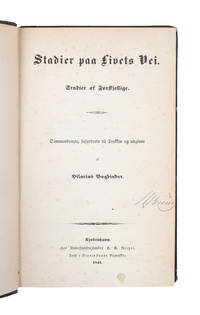
1845Best.-Nr. 62096Kjøbenhavn Copenhagen 1845. Lex8vo. Nice contemporary brown half cloth with gilt title to spine. Capitals worn and wear along upper front hinge. Corners worn. In spite of the wear an attractive and tight copy. First and last leaves with a bit of brownspotting otherwise only light occasional spotting. Old owner's signature to title-page. VIII 383 pp. First edition of one of Kierkegaard's main works "Stages on Life's Way" his pivotal sequal to his main work "Either-Or" in which he had presented the first two stages the aesthetic and the ethical. In "Stages on Life's Way" he continues his work on these stages and moves on to present also the religious stage which takes up ab. two thirds of the work. The religious stage is that in which man attains a personal relationship with God and that in which man only truly begins to exist as the aesthetic and ethical stages are inadequate. It is in this foundational work in the religious stage that Kierkegaard first properly describes what is now known as the "Leap of Faith" in fact a "leap to faith" namely the leap that involves willing and belief in stead of reason and knowledge the leap that you make in order to connect to God and which requires that which he calls "the suspension of the ethical". Stages on Life’s Way is one of Kierkegaard’s most important works. Not only does it sum up and explain some of the most important themes of Kierkegaard’s previous works utilizing the characters and pseudonymous authors of the earlier works to do so; it goes beyond these foundational themes introduces the religious stage and points to the further development of the central themes in Kierkegaard’s philosophy most of which are only fully developed in Concluding Unscientific Postscript. hardcover
Best.-Nr. 36950437like new. unknown
Best.-Nr. 5837855like new. unknown
Best.-Nr. 400732like new. unknown
Best.-Nr. 37883584like new. unknown
Best.-Nr. 400586like new. unknown
Best.-Nr. 37883584-nnew. unknown
Best.-Nr. 31943332like new. unknown
1841Best.-Nr. 61204Kjøbenhavn P.G. Philipsen 1841. 8vo. Elegant later ca. 1920 brown half calf with four raised bands and gilt morocco title-label to gilt spine. With Paul Rubow's ownership signature to front free end-paper. Clean and fresh both in- and externally with no signs of wear to the exterior and only faint brown spots to a few pages. 4 350 pp. First edition of Kierkegaard's dissertation as it appeared in the normal trade without the preliminary Theses which were intended for academics attending the defence. Kierkegaard’s dissertation constitutes the culmination of three years’ intensive studies of Socrates and “the true point of departure for Kierkegaard’s authorship” Brandes. The work is of the utmost importance in Kierkegaard’s production not only as his first academic treatise but also because he here introduces several themes that will be addressed in his later works. Among these we find the question of defining the subject of cognition and self-knowledge of the subject. The maxim of “know thyself” will be a constant throughout his oeuvre as is the theory of knowledge acquisition that he deals with here. The dissertation is also noteworthy in referencing many of Hegel’s theses in a not negative context something that Kierkegaard himself would later note with disappointment and characterize as an early uncritical use of Hegel. Another noteworthy feature is the fact that the thesis is written in Danish which was unheard of at the time. Kierkegaard felt that Danish was a more suitable language for the thesis and had to petition the King in order to gain permission to submit it in Danish rather than Latin. This in itself contains as certain irony as the young Kierkegaard was known to express himself poorly and very long-winded in written Danish. Both stylistically and thematically Kierkegaard’s dissertation is a seedbed of his subsequent work and especially a clear precursor for his magnum opus Either-Or that is to be his next publication. The year 1841 is a momentous one in Kierkegaard’s life. It is the year that he completes his dissertation and commences his sojourn in Berlin but it is also the defining year in his personal life namely the year that he breaks off his engagement with Regine Olsen. And finally it is the year that he begins writing Either-Or In many ways Either-Or is born directly out of “The Concept of Irony” and is the work that brings the theory of Irony to life. Part One of the dissertation concentrates on Socrates as interpreted by Xenophon Plato and Aristophanes with a word on Hegel and Hegelian categories. Part Two is a more synoptic discussion of the concept of irony in Kierkegaard’s categories with examples from other philosophers. The work constitutes Kierkegaard’s attempt at understanding the role of irony in disrupting society and with Socrates understood through Kierkegaard we witness a whole new way of interpreting the world open before us. Wisdom is not necessarily fixed and we ought to use Socratic ignorance to approach the world without the inherited bias of our cultures. Kierkegaard's dissertation appeared in two states – one with the four pages of “Theses” for academics of the university whereas the copies without the theses were intended for ordinary sale. These sales copies also do not have “Udgivet for Magistergraden” and “theologisk Candidat” on the title-page. Himmelstrup 8. hardcover
Best.-Nr. DADAX0415894131New unknown
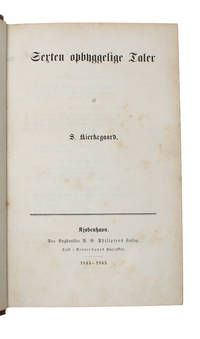
1843Best.-Nr. 61020Kjøbenhavn P.G. Philipsens Forlag 1843 - 45. 8vo. Nice contemporary half calf with gilding to spine. Slight wear to capitals and corners and spine a little spotted. Overall very nice. Some leaves with brownspotting but also internally nicer and fresher than usual. Contemporary owner's inscription to front free end-paper dated 1854. A very nice copy. 4 62; 84; 59 including the blank leaf between the title-page and the preface; 70 2 - i.e. 1 blank f.; 111 pp. Very rare first edition of this Kierkegaard-title which is without doubt the most difficult to get hold of. "Sixteen Upbuilding Discourses" consists of the popular Two Three and Four Upbuilding Discourses. The unsold copies of these "Opbyggelige Taler" "Upbuilding Discourses" were initially collected under the title "Atten opbyggelige Taler" Eighteen Upbuilding Discourses and published with a collected title-page; when "To opbyggelige Taler" "Two Upbuilding Discourses" from 1843 was sold out the remaining sixteen upbuilding discourses were published with the title-page "Sexten opbyggelige Taler". The number of copies of this scarce title is said to be well under 100 and is thus by far the rarest of all of Kierkegaard's books. unknown
Best.-Nr. A9780691622330Paperback / softback. New. Contents include: Foreword Editor's Preface Introduction by the Editor Preface Introduction BOOK ONE: The Objective Problem Concerning the Truth of Christianity Introductory Remarks Chapter I: The Historical Point of View 1. The Holy Scriptures 2. The Church 3. The Proof of the Centuries for the Truth of Christianity Chapter II: The Speculative Point of View BOOK TWO: The Subjective Problem The Relation of the Subject to the Truth of Christianity The Problem of Becoming a Christian PART ONE: Something About Lessing Chapter I: An Expression of Gratitude Chapter II: Theses Possibly or Actually Attributable to Lessing 1. The subjective existing thinker has regard to the dialectics of the process of communication 2. The existing subjective thinker is in his existential relation to the truth as negative as he is positive; he has a much humor as he has essential pathos; and he is constantly in process of becoming i.e. he is always striving 3. Lessing has said that accidental historical truths can never serve as proofs for eternal truths of the reason; and that the transition by which it is proposed to base an eternal truth upon historical testimony is a leap 4. Lessing has said that if God held all truth in His right hand and in His left the lifelong pursuit of it he would choose the left hand A. A logical system is possible B. An existential system is possible PART TWO: How the Subjectivity of the Individual Must be Qualified in Order that the Problem May Exist for Him Chapter I: The Task of Becoming Subjective. The conclusion that would be forced upon ethics if the attainment of subjectivity were not the highest task confronting a human being-Considerations left out of account in connection with the closer understanding of this-Examples of thinking directed towards becoming subjective Chapter II: The Subjective Truth Inwardness; Truth is Subjectivity Appendix. A Glance at the Contemporary Effort in Danish Literature Chapter III: Real or Ethical Subjectivity-The Subjective Thinker 1. Existence and Reality 2. Possibility as higher than Reality-Reality as higher than Possibility-Poetic and Intellectual Ideality-Ethical Ideality 3. The Simultaneity of the Individual Factors of Subjectivity in the Existing Subject-The Constrast between this Simultaneity and the Speculative Process 4. The Subjective Thinker-his Task his Form his Style Chapter IV: The Problem of the Fragments: How can an Eternal Happiness be based upon Historical Knowledge Section I. For Orientation in the Plan of the Fragments 1. That the point of departure was taken in the pagan consciousness and why 2. The importance of a preliminary agreement concerning what Christianity is before there can be any question of mediating between Christianity and speculative thought. The absence of such an agreement favors the proposal of medication while at the same time making any mediation illusory; the presence of such an agreement precludes mediation 3. The problem of the Fragments viewed as a problem introductory not to Christianity but to becoming a Christian Section II. The Problem Itself. The eternal happiness of the individual is decided in time through the relationship to something historical which is furthermore of such a character as to oinclude in its composition that which by virtue of its essence cannot become historical and must therefore become such by virtue of the absurd A. Existential Pathos 1. The Initial Expression for Existential Pathos: the absolute direction respect toward the absolute telos expressed in action through the transformation of the individual's existence Aesthetic Pathos-The deceptiveness of the principle of mediation-The medieval monastic movement-The simultaneous maintenance of an absolute relationship to the absolute telos and a relative relationship to the relative ends 2. The Essential Expression for Existential pathos: Suffering-Fortune and misforutne as the expression for an aesthetic view of life in constradistinction to suffering as the expression of a religious view illustrated by reference to the religious discourse-The Reality of suffering humor-The reality of suffering in the last instance as evidence for the possession by the existing individual of a relationship to an eternal happiness-The illusion of religiosity-The category of Anfechtung-The primary ground and significance of the religious suffering: The dying away from the life of immediacy while still remaining in the finite-An edifying divertisement-Humor as an incognito for religiosity 3. The Decisive Expression for existential pathos: Guilt-That the investigation goes backward instead of forward-The eternal recollection of guilt is the highest expression for the relation between the consciousness of guilt and an eternal happiness-Lower expressions for the consciousness of guilt and corresponding forms of satisfaction-Self-imposted penance-Humor-The religiosity of hidden inwardness Intermediate Clause between A and B B. The Dilectical 1. The dialectical contradiction which constitutes the breach: to expect an eternal happiness in time through a relationship to something else in time 2. The dialectical constradiction that an eternal happiness is based upon something historical 3. The dialectical contradiction that the historical fact here in question is not a simple historical fact but is constituted by that which only against its nature can become historical hence by virtue of the absurd Appendix to B. The retroactive effect of the dialectical upon the pathetic and the factor simultaneously present in the pathos a The consciousness of sin b The possibililty of offense c The smart of sympathy Chapter V. Conclusion. About Childish Christianity Appendix. For an Understanding with the Reader First and Last Declaration Notes Index Originally published in 1941. The Princeton Legacy Library uses the latest print-on-demand technology to again make available previously out-of-print books from the distinguished backlist of Princeton University Press. These editions preserve the original texts of these important books while presenting them in durable paperback and hardcover editions. The goal of the Princeton Legacy Library is to vastly increase access to the rich scholarly heritage found in the thousands of books published by Princeton University Press since its founding in 1905. paperback
Best.-Nr. DADAX036713828XNew unknown
Best.-Nr. DADAX0367204126New unknown
1946Best.-Nr. mon0000072884Cumberlege / Oxford 1946-01-01. Hardcover. Good. in x in x in. Ex-library book usual markings. Hardback. Clean text sound binding. Cumberlege / Oxford hardcover
Best.-Nr. 0691048274.Ghardcover. Good. Access codes and supplements are not guaranteed with used items. May be an ex-library book. hardcover
Best.-Nr. 6486888-6Princeton University Press. Used - Good. Former library copy. Pages intact with minimal writing/highlighting. The binding may be loose and creased. Dust jackets/supplements are not included. Includes library markings. Stock photo provided. Product includes identifying sticker. Better World Books: Buy Books. Do Good. Princeton University Press unknown
1983Best.-Nr. 835191983. Princeton University Press Princeton. 1983. DW. xxxix 421 pages. Sl. wear to extremities of wrapper. Corners sl. bumped. unknown
Best.-Nr. 4782111-6Indiana University Press. Used - Good. Former library copy. Pages intact with minimal writing/highlighting. The binding may be loose and creased. Dust jackets/supplements are not included. Includes library markings. Stock photo provided. Product includes identifying sticker. Better World Books: Buy Books. Do Good. Indiana University Press unknown
Best.-Nr. 7779251-6Indiana University Press. Used - Good. Former library copy. Pages intact with minimal writing/highlighting. The binding may be loose and creased. Dust jackets/supplements are not included. Includes library markings. Stock photo provided. Product includes identifying sticker. Better World Books: Buy Books. Do Good. Indiana University Press unknown
1920Best.-Nr. 57053Kjøbenhavn Gyldendalske Boghandel Nordisk Forlag 1920-1936. 8vo. Alle bind ubeskåret og i original blå kartonnage med de originale bogtrykte rygetiketter. Enkelte bind med lidt slitage ved kapitæler false og titeletiketter samt lettere brunplettede rygge men overvejende i særdeles god stand. Tidligere ejers navnetræk på forsatsbladene. Et enkelt bind med indstregninger og noter i marginen ellers helt ren og frisk. The second edition of Kierkegaard's collected works uncut in the original blue boards with the original title labels. hardcover