Pizzuti Giuseppe MarioMareMagnum
Régis JolivetLivre Rare Book
INTRODUCTION A KIERKEGAARD
réf. PHI101M1945 / 251 pages. Broché. Editions de Fontenelle. Portrait en Frontispice de Kierkegaard.

Librairie du Levant · Bayonne, France18,00 €
2 323 résultats
1995pp. 253, cm 17x11, bross.
réf. 26647Saint-Wandrille, Editions de Fontenelle, 1946, in 8° broché, XVII-253 pages ; cachets ; portrait en frontispice.
réf. 10190Abbaye S Wandrille. Fontenelle. 1946. Grand in-8 (22x14). XVIII-251 pages. Broché.
réf. 8472Editions de Fontenelle 1946
réf. PHI101M1945 / 251 pages. Broché. Editions de Fontenelle. Portrait en Frontispice de Kierkegaard.
réf. 5817In la N.R.F., 1er août 1927, in-8, br., également textes de Lucien Maury (Soeren Kierkegaard), Ernest Hemingway...
195448pp.+ frontispice
2001réf. 994623Oxford University Press 2001. 1st Edition. hardcover. Used-Very Good. Cloth octavo 448 pp. No dj. Includes acknowledgements bibliography and index. Some scuffing and bumping to exterior. Hinge starting. Overall very good. Oxford University Press unknown
2001réf. 1752206Oxford University Press 2001. 1st Edition. hardcover. Used-Very Good. Cloth dj. Some shelf-wear. Else clean copy. Oxford University Press unknown
1850Kjøbenhavn, 1850. Samt. slidt hldrbd. m. tidstypisk rig rygforgyldn. False svage, øvre kapitæl defekt. Brunplettet. (4)+277pp.
1850Nyere blåt blankt omsl. Lidt brunplettet.
1850réf. 13919K., 1850. Nyere blåt blankt omsl. Lidt brunplettet. (4)+277pp.
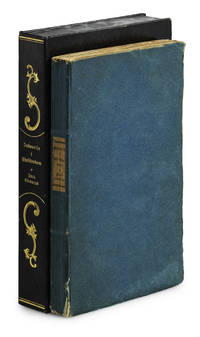
1850réf. 63619Kjøbenhavn, Reitzel, 1850. 8vo. (4), 277 pp. Completely uncut in the original blue cardboard binding. Magnificently preserved with the spine almost completely intact, including the original printed paper title-label. Tiny loss of paper to the capitals and a little loss to the lower front hinge. A small crack to lower back hinge, but binding remarkably firm and tight. Very neat re-enforcements to inner hinges, otherwise unrestored. Light occasional brownspotting. Pencil-annotation to inside of front board. A four-line annotation (about Dean Gude and a sermon he gave in April 1885) to foot of p. 98. With the ownership signature of H.P. Kierkegaard, also dated in his hand “d. 26de September 1850”. Housed in a beautiful black glitted box with elaborate gilding and Gothic gilt lettering to spine (Harry Larsen). A bit of wear to extremities. Himmelstrup 121.
1850réf. 63619Kjøbenhavn Reitzel 1850. 8vo. 4 277 pp. Completely uncut in the original blue cardboard binding. Magnificently preserved with the spine almost completely intact including the original printed paper title-label. Tiny loss of paper to the capitals and a little loss to the lower front hinge. A small crack to lower back hinge but binding remarkably firm and tight. Very neat re-enforcements to inner hinges otherwise unrestored. Light occasional brownspotting. Pencil-annotation to inside of front board. A four-line annotation about Dean Gude and a sermon he gave in April 1885 to foot of p. 98. With the ownership signature of H.P. Kierkegaard also dated in his hand “d. 26de September 1850”. Housed in a beautiful black glitted box with elaborate gilding and Gothic gilt lettering to spine Harry Larsen. A bit of wear to extremities. Himmelstrup 121. A splendid copy of the first edition in original condition – in the original binding with the exceedingly rare original printed title-label preserved – which has belonged to Kierkegaard’s disabled cousin who was a great source of inspiration to him. Kierkegaard’s confidante and close friend his cousin H.P. Kierkegaard received this copy the day after it was published Sept. 25th. We have never seen a copy in this state before with the original title-label preserved. By Kierkegaard himself described as his “most perfect and truest” work and by Mynster considered “a profane game with the holy” Training in Christianity is one of the most important and most controversial of all of Kierkegaard’s works. As Kirmsse says “it marks the beginning of a relentless and single-minded campaign against “Christendom” “ heralding his feud with the established Church and the Danish priesthood. In many ways Training in Christianity is considered one of the most quintessential Kierkegaardian works having at the centre of attention the question of how to become a Christian in Christendom leading ultimately to a fierce attack on the Danish church. It is in this work that Kierkegaard fully exposes his conception of the religious individual and fully describes the personal suffering that comes with being a Christian. Christ is considered the rolemodel and true Christendom consists in following him. Thus the Christian will also suffer for his faith though no man shall become a martyr for the truth. Kierkegaard thus also distinguishes sharply between the established triumphant church and the true struggling one which comes to constitute the essence of his attack on the established Danish Church. The work is published under the same pseudonym as Sickness Unto Death Anti-Climacus and also here the pseudonym is not meant to deceive or to qualify the work aesthetically. On the contrary this work evokes an idealized Christianity and Kierkegaard did not wish to convey that he was himself such an ideal Christian. “Anti-Climacus is also the author of The Sickness Unto Death. He might be considered the author of Kierkegaard’s greatest religious works just as Johannes Climacus is the author of the great pseudonymous esthetic works. H. Hong remarks “The prefix Anti- does not mean ‘against.’ An old form of ‘ante’ before as in anticipate the prefix denotes a relation of rank as in ‘before me’ in the First Commandment”. In his journals Kierkegaard said “Climacus is lower denies he is a Christian. Anti-Climacus is higher a Christian on an extra ordinarily high level”. Kierkegaard used Anti Climacus to write from the vantage point of a perfect Christian because he himself could not claim to be one. It should also be added that Kierkegaard decided to remove this pseudonym at the last moment by hurrying to the printer but was too late.” Dr. Anthony Storm Commentary on Kierkegaard. Along with being his “most perfect and truest” work Kierkegaard also thought it to be together with The Sickness Unto Death his most important. Concluding that Christendom had departed so far from the Christianity of The New Testament Kierkegaard with Training in Christianity seeks to reintroduce Christianity into Christendom. The work’s perfection lies in its combination of preaching and polemics. and truest thing.» In his reflections on such topics as Christ's invitation to the burdened the imitatio Christi the possibility of offense and the exalted Bishop Mynster who was then the face of the Danish Church was outraged when he read the book and called it «a profane game with the holy». Mynster and Kierkegaard had always been closely intertwined. In many ways Kierkegaard considered him almost family but for the outraged Kierkegaard Mynster also typified the complacent and established «official” Christianity. Few people were as important to Kierkegaard as Mynster and no-one else suffered as severely from his attack on the established Christianity in Denmark. The two theological giants never reconciled. For Kierkegaard the radical commandments of Christianity and what it demands from the individual are absolutely essential and with Training in Christianity he begins his crusade against the kind of tame Christianity in which the priests tell the congregation what they want to hear. ”Of the many works he wrote during 1848 his “richest and most fruitful year” Kierkegaard specified Practice in Christianity as «the most perfect Christ he takes as his theme the requirement of Christian ideality in the context of divine grace. Addressing clergy and laity alike Kierkegaard asserts the need for institutional and personal admission of the accommodation of Christianity to the culture and to the individual misuse of grace. As a corrective defense the book is an attempt to find ideally a basis for the established order which would involve the order’s ability to acknowledge the Christian requirement confess its own distance from it and resort to grace for support in its continued existence. At the same time the book can be read as the beginning of Kierkegaard’s attack on Christendom. Because of the high ideality of the contents and in order to prevent the misunderstanding that he himself represented that ideality Kierkegaard writes under a new pseudonym Anti-Climacus.” Hong edition. The present copy is no. 78 in Girsel's "Kierkegaard" The Catalogue which can be found here. unknown
1863réf. 60269Kjøbenhavn. 1863. 8vo. Samtidig skinnryggbind med ryggforgylling og marmorerte dekler. 276 s. MEDBUNDET : Dr. Søren Kierkegaards Indøvelse i Christendom fremstillet og belyst af J. Paludan-Müller Sognepræst i Thisted. Kjøbenhavn. 1856. 87 s. C. A. Reitzels Forlag Dansk. Lite stempel på tittelbladet. unknown
1850réf. 152264Copenhagen: C. A. Reitzel 1850. First edition of Kierkegaard's Practice in Christianity of which he stated: "without a doubt it is the most perfect and truest thing I have written" cited in the Historical Introduction to Princeton's 1991 edition. Kierkegaard fiercely attacks the contemporary Danish church and asserts the need to imitate Christ rather than the ritualistic complacency of modern Christendom. Octavo 200 x 124 mm. Recent black half sheep spine lettered in gilt mottled sides. Binding fine contents somewhat browned and foxed. A very good copy. Himmelstrup 121; McGill p. 52. unknown
1850réf. 13919K. 1850. Nyere blåt blankt omsl. Lidt brunplettet. 4277pp. Originaludgave. Himmelstrup 121. unknown
réf. 1022656643.Gpaperback. Good. Access codes and supplements are not guaranteed with used items. May be an ex-library book. paperback
réf. 1020556439.Ghardcover. Good. Access codes and supplements are not guaranteed with used items. May be an ex-library book. hardcover
réf. 46410384like new. unknown
réf. 46909339like new. unknown
réf. 1024638413.Ghardcover. Good. Access codes and supplements are not guaranteed with used items. May be an ex-library book. hardcover
1850réf. 46401676Kjobenhavn, C. A. Reitzel, 1850 ; in-8, cart. papier bleu, étiquette imprimée au dos, entièrement non rogné. (Cartonnage de l’époque) 2 ff., 277 pp.ÉDITION ORIGINALE de l’École du christianisme, ouvrage dirigé contre le christianisme officiel, légal et constitué. “C’est dans ce livre que se trouve plus particulièrement développé la dialectique du “choix”, ou attirance-répulsion envers la divinité. Le thème du Christ fait homme, souffrant et mouvant comme tel, rachetant la faute de l’humanité par le “scandale” de sa mort, est poussé jusqu’à l’identifier avec l’essence même de la religion. Ce thème constitue la clef de voûte de ce que l’on pourrait appeler l’apologétique kierkegaardienne (...) C’est avec Luther qu’a commencé la corruption du christianisme, par la mise en valeur de l’homme au détriment de Dieu : le christianisme devenu mondain, s’est ainsi perverti lui-même (...) De tous ses ouvrages, l’École du Christianisme est celui où le caractère paradoxal et antinomique de la religion se trouve renforcé par la chaleur même de la polémique.” Dict. des oeuvres. - Himmelstrup n°121.Exemplaire à toutes marges, dans son cartonnage d’origine. Qq. rousseurs.
réf. 1273036093.Gpaperback. Good. Access codes and supplements are not guaranteed with used items. May be an ex-library book. paperback
réf. 101021053X.Gpaperback. Good. Access codes and supplements are not guaranteed with used items. May be an ex-library book. paperback