2 224 résultats
réf. p9857eClimats PHOTOS SUR DEMANDE
réf. 60131P., Editions du Cavalier SCEL, 1933, petit in 12 broché, 185 pages.
réf. 48578Traduit du danois par André Babelon et C. Lund. Paris : Editions du cavalier, 1933. In-12 basane vert empire à coins, dos à nerfs avec auteur et titre doré, couverture conservée, 185 pages. Ex-dono manuscrit sur la page de garde. Edition originale de traduction. bon état.
réf. 25806Climats, Micro-Climats,1999, 118 pp., broché, légères traces d'usage, bon état général.
réf. 006506VPVC
réf. 77927St. Gallen: Verlag Leobuchhandlung. First Edition; First Printing. Hardcover. Very Good in a Very Good glassine dust jacket. No date. Text is in German.; 16mo 6" - 7" tall. Verlag Leobuchhandlung hardcover
réf. 37687BBMarburg, Büchner-Verlag, 2019. Gebundene Ausgabe. Innen sehr gutes, sauberes Exemplar. Kein Besitzervermerk! Keine Anstreichungen! Kein Mängelexemplar! Einband mit nur minimalen bis leichten Gebrauchsspuren.
2022br. Che cosa significa essere liberi? Esiste una determinazione filosofica capace di definire in modo inequivocabile questo principio? Questo breve saggio ripercorre con un linguaggio accessibile a tutti le formulazioni dei concetti di scelta, libertà, autenticità e responsabilità, facendo luce sul contesto filosofico e culturale che le ha declinate, con particolare riferimento al pensiero di Kierkegaard e Sartre.
Milano, Giuffrè, 1973, in-8, brossura editoriale, pp. 321. Ottime condizioni.
1975Mm 120x185 Collana "Argomenti". Volume nella sua brossura originale, 166 pagine. Gora non compromettente al margine destro, peraltro buona copia. SPEDIZIONE IN 24 ORE DALLA CONFERMA DELL'ORDINE.
2011Con l'espressione "discepolo di seconda mano" Kierkegaard si riferiva a coloro che, per contingenza storica, si rapportano alla figura del maestro in maniera indiretta, non essendo stati suoi "contemporanei". Nelle pagine di questo libro i panni del maestro sono vestiti da Søren Kierkegaard, e quelli di discepoli secondari da una nuova generazione di giovani studiosi del filosofo danese. Tuttavia la silloge raggruppa anche una serie di saggi di studiosi appartenenti a generazioni precedenti. Tale separazione non deve suscitare però alcuna perplessità perché, come Kierkegaard ravvisa, non esiste né un discepolo di seconda mano né un discepolo contemporaneo e ogni generazione che precede fa da battistrada e "occasione" alla generazione successiva la quale, senza lasciarsi sopraffare dallo spavento del peso da portare, deve al contrario "correre col vento in poppa". Saggi di: Antonella Fimiani, Alessandra Granito, Laura Liva, Gordon Marino, Umberto Regina, Federica Scorolli, Jon Stewart, Anna Valentinetti. Autori: Roberto Garaventa, Diego Giordano.
1990Il diario del seduttore è la traduzione letteraria della vita estetica che si consuma attimo dopo attimo nella vana ricerca del piacere.
1966Stato discreto, coperta in cartoncino patinato semimorbido, qualche segno d'uso, lievi bruniture, macchie, segno a penna su piatto posteriore, tagli e margini delle pagine leggermente bruniti, quello di testa con accenno di fioritura, pagine in buono stato, sporadiche sottolineature a matita. I volume della collana Biblioteca Sansoni. I.a ristampa. Numero pagine 370 USATO
réf. 46604301-6Mercer University Press. Used - Good. Former library copy. Pages intact with minimal writing/highlighting. The binding may be loose and creased. Dust jackets/supplements are not included. Includes library markings. Stock photo provided. Product includes identifying sticker. Better World Books: Buy Books. Do Good. Mercer University Press unknown
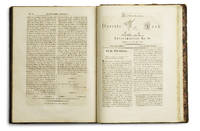
1836Kjøbenhavn [i.e. Copenhagen], 1836. Large 4to. I: Loose, as issued, unbound. With a horizontal and a vertical crease down the middle. 4 pp. II: Loose, as issued, unbound, but inserted into a simple paper folder (small 8vo). With a horizontal and a vertical crease down the middle. 4 pp. + 4 pp. III: Loose, as issued, unbound, but inserted into a simple paper folder (small 8vo). With a horizontal and a vertical crease down the middle. 4 pp.
1836réf. 62102Kjøbenhavn 1834-1836. Large 4to. Interimsblade i.e. Interim Papers 1-100 with the joint title-page and the contents leaf bound in a very nice contemporary brown half calf with gilt spine and marbled paper over boards. Spine with wear and hinges and corners bumped. Edges of boards with wear. Occasional brownspotting throughout but all in all a fine and well preserved copy. Each “Interimsblad” takes up 4 pp. Kierkegaard’s contributions: I: ab. 1 p.; II: 2 3/4 pp.; III: 4 pp.; IV: 4 pp. Very rare first printings of Kierkegaard’s first four publications including the very first publication in Kierkegaard’s own name which constitutes a true milestone in the history of Kierkegaard’s opus as does of course his very first publication. KIERKEGAARD’S VERY EARLIEST publications are the papers that he publishes in Kjøbenhavns Flyvende Post before he publishes his famous first book which is a polemic attack on Hans Christian Andersen. The first and fourth of these earliest periodical publications are arguably the most important being the very first thing Kierkegaard publishes and the very first publication in Kierkegaard’s own name respectively; but all these four earliest papers Himmelstrup 123 and 4 are significant 23 and 4 dealing with contemporary press issues primarily freedom of press. Danish politics in the 1830’es was dominated by the slow implementation of rules for election for and assembly of the Estates of the Realm. But as they were only advisory the papers and periodicals were not allowed to publish their opinions. In response to this a liberal opposition arose around the two polemic papers Kjøbenhavnsposten The Copenhagen Post and Fædrelandet The Fatherland. The first point on the agenda for the Liberals was the fight for freedom of the press and the abolishment of censorship. This fight for freedom of the press was something that found resonance with Copenhagen academics and it stirred up a lively activity in Copenhagen. In 1835 active Liberals had encouraged King Frederik VI to support freedom of press but had received an answer stating that he alone was able to evaluate what was truly the best for the people and the state. After this answer from the king the “Society for the Correct Use of the Freedom of press” was founded by moderate liberals and young liberals and at the end of the year almost 2.300 members had joined. It was in the midst of all this that the 21-year old Søren Kierkegaard then a student of theology had his debut with political-literary articles in Kjøbenhavns flyvende Post in Interimsbladende which were published separately. But as opposed to the predominantly liberal views of almost all other contributors Kierkegaard’s articles expressed distinctly conservative views. His first publication Også et Forsvar for Qvindens høie Anlæg Also a Defense of the High Abilities of the Woman constitutes an unpolished ironic apology for the liberation of women. This article is published in December 1834 and is signed “A.”. As opposed to the following next three articles this does not deal with freedom of press. Kierkegaard’s three following publications however all concern the question of freedom of press and constitute satirical polemics against the two liberal papers Kjøbenhavnsposten and Fædrelandet against Orla Lehmann the upcoming star of the liberal youth and against all liberals in general. These three articles were published in February and April 1836. The two first are signed “B.” and the third signed “S. Kierkegaard” constitutes the very first publication in his own name. As is well known the names under which Kierkegaard later publishes come to play a significant role in his authorship and represent an extremely thorough and well-thought-out construction. The foundation of this play with the reader is thus laid in the present publications in which he begins to develop the style for which he later gained worldwide renown. The “names” A and B under which he here publishes will most famously be used again in Either- Or Part one of which consists in “A.’s Papers” and Part Two in “B.’s Papers Letters to A.” Common for all four of his first publications is the attempt at polemic and satirical power at literary elegance and at a masterful and ceremonious critique of the prose of the opponent – all dominant traits in his later writings. Kjøbenhavns flyvende Post The Flying Post of Copenhagen was one of the most important and most widely read cultural and literary periodicals of the period. It was edited and run by Johan Ludvig Heiberg 1791-1860 arguably the most famous cultural person during the Danish Golden Age. He played a more significant role than any other author or thinker during this period and was the leading character of literature and philosophy in the 19th century. He introduced many German thinkers to Denmark most importantly Hegel – who Kierkegaard would later oppose – and he was part of almost all intellectual discussions of the Danish Golden Age. He was also a patron for many leading figures of the era. Interestingly several people thought that the first of the articles on the freedom of the press was written by Heiberg. This was of dubious merit to Kierkegaard himself as he was opposed to the circles around Heiberg and the Hegelian environment but it was still this article – and this miscomprehension – that gave him a claim to fame. Another paper claimed that this “priceless” article had been written by Heiberg himself who “had written many witty things but never anything as witty as this.” Also Kierkegaard’s professor of philosophy Poul Martin Møller to whom Kierkegaard was very devoted and to whom he dedicated Begrebet Angest the only person outside of his family that Kierkegaard ever wrote a printed dedication for loved the article and assumed that Heiberg had written it. “He Kierkegaard had a lifelong antipathy toward the press though he himself published reviews in various papers. His mistrust of the press as a legitimate organ of communication was based on several observations one of which was that the press was the voice of the masses rather than that of the individual. He viewed that voice with great skepticism and sarcasm in later years averring that the crowd. even if technically correct. is wrong by the very fact of being the crowd. The truth can only be stated and practiced as individuals especially as individuals before God. Admittedly Kierkegaard’s view of the masses was not well developed at this juncture.” D. Antony Storm. Himmelstrup: 1 2 3 & 4. The present copy is no. 1 in Girsel's "Kierkegaard" The Catalogue which can be found here. hardcover
1836réf. 62102Kjøbenhavn, 1834-1836. Large 4to. Interimsblade [i.e. Interim Papers] 1-100, with the joint title-page and the contents leaf, bound in a very nice contemporary brown half calf with gilt spine and marbled paper over boards. Spine with wear and hinges and corners bumped. Edges of boards with wear. Occasional brownspotting throughout, but all in all a fine and well preserved copy. Each “Interimsblad” takes up 4 pp. Kierkegaard’s contributions: I: ab. 1 p. II: 2 3/4 pp. III: 4 pp. IV: 4 pp.
Mm 190x240 Brossura editoriale di pagine 38, estratto da Annali della Facoltà di Lettere e Filosofia dell'Università degli Studi di Perugia, Volume XXV, nuova serie XI, 1987/1988, 4 Studi FIlosofici. Opera in ottime condizioni. Spedizione in 24 ore dalla conferma dell'ordine.
In-8, broché, couverture imprimée, 268, (2) p. Edition originale. Bel envoi de la traductrice et éditrice Nelly Viallaneix à Vladimir Jankélévitch: "Pour Monsieur Jankélévitch, ce 'presque rien' qui, sans lui, n'aurait pas été publié, un témoignage d'affection et d'admiration, Nelly". Nelly Viallaneix (1923-2005) a soutenu sa thèse de doctorat " Kierkegaard et la parole de Dieu" sous la direction de Jankélévitch en 1976. Très bon exemplaire.
réf. Z33760FKNBROCHE EN BON ETAT.Hâte-toi d'écouter - quatre discours édifiants. Kierkegaard Aubier, 1970
1970réf. 31919In-8, broché, couverture imprimée, 268, (2) p. Paris, Aubier Montaigne, 1970.
réf. ria9780691020853_inpPaperback / softback. New. New Book; Fast Shipping from UK; Not signed; Not First Edition; Kierkegaard explored comic perception to its inward depths. He also practised the art of comedy as astutely as any writer of his time. This book shows how his theory of comedy is integrated into his practice of comic perception and how paperback
1994réf. 50021Mainz : Matthias-Grünewald-Verlag, 1994. Die literarische Hiob-Rezeption im 20. Jahrhundert als theologische Herausforderung 448 S. (23 cm) Broschierte Ausgabe