5 071 résultats
1917réf. RNARYOU00DPESeven Arts 1917. Very Good. Naruse Seichi. The Seven Arts; containing Young Japan with American Independence and the War Supplement. April 1917. Lowell Amy; Heine Heinrich; Untermeyer Louis; Yeats John Butler. NY: Seven Arts 1917. 8vo smaller supplement. Blue paperback and a Supplement in stapled wraps. Book condition: Very good with bumped and rubbed extremities. Subtly creased and faded perimeter. Short closed tear exposing gatherings at foot of spine. Supplement darkened near edges lightly rubbed with a few panel scuffs. Front matter bears a tiny chipped top edge and paperclip shadow. Seven Arts paperback books
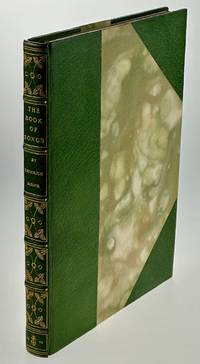
1957réf. 015856New York: Limited Editions Club 1957. Hardcover. Bookplate on front pastedown. Spine faded with a few rubbed spots. Very Good contents Fine in a Near Fine slipcase. Fritz Kredel. Octavo 6" x 9-1/2" bound in half smooth green calfskin leather with a gold-stamped label and hand-decorated paper over boards; 354 pages. Selected translated and with an introduction by Louis Untermeyer. The text is set in Monotype Walbaum employed here for the first time in America. With charming illustrations by Fritz Kredel colored by hand through stencils in the studio of Walter Fischer. Copy #39 of 1500 SIGNED by the illustrator on the colophon page. Limited Editions Club hardcover books
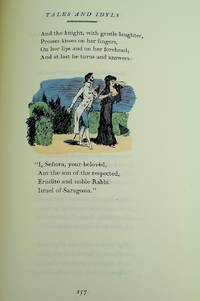
1957réf. 45759LA: Limited Editions Club 1957. Hardcover. Very Good. Hardcover. #610 of 1500cc signed by the illustrator Fritz Kredel. Foxing to prelims and page edges boards sunned at extremities binding scuffed in spots else a very good example; lacking the slipcase. Limited Editions Club hardcover books
1974réf. 72875NY: Pyramid Books 1974. Mass market paperback. Good. Mass market paperback. First Printing. Previous owner's blindstamp on front free endpaper ink date on title page slight spine lean wraps darkened and rubbed esle a good example. Pyramid Books unknown books
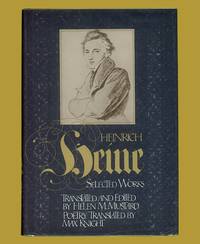
1973réf. 91506NY: Random House 1973. First edition. xxvi 446 pp. Fine in very near fine dust jacket with a few light wrinkles along the bottom edge of the front panel. Translated and edited by Helen M. Mustard with her introduction. Poetry translations by Max Knight. NY: Random House unknown books
1926réf. 1370909Paris France: Pour Les Membres de la Société du Roman Philosophique 1926. Limited Edition #198/233. Hardcover. Quarto 540 pages. In Very Good condition. Rebound in quarter red leather with marbled paper boards and new endpapers. Paneled spine is lightly sunfaded red with gilt lettering and gilt tooling. Minor shelfwear to spine and paper boards. Bumping and slight chipping to fore-edges slightly exposing boards. Slight ink mark to back board board. Top edge of textblock dyed red. Deckled textblock with minor water damage to last pages endpapers of original textblock. Mild soiling to pages 254-257 and 312-313. Signed flat by Heine and the Treasurer of the Society on the limitation page. Shelved in Room A Oversize. Sade wrote the stories collected in this volume while in prison at the Bastille. 1370909. Special Collections - Upstairs. Pour Les Membres de la Société du Roman Philosophique hardcover books
1962réf. 460438Chicago: The University of Chicago Press 1962. Hardcover. Fine/Fine. First edition. Octavo. Ownership signature of noted American psychologist and anthropologist Henry Guze a founder of the American Academy of Psychotherapists the Society for Clinical and Experimental Hypnosis and co-founder of the Society for the Scientific Study of Sex on the front fly else fine in fine dustwrapper. The University of Chicago Press hardcover books
1935réf. 198916London England: John Lane The Bodley Head 1935. Hardcover. Very Good/Fair. First edition thus. Originally published as a limited edition in 1930 by Cresset Press. 16mo. xiii 205pp. 12pp. Gilt-stamped green cloth. Endpapers lightly foxed small bookstore label on rear pastedown corners lightly bumped very good in a good to fair only price-clipped dustwrapper with front panel detached from spine spine darkened and chipped with some loss on the ends. John Lane The Bodley Head hardcover books
1947réf. 347898New York: Schocken Books 1947. Hardcover. Very Good. First Schocken edition. Translated by E.B. Ashton. With a folded facsimile. Sunning to the spine toning to the endpapers else near fine without dustwrapper. From the library of the artists Ben Shahn and Bernarda Bryson Shahn with an estate label designed by their son Jonathan Shahn. Schocken Books hardcover books
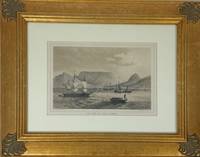
1856réf. 14143831856. In Very Good condition. Artwork measures 7 in by 10 in. Matted in frame measuring 18 in by 15 in. Shelved in PS1101. 1414383. Special Collections - Upstairs. unknown books
1904réf. 1417752Munich: Albert Langen Verlag 1904-1905. Hardcover. Tall quarto 51 issues. In Very Good minus condition. Spine is grayish blue with gilt lettering on red label. Half-bound in grayish blue cloth over marbled green and red paper boards. Boards show light overall shelf wear with rubbing to edges and corners. Scattered light scratches and scuffs to both covers. Spine shows mild wear to head rubbing to red leather label and a few light scuffs. Text block shows mild to moderate age toning throughout interior mild through second half. Occasional chip to page fore edge. Mild creasing to first three leaves of first issue No. 3. Bookplate to front paste down. CONTENTS: Vol.9 No.3 - No.53. Shelved in Room C. 1417752. Special Collections - Upstairs. Albert Langen Verlag hardcover books
1910réf. 006225Berlin: Paul Cassirer 1910. Limited First Edition Thus. Vellum. Near Fine. No. 46 of 60 on Imperial Japan Japan vellum and a total limited edition of 310 copies. Large 4to. 31.5 by 24 cm. 83 2 pp. With 35 lithographic plates six of which are hand-colored and nine of which are signed by Pascin. Also signed by him on the limitation page. The cover also has a partly colored illustration by Pascin done on the vellum. This book was Pascin's first book project. The satirical Heine novel first published in 1833 actually was the inspiration for Wagner's "Der Fliegende Hollander" or "The Flying Dutchman". Pascin was born in Bulgaria was active in Paris for much of his career although becoming an American citizen and working in the U.S. as well. The illustrations in this book have a deliberately naive quality almost as if done by a child. Condition: short tear of vellum along lower front joint 2 to 3 cm in length. Typical yet slight bowing of the vellum and a touch of lifting of the vellum from the boards. Minor darkening of the vellum leaves within along the edges. Paul Cassirer unknown books
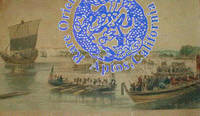
réf. 99009904New York 1856 Putnam. Tall folio single hand colored litho of "PASSING THE RUBICON" 82.5 x 56.5 cm. slight browning marginal tears mounted on a stiff cardboard VERY R A R E ! This work preceded the famous three volume set published in 1856: THE JAPAN EXPEDITION. GRAPHIC SCENES OF THE JAPAN EXPEDITION was a spectacular work and contained 10 hand tinted large and nine smaller colored lithographs to document the arrival of Perry & his Squadron. Most were drawn by Heine the young German who was the expedition artist. The complete work includes: 1. PORTRAIT OF M.C. PERRY. 2. MACAO FROM PENHA HILL. 3. PAGODA OF WHAMPOA. 4. OLD CHINA STREET IN CANTON. 5. KUNG-TWA AT ON-NA LEW CHEW. 6. MIA OR ROADSIDE CHAPEL AT YOKU-HAMA. 7. TEMPLE AT BEN-TENGIN THE HARBOR OF SIMODA. 8. STREET & BRIDGE AT SIMODA. 9. TEMPLE OF THE HA-TSHU-MAN-YA TSCHU-RO AT SIMODA. 10. GRAVEYARD AT THE SIMODA DIO ZENGE. Of these exceedingly RARE lithographs one prints is now offered: PASSING THE RUBICON documents the event of July 11 1853 wherein Lt. Silas Bent from the Mississippi's first cutter confronted Japanese guard boats and a coastal Junk. This is illustrated in S. Morrison: "OLD BRUIN" COMMODORE MATTHEW CALBRAITH PERRY on p.327. This scene shows the American sounding party at work on Monday morning July 11th ".when a flotilla of thirty to forty guard boats filled with soldiers who presented quite a bristling front with their spears and matchlocks while their lacquered caps and shields flashed brightly in the sun confronted the flag launch under charge of Lt. Bent & the senior Japanese officer made minatory gestures with his iron fan and yelled orders which nobody in the American launch understood. The Lieutenant anxious to avoid a crash altered his collision course but dispatched another boat to the Mississippi to ask Capt. Lee to move closer. On the steamer's approach the guard boats retired. And Perry named the nearest point of land 'Point Rubicon' because no foreign ship had passed it for three centuries." See Morrison p.328. The lithograph PASSING THE RUBICON is 83 x 56.5 cm. overall print size is 83 x 49.5 cm. with top and side edges trimmed bottom edge slightly trimmed; overall browned with some surface scuffs tears laid down on an old cardboard complete illustration present with minor faults. The complete title reads: PASSING THE RUBICON. Lieut's. Bent in the Mississippi's First Cutter Forcing His Way Through a fleet of Japanese Boats While Surveying the Bay of Yedo July 11th. 1853. To Commodore M.C. Perry Officers and men of the Japan Expedition this print is respectfully dedicated by their Obt. Servths sic. BIBLIOGRAPHY: R. Pineau: THE JAPAN EXPEDITION 1852-1854 THE PERSONAL JOURNAL OF COMMODORE MATTHEW C. PERRY after p.156 & before p.167 color illustrations. THE PAUL C. BLUM COLLECTION CATALOGUE OF BOOKS Yokohama Archives of History vol.4 no.4395. H. Cordier: BIBLIOTHECA JAPONICA p.513-518. By and large any of these prints from this work is exceptionally rare and seldom if ever found on the market for sale. unknown books
réf. B239775-2Oxford/New York Oxford University Press 2002. xiv 2 200pp. Wraps. Oxford/New York (Oxford University Press), 2002. paperback books
1826réf. 55385Hamburg: Hoffmann und Campe 1826. First edition. Hardcover. Good to very good condition. Octavo. 6 300 2pp. Original decorative marbled paper-covered boards with gilt lettering on green label of spine. Contains Die Heimkehr pp. 110 1823-1824. Die Harzreise pp. 111-260 1824. Die Nordsee pp. 261-300 1825 Erste Abtheilung. With printed Heine annotation at rear addressing several errata and announcing that the complete list of errata will be included in part two of Reisebilder. In addition Heine gives a preview of some of the works included in Reisebilder part two and in closing a sarcastic note for friends 'who still sit on my scripts and may be more impressed by printed than by written words' that all letters and parcels as long as 'care of Heinrich Heine Dr. Jura' is added to the Hoffmann & Campe address wiill certainly be delivered to him. Wilpert/Gühring p. 523/3. Ex Libris of Alexander Alec Stillmark on inside cover. He was awarded the Austrian Federal Chancellor's prize for translation three times. One of the translations was Hugo von Hofmannsthal's title "The Incorruptable Servant." Text in German Gothic script. Light wear along edges of slightly cocked binding front joint with scuffing light on back joint. Lettering on label of spine faded. Small inked number on half-title and name at bottom of title page. Hoffmann und Campe hardcover books
1920réf. 20978Hamburg: Hoffmann & Campe 1920. Limited edition. Hardcover. g. 1/1000. 8vo. 2 volumes resting in brown paper clamshell box with gold-covered metal bas-relief of Heine's head after art work Plakette by David d'Anger. Some age wear staining and bumping to box. 30034pp. Half leather over marbled boards with gold-decorated spine and maroon title-label. Red page edges. Facsimile of Heine's copy he used during his travels through the Harz Harzreise with notes and markings in his handwriting throughout. Nachbildung von Heine's Handexemplar. The Harz is a mountain range in Germany occupying parts of the German states of Lower Saxony Saxony-Anhalt and Thuringia. Near fine condition. Beigabe Supplement: II. Heine-Gedächtnis-Druck Ergänzung zum zweiten Heine-Gedächtnis-Drucke. 191381-11012x-xi4pp. Cloth spine over stiff wraps. Some sunning and age wear on binding. Wraps in good interior in very good condition. "Geleitwort des Herausgebers nebst den vom Verlage hinzugefügten Ergänzungen." Text in German Gothic script. 1 leaf with description of d'Angers Plakette & facsimile of written statement by Adolf v. Menzel to the publishers laid-in as published. Clamshell box in overall good condition. Hoffmann & Campe hardcover books
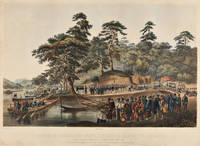
1855réf. 54032New York: Eliphalet M. Brown Jr. 1855-1856. Magnificent Elephant Folio Lithographs of Perry in Japan Magnificent and very rare example of Heine's elephant folio-sized lithographic record of six lithographs illustrating the opening of Japan under Commodore Matthew Perry. In scale scope and quality of execution this is arguably the finest lithographic work ever produced in the United States and is among the rarest of all American color plate books. William Heine was the official artist on Commodore Matthew C. Perry's expedition to Japan in 1853-54. On returning to the United States he produced several series of prints commemorating the trip the first the greatest and the rarest of which is the present group consisting of a titlepage and six plates. These were overseen by the expedition's daguerreotypist Eliphalet Brown who was also an excellent artist and lithographer - he designed and drew the spectacular titlepage. The total number of sets of printed is not known but it is recorded that Brown gave 100 sets to Commodore Perry for distribution to members of the expedition. The number of sets sold to the public has not been established but was undoubtedly small. One of the reasons for the rarity of the complete set is that the plates were printed over two years by three publishers. Individual prints are occasionally encountered particularly the four printed in 1855 by Sarony of New York but the two other plates are much scarcer and were accomplished by different lithographers Boell & Lewis and Boell & Michelin. A secondary reason for the rarity of this set is the initial cost. It was significantly more expensive than Heine's Graphic Scenes of the Japan Expedition a much smaller folio published in the same year as the final plate: the popularity of this smaller set ensured that only very few of the magnificent larger sets were ever sold. The set consists of the following prints: 1 "Passing the Rubicon. Lieut. S. Bent in the 'Mississippi's' First Cutter Forcing his way through a Fleet of Japanese Boats while Surveying the Bay of Yedo Japan July 11th 1853." Printed by Sarony & Co dated 1855. 2 "First Landing of Americans in Japan. Under Commodore M.C. Perry at Gore-Hama July 14th 1853." Printed by Sarony & Co dated 1855. This print is the most dramatic of the series showing the first landing of Perry on Japanese soil. Through a flotilla of American landing barges with the ships' complement of Marines drawn up on the beach Perry proceeds to meet a Japanese delegation while Japanese troops ring in the Americans. In the foreground are two Japanese official launches and two Japanese officials stand in the right foreground. Perry's steamboats can be seen lying under steam in the left corner. 3 "Landing of Commodore Perry Officers & Men of the Squadron to Meet the Imperial Commissioners at Yoku-Hama Japan March 8th 1854." Printed by Sarony & Co dated 1855. 4 "Landing of Commodore Perry Officers & Men of the Squadron to Meet the Imperial Commissioners at Simoda Japan June 8 1854." Printed by Sarony & Co dated 1855. 5"Return of Commodore Perry Officers & Men of the Squadron from an Official Visit to the Prince Regent at Shui Capitol of Lew Chew June 6th 1853." Printed by Boell & Lewis dated 1855. 6 "Exercise of Troops in Temple Grounds Simoda Japan in Presence of the Imperial Commissioners June 8th 1854." Printed by Boell & Michelin dated 1856. This set of the Heine prints belonged to Major Robert Smith John Rodgers son of Commodore John Rodgers of War of 1812 fame and hung in his fine mansion on a hilltop outside of Havre de Grace Maryland. Six lithographs with integral descriptions and titles to the six plates all within an elaborate decorative border including vignettte scenes and portraits of places and people encountered on the expedition six lithographic plates printed in colors and finished by hand by J. Sarony & Co. 4 Boell & Lewis 1 and Boell & Michelin 1 all after Heine. Title leaf not present as usual. Elephant folio. Individually matted and framed. One print with repaired closed tears slightly affecting image. Occasional faint marginal foxing and dust soiling. Very good. PETERS AMERICA ON STONE pp.98 352-53. Samuel Eliot Morison "Old Bruin": Commodore Matthew C. Perry 1794-1858 Boston 1967 p.463. unknown books
1903réf. 6539East Aurora: Roycroft Press 1903. First Edition Thus. First Edition Thus. 8vo. Beautifully bound in three-quarter crushed green morocco with marbled boards elegant gilt decorated spine marbled endpapers. PRESENTATION COPY: "To Alice Keiles Reserve your best thoughts for the Elect Few. Elbert Hubbard." Printed in red and black on Japan vellum. David Ogle reports: "All known copies of the limited dieiton 100 copies are hand-illumined though this copy with rubricated initals does not appear to be hand-illumined an interesting feature which may mean ohe of Hubbard's own copies for presentation. Book is in very fine condition Box with original label very good. Roycroft Press unknown books
1927réf. 1370666Paris France: Simon Kra 1927. Limited Edition 1/600 Copies. Softcover. Octavo vii 304 pages. In Very Good condition. Bound in printed grey wraps with a protective clear plastic wrapping. Suntanned spine is grey with black lettering. Tanning to edges and thinning to front and back covers. Slight tearing and chipping to top and bottom edges of dust jacket. Minor tear on back cover next to spine. Age-toning to textblock with minor soiling to right margins of some pages and slight tearing along right edge. Several pages uncut. Presentation inscription to limitation page for Louis Jean Finot this copy is unnumbered. This book is one of only 600 copies printed on vellum and includes a facsimile of one of Sade's manuscripts in his own writing. Sade wrote the stories collected in this volume while in prison at the Bastille. First Trade edition after the 1926 limited edition. 1370666. Special Collections - Downstairs. Simon Kra unknown books
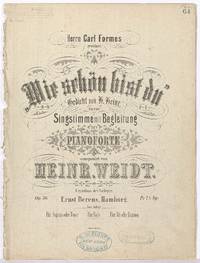
1856réf. 620799Hamburg: Ernst Berens 1856. Softcover. Good. Sheet music. Folio. Lyrics in German and English. Single bifolium with a single-sheet-insert making six pages. Notched and worn along the fold with page numbers stamped in the top corners from once being bound within an album as a result the insert remains attached to the bifolium two music shop stamps on the front cover edgewear and soiling to the exterior complete but just a good or better copy. For voice and piano. Plate number 56. Ernst Berens unknown books
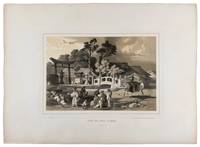
1856réf. 42583New York: G.P. Putnam & Company 1856. Tinted lithograph mounted on support sheet with printed letters as issued with small stab holes where previously bound. A finely observed street scene at Shimoda Japan from Graphic Scenes of the Japan Expedition based on Wilhelm Heine's drawings during Commodore Matthew C. Perry's expedition to Japan showing the newly accessible treaty port through its built environment local movement and everyday encounters. Heine's view presents a street near the gate at Shimoda in Izu Province shortly after the port's opening to American vessels under the Treaty of Kanagawa. The scene is organized around a small arched stone bridge with pale balustrades set before a shrine approach marked by a large torii stone lanterns thatched and tiled buildings and tall windswept trees. The composition balances architectural record with social observation giving equal attention to the cut-stone bridge the street's raised central path the houses lining the road and the figures who animate the foreground. At right two bearers carry a traveller in a kago the enclosed palanquin used in Japan where wheeled carriages were not part of ordinary travel. In the foreground adults and children gather around a seated figure likely an artist drawing in the street while other figures pass across the bridge or stand beneath the torii. These small groups give the print a sense of immediacy: Shimoda appears as a functioning town observed at close range. Wilhelm Heine was the official artist on Commodore Matthew C. Perry's expedition to Japan in 1853-54. On returning to the United States he produced several series of prints commemorating the trip. A group of six elephant-folio prints appeared in 1855 and the following year a second volume was issued in a smaller format with different images and with explanatory text. Both projects employed the New York lithographic firm of Sarony among the best lithographers in the United States at that time. Bennett p.53; McGrath American Color Plate Books 123. G.P. Putnam & Company unknown books
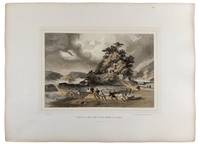
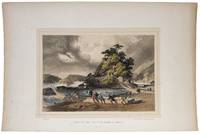
1856réf. 42584New York: G.P. Putnam & Company 1856. Tinted lithograph mounted on support sheet with printed letters as issued with small stab holes where previously bound. A fine plate from Graphic Scenes of the Japan Expedition of a Benten temple in Shimoda Japan harbour showing one of the treaty ports opened to American vessels in 1854 through the combined lens of topography harbour life and local religious practice. Shimoda or "Simoda" in the period spelling used here had particular importance for Perry's expedition. Under the Treaty of Kanagawa signed on 31 March 1854 it was one of the two ports opened to American vessels for supplies and refuelling. Heine records the harbour as a coastal landscape of daily movement local religious architecture and practical maritime activity. In the foreground Japanese boatmen haul a long narrow boat through the surf while a second boat lies angled on the beach at right. Beyond them the temple rises from a small rocky promontory half hidden among trees and reached by a stepped landing and gate with low mountains and a heavy cloud filled sky in the distance. The titles "Ben-Teng" is a 19th-century transliteration of Benten or Benzaiten a deity closely associated with water good fortune music and eloquence. Benten halls and shrines are often found beside rivers ponds springs and the sea which makes the placement of this harbour temple especially fitting within the image. The composition uses this setting to strong effect: the shrine rises above the labour of the beach while the dramatic sky and surrounding mountains give the small coastal sanctuary a commanding presence within Shimoda's new post-treaty landscape. Wilhelm Heine was the official artist on Commodore Matthew C. Perry's expedition to Japan in 1853-54. On returning to the United States he produced several series of prints commemorating the trip. A group of six elephant-folio prints appeared in 1855 and the following year a second volume was issued in a smaller format with different images and with explanatory text. Both projects employed the New York lithographic firm of Sarony among the best lithographers in the United States at that time. Bennett p.53; McGrath American Color Plate Books 123. G.P. Putnam & Company unknown books
1856réf. 42598New York: G.P. Putnam & Company 1856. Tinted lithograph on proof paper tipped onto a bristol board with glossy back as issued with additional hand colouring. A fine plate of Shimoda harbour in Japan showing the Benten temple on a rocky tree-covered rise above the water from Graphic Scenes of the Japan Expedition. Shimoda or "Simoda" in the period spelling used here had particular importance for Perry's expedition. Under the Treaty of Kanagawa signed on 31 March 1854 it was one of the two ports opened to American vessels for supplies and refuelling. Heine records the harbour as a coastal landscape of daily movement local religious architecture and practical maritime activity. In the foreground Japanese boatmen haul a long narrow boat through the surf while a second boat lies angled on the beach at right. Beyond them the temple rises from a small rocky promontory half hidden among trees and reached by a stepped landing and gate with low mountains and a heavy cloud filled sky in the distance. The titles "Ben-Teng" refers to Benten or Benzaiten a deity often associated with water and shoreline shrines. This gives the image a specificity beyond its topographical interest: Heine presents Shimoda through a recognisable local sacred site placed directly within the harbour that had become newly significant in American and Japanese relations. The composition balances picturesque scenery ethnographic observation and the physical geography of a newly opened treaty port giving equal weight to topography and local life. Wilhelm Heine was the official artist on Commodore Matthew C. Perry's expedition to Japan in 1853-54. On returning to the United States he produced several series of prints commemorating the trip. A group of six elephant-folio prints appeared in 1855 and the following year a second volume was issued in a smaller format with different images and with explanatory text. Both projects employed the New York lithographic firm of Sarony among the best lithographers in the United States at that time. Bennett p.53; McGrath American Color Plate Books 123. G.P. Putnam & Company unknown books
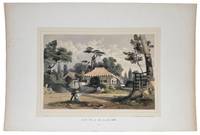
1856réf. 42599New York: G.P. Putnam & Company 1856. Tinted lithograph on proof paper tipped onto a bristol board with glossy back as issued with additional hand colouring. A quietly revealing image from Heine's Graphic Scenes of the Japan Expedition: the American encounter with the Ryukyu Islands in Japan where diplomacy observation and coastal movement preceded the better-known landings in Japan. This plate is one of the more understated images in Graphic Scenes of the Japan Expedition and that restraint is part of its appeal. Lew Chew was the period Western name for the Ryukyu Islands and On-Na corresponds to Onna on Okinawa. The scene shows a kung-kwa or village rest house set back behind a low wall and gate its tiled roof partly screened by trees. Heine gives the building a strong sense of place: the whitewashed wall shaded yard garden growth and open path all suggest a local administrative or stopping-place outside the more formal diplomatic centres of Naha and Shuri. In the foreground one figure sits with a portfolio or sketchbook while another stands nearby. Ryukyuan figures appear closer to the building absorbed into the architecture and enclosure of the scene. The print therefore records more than a picturesque stop on the route to Japan turning a coastal village structure into evidence of landscape architecture custom and access. Within the Perry visual record Kung-Kwa at On-Na is valuable precisely because it shifts attention from treaty ceremony to the quieter geography of the voyage. It places Okinawa within the wider American itinerary through the China Seas the Ryukyus and Japan and preserves a carefully observed view of a Ryukyuan public building at the moment when the islands were being drawn into the diplomatic and commercial mapping of the Pacific. Wilhelm Heine was the official artist on Commodore Matthew C. Perry's expedition to Japan in 1853-54. On returning to the United States he produced several series of prints commemorating the trip. A group of six elephant-folio prints appeared in 1855 and the following year a second volume was issued in a smaller format with different images and with explanatory text. Both projects employed the New York lithographic firm of Sarony among the best lithographers in the United States at that time. Bennett p.53; McGrath American Color Plate Books 123. G.P. Putnam & Company unknown books
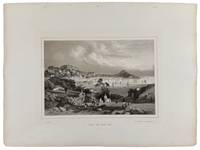
1856réf. 42582New York: G.P. Putnam & Company 1856. Tinted lithograph mounted on support sheet with printed letters as issued with small stab holes where previously bound. A mid nineteenth century view of Macao China from Penha Hill published as the first topographical scene in Heine's Graphic Scenes of the Japan Expedition showing the city's harbour churches fortified heights and waterfront at a moment when Macao's older role in the China trade was being overtaken by Hong Kong. Heine's view looks down from Penha Hill across Macao's semi-circular harbour with the town rising in terraces from the waterfront toward its churches gardens and fortified heights. The composition places Macao's maritime and religious identity in a single prospect: small vessels fill the inner harbour larger ships lie farther out and the built town gathers around the shoreline beneath prominent ecclesiastical and defensive structures. In the foreground porters carrying shoulder poles and a seated group of robed women animate the hillside road giving the view a local and social immediacy beyond its topographical function. Macao had developed from the sixteenth century as the principal Portuguese settlement on the South China coast occupying a narrow peninsula near the entrance to the Pearl River system and serving as a crucial intermediary point in trade between China Japan India and Europe. Its urban form is clearly legible in Heine's image. The waterfront known as the Praia curves around the harbour below the elevated town while Penha Hill provides the high vantage from which Macao appears as an amphitheatre of houses churches gardens and forts descending toward the water. By the time Heine's view was published Macao's commercial standing had changed substantially. Hong Kong occupied by Britain in 1841 and rapidly developed as a free port drew away much of the foreign trade that had once passed through Macao. Heine's print records the older Portuguese city in this altered commercial landscape: still picturesque densely built and socially important as a resort and residence for foreign merchants connected with Canton but no longer the dominant European entrepôt on the China coast. Seen from Penha Hill Heine's Macao appears as a harbour city where Portuguese civic and religious landmarks Chinese geography and nineteenth-century treaty-port commerce meet in a single prospect. Wilhelm Heine was the official artist on Commodore Matthew C. Perry's expedition to Japan in 1853-54. On returning to the United States he produced several series of prints commemorating the trip. A group of six elephant-folio prints appeared in 1855 and the following year a second volume was issued in a smaller format with different images and with explanatory text. Both projects employed the New York lithographic firm of Sarony among the best lithographers in the United States at that time. Bennett p.53; McGrath American Color Plate Books 123. G.P. Putnam & Company unknown books