Anonymous ArtistABAA
263.420 resultados
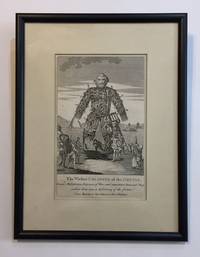
1771ref. 2992London: printed for J. Cooke 1771. First Edition. Very good. Engraved print framed behind glass. Print size: 215 x 133 mm slightly cropped affecting several letters. Frame size: 342 x 263 mm. Slight foxing some browning along edges upper left corner slightly curled in. A striking 18th century engraving of a great and terrible Wicker Man. It would appear that an image of the iconic Wicker Man first appeared in print in 1610 with the publication of John Selden's "Jani Anglorum." We find it again in Aylett Sammes's "Britannia Antiqua Illustrata" 1676 which clearly influenced the anonymous artist of the present engraving -- and many others who followed. It is believed that so-called Wicker Man statues were ritually burned by the ancient Druids; that they were at times filled with human sacrifices may be an early modern fabrication. The caption of our print promotes these wild and terrifying claims: "The Wicker Colossus of the Druids wherein Malefactors Prisoners of War and sometimes Innocent Persons when there was a deficiency of the former were Burnt as Sacrifices to their Deities." This particular print appeared opposite page 77 in the 1771 edition of Spencer's "Complete English Traveller. printed for J. Cooke unknown books
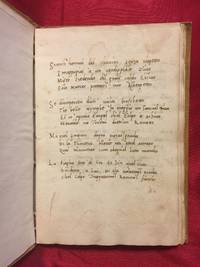
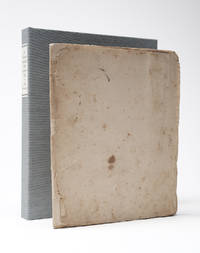
1510ref. 2973Venice 1510. 8vo. in fours. Collation: A-Q4 COMPLETE. 64 ff. some signatures written in contemporary MS several erroneously neat modern foliation in pencil. Paper size: 155 x 105. Watermarks: Northern Italy ca. 1480-1520 see below. Bound in late 18th century Italian sprinkled ochre boards upper cover with title in MS. Text in Italian and with the titles of several poems in Latin. Several types of Italian humanistic literae cursivae all apparently by the same person see images below numerous corrections throughout. Fascinating Unknown Venetian Manuscript of Unpublished Sonnets and Love Letters ca. 1510. An important discovery. Unknown manuscripts of unpublished Italian poetry written in Venice during the age of Aldus Manutius are rare in private ownership. The present manuscript contains 100 poetical compositions sic and merits considerable scholarly inquiry: certain sonnets and poems were extensively revised showing authorial development; the handwriting is perfectly clear in some instances modeled after contemporary Italian writing masters; and finally the codex is preserved in remarkably fresh condition and is perfectly suitable for exhibition and intensive study. The manuscript consists mainly of sonnets in the style of Petrarch several capitoli and strambotti and includes many revisions variants and even cancellations to which two intriguing love letters were added. The name of the author is unknown but his identity may yet be discovered as he left a number of intriguing clues in the text the most obvious one being the family name Colonna famous in Venice and Rome and the names of several of his muses. Certain sonnets exhibit handwriting reminiscent of Giovanni Antonio Tagliente ca. 1460s - ca. 1528 who worked for the Venetian Chancery and whose "Lo presente libro" Venice 1524 continues to inspire modern-day calligraphers and typographers. We may also reference the work of writing master Ludovico Vicentino degli Arrighi 1475-1527 who seems to have started his career in Venice before becoming a Papal scribe and type designer. That the MS was written over a long period in some instances interpolated on formerly blank leaves is attested by the changes in handwriting and ink. To illustrate the development of the codex itself we propose an artificial division of four sections: ¶ Section A contains 42 sonnets written in the litera cursiva styles A and B. The neat humanistic handwriting is comparable with that used by contemporary Venetian scribes. If the text had been copied from previous drafts it is clear that the author remained unsatisfied as there are a number of substantive revisions in the text. In the upper margin of eleven sonnets were written the title of the poem - in Latin - at some point in the life of the MS. Two sonnets in this section were cancelled by the author. ¶ Section B contains 32 poems written in the litera cursiva styles C-G. These were presumably written in the same period except for some interpolated sonnets that were written slightly afterwards. ¶ Section C contains 16 poems one of which bears the date 27 Ianuarij 1510 fol. 46v. This section surely contains poems written in a different period including two sonnets fol. 49r-v that were written in the humanistic litera cursiva style A which begins the MS. ¶ Section D contains two Love Letters plus an Addenda of 10 "new" poems and capitoli hastily written. That the author may have had thoughts on publishing his work is suggested by the "printer's signatures" that were written by him in ink in the lower margins of the first 16 leaves. If such a book was ever printed it has not been located; indeed not even a single poem has been traced see below for a complete Index Poematum. The fact that the author never signed his work may be due to the private and very personal contents of this Canzoniere. The work was probably begun by the author as a young man and for years it served as a vehicle of consolation for unrequited love. Faustina Helena Colonna Laura Arianna In the first sonnet Stanch'ormai dal cacciar senza rispetto fol. 1r the author claims to have met "three beautiful nymphs" during a break from hunting. A possible connection to the Colonna family is first suggested in Sonnet II A una colonna d'alabastro fina 1v in which the poet declares his eternal lover for Faustina "ni altra Dea adorerò ch'a Faustina." The word colonna is found in other compositions throughout the Canzoniere suggesting that at least one of the author's muses was a member of the famous Colonna family. Sonnet XVIII Ardo piango sospiro et a tutt'hore 9v ends with the verse chiedendo sempre a un cor di marmo a una colonna viva "always begging a marble heart a living column" again suggesting by means of a well-crafted literary image the Colonna family. Most importantly the actual name "Helena Colonna" appears as the caption heading to Sonnet LXXXII Da una marmorina Alta colonna 48v. Lady Colonna may be referenced in the first Love Letter 53v in which the author describes her as alta colonna di mia vita "high column of my life". No longer is the Colonna surname obscured behind imagery. The promise of endless love to Faustina was not kept unless the author cleverly utilized more than one name for the same woman a not-uncommon practice in this particular genre. Two other names appear herein namely Laura and Arianna. That the author may have had changes of heart might be due to the fact that he seems to have written the poems over an extended period of time see images of the handwriting development A-G and is therefore a record of failed love years in the making. The sonnets reflect perpetual desperate longing almost always to the point of death. How could it be otherwise The Philosopher and His "Poetessa" Muse In Sonnet LI I' solea ben la penna et l'intelletto 28v the author states quite clearly that the object of his desire was also a poet declaring that a mortal blow has pierced his side because he has lost the paper the ink and each amorous rhyme of his Lady's verse persi la carta l'inchiostro e ogni amoroso detto. The author claims that he is much better at writing about philosophy: Smaritha quella strada. altro sentiero Hora mi è scorta mi governa et regge Qual va fina Avicenna e agli aphorismi Ove Signor si vostre rime egregge Non han da me risposta: a dirvi 'l vero Mi torna meglio scriver Syllogismi. "The road is lost. A different path is now taking me to Avicenna the philosopher and to Aphorisms where Lady your excellent rhymes have no answer; to tell you the truth I'm better in writing Syllogisms." Thus the identity of the author a "reluctant poet" may be found among contemporary Venetian philosophers. Index Poematum Section A litera cursiva styles A and B: I. Stanch'ormai dal cacciar senza rispetto "Stanch' hormai dal chacciar senza rispetto" fol. 1r II. A una colonna d'alabastro fina 1v III. Deponni l'archo la pharetra Amore 2r: textual corrections IV. Deh! Potess'io canggiar tecco mia sorte 2v: caption title in Latin V. Non posso più celar la fiamma ardente 3r: caption title in Latin VI. Era tutto coperto d'adamante 3v: caption title in Latin textual correction VII. Vedendo de gli fior le Vite corte 4r: caption title in Latin textual correction VIII. Vaten felice Aventurata Rosa 4v: caption title in Latin IX. L'esca gli stral et l'amorosa Rete 5r: caption title in Latin X. Quando sera quel giorno che chi m'have 5v: the entire sonnet cancelled XI. Dolce m'e 'l giogo et la pregion men grave 6r: caption title in Latin XII. La singular mia fede che vi porto 6v: entire sonnet cancelled XIII. Ardo d'Amor et ho la fiama viva 7r: caption title in Latin textual corrections XIV. Donna gentil fin hor son sta patiente 7v: caption title in Latin XV. Se mai per tempo alchun mi vedrò sciolto 8r: caption title in Latin XVI. Amor un dolce viso teso havea 8v: caption title in Latin XVII. Madonna ogni mio ben da dolci Rai 9r XVIII. Ardo piango sospiro et a tutt'hore 9v XIX. Qual vero Pregionier al sacro Tempio 10r XX. Sono doi animali un de si altera 10v XXI. Un scoglio d'una Pietra è tanto ardita 11r XXII. Amor in guisa d'huom che guerra aspetta 11v XXIII. Il mie Adversario a cui in tutte l'hore 12r XXIV. Amor nel volto mio ben più di mille 12v XXV. Sapete che ben solo me nutrisco 13r XXVI. Una che qui tra noi excider suole 13v XXVII. Si questo e ver Amor como se dice 14r XXVIII. Donna gentil mi sento 14v XXIX. Deh! Perché non vi è noto il mio dolore 15r XXX. Se gli è pur mio destin ch'amando i' rompa 15v XXXI. Sempre vidi Iustìa star accorta 16r XXXII. Come voi ho et d'enverno et d'estate 16v: textual corrections XXXIII. D'un verdeggiante Lauro un giorno Amore 17r: textual corrections XXXIV. Gli occhi leggiadri ove ch'alberga Amore 17v: final line verse rewritten in an 18th century hand XXXV. S'io fusse di sospir Et pianto privo 18r: extensively revised then completely cancelled XXXVI. Gratie che a pocche donne Amor concede 18v XXXVII. Occhi miei lassi ho ben mirare Fiso 19r: textual corrections XXXVIII. Il Pellegrin avintto dal disio 19v: textual corrections XXXIX. Il Chacciator che nel bosco la Ferra 20r XL. Smarite piaggie ov'hor piangendo torno 20v XLI. Mille fiate al di m'assale Amore 21r XLII. Ogni luocho mi spiace ov'io non trovo 21v fol. 22r: S'io fusse de sospir et pianto privo: variant of Sonnet XXXV hastily written as a draft 22v-23r: two pages of verse extensively revised and then apparently abandoned 23v: blank Section B litera cursiva styles C-G XLIII. Amor Fortuna a sì'nfelice Sorte 24r Fol. 24v: blank XLIV. Lasso credendo haver pur qualche pace 25r: textual corrections XLV. Scoprir non posso l'amorosa fiama 25v XLVI. Miser vo pur scorgendo a passo: a passo 26r: textual corrections XLVII. Miser tutto ardo Et piango a tutte l'hore 26v XLVIII. Io viverei con la Phenice a prova 27r XLIX. Per la merce dil mio si longo affanno 27v L. Gli occhi beati intorno han l'esca e'l visco 28r: textual corrections LI. I' solea ben la penna et l'intelletto 28v LII. Sotto rara beltà nascosto è l'hamo 29r: textual corrections including one stanza cancelled LIII. Piango cantando 'n rime il mio lamento 29v: textual corrections LIV. Qual dolce mana qual esca qual visco 30r: introduction of "Laura" LV. Quando Madonna con dolci parole 30v LVI. In fronte meco i' porto l' ben e il male 31r: textual corrections LVII. Occhi ove ch'Amor sovente tresca 31v: textual corrections LVII and LVIII are written on the same page but in different handwriting styles LVIII. Che il tempo si consuma ogni fier cosa 31v: textual corrections LIX. Sol per farmi gustar mana in veneno 32r LX. Baso ogni giorno mille et mille volte 32v LXI. N'anti ch'entrasse un'hora me ritrovo 33r Fols. 33v-34r: blank LXII. Lauda le ver ch'ogni fidel amante 34v LXIII. Laura soave che si dolcemente 35r: reintroduction of "Laura" LXIV. Deh! Vi fusse si noto quanto ch'io ardo 35v Fol. 36r: blank LXV. Si come è vagho un vivido colore 36v: a capitolo written for "Arianna" LXVI. Maraveglia non è si ho mesto il volto 37r LXVII. Chi non vedrà quanto è mia bella 37v LXVIII. Dovran per mostrar gran maraviglia 38r LXIX. Si come è bello un vivido colore 38v: preliminary verses corrected cancelled and apparently abandoned LXX. Se mai per altra donna i' rompo fede 39r Fols. 39v-40r: blank LXXI. Et copre donna quel candido seno 40v: caption heading: "Laura S. C." LXXII. Amor da cui mai fu troppo lontano 41r LXXIII. Quella ch'un tempo la ti piacque tanto 41v-42r LXXIV. S'el primo di che mi piacesti tanto 42r-43r: ending with "Telos" in Greek Fol. 43v: blank Section C: LXXV. Vaga et smarita va Phylosophia 44r LXXVI. Spirto gentil in cui valor si trova 44v LXXVII. Occhi che nel mio cor fate il bel nido 45r LXXVIII. Gli occhi ove scherzar si vede amore 45v: textual corrections LXXIX. S'el vivo Sol et le doi chiare Stelle 46r: dated 27 January 1510 at Venice "M.E." LXXX. La meggia notte facea meggio giorno 46v: textual corrections LXXXI. Gratie da gli occhi uscian sante et si nove 47r: textual corrections Fols. 47v-48r: blank LXXXII. Da una marmorina Alta colonna 48v: textual corrections; caption title: "Helena Colonna" LXXXIII. Istarò sempre come scoglio al onde 49r LXXXIV. Ogni supplitio dammi ogni martoro 49v LXXXV. Questo già non pensai superba Altera 50r LXXXVI. Deh! Pensa un poco a la mia Iniqua sorte 50v LXXXVII. Da poi che per amar son gionto a morte 51r LXXXVIII. Non è cosa mortal benchè in fra sphera 51v LXXXIX. Ben è infelice chi in fra mondo ingrato 52r XC. Se dil mio amor volevi esser felice 52v: textual corrections Section D Sigs. O-Q4: NB: These three gatherings have a waterstain which does not appear in any of the preceding gatherings or individual leaves. First Letter: Honoranda et singular mia Diva la cui imagime como richo thesoro explicit: Vale o et praesidium et dulce decus meus 53r-54v Second Letter: Suolsi communemente dire almo mio Sole explicit: Vale. 54v-55v XCI. Così come un sasso accorto et destro 55r XCII. Né illegible word d'haver più pena vale 55r XCIII. A che mostrarmi pace nel aspetto 56v XCIV. Io son contento poi che m'hai nel Iocho 57r-57v XCV. Sacro santo mio nome Alma mia stella 58r-59r: caption heading: "Capitolo" / Finis XCVI. Rotto e carcho d'amor spreciato e l'arco 59r-60v: caption heading: "Capitolo" / Finis XCVII. Un dolce laccio ha fatto amore 61r-61v: textual corrections; caption heading: "Capitolo" / "Telos" in Greek Fols. 62r-63r: blank XCVIII. Mai rosa fu si vagha nel mattino 63v: caption heading: "Strambotti" XCIX. De' Lumi da begli occhi discendea 63v: caption heading: "Strambotti" C. Doi occhi da far arder 64r: caption heading: "Sonetto" Fol. 64r: blank WATERMARKS: As the book is an octavo the watermarks appear in the upper gutter margins and thus only one half appears at one time; however it has been possible to identify them especially with the aid of the countermarks "angle" and "lettre B". Chapeau: type of Briquet 3456 Venice 1499 and Briquet 3461 Udine 1521. Balance: type of Briquet 2575 Venice 1478 Briquet 2587 Verona et al. 1525. unknown books
ref. 3001S.l. n.d. 20th century. Watercolor on paper. Matted visible 163 x 83 mm and framed 257 x 150 mm. This weird and wonderful watercolor may be something we will forever regret selling at any price. It is unsigned but clearly by an artist of considerable imagination. We find the image compelling and highly curious: in the shadow only one hand is holding the mask and yet the girl is firmly grasping it with two. What is the significance of this demonic mask and why would a girl be presenting it above her head in a manner that could almost be described as ritualistic The child seems to gaze away from the viewer but who - or what - is she looking at We unable to explain our fascination with this watercolor. For those who are similarly ensorcelled: no explanation is required. unknown books
1814ref. 35391Philadelphia PA: Published by Johnson & Warner No. 147 Market Street; Griggs & Dickinsons Printers 1814. 12mo. 35pp woodcut frontispiece illustration 6 full page woodcut illustrations. Bound in stiff plain yellow wrappers lightly toned stitched. First and last leaves pasted down to wrappers. Stitched spine worn. Uniform tanning light scattered foxing. Good to Very Good. Rosenbach 514. Published by Johnson & Warner, No. 147, Market Street; Griggs & Dickinsons, Printers unknown books
1835ref. 20091835. First Edition. Softcover. Very good. Small 4to. Manuscript on paper. 2 53 pp. Complete. Stitched plain paper wrappers torn and frayed along spine with loss edges untrimmed. Minor blemishes to the text but unsophisticated. Preserved in a protective cloth case. Highly curious and apparently unpublished German Romantic play concerning the "Death of Lottchus" in Part 1 and his ghost in Part 2 "The Happiness of Marriage." The action takes place in Rubeland Saxony-Anhalt. Other performers include Flanko Wolf Fritzus and his wife Perdestalla Liebling and Maloss. Despite extensive searching we have been unable to find any reference to a play such as this. unknown books
1803ref. 1261Paris: Barba Delaunay Cavanagh Les Marchands de Nouveautes & Tiger 1803. Hardcover. Very good. Dates: 1803-1824. 16mo. together 5 works in one volume: 144 pp 179 pp 160 pp 122 pp 108 pp. each work accompanied by an engraved frontispiece of which 2 are hand-colored some fraying along outer edges. Bound in contemporary French half basane over marbled boards a little worn but suitable for exhibition and study. Highly curious Sammelband of five "Ana" an important genre of late-18th and early 19th century French literature today little known and under-appreciated by academics. At that time EVERYONE read Ana even the critics who excoriated these fugitive pieces of literary ephemera while secretly delighting in their unabashed "bad taste." Concerning Ana Mornet correctly states: "One misunderstands the history of French thought in the 18th-century if one confines it to the history of strictly literary genres . In the provinces especially far from the theater the opera and the fashionable salons when one ceases to be ignorant and indifferent." Mornet judges that the genre of Ana is particularly responsible for assembling useless fragments of knowledge without a greater plan. He qualifies Ana as "crumbs of science" "empty and puerile curiosities" "and chatter." Modern academics ignore Ana at their peril. Once ubiquitous many of them are now very scarce as they were read and reread by audiences all over French and soon discarded. Ana serve to inform us about French language and culture high and low in the broadest possible way. A very balanced account of the history and significance of Ana is given by Jennifer Tsein The Bad Taste of Others: Judging Literary Value in Eighteenth-Century France 2012 pp. 173-174 with references to Daniel Mornet's Histoire De La Clarte Francaise 1929. ¶ CONTENTS OF THE COLLECTION: 1. Angotiana ou suite de calembours comme s'il en pleuvait. Contenant les amours du Per-Vertisseur et l'histoire du fameux Lagalisse sa naissance sa vie sa mort en 50 couplets. Avec le portrait de Corsse dans madame Angot. Septième édition. Paris 1803. 2. Armand Raguenau de la Chaînaye. Facetiana précédé de l'origine de Mlle d'Alambic épouse d'Esprit-Pointu et orné de son portrait en taille d'ours. Avec les bons mots de Marianne par Anagrame Dauneur sic. Paris 1817. 3. Rousseliana ou recueil de tous les bons mots vers calembourgs lazzis et facéties des Cadet-Roussel où l'on a réuni toutes les additions de Monsieur Brunet qui ne se trouvent pas dans les pièces imprimées. Avec sa permission et la tragédie de Matapan ou les assassinats de l'amour. Par Anagrame Dauneur. Paris n.d. 4. Carnavaliana et Caremiana ou Variétés sur le carême et le carnaval bons mais anecdotes plaisantes chansons etc'. A Baochopolis. Paris n.d. ca. 1811 "Ce n'est pas un chef-d'oeuvre" ! according to Adrien-Jean-Quentin Beuchot Répertoire de bibliographies spéciales curieuses et instructives Paris 1811 where he describes the work as appearing "only a few days ago" p. 7. 5. Paysaniana ou Recueil d'anecdotes bons mots plaisanteries sarcasmes réparties ingénieuses traits de naïveté de finesse d'ingénuité et de malice des paysans entremêlé de chansons villageoises et terminé par l'oraison funèbre d'un paysan; par un Campagnard. Paris n.d. ¶ REFERENCES: Aude Bibliographie des Ana pp. 7 40 92 25 et 80. Barba, Delaunay, Cavanagh, Les Marchands de Nouveautes, & Tiger hardcover books
ref. 0000655France Early 20th Century. Marble paper wrappers. Very Good. 12mo. 14.5 x 9.3 cm. Marble paper wrappers. Title written on small piece of paper glued to front cover. with written title on pasted piece of paper on front cover. Collation; 17pp. One page of text and 16pp. of drawings. The text page gives a description and name of all the parts of the Vickers machine gun. Each part is numbered in the text and on the drawing of the machine gun in the first double page drawing on the next page and following single page drawing. The remaining pages are organized as plates I-VIII. Every part illustrated has each component of the part labeled in French. Any person can use this manuscript to know each and every part of the gun to the point that they could disassemble and assemble it without error. This a most detailed and extensive drawing of the Vickers machine gun a most reliable weapon used by the British army from 1912 during the first World War and continued in use until 1968. The Vickers machine gun or Vickers gun is a name primarily used to refer to the water-cooled .303 British 7.7 mm machine gun produced by Vickers Limited originally for the British Army It was in service from before the First World War until the 1960s with air-cooled versions of it on many Allied World War I fighter aircraft.The weapon had a reputation for great solidity and reliability. Ian V. Hogg in Weapons & War Machines describes an action that took place in August 1916 during which the British Army's 100th Company of the Machine Gun Corps fired their ten Vickers guns continuously for twelve hours. Using 100 new barrels they fired a million rounds without a single failure. "It was this absolute foolproof reliability which endeared the Vickers to every British soldier who ever fired one."Wikipedia unknown books
ref. 008990Tashkent: Gotlitizdat of the UzSSR 1958. First Edition. Hard Cover. Very Good. 8vo - over 7¾" - 9¾" tall. 191 pp. Tashkent: Gotlitizdat of the UzSSR, 1958 unknown books
1933ref. 309321933. Waugh Alec introduction by. Waugh Alec introduction by. Anonymous. A Lawyer's Notebook. Introduction by Alec Waugh. London: Martin Secker 1933. 246 pp. Paperboards over cloth lightly rubbed. Paper label on spine. Minor foxing to endpapers. Very good. $10. unknown books
ref. 002978People's Republic of China: s. n. Fine. Character set of 108 die-cuts in various colors pink green black red brown orange etc. undated second half of the 20th century; housed in a silk-covered box in black and red with gilt title to lid and two faux-bone fasteners; paper-cuts approx. 5 x 3 1/2 each in a protective tissue wrap; box - 6 3/4 x 5 x 1; one of the paper cuts with a small crease to upper corner the rest in fine condition; box with minor wear to edges and corners - in near fine condition. An uncommon complete set each paper cut represents one of the 108 characters of the 14th-century Chinese novel "Outlaws of the March" also translated as "Water Margin" and attributed to Shi Nai'an. The faces costumes weapons and names and nicknames are incredibly finely detailed. As they are all created by hand it has been said that no two sets are completely the same. The Chinese art of paper cutting using scissors or knives is one of the country's oldest and most popular folk arts and dates back tot he second century AD after the invention of paper by Cai Lun in the year 105. s. n. unknown books
1926ref. 2327New York: Gallia Laboratories Inc. 1926. 24mo 5 1/2 x 4 1/4 inches; 138 x 107 mm 8 pages in stapled wrappers. Promotional pamphlet for Kola Astier a product possessing "remarkable curative and stimulative properties quite unknown to any other preparation." According to the manufacturer Gallia Laboratories Kola Astier builds muscular strength fights fatigue relieves depression and "melancholia" stimulates the heart and helps in combatting bronchitis pneumonia and "senile debility." It also acts we're told as a "remarkable regenerator" for "tired overworked men and women." Where did this cure for every ailment come from According to the company Dr. P. Astier recognized the amazing properties of the kola nut. "Long before the white man traversed the midnight jungles and the wild plains of mysterious Africa the natives were using the fruit of the Kola Tree to increase their physical stamina and powers of endurance. Finally when the first white explorers forced their way into the heart of the Dark Continent they too soon recognized the value of this gift of the Gods." This text is accompanied by an illustration of spear-wielding African warriors. Other illustrations depict runners an apparently sick office worker and an exhausted home maker. Unfortunately for the company the U.S. Agriculture Department determined that Kola Astier contained no ingredients capable of producing any therapeutic or curative effects claimed by the company. In March 1933 the U.S. Attorney for New Jersey sought the seizure of 199 bottles of Kola Astier Granulated charging misbranding in violation of federal rules. Analysis by the U.S. Agriculture Department showed that the product consisted essentially of sugar 97.3% and small proportions of plant material including kola. A federal district court ordered that the 199 bottles be destroyed. That judgment didn't stop Gallia Laboratories from promoting its miracle cure. In June 1943 the Federal Trade Commission charged the company with making false misleading and deceptive statements about its products. It ordered the company to stop claiming that Kola Astier had any therapeutic value in the treatment of any disorder. This pamphlet is rare. OCLC shows no institutional holdings. None in commerce. CONDITION: Some staining soiling and a few small nicks to wrappers as well as rusting to staples. But the pages are clean bright and unmarked. A Very Good copy. Gallia Laboratories, Inc. paperback books
1935ref. 7217Paris: Les Editions Nationales 10 Rue Mayet; Le Société. 1935. Octavo 210 x 16.5 cm. 38 8 pages. Illustrated with color lithographs by Edy Legrand. FIRST ORDINARY EDITION one of thirty-five thousand copies on velin d'alfa. A promotional item serving the producers of Roquefort cheese with text by two of the greatest of French mid-century food writers and illustrations by the great illustrator and painter Edy Legrand. Tiny bit of bumping to corners; otherwise internally fine. In tan wrappers printed in blue and black; wrapper edge rubbed and spotted. Good plus. Les Editions Nationales, 10 Rue Mayet; [Le Société...] unknown books
1833ref. 7019Quedlinburg & Leipzig: G. Basse 1833. Octavo 17.5 x 12 cm. 80; 44 pages; with the addition of 12 pages and 4 pages respectively of contemporary hand-written notes in German. Second Improved Edition; First Edition. Two works bound as one. The first consists of a general guide to making all kinds of vinegars from different sources and for differing purposes. Domestic and commercial production of these useful ferments are discussed including unusual applications e.g. as perfume bases. The second part is a complement to the first item in that the author discusses the production of various sources for initiating fermentation especially those utilized in alcoholic distillation. Overall age-toning and some stains. The last four pages of advertisements of the second item removed at binding. In contemporary paste paper boards. Worn at extremities paper spine label partially worn away. Good or a bit better. A small attractive nineteenth century ownership stamp on a blank portion of the title page of the first item. Neat ownership signature to front fly "Ex Libris m. Schmitt". Additional pencil ownership inscription to front paste down locating the book in Harrisburg Penn. The autograph notes are bound in place with additional blanks after each item. Rare. OCLC locates no copies of the first part and just seven copies of the second none in North America. G. Basse hardcover books
ref. 108081London-Paris-New York: Raphael Tuck & Sons Co. Ltd. n. d. circa 1895. Small slim 8vo 8 pp. text and illustrations printed in brown excepting two chromolithograph illustrations staple bound linen with chromolithograph wrappers cover title. Some pages creased cover slightly discolored joint has a tear some stains; good. § Father Tuck’s “Dolly Dear Series” Artistic Series No. 2304. Tuck & Sons became a limited company in 1895. Includes the nursery rhymes “Little Jack Horner” “A Little Cock-Sparrow” and “Puss in Boots” retold in verse. OCLC 317816739. Raphael Tuck & Sons unknown books
ref. 108084London-Paris-New York: Raphael Tuck & Sons Co. Ltd. n. d. circa 1890-1900. Small slim 8vo. 8 pp. in-text illustrations including two chromolithographed illustrations staple bound linen with chromolithograph wrappers cover title. Cover slightly darkened edges slightly frayed some stains; good. § Father Tuck’s “Dolly Dear Series” Artistic Series No. 2802. Tuck & Sons became a limited company in 1895. Includes the nursery rhymes “Little Bo-Peep” “The Fisher of Lea” “Thank you Pretty Cow” and “As I was going Along” retold in verse. OCLC 317816739. Raphael Tuck & Sons unknown books
1996ref. 1079098pp. Oldham UK: Incline Press 1996. 8pp. with 5 wood engravings by Enid Marx. Dark gray soft cover with hand-bound pages. Fine as issued. § One of an unnumbered edition. Incline Press paperback books
1867ref. 5264Boston: Ticknor and Fields 1867. 16mo. vii 183 pages. First edition. A novel addressing the strains of running a household during the Civil War including the challenges of War-time taxation speculation oil fever inflation etc. A section in which the main character considers charitable work with the Sanitation Commission or ladies' charitable groups is enlightening. Some soiling to a few pages. Previous owner's inscription to endpapers; newspaper clipping bearing a mosquito bite remedy pasted to foot of title page; bookseller's ticket removed from rear paste-down. wear and rubbing to boards and spine of blind- and gilt-titled brick red cloth. Good. Wright American Fiction vol. 2 no. 2235. Ticknor and Fields hardcover books
1868ref. 3812New York: G.P. Putnam & Son 661 Broadway 1868. Octavo 134 pages 6 ads variously paginated. First edition. A special forward on breakfast includes the following: "A breakfast should be as carefully composed as a dinner. Secure by art what is due to the dignity of the meal and give it its true position." With the bookplate of Mrs. John Calvin Smith wife of the cartographer and member of the American Geographical and Statistical Society. Additional previous owner's name to preliminary blank. Otherwise near fine in publisher's blank-ruled and gilt-titled green cloth. OCLC locates thirty-six copies; Bitting 618; Brown 2369a; Cagle 808. G.P. Putnam & Son, 661 Broadway hardcover books
1868ref. 4990New York: G.P. Putnam & Son 661 Broadway 1868. Octavo 134 pages 6 ads variously paginated. First edition. A special forward on breakfast includes the following: "A breakfast should be as carefully composed as a dinner. Secure by art what is due to the dignity of the meal and give it its true position." Some soiling throughout; hinged a bit shaken; in publisher's blank-ruled and gilt-titled brown cloth. Cloth is edgeworn and dampstained. OCLC locates thirty-six copies; Bitting 618; Brown 2369a; Cagle 808. G.P. Putnam & Son, 661 Broadway hardcover books
ref. 8845ca. 1890. Oblong label from an apple crate. 4 1/2” tall x 14” wide. Full-color illustrations. Some chipping to corners. Moderate spotting with a crease from top to bottom. § A charming Victorian chromolithographic label depicting two children standing under an apple tree with six more children peering over the wall longingly. A large juicy apple appears at the left with the lettering “Choice Apples”. unknown books
1898ref. 241541Paris: Carrington 1898. paperback. very good. Literally tranlated from the Arabic. By an English "Bohemian". Frontispiece. Rubricated title. Tall 8vo uncut original stiff buff printed wrappers dust soiled. Paris: Charles Carrington 1898. Very good. One of 500 numbered copies. Carrington unknown books
1866ref. 1646Paris: Achille Faure Libraire-Editeur 1866. Duodecimo 180 pages. FIRST EDITION. A collection of three hundred eleven culinary observations with a calendar. With the ex libris stamp of H.J. Grossi and a bookseller's stamp to the rear paste down. Little bump to head of spine otherwise a fine copy in contemporary green buckram. Vicaire Bitting later edition. Achille Faure Libraire-Editeur hardcover books
1868ref. 33727New York: Harper 1868. Harper unknown books
1813ref. 25236Albany: Backus 1813. First American edition. Full antique calf gilt. Backus unknown books
ref. 6252France: Adrien Maeght ca. 1850. Oblong 8vo 15 color lithographs. Original blue cloth boards with gilt floral design surrounding title all set inside a gray cloth label affixed to upper board. Slight bowing to upper board. A very good copy. § First edition. La Flotte de Jours translates as The Ships of our Days. This lovely book contains 15 full-color fold-out lithographs depicting 15 different French ships. No copies on OCLC or COPAC. Adrien Maeght hardcover books