Cheney, Harriet Vaughan (Anonymous)Biblio.com
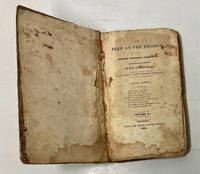
1824ref. 2231529Boston: Wells and Lilly 1824. 1st. Hardcover. Fair/None. 270 pages. Hardcover without dust jacket. Significant wear and rubbing to faded marbled boards. Spine appears to have thin cloth repair or rebinding without title. Staining foxing age wear throughout text block. Names of previous owners in front end papers. From p270 onward final six pages of volume appear to be missing with pp271-2 partially intact. Volume II only. This is part of a scarce early 19th century American work of historical romance fiction written by a woman. Evans 15732; OCLC locates 8 copies. Harriet Vaughn Cheney nee: Foster; 1796-1889 was a Massachusetts-born American-Canadian novelist. Her first book was published in Boston in 1820 and was followed with this novel four years later. She would later marry a Canadian and move to Montreal where she and her sister founded a monthly girl's magazine titled "The Snow Drop". Record # 2231529 Wells and Lilly hardcover
ref. 828496Imprimerie De Marius Olive Marseille 1838 In-8 carré ( 265 X 210 mm ) de 23 pages, broché sous couverture imprimée. Rousseurs. Trés rare.
ref. FR5151HPHOTOS SUR DEMANDE
ref. 500346738Cherche midi Sans date. Après avoir révélé sa séropositivité et sa greffe cardiaque dans 'L'Amour dans le sang' Charlotte Valandrey reçoit une lettre anonyme d'une personne qui prétend connaître et aimer le cœur greffé qui bat en elle. Ce livre relate son parcours pour comprendre cette présence intime et se libérer de cette étrange relation
1871ref. 19856Par M. le Vicomte de Chateaubriand. 4 gravures hors-texte dont le frontispice.Alfred Mame et fils, éditeurs - 1871 - 360 pp.Reliure demi chagrin de l'époque. Dos à nerfs ornés et doré, avec auteur et titre. Armes du lycée d'Angoulème sur le 1er plat. Menus frottements. Pas de rousseur. Très bon état. Format in-4°(27x18).
ref. 007092Charles-Simon Favart ; Hugh Kelly [traduit par Marsollier ou Mme Riccoboni] ; Anonyme ; Jean-François Cailhava de L'Estandoux ; Bernard-Joseph Saurin ; Recueil de pièces de théâtre à savoir, dans l'ordre de citation des auteurs : 1. Les Moissonneurs, comédie ; 2. La fausse Délicatesse, comédie ; 3. L'école du Soldat ou les Remords du Déserteur françois ; 4. Le Mariage interrompu, comédie ; 5. Spartacus, tragédie. Paris, Duchesne, 1768. [2]-88-[4]p. Paris, Duchesne, 1768. IV-98-[1]p. Paris, Duchesne, 1768. 56p. Paris, Merlin, 1769. [2]-V-[1]-78p. Paris, Duchesne, 1769. XVI-72p. Edition originale des quatre premières pièces. Reliure pleine basane, dos à nerfs orné, pièce de titre maroquin, tranches rouges. Coiffe supérieure arrachée (mais solidaire au livre), étiquette papier ancienne collée sur le premier plat, petits défauts. Bon exemplaire.
ref. 76613non indiqué sd, plaquette de 38 pages avec de nombreuses illustrations et un avant-propos du chanoine J. Sautel - très bon état
ref. lc_90537de la baconnière (1 janvier 1979)
1820ref. 28079Paris Cereghetti 1820 une gravure en couleurs, sur papier vergé crème, GRAVÉE A L'EAU-FORTE ET AQUARELLÉE à la main, FORMAT: 30,5 x 45 cm., sans date (1820) Paris Cereghetti Editeur,
1820ref. 28081Paris Cereghetti 1820 une gravure en couleurs, sur papier vergé crème, GRAVÉE A L'EAU-FORTE ET AQUARELLÉE à la main, FORMAT: 30,5 x 45 cm., sans date (1820) Paris Cereghetti Editeur,
1820ref. 28082Paris Cereghetti 1820 une gravure en couleurs, sur papier vergé crème, GRAVÉE A L'EAU-FORTE ET AQUARELLÉE à la main, FORMAT: 30,5 x 45 cm., sans date (1820) Paris Cereghetti Editeur,
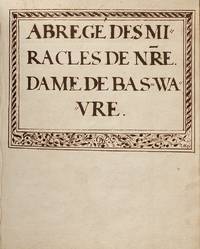
ref. 54926Modern-day Walloon Brabant Belgium dated May 1 1622. Small quarto 18.7 × 14.7 cm. Contemporary vellum; boards ruled and with gilt fleurons to center; 52 pp. of manuscript text to rectos and versos in brown ink on laid paper in a neat calligraphic hand. Text in French. Decorative title with signature and date to leaf 4. Boards lightly distended and with a few stains; text resized to binding minimally affecting the occasional letter edge and one chapter heading; paper somewhat toned and discolored; a few spots throughout; overall good or better. Anonymously authored and apparently unpublished manuscript composed as part of a popular revival during the Counter Reformation of the cult of Our Lady of Basse-Wavre in Belgian Walloon Brabant known today as Notre-Dame de Paix et de Concorde Our Lady of Peace and Concord. The church had been founded as a Benedictine priory dedicated to Saint Mary established by Affligem Abbey around 1092-1093 on land granted in 1086 by Count Henry III of Louvain and his brother Godfrey. In 1999 the chapel which had become a parish church in 1803 was made a minor basilica by Pope John Paul II the first and only basilica in the province of Walloon Brabant. According to tradition around 1050 farmers heard the sounds of "heavenly music" from the current site of the church the marshes of Basse-Wavre and decided to erect a structure in honor of the Virgin after witnessing a miraculous apparition. The construction was then relocated from the unstable marshlands but over and over it reverted to the original site by the morning. This culminated in a second vision during which the Virgin was said to proclaim: "I will live in this valley for I have chosen it" the vision is also described in chapter one of the present work. The preface establishes the probity of the author's sources: he or she relied primarily on the "Chronica" of Sigebert of Gembloux c. 1030-1112 a Benedictine monk of Gembloux Abbey in addition to other "ancient manuscripts" and "public testimony." These are said to cumulatively demonstrate a frequency and "grandeur" of miracles surpassing even those of Apostolic times and including "the greatest ones" such as the resurrection of the dead the restoration of eyesight to the blind and the curing of various illnesses. The manuscript is further divided into seven chapters which cover the foundation of the church; the discovery of the reliquary; the translation of relics to Brussels and miracles effected there; gatherings and processions with the relics; "burning sickness extinguished" from the bodies of Brussels residents most likely ergotism or St. Antony's fire; the reliquary chest; and finally a number of miracles worked elsewhere in the region during processions. The cult of Notre Dame de Basse-Wavre primarily centered around a "small casket" petit coffret of relics discovered at the site of the original vision which contained among numerous other important relics a fragment of the True Cross and of the Blood of Christ. By 1150 it was decided to translate the relics which were now in a reliquary chest "chapse" to Brussels possibly to protect against the plague where it was further embellished by silversmiths with precious metals and stones and where it worked countless miracles between the time of Easter and St. John's day June 24. A later chapter describes another miracle involving the chest within this time frame which may explain the subsequent tradition of a procession with the relics on June 24: seeing the many miracles associated with it the religious at Affligem Abbey desired to take possession of the "chapse" in order to honor their own monastery with it. But when the many monks and religious came to Brussels the chest would not budge until St. John's Day - again reenforcing the notion that the Virgin alone could chose the site of her cult. A fair copy in an easily legible hand the manuscript is signed with the initials "CDP" on the decorative title and was apparently never published. While it contains no express requests or suggestions its most likely purpose would have been to bolster a Brabantine Marian cult that had played a great role in medieval times and was witnessing a revival of sorts during the early seventeenth century as part of the Counter Reformation in the Spanish Netherlands. This intention is also suggested by the dedication to Isabella Clara Eugenia 1566-1633 sovereign of the Spanish Netherlands daughter of King Philip II and by 1622 widow of Albert VII Archduke of Austria. Albert and Isabella had taken a keen interest in Marian pilgrimate sites during their rule in an attempt to redefine the Spanish Netherlands as Catholic in distinct contrast to the Protestant North. At the time of writing Isabella had been a widow for almost one year and had publically assumed an expression of greater piety by taking the habit of a Poor Clare tertiary. Curiously the work was also written about one year after the Archbishop of Mechelen Jacobus Boonen had taken office. Boonen would officially affirm the cult by endowing the chapel of Basse-Wavre with a new reliquary in 1628 and one wonders whether the present text did not play a role however small in this turn of events. The lack of any provenance marks or annotations allows us only to conjecture as to its specific purpose; whether it was intended to be presented in this form to be submitted to the Church for approval to be printed or to be deposited as a reference copy with a local church monastery or the Bishop we cannot say. As of September 2026 we cannot trace the current text in any public holdings. STCV only records two titles on Basse-Wavre both later 1642 and 1721. unknown
1763ref. 24501Sans Lieu Sans Éditeur 1763 In-12 2 volumes in-12, 199 + 184 pp. Edition Originale de celui Qui fut le premier Maire de Pierry ( marne). Auteur trop souvent méconnu, précurseur de la littérature fantastique avec son oeuvre la plus célèbre, le Diable amoureux. Il f. Travail récent très bon cartonnage moderne, exemplaire à toutes marges
1846ref. 031953London: Charles Knight & Co. 1846. Book. Very Good. Cloth. New Edition. 16mo - over 5¾ - 6¾" tall. Red cloth over boards with brown paper pastedown and black label to spine. New Edition - most likely abridged. 5 7/8 x 3 3/4. "Line drawn frontis and 11 additional illustrations. Bookplate to endpaper and inscription to free endpaper. Wear to extremities; corners bumped and frayed. Front hinge starting. Endpaper to rear creased and torn. Inside foxing throughout otherwise pages clear readable and text block tight. A very good copy. Charles Knight & Co. Hardcover
1748ref. 10751Depuis l'année de Rome 543, jusqu'à l'année 548.Nouvelle édition, augmentée de plus de cent planches en taille-douce, compris des Cartes Géographiques qui ont rapport à l'Histoire.Tome IX. A Paris, chez Rollin 1748. (Ce volume contient 8 planches rempliées dont 1 carte de l'Espagne).Reliure plein veau de l'époque. Dos à nerfs orné et doré. Pièces de titre et de tomaison maroquin rouge. Filet à froid encadrant les plats. Tranches rouges. Rares rousseurs. Coiffes frottées, coins émoussés. Intérieur sain. Format in-12°(17x10).
1819ref. 18903Voyage en Italie par le peintre Antoine-Louis Castellan (1772-1838).Edition originale. Paris, chez A. Nepveu, libraire - 1819 - 367 pp, 307 pp, et 365 pp. - 50 planches gravées dont 6 à double page.Reliure plein veau de l'époque. Dos lisse ornés et dorés avec titre et tomaison. Coiffe sup. du T3 accidentée. Dos insolés. Pas de rousseur. Très bon état. Format in-8°(21x13).
1870ref. 265BB1870. Paris. Cheval ca. 1870 42 : 525 cm. Lithographie estampe en couleurs. unknown
1871ref. 261BB1871. Paris Edouard Blot 1871 50 : 315 cm. Lithographie avec texte typographique de Jules Choux. unknown
1871ref. 259BB1871. Paris Puissant 1871 585 : 395 cm. Lithographie avec texte typographique. Bords supérieur et inférieur légèrement froissés. unknown
1871ref. 257BB1871. Paris Cheval 1871 42 : 52 cm. Lithographie Estampe en couleurs. Collection de caricatures et de charges pour servir à l'histoire de la guerre et de la révolution de 1870-1871. unknown
1820ref. 5262Voyages et conquêtes des premiers navigateurs au nouveau monde; traduit de l'allemand, précédé d'une notice biographique sur l'auteur par M. Larenaudière. Nouvelle édition revue et corrigée, ornée de huit jolies figures.Paris, chez F. Denn, sans date, vers 1820.Reliure pleine basane mouchetée de l'époque. Dos lisse orné et doré. Tranches marbrées. Pales rousseurs sporadiques. Coins, coiffes et bords frottés. Bon état. Format in-12°(18x11).
1976Mm 110x185 Collana "Passato e futuro". Edizione a cura di Franca Biondi. Brossura editoriale di 282 pagine. Copia molto buona. SPEDIZIONE IN 24 ORE DALLA CONFERMA DELL'ORDINE.
1760ref. LBW-466[circa 1760]. En deux feuilles jointes de 307 x 518 mm.
ref. 22909In-8 à l'italienne, [41] ff., parchemin rigide, dos à nerfs (exemplaire défraîchi).
1834ref. 6089Réduit aux traits les plus curieux; pour servir de suite à l'abrégé de l'histoire générale des voyages par la Harpe, etc. Quatrième édition ornée de huit gravures.A Paris, chez Ledentu 1834.Reliure pleine basane fauve de l'époque. Fers à froid sur les plats. Dos lisse orné et doré. Tête dorée. Reliure frottée. Rares rousseurs. Intérieur en bon état. Format in-12° (17x10).