171.111 resultados
ref. DN-AYNF-50HPFine. Hardback with dust jacket. Indexed edition red letter no marks in text shipping daily. hardcover
1790ref. 4138London: Published by Robert Sayer 1790. Hand-coloured mezzotint. State vi/viii. A remarkable portrait of Lord Grosvenor's Pangloss by the master equine painter George Stubbs. George Stubbs is considered to be one of the greatest English painters. His ingenious animal and sporting pictures remain unrivalled in their passionate depiction of emotion and their commitment to naturalistic observation. Stubbs was briefly apprenticed to the painter Hamlet Winstanley a relationship that quickly ended leaving the young artist to his own education. In contrast to contemporary academic theory Stubbs attached great importance to the belief that art should imitate nature not the work of other artists. He spent years carefully studying human and equine anatomy so that he could truthfully represent natural form and movement. A result of this study was his famous Anatomy of the Horse which details with beautiful engraving the various elements of a horse's anatomy from skeletal form to muscular definition. By the 1760's Stubbs had developed a considerable reputation as a sporting artist and had attracted a number of distinguished patrons. Continuing in search of innovation Stubbs began experimenting with a myriad of different mediums becoming accomplished in both enamels and printmaking. Through arduous application he became a talented mezzotint engraver and worked with ease in both soft ground and etching techniques. Stubbs' masterful paintings inspired some of the greatest engravers of the day to reproduce his work for publication including his own son George Townly Stubbs who reproduced with faithful accuracy the sublime emotion inherent in his father's exquisite works. Stubbs was elected Director of the Society of Artists and a Royal Academician and today his prized paintings are housed in some of the finest museums in the world. Stubbs was often commissioned to paint accurate portraits of specific racehorses for proud aristocratic patrons who wished to highlight their horses' racing success. This practice is expertly exemplified with this magnificent print of Pangloss Lord Grosvenor's beloved horse. Pangloss was foaled in 1755 and named after a character in Voltaire's Candide; little is known about Lord Grosvenor's horse apart from the fact that his racing career was ended by a broken leg. This print was the second of a series of engraved horse portraits begun by the publisher Ryland in 1771 and extended by Robert Sayer in 1777. Although the inscription on the print establishes Stubbs as the painter the painting has not been identified making this print extremely intriguing since it is the only record of Stubbs' lost work. Lennox-Boyd George Stubbs 20 vi/viii; Gilbey Life of George Stubbs no.39; Siltzer The Story of British Sporting Prints p.270. Published by Robert Sayer unknown books
1790ref. 4138London: Published by Robert Sayer 1790. Hand-coloured mezzotint. State vi/viii. A remarkable portrait of Lord Grosvenor's Pangloss by the master equine painter George Stubbs. George Stubbs is considered to be one of the greatest English painters. His ingenious animal and sporting pictures remain unrivalled in their passionate depiction of emotion and their commitment to naturalistic observation. Stubbs was briefly apprenticed to the painter Hamlet Winstanley a relationship that quickly ended leaving the young artist to his own education. In contrast to contemporary academic theory Stubbs attached great importance to the belief that art should imitate nature not the work of other artists. He spent years carefully studying human and equine anatomy so that he could truthfully represent natural form and movement. A result of this study was his famous Anatomy of the Horse which details with beautiful engraving the various elements of a horse's anatomy from skeletal form to muscular definition. By the 1760's Stubbs had developed a considerable reputation as a sporting artist and had attracted a number of distinguished patrons. Continuing in search of innovation Stubbs began experimenting with a myriad of different mediums becoming accomplished in both enamels and printmaking. Through arduous application he became a talented mezzotint engraver and worked with ease in both soft ground and etching techniques. Stubbs' masterful paintings inspired some of the greatest engravers of the day to reproduce his work for publication including his own son George Townly Stubbs who reproduced with faithful accuracy the sublime emotion inherent in his father's exquisite works. Stubbs was elected Director of the Society of Artists and a Royal Academician and today his prized paintings are housed in some of the finest museums in the world. Stubbs was often commissioned to paint accurate portraits of specific racehorses for proud aristocratic patrons who wished to highlight their horses' racing success. This practice is expertly exemplified with this magnificent print of Pangloss Lord Grosvenor's beloved horse. Pangloss was foaled in 1755 and named after a character in Voltaire's Candide; little is known about Lord Grosvenor's horse apart from the fact that his racing career was ended by a broken leg. This print was the second of a series of engraved horse portraits begun by the publisher Ryland in 1771 and extended by Robert Sayer in 1777. Although the inscription on the print establishes Stubbs as the painter the painting has not been identified making this print extremely intriguing since it is the only record of Stubbs' lost work. Lennox-Boyd George Stubbs 20 vi/viii; Gilbey Life of George Stubbs no.39; Siltzer The Story of British Sporting Prints p.270. Published by Robert Sayer unknown
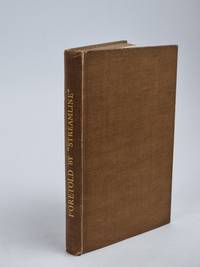
1934ref. 41557Eneas Mackay: Sterling Scotland 1934. First edition & 1st printing. Hardcover. VG copy in a poor/fair worn and torn dustjacket. ''Streamline'' - ''the author of these stories is a well-known airpilot who served in the R.N.A.S. and R.F.C during the war''. Very uncommon UK hardcover. Eneas Mackay: Sterling, Scotland hardcover
1934ref. 6189Stirling Scotland United Kingdom: Eneas Mackay 1934. First Edition. hardcover. Very Good. N/A. Publication: Stirling Eneas Mackay 1934. Formatting: 8vo original publisher's cloth. Condition Report: Very Good. A remarkably firm tight copy in the original publisher's brown cloth. The binding remains robust and entirely square with sharp corners that show only a trace of faint rubbing to the extremities. The spine is secure and its gilt lettering remains notably bright and unoxidised though the cloth exhibits some gentle uniform sun-fading typical of the era. The text block is pleasingly crisp; the pages are bright entirely free of foxing and the original untrimmed edges display only light natural age-toning. Internally the hinges are perfectly sound making this an exceptionally well-preserved and handsome survivor. Catalogue Note: This is a scarce first edition first printing of the title published in 1934 by Eneas Mackay. The author writing under the pseudonym "Streamline" was purportedly a well-known aviator who served with the Royal Naval Air Service and the Royal Flying Corps during the First World War. Copies of this title are uncommonly seen on the open market particularly in such unblemished condition without the aid of a dust jacket. It represents an unusual and highly specific entry into early twentieth-century occult and paranormal literature making it a compelling acquisition for collectors of Scottish printing early aviation pseudonyms and esoteric short fiction. A rare and intriguing collection of thirteen tales centered on the phenomenon of second-sight. Rooted in genuine accounts of premonitions warnings and infallible foresight gathered over thirty-five years the author explores the profound and often inexplicable reality of events foretold. Rather than simple ghost stories these are sobering purportedly true narratives detailing tragic or unpleasant premonitions where the seer was left entirely powerless to alter the impending fate. Eneas Mackay hardcover
1934ref. 09257New York: Farrar & Rinehart Inc 1934. Very Good/Very Good-. Octavo 296 pages; publisher's red cloth light off-setting to end papers. Dust jacket with price of $2.00 legible but partly clipped; tape removed from spine ends. First printing with Farrar Rinehart logo on copyright page light off-setting to end papers light stain in upper margin for first 20 leaves not affecting text. Farrar & Rinehart, Inc hardcover books
1934ref. 09257New York: Farrar & Rinehart Inc 1934. Very Good/Very Good-. Octavo 296 pages; publisher's red cloth light off-setting to end papers. Dust jacket with price of $2.00 legible but partly clipped; tape removed from spine ends. First printing with Farrar Rinehart logo on copyright page light off-setting to end papers light stain in upper margin for first 20 leaves not affecting text. Farrar & Rinehart, Inc hardcover
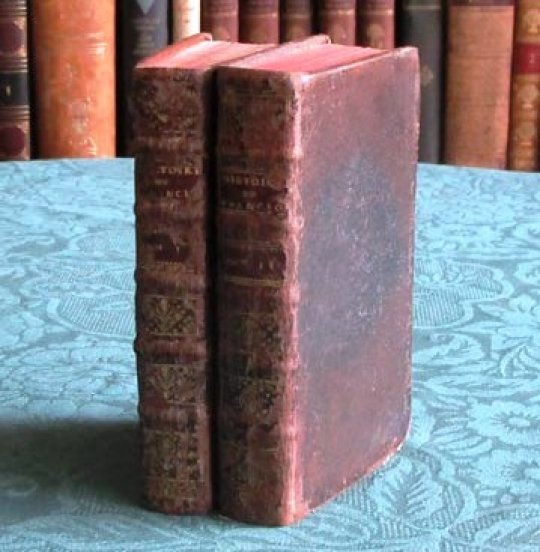
1760ref. 052729London: D. Chamberlaine 1760. The Third Edition . Hardcover. Good/No Jackets. 16mo - over 5¾" - 6¾" tall. 2vol.set: v1: 136&138pp. v2: 148&170pp. HBs full leather w/red&gilt-5 bands; covers detached ft.coverv1; both coversv2; rubbedscuffed&worn; staining on endpapers; ft.endpaperv2 detached; PON Geo. King 1779; cleantight pgs. Sterne's experimental fiction about fiction writing D. Chamberlaine hardcover
1903ref. 62969Zum ertensmal vollständig herausgeben von E. Stengel, Gedruckt für die Gesellschaft für romanische Literatur, Dresden, Vertreter für den Buchhandel, Max Niemeyer, Halle, 1903, XI-479 pp.
ref. 8836Bruxelles, De Rycker et Mendel, 1913. In 8 broché, premier plat orné d’un motif en relief, illustré.
ref. 0916856526.Ghardcover. Good. Access codes and supplements are not guaranteed with used items. May be an ex-library book. hardcover
1853ref. 5246Illustrée par de nombreuses vignettes, culs-de-lampe, bandeaux, etc.Paris, Victor Lecou 1853.Reliure demi-chagrin marron de l'époque. Dos à nerfs orné et doré. Tranches dorées. Quelques rousseurs sur les 30 premiers feuillets. Mors très légèrement frotté. Bon état. Format in-4° (27x19).
ref. 8I-SH8T-4IZBNew. unknown
1838ref. 160394 titres en 1 volume.1° La Lanterne magique, Histoire de Napoléon racontée par deux soldats Par Frédéric Soulié, ornée de 50 vignettes avec des Annotations par E. De La Bédollierre.Suivi de : 2° Bataille d'Austerlitz. 3° Inauguration de l'Arc de Triomphe. 4° Tableau Chronologique de l'Histoire de Napoléon pour servir de Complément au Texte de la Lanterne magique par E. De la Bédollierre (1769-1821).Édition originale. Paris, Alphonse Henriot - 1838 - 293 pages.Reliure bradel percaline prune de l'époque. Dos lisse au titre doré. Pas de rousseur. Très bon état malgré un dos insolé. Format in-8°(21x14).Frédéric Soulié (1800-1847) est un romancier, auteur dramatique, critique et journaliste français. Il fut, avec Honoré de Balzac, Eugène Sue et Alexandre Dumas, l'un des quatre grands feuilletonistes de la monarchie de Juillet. Auteur fécond et très populaire à l'époque, ses plus grands succès furent, comme romancier, Les Mémoires du Diable et, au théâtre, La Closerie des genêts.
1950ref. 6452Illustrations en couleurs.Edité par les laboratoires Pépin Leboucq. s.d. vers 1950. 62 pp.Ouvrage broché. Couverture illustrée. Pas de rousseur. Bon état. Format in-12° (18x13).
1721ref. 16968Composée par Nicolas de Moulinet, Sieur du Parc Gentilhomme Lorrain, soigneusement revue et corrigée dans cette nouvelle édition. Charles Sorel (1599-1674) a publié en 1633 la troisième version de sa vraye histoire comique de Francion sous le pseudonyme de Nicolas de Moulinet sieur du Parc, gentilhomme lorrain.A Leyde, chez Henry Drumond - 1721 - 10 ff, 390 et 3 ff, 473 pages. Grand ex-libris armorié collé au verso du titre du T1. 2 titres-frontispice et 11 figures gravées hors textes, dont 1 gravure supplémentaire non prévue.Reliure plein veau de l'époque. Dos à 5 nerfs ornés et dorés. Pièces de titre et de tomaison maroquin rouge (petits manques aux pièces). Tranches rouges. 1 coin émoussé. Dos frottés. Rares rousseurs. Bon état. Format in-12°(17x10).La Vraye Histoire comique de Francion est un roman, dont la première version est écrite par Charles Sorel en 1623. Elle constitue l'une des premières et des plus importantes histoires comiques. Il raconte les aventures amusantes de Francion, gentilhomme français à la recherche du grand amour. Elles permettent à Sorel de faire une satire assez vive de la société de son temps.L'histoire comique de Francion, est publiée d'abord en sept livres, revue et allongée en onze livres en 1626, puis en douze livres en 1633
ref. 103353Neuilly-sur-Seine, 190, Avenue de Neuilly, s.d (c. 1940), in-8, 14 pp, Broché, couverture illustrée, Catalogue illustré en noir. Plis et accrocs à la couverture. Couverture rigide
ref. R320025075DEGORGE-CADOT. NON DATE. In-12. Broché. Etat passable, Plats abîmés, Dos abîmé, Mouillures. 271 + 12 pages - Quelques rousseurs et mouillures sans conséquence sur la lecture - Ouvrage partiellement desolidarisé - 2eme plat desolidarisé - Dos abimé et fendu - petite ollée sur le haut du 1er plat.. . . . Classification Dewey : 848-Ecrits divers, citations, journaux intimes, souvenirs, mémoires
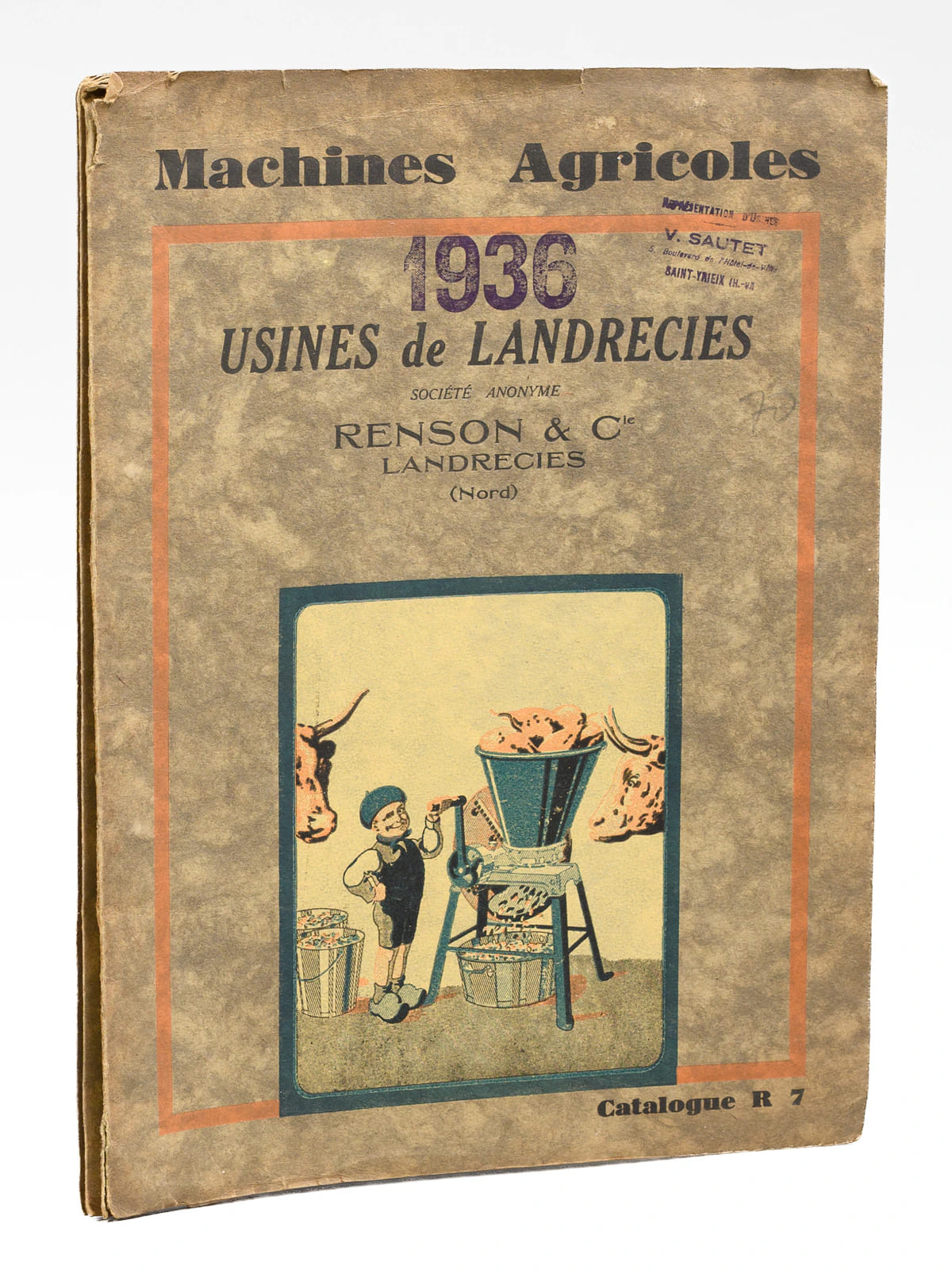
1936ref. 72068Catalogue commercial R7, 1 brochure in-4, Renson & Cie, Landrecies, Nord, Imprimerie Paul Collier, Fourmies, s.d. [ 1936, tampon en couv. ], 18 ff. dont un détaché
1921ref. ROD0028105Non Renseigné. 1921. In-8. Broché. Etat d'usage, 1er plat abîmé, Mors fendus, Intérieur bon état. 476 p. - 1er plat manquant - Manque de 1 à 2 cm sur la partie inférieure de la page de titre jusqu'à la p. 44 - En l'état.. . . . Classification Dewey : 672-Métallurgie des métaux ferreux
1928ref. 557301 vol. in-4 cartonnage éditeur demi-percaline marron, Société Anonyme Française des Films Paramount, 1928-1929, non paginé, mais 4 pages sont consacrées à chacun des 63 films, avec 64 planches supplémentaires hors texte et annexes
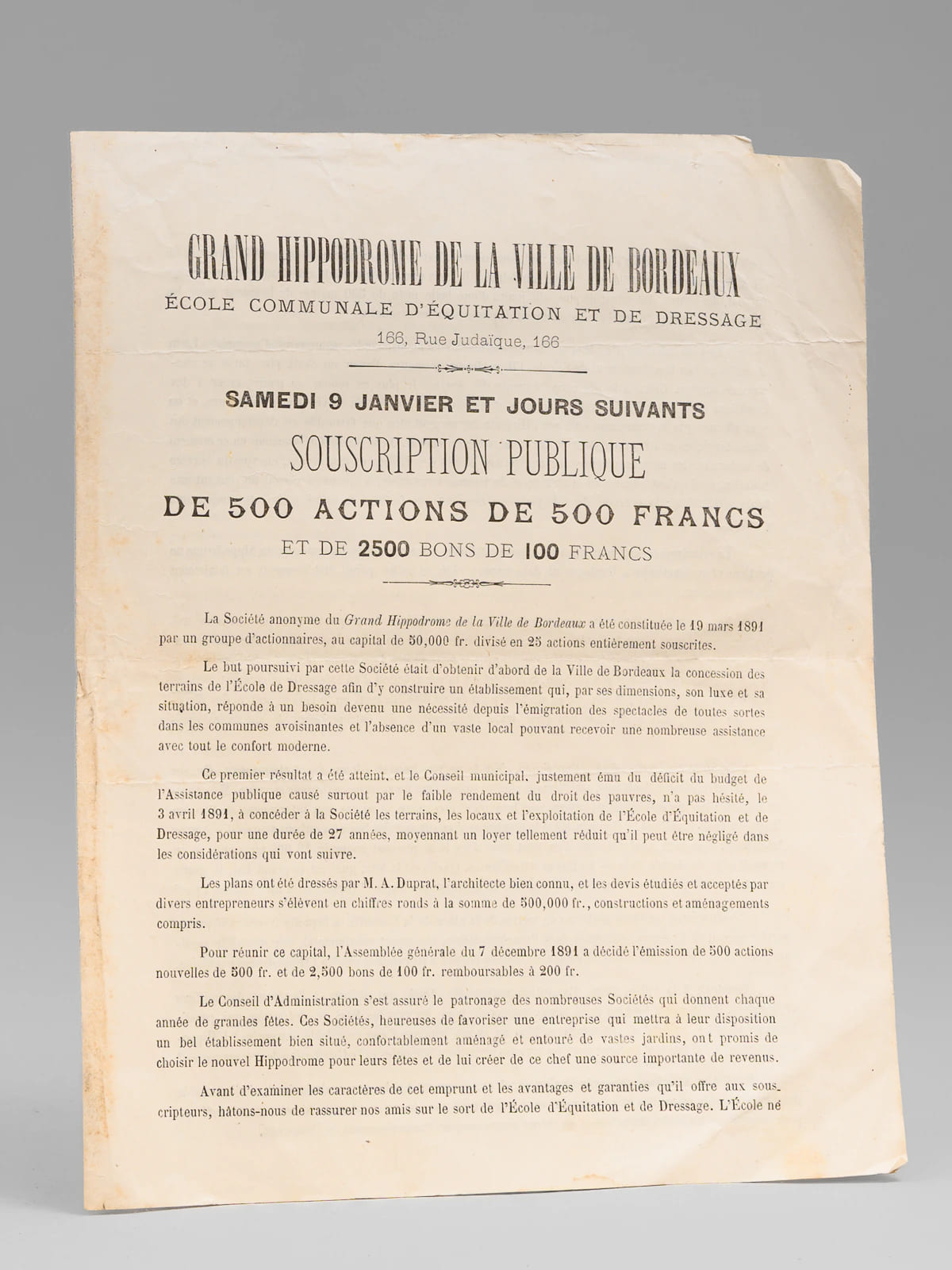
1892ref. 720781 brochure in-4 (26,4 x 21 cm) de 2 ff., Imp. G. Delmas, Bordeaux [ 1892 ] : [ Prospectus publicitaire pour souscription : ] Grand hippodrome de la Ville de Bordeaux. École communale d'équitation et de dressage, 166, rue Judaïque, 166. Samedi 9 janvier et jours suivants. Souscription publique de 500 actions de 500 francs et de 2500 bons de 100 francs. La Société anonyme du Grand Hippodrome de la Ville de Bordeaux a été constituée le 19 mars 1891 [ ... ] L'Ecole d'équitation et de dressage [ ... ] ne sera nullement sacrifiée à l'hippodrome; elle continuera d'exister comme par le passé, sous la direction de M. X. Barailhé et conformément à l'arrêté municipal [... ] Quoi qu'il arrive, quelle que soit la tournure que prendront les affaires de la Société, les porteurs de titres sont certains de toucher pendant 27 années le produit de l'exploitation de l'Hippodrome [... ]
1933ref. 98199Ornans, Usines d'Ornans, 1933, in-4, 6 pp, Broché, couverture illustrée en noir, Catalogue illustré en noir de divers modèles de clous. Exemplaire défraichi. Couverture rigide
ref. Z22753BLWRelié NEUF sous blister.PHOTOS SUR DEMANDE
ref. 500308188Michelin Sans date.