263.898 resultados
1790ref. dz1163Gravure 1790 "Gravure en noir et blanc (l'image elle même mesure env. 8 x 11,5 cm) tirée de l'édition de 1790 de ""Monumens du culte secret des dames romaines"" de Pierre-François Hugues d'Hancarville ; image intacte, très bon état général. Livraison a domicile (La Poste) ou en Mondial Relay sur simple demande."
1790ref. dz1164Gravure 1790 "Gravure en noir et blanc (l'image elle même mesure env. 8 x 11,5 cm) tirée de l'édition de 1790 de ""Monumens du culte secret des dames romaines"" de Pierre-François Hugues d'Hancarville ; bords du support irréguliers, par ailleurs image intacte, très bon état général. Livraison a domicile (La Poste) ou en Mondial Relay sur simple demande."
1790ref. dz1166Gravure 1790 "Gravure en noir et blanc (l'image elle même mesure env. 8 x 11,5 cm) tirée de l'édition de 1790 de ""Monumens du culte secret des dames romaines"" de Pierre-François Hugues d'Hancarville ; mouillure légèrement brunie sur l'image en queue, bords du support irréguliers, par ailleurs assez bon état général. Livraison a domicile (La Poste) ou en Mondial Relay sur simple demande."
1790ref. dz1167Gravure 1790 "Gravure en noir et blanc (l'image elle même mesure env. 8 x 11,5 cm) tirée de l'édition de 1790 de ""Monumens du culte secret des dames romaines"" de Pierre-François Hugues d'Hancarville ; bords du support irréguliers, par ailleurs image intacte, très bon état général. Livraison a domicile (La Poste) ou en Mondial Relay sur simple demande."
1790ref. dz1168Gravure 1790 "Gravure en noir et blanc (l'image elle même mesure env. 8 x 11,5 cm) tirée de l'édition de 1790 de ""Monumens du culte secret des dames romaines"" de Pierre-François Hugues d'Hancarville ; bords du support irréguliers, petit manque dans le coin supérieur gauche de la gravure, par ailleurs assez bon état général. Livraison a domicile (La Poste) ou en Mondial Relay sur simple demande."
1790ref. dz1169Gravure 1790 "Gravure en noir et blanc (l'image elle même mesure env. 8 x 11,5 cm) tirée de l'édition de 1790 de ""Monumens du culte secret des dames romaines"" de Pierre-François Hugues d'Hancarville ; légère mouillure un peu brunie dans le coin inférieur gauche de la gravure, par ailleurs assez bon état général. Livraison a domicile (La Poste) ou en Mondial Relay sur simple demande."
1790ref. dz1170Gravure 1790 "Gravure en noir et blanc (l'image elle même mesure env. 8 x 11,5 cm) tirée de l'édition de 1790 de ""Monumens du culte secret des dames romaines"" de Pierre-François Hugues d'Hancarville ; rousseur dans le coin inférieur gauche de la gravure, par ailleurs bon état. Livraison a domicile (La Poste) ou en Mondial Relay sur simple demande."
1790ref. dz1171Gravure 1790 "Gravure en noir et blanc (l'image elle même mesure env. 8 x 11,5 cm) tirée de l'édition de 1790 de ""Monumens du culte secret des dames romaines"" de Pierre-François Hugues d'Hancarville ; image intacte, très bon état général. Livraison a domicile (La Poste) ou en Mondial Relay sur simple demande."
1790ref. dz1172Gravure 1790 "Gravure en noir et blanc (l'image elle même mesure env. 8 x 11,5 cm) tirée de l'édition de 1790 de ""Monumens du culte secret des dames romaines"" de Pierre-François Hugues d'Hancarville ; bords du supports irréguliers, par ailleurs image intacte, très bon état général. Livraison a domicile (La Poste) ou en Mondial Relay sur simple demande."
1882ref. 002201S. l.: s. n. 1882. Softcover. Monochrome photograph pasted on board n. d. ca 1882; photo 4 x 6 1/4 board 4 1/4 x 6 1/2; captioned below image; small note in ink and a date May 9th / 82 to verso; a few very minor spots to photo; a bit of foxing to board; very good condition.A beautiful photograph of HMS Victory - the world's oldest naval ship still in commission. The 104-gun first-rate ship of the line of the Royal Navy was ordered in 1758 and launched in 1765. It would become best known for being Lord Nelson's flagship at the Battle of Trafalgar in 1805. Throughout the 19th century it also served as a troopship and a prison ship. Moved to dry dock in 1922 the ship went through several major restoration periods eventually became a museum part of the National Historic Fleet and since October 2012 HMS Victory has been the flagship of the First Sea Lord. S. l.: s. n. paperback
1882ref. 002201S. l.: s. n. 1882. Softcover. Monochrome photograph pasted on board n. d. ca 1882; photo 4 x 6 1/4 board 4 1/4 x 6 1/2; captioned below image; small note in ink and a date May 9th / 82 to verso; a few very minor spots to photo; a bit of foxing to board; very good condition.A beautiful photograph of HMS Victory - the world's oldest naval ship still in commission. The 104-gun first-rate ship of the line of the Royal Navy was ordered in 1758 and launched in 1765. It would become best known for being Lord Nelson's flagship at the Battle of Trafalgar in 1805. Throughout the 19th century it also served as a troopship and a prison ship. Moved to dry dock in 1922 the ship went through several major restoration periods eventually became a museum part of the National Historic Fleet and since October 2012 HMS Victory has been the flagship of the First Sea Lord. S. l.: s. n. paperback books
ref. 1020544082.Ghardcover. Good. Access codes and supplements are not guaranteed with used items. May be an ex-library book. hardcover
ref. 102264565X.Gpaperback. Good. Access codes and supplements are not guaranteed with used items. May be an ex-library book. paperback
2001ref. R300270959Lacour. 2001. In-8. Broché. Bon état, Couv. convenable, Dos satisfaisant, Intérieur frais. 19 pages agrafées.. . . . Classification Dewey : 840-Littératures des langues romanes. Littérature française
ref. 107.466Cologne, Chez Jacques Le Jeune, 1704. 11 x 17, 288 pp., reliure muette carton, état moyen (couverture défraîchie, trou de ver interne au bas des pages).
ref. 107.394Amstelodami (Amsterdam), Typis Joannis-Ludovici Delormi (Delorme), 1704 8 x 15, 5-163-16 pages, reliure ancienne plein cuir à 5 nerfs, dos 1 pièce de titre et 5 décors floraux, chants décorés, plats ornés d'un encadrement doré, tranches rougies, garde marbrée, bon état (mors avant légèrement fendu).
ref. 1020290110.Ghardcover. Good. Access codes and supplements are not guaranteed with used items. May be an ex-library book. hardcover
ref. RO50007994Carli. début XIXème. In-12. Broché. Bon état, Couv. légèrement passée, Dos satisfaisant, Intérieur bon état. 3 pages. Imprimé sur du papier à la forme.. . . . Classification Dewey : 780.26-Partitions
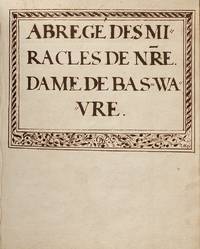
ref. 54926Modern-day Walloon Brabant Belgium dated May 1 1622. Small quarto 18.7 × 14.7 cm. Contemporary vellum; boards ruled and with gilt fleurons to center; 52 pp. of manuscript text to rectos and versos in brown ink on laid paper in a neat calligraphic hand. Text in French. Decorative title with signature and date to leaf 4. Boards lightly distended and with a few stains; text resized to binding minimally affecting the occasional letter edge and one chapter heading; paper somewhat toned and discolored; a few spots throughout; overall good or better. Anonymously authored and apparently unpublished manuscript composed as part of a popular revival during the Counter Reformation of the cult of Our Lady of Basse-Wavre in Belgian Walloon Brabant known today as Notre-Dame de Paix et de Concorde Our Lady of Peace and Concord. The church had been founded as a Benedictine priory dedicated to Saint Mary established by Affligem Abbey around 1092-1093 on land granted in 1086 by Count Henry III of Louvain and his brother Godfrey. In 1999 the chapel which had become a parish church in 1803 was made a minor basilica by Pope John Paul II the first and only basilica in the province of Walloon Brabant. According to tradition around 1050 farmers heard the sounds of "heavenly music" from the current site of the church the marshes of Basse-Wavre and decided to erect a structure in honor of the Virgin after witnessing a miraculous apparition. The construction was then relocated from the unstable marshlands but over and over it reverted to the original site by the morning. This culminated in a second vision during which the Virgin was said to proclaim: "I will live in this valley for I have chosen it" the vision is also described in chapter one of the present work. The preface establishes the probity of the author's sources: he or she relied primarily on the "Chronica" of Sigebert of Gembloux c. 1030-1112 a Benedictine monk of Gembloux Abbey in addition to other "ancient manuscripts" and "public testimony." These are said to cumulatively demonstrate a frequency and "grandeur" of miracles surpassing even those of Apostolic times and including "the greatest ones" such as the resurrection of the dead the restoration of eyesight to the blind and the curing of various illnesses. The manuscript is further divided into seven chapters which cover the foundation of the church; the discovery of the reliquary; the translation of relics to Brussels and miracles effected there; gatherings and processions with the relics; "burning sickness extinguished" from the bodies of Brussels residents most likely ergotism or St. Antony's fire; the reliquary chest; and finally a number of miracles worked elsewhere in the region during processions. The cult of Notre Dame de Basse-Wavre primarily centered around a "small casket" petit coffret of relics discovered at the site of the original vision which contained among numerous other important relics a fragment of the True Cross and of the Blood of Christ. By 1150 it was decided to translate the relics which were now in a reliquary chest "chapse" to Brussels possibly to protect against the plague where it was further embellished by silversmiths with precious metals and stones and where it worked countless miracles between the time of Easter and St. John's day June 24. A later chapter describes another miracle involving the chest within this time frame which may explain the subsequent tradition of a procession with the relics on June 24: seeing the many miracles associated with it the religious at Affligem Abbey desired to take possession of the "chapse" in order to honor their own monastery with it. But when the many monks and religious came to Brussels the chest would not budge until St. John's Day - again reenforcing the notion that the Virgin alone could chose the site of her cult. A fair copy in an easily legible hand the manuscript is signed with the initials "CDP" on the decorative title and was apparently never published. While it contains no express requests or suggestions its most likely purpose would have been to bolster a Brabantine Marian cult that had played a great role in medieval times and was witnessing a revival of sorts during the early seventeenth century as part of the Counter Reformation in the Spanish Netherlands. This intention is also suggested by the dedication to Isabella Clara Eugenia 1566-1633 sovereign of the Spanish Netherlands daughter of King Philip II and by 1622 widow of Albert VII Archduke of Austria. Albert and Isabella had taken a keen interest in Marian pilgrimate sites during their rule in an attempt to redefine the Spanish Netherlands as Catholic in distinct contrast to the Protestant North. At the time of writing Isabella had been a widow for almost one year and had publically assumed an expression of greater piety by taking the habit of a Poor Clare tertiary. Curiously the work was also written about one year after the Archbishop of Mechelen Jacobus Boonen had taken office. Boonen would officially affirm the cult by endowing the chapel of Basse-Wavre with a new reliquary in 1628 and one wonders whether the present text did not play a role however small in this turn of events. The lack of any provenance marks or annotations allows us only to conjecture as to its specific purpose; whether it was intended to be presented in this form to be submitted to the Church for approval to be printed or to be deposited as a reference copy with a local church monastery or the Bishop we cannot say. As of September 2026 we cannot trace the current text in any public holdings. STCV only records two titles on Basse-Wavre both later 1642 and 1721. unknown
1908ref. af20Fémina Illustration 1908 "Illustration en couleurs (50 x 30 cm sur support 56,5 x 30,5 cm) tirée de la revue Fémina, intitulée ""L'arrivée du 'train des maris'"" ; pliure au centre, par aileurs bon état. Livraison a domicile (La Poste) ou en Mondial Relay sur simple demande."
ref. 2764Sans lieu. 1982. Impression en rouge et noir proche de la sérigraphie. Dim: 620 x 445 mm.
1999ref. RO30313781La pochothèque / Le livre de poche. 1999. In-12. Broché. Etat d'usage, Tâchée, Dos satisfaisant, Intérieur frais. 188 pages augmentées de nombreuses gravures noir et blanc dans et hors texte.. . . . Classification Dewey : 940.1-Moyen-Age
2003ref. R320088742A COMPTE D'AUTEUR. 2003. In-4. En feuillets. Bon état, Couv. convenable, Dos satisfaisant, Intérieur frais. 35 pages accompagnées d'une lettre manuscrite de 3 pages datée du 16 fevrier 2003.. . . . Classification Dewey : 929-Généalogie
1885ref. 001237Philadelphia: Leon Meyers Publishers 1885. Softcover. Die-cut card stock chromolithographed; 5 ½ x 11; crease line and a spot of rubbing to lower right corner; closed cut to top edge with a small piece of tape on verso; colors still bright and vibrant; business details of the company printed on verso; very good. A beautiful and uncommonly large advertising card for “J. G. Gehring & Sonâ – a prominent company in Baltimore established in 1824 which made not only jewelry and watches but sterling flatware as well. The image depicts a beautiful young lady walking on a road bordered by rose bushes nad holding a large ring . Philadelphia: Leon Meyers, Publishers paperback books