AnonymousBiblio.com

ref. 1177806614.Gpaperback. Good. Access codes and supplements are not guaranteed with used items. May be an ex-library book. paperback
1999ref. 18394China: China Guardian 1999. First edition. Paperback. Very Good . 8 x 11 in. Heavy paper covers. Auction catalog with Lavish color plates. Text mostly in Chinese with titles etc in English. Condition is VERY GOOD ; mild edge wear covers a bit scuffed but very clean. Binding tight and text unmarked. Art. Stax. China Guardian paperback
ref. 1172305358.Gpaperback. Good. Access codes and supplements are not guaranteed with used items. May be an ex-library book. paperback
ref. 1164911473.Gpaperback. Good. Access codes and supplements are not guaranteed with used items. May be an ex-library book. paperback
ref. 1437112617.Gpaperback. Good. Access codes and supplements are not guaranteed with used items. May be an ex-library book. paperback
ref. 1020185430.Ghardcover. Good. Access codes and supplements are not guaranteed with used items. May be an ex-library book. hardcover
ref. 1024390136.Ghardcover. Good. Access codes and supplements are not guaranteed with used items. May be an ex-library book. hardcover
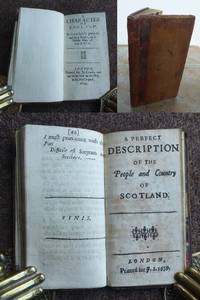
1659ref. 53907London printed for Jo. Crooke and are to be sold at the Ship in St. Paul's-yard 1659. A CHARACTER OF ENGLAND title continued: As it was lately presented in a letter to a noble man of France. SECOND EDITION 1659. The second edition is one of three printed in the same year. The editions are easily recognised the title page in the first edition has present-ed and a small "s" after London and a different collation the second edition has present-ted and a comma after London the third edition states it on title page. 12mo small thin book approximately 120 x 60 mm 5 x 2½ inches pages: 6 1-66 collation: A-C12 6 leaves in section "B" have paper fault to lower margins with slight loss of paper no loss to text see attached image and all leaves in this section have pale age-browning see ESTC R213652. A PERFECT DESCRIPTION of the PEOPLE and COUNTRY of SCOTLAND London printed for J.S. 1659. Anonymous James Howell or Sir Anthony Weldon see Library Hub Discover. Pages: 2 1-22 last page blank pale age-browning throughout including title page ESTC R204012. Bound together in polished calf covers with old amateur repair to spine marbled endpapers engraved bookplate James Brindley Esq M.A.F. S.A to first pastedown. Spine rubbed corners worn at tips first inner paper hinge cracked. A good tight copy. The Noble Man of France finds London to be a city with narrow streets and without fountains or running water. He admires St. Paul's and the Banqueting-house at Whitehall but is disgusted at the meanness of their surroundings. He then returns to complaints about the inconveniences of London and of the 'cloud of sea-coal'. . He has much to say of the national practice of drinking in Ale-houses and of the vile manners of the ladies and being Gaudy. He dislikes English social manners at dances at dinners in Hyde-park and in the Spring Garden. He is very difficult to please." - see full article in Geoffrey Keynes John Evelyn A Study in Bibliophily with a Bibliography of his Writings page 60-67 No. 15: "A True first edition of A Character of England containing 42 leaves and 71 numbered pages is an exceedingly rare book. It was soon reset and reprinted on 36 leaves with 66 numbered pages as our copy and this is also very uncommon"; Christie's The Evelyn Library Part iv page 87 No.1682 listing a third edition; Sotheby's The Collection of Robert S Pirie Volume I page 217 No. 354 listing the second edition; Bloomsbury Auctions The Cetus Library page 40 lot No.118 this is the same copy as the Pirie copy. MORE IMAGES ATTACHED TO THIS LISTING ALL ZOOMABLE FURTHER IMAGES ON REQUEST. Postage at cost and all parcels sent fully tracked and fully insured. London, printed for Jo. Crooke, and are to be sold at the Ship in St. Paul's-yard, 1659. hardcover
ref. B9781016475518Hardback. New. hardcover
ref. 1016475519.Ghardcover. Good. Access codes and supplements are not guaranteed with used items. May be an ex-library book. hardcover
1883ref. 007196New York: Henry Holt and Company 1883. This is the first novel by the Irish writer Emily Lawless 1845-1913. Published anonymously it is the story of a young artist living in London. Lawless was popular and current criticism views her as an under-appreciated influence on the modernists. Number 147 in Holt's "Leisure Hour Series." Not common. A Near Fine copy bound in the publisher's light tan cloth with decorative stampings in black. Titling in gilt on the spine. Clean text; 337 pages; with the paste-downs and endpaers printed in red as a catalog. Just hints of rub at the margins; the front paste-down is stamped "Wing Cottag." Very close to a a Fine copy. In an archival plastic protector. First American Edition. Decorative Cloth. Near Fine/No Jacket. 12mo - over 6¾" - 7¾" tall. Henry Holt and Company Hardcover
ref. DADAX0526646810Wentworth Press 2019-03-01. hardcover. New. 6.14x0.88x9.21. Buy with confidence. Excellent Customer Service & Return policy. Wentworth Press hardcover
ref. B9783368806453Hardback. New. hardcover
ref. B9783368806446Paperback / softback. New. paperback
ref. 0526646810.Ghardcover. Good. Access codes and supplements are not guaranteed with used items. May be an ex-library book. hardcover
ref. 3368806459.Ghardcover. Good. Access codes and supplements are not guaranteed with used items. May be an ex-library book. hardcover
ref. 3368806440.Gpaperback. Good. Access codes and supplements are not guaranteed with used items. May be an ex-library book. paperback
ref. 1018179518.Ghardcover. Good. Access codes and supplements are not guaranteed with used items. May be an ex-library book. hardcover
1893ref. 19819Paris Paul Ollendorf 1893 In-12 271 pp, préface de Pierre Loti, traces de scotch sur les couvertures et à 2 ff, dos absent et débroché
ref. 1348231009.Ghardcover. Good. Access codes and supplements are not guaranteed with used items. May be an ex-library book. hardcover
1930ref. C907741930. Very Good. Anon A Child Went Forth nd. but 1930s. Bound typescript of volume two of two ; chapters 12 Ã 22 pps. 287 Ã 628. MS double space typed and bound in red cloth; 10 x 7 _ Ò 25 x 19cm; front cover lettered in gilt A CHILD WENT FORTH / rule / VOL.2 ; no title but cover inscription repeated on flyleaf. Slight fading else VG. An epigraph follows each chapter heading authors include Shakespeare Edward Thomas Lascelles Abercrombie Edward Fitzgerald and John Addington Symonds. There is also a reference in the text to the gay artist Henry Scott Tuke. A correction in pencil is on p. 389. Possibly by L P Hatley bought at Bellam's auctions cicca 2000 in a dispersal of his sisters books. Taking the title from a Walt Whitman poem which celebrates the entry of a boy into adolescence this second volume continues the story of a day boarder named Peter Malling and his sexual relationships with three schoolmasters and one pupil at Bredonvale prep school in an unnamed county in England. Although we have only volume two of the narrative there are certain clues as to what has occurred in the first volume. The story would seem to have begun when Peter was aged eight and a new pupil at Bredonvale. We are told that a young and charismatic master called Benson had taken an interest in the child becoming his mentor. Benson then appears to have left the school and volume two begins with two of the other schoolmasters Jocelyn and Standish replacing him to a certain extent though Standish as it later transpires is more interested in a bully called Royston PeterÕs nemesis. Until the reappearance of Benson at the close of the book it is Jocelyn who shows Peter now twelve and on the edge of puberty the attention he craves. He takes him to tea at his home and swimming both of which are excuses for repeated physical contact with the innocent boy. He also mentors him in football and awards him his colours which cements the affection between them. The price Peter has to pay for Ô sucking up Ô to Jocelyn are two heavy beatings at the hands of Royston and his cohorts both of which are heavy with sado-masochistic imagery of bruised and torn flesh. Peter plays the part of the manly young athlete who wonÕt be cowed by the punishment meted out to him and who bears his scars as badges of honour. By this time Peter realises that he himself has sexual feelings towards a smaller boy who worships him. The crisis of the book is the serious sexual assault that RoystonÕs older and stronger brother commits against the vulnerable Peter immediately after the second and most terrible beating. We are not told the exact nature of this assault but the aftermath of it which leaves the victim close to suicide and a husk of his former self as an athlete strongly suggest that it was rape. It is the welcome reappearance of Benson and the prospect of a renewed relationship with him when he takes up a post at Downton College the nearby public school which offers hope to Peter who is looking forward to going there. Now at thirteen an older and wiser boy he regains his former resilience self respect and physical strength and uses it to beat up his enemy Royston whose reputation is destroyed. Having finally realised that Standish and Jocelyn were not interested in his personal qualities but only in his body he vows that the final beating due to him for assaulting Royston and appearing mistakingly to have sexually assaulted the boy he loves will be his last. He submits to the heavy beating meted out by the sadistic headmaster with an inner strength born out of a new and positive state of mind. The narrative ends as it began with Jocelyn and Standish discussing the merits of a more mature Peter in the common-room. The identity of the author of A Child Went Forth the era described and the locus of the action is not identified though it is obvious that the narrator was very familiar with prep and public school life either as a schoolboy or a master. There are a number of clues that point to the action taking place not long after the first world warÑpossibly in the mid nineteen twenties. There are references to a craze for making crystal sets tramcars a Ô bus horse-drawn mower. The slang could belong to any period of the early twentieth century Ô jolly wellÕ ÔbateyÕ ÔrotÕ. The location of the school and its environs are also hinted at. The River Bredon whose name is perhaps borrowed from a poem by A. E. Housman lies at the bottom of a deep gorge and is surely the river Avon the ÔGordano woodsÕ Easton in Gordano is a village close to the Avon are the Leigh Woods located across from the Clifton suspension bridge. Bridgetown may be Bristol the distant Redbury could be Redcliffe. All those clues possibly point to the author having had a close association with Clifton College possibly the Downton College of the book. Could the author be C.H.B Kitchin 1895 - 1967 a former pupil of Clifton College among whose novels are four that had gay themes most notably The Book of Life which tells the story of a young orphan unhappy at boarding school whose only friends were an uncle and a disgraced ex schoolmaster. Kitchin had also spent some time as a schoolmaster and had afterwards mentored two gay writers --Francis King and J. R. Ackerley. He was also friends with L. P. Hartley with whom he has been compared. Hartley was also at Clifton. The plotting of A Child Went Forth is well constructed the style of writing is assured and the whole narrative is as well paced as a thriller. Moreover although some of the philosophical exchanges between Jocelyn and Standish are occasionally stilted this flaw is counterbalanced by the interior monologues of the central character into whose childish mind the author has delved most effectively. hardcover
2024ref. Gyan-9789370734999Facsimile Publisher 2024. Hardcover. New. 25.13 x 18.78 x 5.01 cm. English Facsimile Publisher hardcover
2024ref. Gyan-9789370734999Facsimile Publisher 2024. Hardcover. New. 25.13 x 18.78 x 5.01 cm. English Facsimile Publisher hardcover
ref. 46437878-nnew. unknown
ref. B9781015962217Hardback. New. hardcover