AnonymousBiblio.com

171.111 resultados
ref. ria9783348037839_inpPaperback. New. New Book; Fast Shipping from UK; Not signed; Not First Edition; Untrodden Fields of Anthropology is an unchanged high-quality reprint of the original edition of 1885. Hansebooks is editor of the literature on different topic areas such as research and science travel and expeditions cooking and nu paperback
2017ref. 1-3337320562hansebooks 2017. Paperback. New. 770 pages. German language. 8.50x6.56x1.74 inches. hansebooks paperback
ref. 3348037832.Gpaperback. Good. Access codes and supplements are not guaranteed with used items. May be an ex-library book. paperback
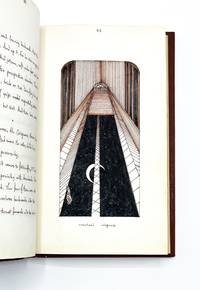
ref. 43982n.p.: n.p. 1970. Near fine. Enigmatic and disquieting collection of six short stories and one 90-page novella neatly and distinctively handwritten and illustrated in brown ink. The material veers in tone from the parodic to the surreal to the philosophically melancholic; the style incorporates a recondite vocabulary "the pyral tarantism of being in the world" and a single consistent insistent voice alternating long unpunctuated Joycean streams of frantic consciousness with brief and airless sentence fragments. A perpetual undercurrent of violent sexuality surfaces as much in the settings and scenery as in the events: a car crash; a game of human chess; a blazing furnace; a slaughterhouse. The table of contents gives titles for each work but no author's name; the bookplate with initials "A. J." offer the only clue to the item's creator or owner. The authorial narration steps out of its queasy dreamtime now and then to comment on itself "It would appear that this is the whim of the authors" or to focus on a concrete and precisely dated image: "Week-end Traffic" catalogs automobile makes and models in obsessive parodic almost Ballardian detail - a 1931 Alfa-Romeo; a '28 Lombard a Triumph Scorpion - and characters offer each other Passing Cloud cigarettes. But for the most part settings are as hard to place as the book itself. Character names are almost but not quite real: Nish Rogoze Valetta Fedor Shad. Illustrated with line drawings in brown pen presumably also by the writer with occasional accents in black and brief captions taken from the scenes they illustrate. The execution is skilled but careful often quoting other artwork as in the illustration to the final story "Communication" whose subject is the Breughel painting Dulle Griet; we see a copy of Brueghel's scene through the latticework of a window. Other illustrations appear to be carefully composed from copies or multiple tracings giving something of the effect of a Max Ernst collage - particularly the images of a horse-headed woman and a lion-headed man perhaps an intentional quotation from Une Semaine de Bonte. A Piranesi-esque interior gives way to a crowned woman in 20th century corset and garter belt: the Queen. Although a precise date cannot be given this book bears the stamp of a London bindery which operated as Bailey Bros. until a name-change in the 1970s and references in the text place its composition after the 1930s; we estimate the date of production to be circa the late 1960s to early 1970s - though its private library feel perhaps hints at a possible earlier creation. Bizarre and unsettling yet also the product of an original voice. In short: a singular artist's book of unique vision. Original red morocco with raised bands and decorative gilt stamping to spine. Top edge gilt. Black and gold patterned endpapers. 205 pages. Bookplate taped to ffep; brown geometric design with designer initials ACW at lower right and "Ex Libris AJ". Gilt stamping to lower edge of back cover below paste-down: "BOUND BY BAILEY BROS. LTD." Slight chipping to leather at inside rear hinge. Light edgewear and rubbing. n.p. unknown books
ref. 43982n.p.: n.p. 1970. Near fine. Enigmatic and disquieting collection of six short stories and one 90-page novella neatly and distinctively handwritten and illustrated in brown ink. The material veers in tone from the parodic to the surreal to the philosophically melancholic; the style incorporates a recondite vocabulary "the pyral tarantism of being in the world" and a single consistent insistent voice alternating long unpunctuated Joycean streams of frantic consciousness with brief and airless sentence fragments. A perpetual undercurrent of violent sexuality surfaces as much in the settings and scenery as in the events: a car crash; a game of human chess; a blazing furnace; a slaughterhouse. The table of contents gives titles for each work but no author's name; the bookplate with initials "A. J." offer the only clue to the item's creator or owner. The authorial narration steps out of its queasy dreamtime now and then to comment on itself "It would appear that this is the whim of the authors" or to focus on a concrete and precisely dated image: "Week-end Traffic" catalogs automobile makes and models in obsessive parodic almost Ballardian detail - a 1931 Alfa-Romeo; a '28 Lombard a Triumph Scorpion - and characters offer each other Passing Cloud cigarettes. But for the most part settings are as hard to place as the book itself. Character names are almost but not quite real: Nish Rogoze Valetta Fedor Shad. Illustrated with line drawings in brown pen presumably also by the writer with occasional accents in black and brief captions taken from the scenes they illustrate. The execution is skilled but careful often quoting other artwork as in the illustration to the final story "Communication" whose subject is the Breughel painting Dulle Griet; we see a copy of Brueghel's scene through the latticework of a window. Other illustrations appear to be carefully composed from copies or multiple tracings giving something of the effect of a Max Ernst collage - particularly the images of a horse-headed woman and a lion-headed man perhaps an intentional quotation from Une Semaine de Bonte. A Piranesi-esque interior gives way to a crowned woman in 20th century corset and garter belt: the Queen. Although a precise date cannot be given this book bears the stamp of a London bindery which operated as Bailey Bros. until a name-change in the 1970s and references in the text place its composition after the 1930s; we estimate the date of production to be circa the late 1960s to early 1970s - though its private library feel perhaps hints at a possible earlier creation. Bizarre and unsettling yet also the product of an original voice. In short: a singular artist's book of unique vision. Original red morocco with raised bands and decorative gilt stamping to spine. Top edge gilt. Black and gold patterned endpapers. 205 pages. Bookplate taped to ffep; brown geometric design with designer initials ACW at lower right and "Ex Libris AJ". Gilt stamping to lower edge of back cover below paste-down: "BOUND BY BAILEY BROS. LTD." Slight chipping to leather at inside rear hinge. Light edgewear and rubbing. n.p. hardcover books
ref. 43982n.p.: n.p. 1970. Near fine. Enigmatic and disquieting collection of six short stories and one 90-page novella neatly and distinctively handwritten and illustrated in brown ink. The material veers in tone from the parodic to the surreal to the philosophically melancholic; the style incorporates a recondite vocabulary "the pyral tarantism of being in the world" and a single consistent insistent voice alternating long unpunctuated Joycean streams of frantic consciousness with brief and airless sentence fragments. A perpetual undercurrent of violent sexuality surfaces as much in the settings and scenery as in the events: a car crash; a game of human chess; a blazing furnace; a slaughterhouse. The table of contents gives titles for each work but no author's name; the bookplate with initials "A. J." offer the only clue to the item's creator or owner. The authorial narration steps out of its queasy dreamtime now and then to comment on itself "It would appear that this is the whim of the authors" or to focus on a concrete and precisely dated image: "Week-end Traffic" catalogs automobile makes and models in obsessive parodic almost Ballardian detail - a 1931 Alfa-Romeo; a '28 Lombard a Triumph Scorpion - and characters offer each other Passing Cloud cigarettes. But for the most part settings are as hard to place as the book itself. Character names are almost but not quite real: Nish Rogoze Valetta Fedor Shad. Illustrated with line drawings in brown pen presumably also by the writer with occasional accents in black and brief captions taken from the scenes they illustrate. The execution is skilled but careful often quoting other artwork as in the illustration to the final story "Communication" whose subject is the Breughel painting Dulle Griet; we see a copy of Brueghel's scene through the latticework of a window. Other illustrations appear to be carefully composed from copies or multiple tracings giving something of the effect of a Max Ernst collage - particularly the images of a horse-headed woman and a lion-headed man perhaps an intentional quotation from Une Semaine de Bonte. A Piranesi-esque interior gives way to a crowned woman in 20th century corset and garter belt: the Queen. Although a precise date cannot be given this book bears the stamp of a London bindery which operated as Bailey Bros. until a name-change in the 1970s and references in the text place its composition after the 1930s; we estimate the date of production to be circa the late 1960s to early 1970s - though its private library feel perhaps hints at a possible earlier creation. Bizarre and unsettling yet also the product of an original voice. In short: a singular artist's book of unique vision. Original red morocco with raised bands and decorative gilt stamping to spine. Top edge gilt. Black and gold patterned endpapers. 205 pages. Bookplate taped to ffep; brown geometric design with designer initials ACW at lower right and "Ex Libris AJ". Gilt stamping to lower edge of back cover below paste-down: "BOUND BY BAILEY BROS. LTD." Slight chipping to leather at inside rear hinge. Light edgewear and rubbing. n.p. unknown
ref. 43982n.p.: n.p. 1970. Near fine. Enigmatic and disquieting collection of six short stories and one 90-page novella neatly and distinctively handwritten and illustrated in brown ink. The material veers in tone from the parodic to the surreal to the philosophically melancholic; the style incorporates a recondite vocabulary "the pyral tarantism of being in the world" and a single consistent insistent voice alternating long unpunctuated Joycean streams of frantic consciousness with brief and airless sentence fragments. A perpetual undercurrent of violent sexuality surfaces as much in the settings and scenery as in the events: a car crash; a game of human chess; a blazing furnace; a slaughterhouse. The table of contents gives titles for each work but no author's name; the bookplate with initials "A. J." offer the only clue to the item's creator or owner. The authorial narration steps out of its queasy dreamtime now and then to comment on itself "It would appear that this is the whim of the authors" or to focus on a concrete and precisely dated image: "Week-end Traffic" catalogs automobile makes and models in obsessive parodic almost Ballardian detail - a 1931 Alfa-Romeo; a '28 Lombard a Triumph Scorpion - and characters offer each other Passing Cloud cigarettes. But for the most part settings are as hard to place as the book itself. Character names are almost but not quite real: Nish Rogoze Valetta Fedor Shad. Illustrated with line drawings in brown pen presumably also by the writer with occasional accents in black and brief captions taken from the scenes they illustrate. The execution is skilled but careful often quoting other artwork as in the illustration to the final story "Communication" whose subject is the Breughel painting Dulle Griet; we see a copy of Brueghel's scene through the latticework of a window. Other illustrations appear to be carefully composed from copies or multiple tracings giving something of the effect of a Max Ernst collage - particularly the images of a horse-headed woman and a lion-headed man perhaps an intentional quotation from Une Semaine de Bonte. A Piranesi-esque interior gives way to a crowned woman in 20th century corset and garter belt: the Queen. Although a precise date cannot be given this book bears the stamp of a London bindery which operated as Bailey Bros. until a name-change in the 1970s and references in the text place its composition after the 1930s; we estimate the date of production to be circa the late 1960s to early 1970s - though its private library feel perhaps hints at a possible earlier creation. Bizarre and unsettling yet also the product of an original voice. In short: a singular artist's book of unique vision. Original red morocco with raised bands and decorative gilt stamping to spine. Top edge gilt. Black and gold patterned endpapers. 205 pages. Bookplate taped to ffep; brown geometric design with designer initials ACW at lower right and "Ex Libris AJ". Gilt stamping to lower edge of back cover below paste-down: "BOUND BY BAILEY BROS. LTD." Slight chipping to leather at inside rear hinge. Light edgewear and rubbing. n.p. hardcover
ref. NL-02380Quite likely the only surviving example. From time to time we encounter works that despite our best efforts resist definitive identification. Such is the case with this fascinating 17th-century engraved view of Jerusalem. The sheet which survives in excellent condition appears to have been designed for inclusion in a larger publication. However the absence of editorial data institutional records or market parallels makes it impossible to determine the intended work or its creator with certainty. A somewhat schematic bird's-eye view of the fortified ancient city of Jerusalem dominates the center of the composition. Among the recognizable landmarks are the large enclosure of the Temple Mount Haram al-Sharif and the Roman amphitheater below it. Mount Zion with the palaces of David and Solomon appears as a small walled cluster near the bottom of the scene. Outside the city walls crosses mark the site of Golgotha — locus of the Crucifixion. Above the city view virtually dominating the composition is a large circular panel depicting the crucified Christ flanked by the Virgin Mary and Mary Magdalene. Hovering above this scene God the Father looks down with open hands offering a gesture of blessing. The triangular halo symbolizes the Trinity and his presence completes the Trinitarian theme complemented by the dove of the Holy Spirit and the Son depicted in the panel below. The entire composition is framed by an elaborate architectural border in the ornate Baroque style typical of the period. At the base a large blank cartouche—meant to hold editorial information—is held by two monks. Above two additional monks support the circular panel of Christ. While the monks serve as generic emblems of sacred authority and devotion the frame's four corners include identifiable saints: at the top St. Bernardino of Siena left and St. Francis of Assisi right; at the bottom St. Bonaventure left and St. Anthony of Padua right each flanking a second pair of empty cartouches intended for annotation. Census We have not been able to identify the publication for which this engraving was intended. Indeed we do not even know if that publication ever came to fruition or who was behind it. From our extensive descriptive and pictorial searches we have found no parallels or bibliographic references allowing us to conclude that this view is very rare.
ref. Atlantic-9780593191699Hardcover. New. hardcover
ref. Atlantic-9780593191699Hardcover. New. hardcover
ref. 12601Anonymous. UNTITLED - Soldiers on Patrol. Pastels on paper not dated. Unsigned. 11 7/8 x 11 1/4 inches. A very well executed image showing a group of five armed soldiers in what appears to be a desert streching to a distant horizon where black smoke is rising from an unseen source; clouds of red and blue/green are reflected on the sand below vehicle tracks in the foreground trail off into the distance; small desert shrubs grow from the sands. There is nothing which provides a clue as to the dating or location of this scene. In very good condition with a short tear bottom center and few very tiny edge nicks. unknown
2026ref. 1-1250446899Macmillan Audio 2026. Audio CD. New. unabridged edition. 1.00x1.00x1.00 inches. Macmillan Audio unknown
ref. 47969240-nnew. unknown
ref. 8807000like new. unknown
ref. DADAX0274429969Wentworth Press 2018-08-01. paperback. New. 6.14x1.69x9.21. Buy with confidence. Excellent Customer Service & Return policy. Wentworth Press paperback
ref. DADAX0274429241Wentworth Press 2018-08-01. paperback. New. 6.14x1.88x9.21. Buy with confidence. Excellent Customer Service & Return policy. Wentworth Press paperback
ref. DADAX0274428474Wentworth Press 2018-08-01. hardcover. New. 6.14x1.88x9.21. Buy with confidence. Excellent Customer Service & Return policy. Wentworth Press hardcover
ref. DADAX0274443031Wentworth Press 2018-08-01. paperback. New. 6.14x1.74x9.21. Buy with confidence. Excellent Customer Service & Return policy. Wentworth Press paperback
ref. DADAX0274398206Wentworth Press 2018-08-01. paperback. New. 6.14x1.70x9.21. Buy with confidence. Excellent Customer Service & Return policy. Wentworth Press paperback
ref. DADAX0274432684Wentworth Press 2018-08-01. paperback. New. 6.14x1.94x9.21. Buy with confidence. Excellent Customer Service & Return policy. Wentworth Press paperback
ref. ria9783743613560_inpPaperback. New. New Book; Fast Shipping from UK; Not signed; Not First Edition; Untersuchungen aus dem Physiologischen Institute der Universität Heidelberg ist ein unveränderter hochwertiger Nachdruck der Originalausgabe aus dem Jahr 1878. Hansebooks ist Herausgeber von Literatur zu unterschiedlichen Themengebiete paperback
ref. 0274432684.Gpaperback. Good. Access codes and supplements are not guaranteed with used items. May be an ex-library book. paperback
ref. 0274428474.Ghardcover. Good. Access codes and supplements are not guaranteed with used items. May be an ex-library book. hardcover
ref. 0274443031.Gpaperback. Good. Access codes and supplements are not guaranteed with used items. May be an ex-library book. paperback
ref. 0274398206.Gpaperback. Good. Access codes and supplements are not guaranteed with used items. May be an ex-library book. paperback