7,201 results
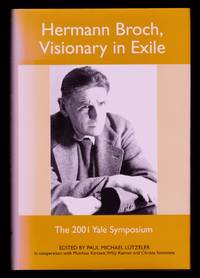
2003ref. 5031Camden House 2003. Hardcover. Very Good/Good. Hardcover xiv 266 pages NOT ex-library. A very good copy in a good dust jacket. Clean untanned interior with unmarked text free of inscriptions and stamps firmly bound. A gentle crease to first couple of leaves. Dust jacket is untorn with a straightened corner fold front flap and sunning to spine; a touch of mild edgewear. -- The Austrian novelist Hermann Broch ranks with Kafka and Musil among the three greatest 20th-century Austrian novelists and belongs to the century's most gifted novelists in German from whatever country. He established his reputation with The Sleepwalkers a trilogy of political and philosophical novels. His best-known work is The Death of Virgil a long challenging work in a lyrical exuberant and sometimes nearly incomprehensible style a kind of cerebral stream-of-consciousness of the dying Virgil. Broch also wrote extensively about modern art and architecture Hofmannsthal and mass psychology. He has a special connection to Yale as he lived the last years of his life there after having escaped Austria in 1938. The participants in the Yale Symposium of April 2001 are among the world's most prominent Broch scholars. Fourteen of their presentations have been extensively revised for this volume which focuses on Broch as critic and as novelist and dramatist. Topics include Broch's views on kitsch and art and on drama; his cultural criticism; his cooperation with Borgese and Arendt; his theory of mass psychology; history in his works Ernst Kretschmer's influence on him; Virgil and Celan's Atemwende; Jean Starr Untermeyer's translation of Virgil; guilt and the fall in Those without Guilt; and Broch reception in Japan. Paul Michael L tzeler is Distinguished University Professor of German at Washington University St. Louis and editor of Broch's collected works. -- Contents: Introduction: Broch Our Contemporary / Paul Michael L tzeler; I. Hermann Broch: The Critic: -- Kitsch and Art: Broch's Essay "Das B se im Wertsystem der Kunst" / Ruth Kluger; Erneuerung des Theaters: Broch's Ideas on Drama in Context / Ernst Sch rer; "Der Rhythmus der Ideen": On the Workings of Broch's Cultural Criticism / Bernhard Fetz; "Kurzum die H lle": Broch's Early Political Text "Die Strasse" / Wendelin Schmidt-Dengler; Visionaries in Exile: Broch's Cooperation with G.A. Borgese and Hannah Arendt / Paul Michael L tzeler; Fear in Culture: Broch's Massenwahntheorie / Wolfgang M ller-Funk; -- II. Hermann Broch: The Novelist and Dramatist: -- Inscriptions of Power: Broch's Narratives of History in Die Schlafwandler / Kathleen L. Komar; The German Colonial Aftermath: Broch's 1903. Esch oder die Anarchie / Judith Ryan; Neither Sane nor Insane: Ernst Kretschmer's Influence on Broch's Early Novels / Gisela Brude-Firnau; Non-Contemporaneity of the Contemporaneous: Broch's Novel Die Verzauberung / Gisela Roethke; "Great Theater" and "Soap Bubbles": Broch the Dramatist / Roberto Rizzo; A Farewell to Art: Poetic Reflection in Broch's Der Tod des Vergil / J rgen Heizmann; Poetry as Perjury: The End of Art in Broch's Der Tod des Vergil and Celan's Atemwende / Peter Yoonsuk Paik; "Beyond Words": The Translation of Broch's Der Tod des Vergil by Jean Starr Untermeyer / John Hargraves; Between Guilt and Fall: Broch's Die Schuldlosen / Theodore Ziolkowski; Broch Reception in Japan: Shin'ichiro Nakamura and Die Schuldlosen / Koichi Yamaguchi; Index of Broch's Works; Index of Names Camden House hardcover
ref. 1804211206.Ghardcover. Good. Access codes and supplements are not guaranteed with used items. May be an ex-library book. hardcover
1944ref. 9848New York: The Viking Press 1944. fair. 287 illus. tables notes & addenda biblio index ink name & address on title pg sl discolor ins bds bds spotted & stained. Board and spine edges worn. The Viking Press unknown
ref. 21980782like new. unknown
ref. SONG1532090315iUniverse 2019-12-11. hardcover. Used: Good. 6.00x0.94x9.00. Buy with confidence. Excellent Customer Service & Return policy. iUniverse hardcover
ref. 1804211338.Ghardcover. Good. Access codes and supplements are not guaranteed with used items. May be an ex-library book. hardcover
ref. A9781167110351New. unknown
1931ref. SKU2010031238David McKay 1931. Hardcover. Very Good/No Dustjacket . First Thus. Bound in red gilt-blocked cloth. The only poetical work of its kind in the English language which retains the meter refrain & stanzaic structure & thought of the original Arab. Translated & Annotated by his friend & pupil19th-century British poet & scholar Sir Richard Burton with dramatic woodcut illustrations by Willy Pogeny. Not only a poem but the life-philosophy of a thoughtful man of action the Kasidah can be roughly translated as testament. With extensive explanatory Notes by Burton Introduction by Dhan Gopal Mukerji. David McKay hardcover
ref. 0282630236.Gpaperback. Good. Access codes and supplements are not guaranteed with used items. May be an ex-library book. paperback
ref. 0265174694.Ghardcover. Good. Access codes and supplements are not guaranteed with used items. May be an ex-library book. hardcover
ref. 3801203808.Gpaperback. Good. Access codes and supplements are not guaranteed with used items. May be an ex-library book. paperback
ref. 1104418010.Ghardcover. Good. Access codes and supplements are not guaranteed with used items. May be an ex-library book. hardcover
2010ref. DADAX1160739463Kessinger Publishing 2010-03-19. paperback. New. 6.00x0.99x9.00. Buy with confidence. Excellent Customer Service & Return policy. Kessinger Publishing paperback
ref. 22649Tapuscrit original dude l'article " Trésor enfoui - La Clef de Bob et Bobette " par Pierre-René Serna publié en 2000 dans le n° 90 due la revue " Le Collectionneur de Bande dessinées ". 16 pages tapées à la machine sous chemise au format 21 x 30 cm avec annotations de l'auteur en page 15. On joint les 16 pages de la version définitive, corrigée, sur papier fort. L'auteur a inscrit son nom, au stylo, au verso de la couverture. Edition originale ayant appartenu à Jacques Bisceglia et qui provient de ses archives.
1903ref. 116991903. Slg. klin. Vortr. N.F. 356/57. - Leipzig Verlag von Breitkopf & Härtel 1903 8° 80 pp. 5 Abbildungen orig. Broschur. Sehr gutes Exemplar des Erstdruck dieser wichtigen Arbeit. Willy Anschütz Assistent bei Mikuliz habilitierte sich mit diesem Thema. Die Arbneit ist historisch wertvoll: Auf 15 Seiten werden die bis dato bekannten Fälle aufgezählt und die Literatur genannt. unknown
2004Mm 295x310 Volume in copertina rigida con sovraccoperta, 367 pagine profusamente illustrate in nero. Testo in lingua tedesca - german text. Copia pari al nuovo; spedizione in 24 ore dalla conferma dell'ordine.
ref. 18786Genève, 1963 Tome I :139 p. et 8 planches N/B. Tome II : 170 p. et 12 planches N/B. 2 volumes brochés. 20 x 27
1913ref. 566821913. Z. Immunit.forsch. Orig. 17/5. - Jena Verlag von Gustav Fischer 1913 8° pp.487-606 Broschur. Erstdruck! Aus der Experimentell-biologischen Abteilung Prof. H. Sachs des Königl. Institut für experimentelle Therapie zu Frankfurt a.M. Direktor: Geh. Obermed.-Rat Prof. Dr. P. Ehrlich. Sachs Nr.379 unknown
1863ref. 330851863. Cbl. med. Wiss. 1/53. - Berlin August Hirschwald 5. December 1863 8° pp.832-848 Rückenbroschur. Erstdruck! "Unter den vielen Methoden welche zur Gewinnung der Blutkrystalle angegeben worden sind liefert keine diese Substanz in solcher Reinheit dass sie zur weiteren chemischen Untersuchung tauglich wäre. Keine der bekannten Methoden gestattet die Gewinnung grösserer Mengen der Krystalle ohne Beimengung von Blutkörperchen oder Niederschlägen aus dem Blutserum. Das Mittel die rothen Körperchen des Blutes vollständig aufzulösen besteht in der Anwendung der Alkalisalze der Gallensäuren. Da Meissner in seinem Jahresberichte über die Fortschritte der Physiologie im Jahre 1862 p. 293 gelegentlich erwähnt dass es Dr. Thiry gelungen sei "die Löslichkeit des Hämatokry stallins in den Gallensäuren" zur Darstellung der Blutkrystalle zu verwerthen so soll hier kurz eine Methode mitgetheilt werden nach welcher mir schon seit längerer Zeit die Herstellung völlig reinen Hämatokrystallins gelang." Wilhelm "Willi" Kühne Sohn eines wohlhabenden Kaufmanns legte 1854 am Johanneum Lüneburg das Abitur ab. Er begann im selben Jahr ein Studium an der Universität Göttingen wo er Chemie bei Friedrich Wöhler Physiologie bei Rudolf Wagner und Anatomie bei Jakob Henle studierte. 1856 wurde er bei Wagner mit einer Arbeit über künstlichen Diabetes bei Fröschen zum Dr. phil. promoviert. Anschließend forschte er an der Universität Jena bei Karl Gotthelf Lehmann zum Zuckerstoffwechsel. 1858 wechselte Kühne erst nach Berlin wo er als Mitarbeiter von Felix Hoppe-Seyler an der Chemischen Abteilung des Pathologischen Instituts tätig war und bei Emil Du Bois-Reymond Studien zur Muskulatur betrieb und anschließend nach Paris zu Claude Bernard. 1860 folgte ein Aufenthalt in Wien bei Ernst Brücke und Carl Ludwig. Ab 1861 leitete Wilhelm Kühne das Chemische Labor im Pathologischen Institut Rudolf Virchows in Berlin wo er sich mit Zellphysiologie auseinandersetzte. Von 1868 bis 1871 hatte er den Lehrstuhl für Physiologie der Universität von Amsterdam inne 1871 ging er an die Universität Heidelberg wo er als Nachfolger Hermann von Helmholtz' bis zu seinem Lebensende das Physiologische Institut leitete. unknown
1948ref. 300000882Istra 1948. 1948. Istra unknown
1996ref. 548Mayence, v. Hase & Koehler, 1996 Fort in-4, cartonné, sous jaquette. XIII-458 pages. Nombreuses photographies en noir.
1928ref. 103490ABHeidelberg, Iris Verlag, 1928. Mit Abb. 162,1 S. Illustr. OKt. - OKt. minimal fleckig u. verblasst, ob. Kapital m. kl. Papierstreifen, gutes Ex.
1955ref. 210114ed. Plon 1955 in-12 br., edition originale, un des 20 exemplaires numerotes sur papier Lafuma (seul grand papier), brunissure sur la premiere page, envoi, on joint un article de presse sur le livre
1957ref. 210115ed. Plon 1957 in-8 br., edition originale, ex. numerote sur pur fil des papeteries du Marais (seul grand papier), non coupe