Wagner, Richard; Willy PoganyBiblio.com
7.201 resultados
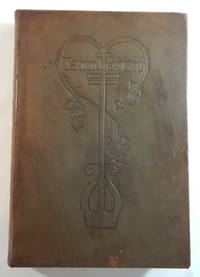
1911ref. 24558London: G. G. Harrap & Co 1911. Limited edition. Hardcover. Very good. 4to. Full calf embossed on the spine and upper board. Top edge gilt. Illustrated throughout by Pogány in black and white and tipped-in full color plates. Leather rubbed at hinges and edges with some light soiling else this is a very good copy. One of 525 numbered copies signed by Pogány. This is number166. . G. G. Harrap & Co hardcover
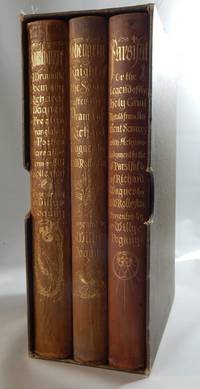
1913ref. 24584London: G. G. Harrap & Co 1913. First edition. Very good. Hardcover. Three volumes. 4to. Quarter green calf spine blocked in gilt; Cloth sides with gilt title and design on the upper boards. Top edges gilt. Illustrated throughout by Pogány in black and white and 40 mounted full color plates Spines sunned to a pleasing tan color else this is a very good set. In the publisher's slipcase which has some light wear. G. G. Harrap & Co unknown
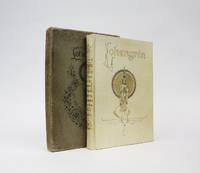
ref. 23683London: George G. Harrap and Company. 1913. First edition first printing. First edition first printing. Deluxe limited edition signed by the illustrator. Publisher's original vellum-covered boards with titles and illustrations in gilt to the spine and upper board. Top edge gilt. Illustrated endpapers. Lavishly and profusely illustrated with 8 mounted colour plates colour lithographs and black and white line drawings throughout by Willy Pogany with some of the text and drawings being accented with brown blue and green. A near fine copy the binding firm the boards only very slightly bowed. The contents with very faint spotting to the prelims are otherwise entirely complete and clean throughout and without previous owners' stamps or inscriptions. Complete with the original illustrated box which is worn at the edges with one side of the bottom half split at the corners. A beautiful scarce edition. This deluxe issue was issued in a limited edition of 525 copies this example numbered 16 and signed by Willy Pogany in black in on the limitation page. Pogany's stunning Art Nouveau-tinged illustrations breathe life into Wagner's opera which is based on the German Arthurian legend of the knight Lohengrin son of of Percival who rode a boat drawn by swans to rescue a lady. Further details and images for any of the items listed are available on request. All items are catalogued by humans. Lucius Books welcomes direct contact with our customers. London: George G. Harrap and Company. 1913 hardcover
1950ref. 40304Leipzig, J.A. Barth, 1950. Orig. full cloth. XVIII,471 pp.
1955ref. 26187Stuttgart, S. Hirzel Verlag, 1955. 45 Seiten , 30 cm, kart.
ref. 3663004279.Gpaperback. Good. Access codes and supplements are not guaranteed with used items. May be an ex-library book. paperback
ref. 0274073919.Ghardcover. Good. Access codes and supplements are not guaranteed with used items. May be an ex-library book. hardcover
ref. 033140110X.Ghardcover. Good. Access codes and supplements are not guaranteed with used items. May be an ex-library book. hardcover
ref. 027402036X.Ghardcover. Good. Access codes and supplements are not guaranteed with used items. May be an ex-library book. hardcover
1927ref. 24331Berlin: Julius Springer 1927. First Edition. Cloth. Very Good. First Edition. viii 418 2-ads pages. 8vo. Publisher's blue/black boards with gilt lettering and publisher's device on spine and titles on front panel. Bookstore tag on front pastedown. Binding glued in gutter at Vorwort foreword. Otherwise a nice clean bright copy. Text in German. Cloth. Wagner was a full member of the Academy of Sciences Berlin and was made in 1931 an Honorary Member of the American Academy of Arts and Sciences Boston. He held numerous other awards including in 1930: Slaby-Plakette des Deutschen Funktechnischen Verbandes. In 1924 he founded the magazine Zeitschrift Elektrische Nachrichtentechnik. In the foreword Wagner notes that the sudden onset of broadcasting has created high demand for wireless telephony and has accelerated technical developments dramatically. The new building blocks of broadcasting can be built on the progress made in radio technology. In addition to the general relations of electrodynamics the laws of transmission propagation and reception of electric waves the events occurring in the electron tubes and their mode of action in the various circuits as rectifiers amplifiers and vibration exciters and finally the laws of acoustics and the operation of the electro-acoustic devices all play a role. Knowing all of these things is essential for building a good broadcast radio but is not easy to acquire because so far there has been no where to go for sound details regarding all of these issues. The Heinrich Hertz Society in 1925 created a plan to promote broadcasting over the airwaves by organizing a series of lectures about "The scientific basis of radio communications". This book was the much enlarged result. Wagner is probably best known for the development of what we now call wave filterswork he did starting in 1915. "The most prominent researchers G. A. Campbell in the United States and K. W. Wagner in Germany explored selective filter circuits for telephone applications in the early years of World War I thus paving the way for the first ideas about electrical circuit synthesis. They designed sophisticated filter circuits simply by cascading elementary sections of lossless inductors and capacitors. The circuits obtained in this way had a striking similarity to circuit models in engineering transmission line theory and henceforth were called ‘wave filters’." Life and Work of Wilhelm Cauer 1900 – 1945 Cauer et al Proc. MTNS2000 Perpignan France June 19 - 23 2000 Waveguide filters today are most useful in the microwave band of frequencies where they are a convenient size and have low loss. Examples of microwave filter use are found in satellite communications telephone networks and television broadcasting. Davis Electrical and Electronic Technologies #372 noting that in 1915 filter technology came into being with the independent proposal of it by Campbell and Wagner. Julius Springer unknown books
1927ref. 24331Berlin: Julius Springer 1927. First Edition. Cloth. Very Good. First Edition. viii 418 2-ads pages. 8vo. Publisher's blue/black boards with gilt lettering and publisher's device on spine and titles on front panel. Bookstore tag on front pastedown. Binding glued in gutter at Vorwort foreword. Otherwise a nice clean bright copy. Text in German. Cloth. Wagner was a full member of the Academy of Sciences Berlin and was made in 1931 an Honorary Member of the American Academy of Arts and Sciences Boston. He held numerous other awards including in 1930: Slaby-Plakette des Deutschen Funktechnischen Verbandes. In 1924 he founded the magazine Zeitschrift Elektrische Nachrichtentechnik. In the foreword Wagner notes that the sudden onset of broadcasting has created high demand for wireless telephony and has accelerated technical developments dramatically. The new building blocks of broadcasting can be built on the progress made in radio technology. In addition to the general relations of electrodynamics the laws of transmission propagation and reception of electric waves the events occurring in the electron tubes and their mode of action in the various circuits as rectifiers amplifiers and vibration exciters and finally the laws of acoustics and the operation of the electro-acoustic devices all play a role. Knowing all of these things is essential for building a good broadcast radio but is not easy to acquire because so far there has been no where to go for sound details regarding all of these issues. The Heinrich Hertz Society in 1925 created a plan to promote broadcasting over the airwaves by organizing a series of lectures about "The scientific basis of radio communications". This book was the much enlarged result. Wagner is probably best known for the development of what we now call wave filterswork he did starting in 1915. "The most prominent researchers G. A. Campbell in the United States and K. W. Wagner in Germany explored selective filter circuits for telephone applications in the early years of World War I thus paving the way for the first ideas about electrical circuit synthesis. They designed sophisticated filter circuits simply by cascading elementary sections of lossless inductors and capacitors. The circuits obtained in this way had a striking similarity to circuit models in engineering transmission line theory and henceforth were called ‘wave filters’." Life and Work of Wilhelm Cauer 1900 – 1945 Cauer et al Proc. MTNS2000 Perpignan France June 19 - 23 2000 Waveguide filters today are most useful in the microwave band of frequencies where they are a convenient size and have low loss. Examples of microwave filter use are found in satellite communications telephone networks and television broadcasting. Davis Electrical and Electronic Technologies #372 noting that in 1915 filter technology came into being with the independent proposal of it by Campbell and Wagner. Julius Springer unknown
ref. __311262355XDe Gruyter 1929. Hardcover. New. 4th reprint edition. 388 pages. German language. 5.00x1.06x8.00 inches. De Gruyter hardcover
ref. BN213711Luzern Schweiz Reich 1992. HanseStädte HanseStädte Wacker Willy Text Luzern (Schweiz), Reich, 1992 unknown
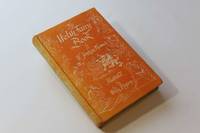
1957ref. mon0001651954University of Wales 1957. Hardcover. Good. . The Welsh Fairy Book by W. Jenkyn Thomas is a delightful collection of traditional Welsh fairy tales legends and folk stories gathered from the oral traditions of Wales. The stories feature fairies giants enchanted kingdoms magical objects supernatural creatures and colourful characters while reflecting the landscapes customs and folklore of Wales. Thomas preserves the distinctive flavour of Welsh storytelling while making the tales accessible to a wider audience. Illustrated by Willy Pogany this is an attractive and important collection of Welsh folklore and children�s literature.rn University of Wales hardcover
ref. 80170Casterman 1979, album cartonné illustré, 22pp avec des illustrations en couleurs; collection Farandole - bon état
ref. 11127Neuchâtel, éditions de la Baconnière, 1978. Petit in-8 broché, couverture imprimée en deux tons. Tout petit choc au coin supérieur du second plat.
ref. 9055440299.Ghardcover. Good. Access codes and supplements are not guaranteed with used items. May be an ex-library book. hardcover
1972ref. Khe05178Bonn ( Vorstand der SPD ) 1972 (= Erste Ausgabe). 8°, illustrierter Originalumschlag ( Klammerheftung ) 62 S., 1
1905ref. 342131905. BKW 42/2425. - Berlin August Hirschwald 12. und 19. Juni 1905 4° pp.737-796 feine Broschur. Erstdruck! unknown
1930ref. 13467Eschig Max 1930
ref. 25821Lambert Schneider, Heidelberg, Erste Auflage. Originallederband mit Rückenvergoldung und Kopfgoldschnitt. [8], XXXII, 1027, [1] Seiten. 19,5 : 12 cm.
ref. 29648660-nnew. unknown
ref. 7412080like new. unknown
ref. 7412080-nnew. unknown