1982rif. 2091502135708026Amaha Eiji diary publication publication 1982. Soft Cover. Fine. The book is in fine condition. Amaha Eiji diary publication publication paperback
1964rif. 2083002115713258Keisuji Local Journal Editorial Committee 1964. Soft Cover. Fine. Number of pages: 498p Size: 22cm Number of books: 1 Keisuji Local Journal Editorial Committee paperback
1909rif. 2111902156202531Not Available 1909. Soft Cover. Fine. The book is in fine condition. Not Available paperback
1989rif. 2092902140700171Japan Newspaper Association 1989. Soft Cover. Fine. Size: B5 Number of books: 5 books set Japan Newspaper Association paperback
1991rif. 2091502135417634Not Available 1991. Soft Cover. Fine. Number of books: 1 Not Available paperback
1975rif. 2091502133516550Yomiuri Shimbun 1975. Soft Cover. Fine. Number of books: 1 Yomiuri Shimbun paperback
rif. 1058072Encuadernación de tapa dura. . Madrid. Imp. Nacional. 1858. 24x17 cm. portada 2 h. 655 págs. 12 estados plegados otros a doble página. Holandesa piel gofrada. # H.ª de España hardcover
2008rif. 2111902154700798Sugoku Shrine office 2008. Soft Cover. Fine. Number of pages: 785p Size: 22cm Sugoku Shrine office paperback
rif. M8571aRare set of 5 volumes. Centre Franco-Egyptien d'Etude des Temples de Karnak CFEETK. Cahiers de Karnak. 5678 & 9. Paris 1975-1994. First edition. In-4. Cahiers V and VI are bound in green half-leather with boards. Cahiers VII VIII and IX are in their original white softcover well protected by a removable paper wrap. A fine set. Language: French/Français. This set ships from Europe shipping costs will be updated accordingly BPF. Relevant subjects: Egypt: Journals Egypt New Kingdom Pyramids Tombs Temples & Towns. unknown
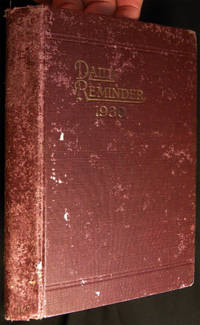
1936rif. 030251Phoenix Arizona 1936. Very legibly handwritten 365 pages aside from a few compressed days' worth of memories at the front pages & a couple of 'Memorandum' pages at back with a few names and addresses. Compiled in1936 by repurposing a 1930 blank diary with appropriate changes of dates written-in. Lola Felty Wright was the wife of Charles H. Wright 1882 - 1943 a 40-year law enforcement veteran in the West which was mostly spent with the Phoenix police. In addition to being a mother and homemaker churchwoman & the partner of an active lawman Lola F. Wright took care of the family farm fished hunted had the care of older children and extended relations and reports on all the activities in which she was involved along with those of her husband and noting the details of shopping cooking & menus at home and when dining out church affairs and visiting speakers and a very active social and family life. At this point of her life she's in her mid-'50s and continuing a rigorous round of life active in country and city. The diary is a good record of the times as well with day-by-day notes on political social and family life as well as that of the U.S. and mostly frugally coping daily living in the throes of the Great Depression. Interwoven throughout the daily recorded life-detail is a great sense of interpersonal & community cooperation and interactivity that was helping folks "get by" together. Jan. 1 1936. "…Husband worked all night last night on radio Patrol. Will work from 10 to 6 all this month… Jan. 20. "…went to Republican club meeting at Y.M.C.A. Mrs. Eva Robinette was reelected state president. Saw many old friends as this was my first time to attend for over a few years. Sat by Mrs. Rodney Macdonald…We are going to the board meeting at the Church tonight and I will take husband to work at 10. Quite cold for Phoenix. Blizzard in the east & west." Jan. 25. "…heard Al Smith's talk over the radio which we enjoyed very much…" Jan. 26 At church "…Bottle for pennies for piano fund was passed and $ 1.53 collected…Bob & Goldie were here and told us that Bob lost his job last night…" Jan. 27 "…Goldie & Bob here as they came from the trial of Chief of Police Johnson. He was fined $ 200 for contempt of court for arresting owners of vending or slot machines when the judge had issued a restraining order…" Feb. 3 "…Bob got his civil service decision from board and they ordered him to work as jailor…" Feb. 7 "…we had a wonderful dinner of fried chicken hot biscuits & gravy turnips and greens brought a chicken home with us also eggs & milk…" Feb. 8 "…bought our groceries; then home where I prepared a quick lunch of fried pork steak cabbage salad and apple pie…Bob is working at Nu Way Market. Jim was here has chance to sell his lot for $ 1500…." Feb. 15 "…I arose at 7:30 prepared breakfast and dressed chicken made an apple crumb pie and a bread pudding. Cooked a stew…I bought a wine colored crepe dress at the Boston store. Came home & washed dishes washed off car wheels. I ironed some & pressed my dress also did some alterations on it…tuned in on Police radio & heard all calls." Feb. 28 "…Got up at 4:30 and prepared breakfast and lunch for our fishing trip to Stewart Mountain Dam. We arrived at the dam about 7:30 and fished until ten and did not even get one bite never saw a minnow. The lake was up and more water coming in; and water was very cold…" more encouragingly a further fishing trip to the same location in May on the west side of the lake landed crappies striped bass and several perch Mar. 1: "…Jim Peck was here he lost his position with the Indian service at Keams Canyon…" Mar. 11: "…Floye brought little Jimmie over about 9 and left him while she went to work at the Center St. store. They are still having a rush due to the War on cleaning prices…Her maid failed to come back after she had advanced her $ 7.50 on her wages. She left for Okla…" Mar. 21: "…As usual I got dinner. I made two pies one custard and one chocolate dressed a nice fat fryer. Had hot biscuits and gravy & pinto beans with chile…" Mar. 24: "…Jimmie came over & spent the evening he had just had a long talk with John Udall newly elected mayor. He thinks his father can be chief of police if he wants to be…" Mar. 27: "…they found the wrecked plane & 4 bodies of the Phoenix man. Harold Marks & 3 others. Sad accident…" May 16: "…Geneva has left Albert. He beat her with a rope. He is a brute poor girl she looks so sad. They had Albert arrested & he is in Mesa jail. They got Herman Lewcovitz for his attorney…" later "…Albert got out on bond…very repentant…" July 17: "…Bob & Charlie went to work on street car. Irving Hays is motorman on streetcar they ride down on every night…" July 22: "…Bob jailor had a hearing and was suspended today for 30 days for failing to search a prisoner and a loaded gun was found on him. Bob says it is a frame-up…" Oct. 23: "…Charlie came in at 2 o'clock this morning with his face bleeding where a drunk had him in the eye. Broke his glasses rim & frame & pushed one lens out but did not break it. He went to the hospital…we went to Dr. Ploussard…Charlie's face looks bad but he is going to work tonight…" Oct. 29: "…The radio programs are all on politics. Roosevelt & Landon spoke tonight. They both made good talks…" Nov. 3 "Today is election day we are taking it easy as we are not anxious to see any candidate elected…" Dec. 4: "Mr. Hamman the lumberman and Mr. Morgan the architect were here today. They are making plans to build a duplex 2 story on the lot in the back of our house. We have been talking of that ever since we bought the place but can't make up our minds as it will cost about $ 10000 and that is more than we want to go in debt. It would make us a nice income and we are undecided about it…" And more. Snippets: Mention of getting a letter from an uncle reporting television location unspecified; radio is regularly listened to and is an important source of news and entertainment at front of the diary is a note regarding the Death Valley Days program. Shopping at Kress store downtown; use of street cars to get around; "Old age pension meeting"; All-day missionary meeting at Mrs. Blair's; Revival at Glendale with Bro. Volk as evangelist; visit of Charis corsets lady; "doing some typing" often; many anecdotes about people losing changing trying to get jobs and work; Tucson funeral service for Rev. Hoffman; Fannie Marlan and a talk on Pioneer days; Mr. Sloane of the W.O.W. Woodmen of the World fraternal/insuring group; Happy Days market; Phoenix night of the national broadcast of Amateur Hour; temporary appointment of Gen. Glassford as chief of police a measure made in order to clean up the dept. Very involved with the W.C.T.U. Temperance society; KTAR radio broadcasts; ex-chief Johnson suspended; Red Cross instructions at police dept; Vernon Wilson & wife "came in and brought the Navaho blankets…" further on the Wilsons borrow some money and leave rugs for security; the diarist notes that her husband and his police officer partner are the only officers on patrol on Sunday a 'choice' day for others to take off; "Road Trip" to Long Beach driving and mentioning stops and details staying at the Del Mar Hotel "…a nice room for $ 8 per week…Daves Cafeteria again for nice baked ham dinner…"; Mr. Wright has to attend court on various cases; Mrs. Wright has heart problems and eventually needs 'electrical' treatments and heat 'radiotherm'; hunting deer at Kaibab Forest outside of Prescott and other events and occurrences including lots of family illness and coping with sickness and care of family friends and relations. People & families mentioned: 'Jennings' Charlie Wright 'sees' often in town; Stella Martin Steel; Reverend Line; Rev. Carson Taylor; Rev. Sturgis; Johnnie Moore Wrights law enforcement partner; Mrs. Duclow; political figures including John Udall elected mayor; Mrs. Ruggles; Bro. Dodson; Martha Knapp; Mrs. Sexton; Mrs. Welch Mrs. Godfrey; Mrs. Patten; Sr. Fitkin Sr. Young Sr. Patton Bro. & Sr. Perkins who are returned missionaries from Africa in Pentecostal church; Mary & Bill Rickman; Geydes Smith; Angeles Goodykoontz; Dr. Flaherty; Judge Ling; Jack Tarbell; Juanita Spuro granddaughter of Mrs. Wrigley; Donna Jean Shavers; electrocution of Hauptman Lindbergh kidnapping; dust storms cleaning constantly; boils on face & neck; husband Charlie gets knocked down by a car while on duty at 2:30 in the morning driver says he didn't see him; Brock Morrison appointed asst. chief of police; Miss Thompson returned missionary from China; Mrs. John Gardner McAlister; Gus Dobrinski; Juanita Rathburn; Rev. Gomez & wife; Lauranna Sturgis; Christine Anderson; Mrs. Ball; Emmett Harris; Lester Flake; Gerald Veyter accidentally shot and killed himself coming home from rabbit hunting; Dr. Rowland; and others. C.H. Wright died while still serving as assistant chief of Police of Phoenix. Our research on biographical information for Lola F. Wright is limited; her husband's 'find a grave' shows his marker & a news obituary clipping which mentions his surviving family and no further details of any of his relations. A notation at the front of the diary in a later hand notes the famous arrest which Charles Wright participated in of the ".pair of desperadoes charged with the murder of a policeman." the Irene Schroeder case; who later became the first woman to be electrocuted for her crimes. Diary approx. 5" x 7 3/4" size bound in worn brick-red cloth that has lost some of its original color. Edge tips wear to the binding; securely sewn and in good condition. . Diary. Hard Cover. Good. hardcover
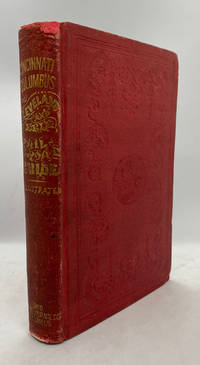
1854rif. 9279Columbus: Ohio State Journal Company 1854. Second Edition. Hardcover. Very good-. Octavo 135pp. illustrated. This is the second edition published two years after the first and certainly the better one being the first to contain the numerous tinted lithographed plates. About very good in the publisher's blind-tooled red cloth with gilt detail on the spine. Some inartful but not disfiguring coloring-in to some chipped areas on the spine extremities. This copy lacking the folding frontispiece and one plate "View of Morrow from the South" but otherwise complete and with five plates not noted in the list of illustrations all in the Cleveland area "Cleveland Station" "West Branch Rocky River Near Olmsted Station" "East Branch Rocky River Berea Station" "Elk Creek" and "Grand River Near Painesville Station". The list of illustrations calls for 28 plates including the map. While we have 26 of the 28 the 5 extra yield a total of 31 plates. Thus while incomplete still a desirable and very "Cleveland" copy of this important image-driven guide for rail travelers in Ohio. The author goes on tangents for example spending more than two pages discussing the general history of the Mormons as the guide passes through Kirtland but these digressions seem to be in some sense the point--offering diversion to the weary traveler. Howes O52; Thomson 887. With strong recent auction records we have priced the book accordingly at about 1/3 its natural price were the frontispiece present. Ohio State Journal Company hardcover
rif. 7237Manitou Springs Colorado: Manitou Springs Daily Journal September 1 1888. 64mo brochure 3.25" x 5" pictorial wrappers ad on inside of front wrapper. Accordion fold contents in 6 two-sided panels 3" x 4.5" with illustrations on one side and text on other text at inside back cover. CONDITION: Very good light wear small crease to wrapper spine. A handsomely produced brochure illustrating the Manitou Grand Caverns with pictures of the following caves and formations: "the Narrows" "Grant Monument" "The Interior Cascades" "The Dairy and Churn" "The Organ" "The Seven Columns" "The Card Rack" and "In Grand Concert Hall." The text apparently a reprint of a 1 September 1888 Manitou Springs Daily Journal article tells the story of the caves' discovery and provides lavish descriptions of these "dazzling wonders and gorgeous cuts and figures of Dame Nature.hidden and treasured in the bowels of the earth." George Washington Snider 1851-1921 a stone-cutter from Ohio explored and connected several of the Manitou Grand Caverns caves in the early 1880s while in partnership with Charles Rhinehart with whom he ran tours of the Cave of the Winds. Following a split with Rhinehart Snider began running tours of the Manitou Grand Caverns in 1885. By 1896 overwhelmed with debt he had turned operations over to his brother and left Manitou. Manitou Springs, Colorado: Manitou Springs Daily Journal, September 1, 1888 unknown
rif. 25583EXPOSITION--LONDON--1851 THE ART JOURNAL. ILLUSTRATED CATALOGUE. THE INDUSTRY OF ALL NATIONS 1851. London: The Art Journal 1851. Folio. Rebacked calf spine and tips with marbled boards. xxvi 328 xvi viii xxii viii viii pages. First edition. Containing hundreds of engravings and articles on science by Robert Hunt textiles by Lewis D.B. Gordon the exhibition itself by Ralph Wornum plants and agriculture by Edward Forbes and color by Mrs. Merrifield. Rebacked else very good. unknown
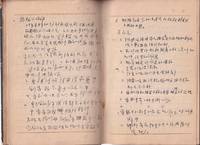
1950rif. 215749Northeast China People's Press. Late1950s. Army distributed notebook with pictorial endpapers 24pp of inspirational text map of the Korean campaign with printed annotated and some captioned black and white photographic illustrations. Final 8 pages contain a month by month printed summary of the Korean campaign 1950 - 51. However the diary entries are dated 1959 and 1960 and are unrelated to the Korean campaign. Entries are written in cursive Chinese script. Pages and endpapers foxed and browned upper hinge split edges thumbed cover worn and upper right corner creased. Heavy signs of use but still sound. 16.6 x 11.5cm. . Northeast China People's Press. unknown
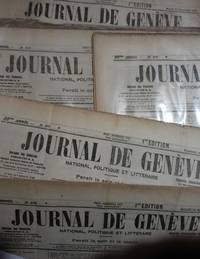
1918rif. 138439Genève 1918. Board Book. Livre en français. Couverture rigide. 91 quotidiens. 35 x 52 cm. 6 à 8 pages. Rousseurs. Petits défauts quelques plis fatigués. Marges brunies. ref. 138439 Genève unknown
rif. 5L1482Philipon Paris 1865. Insgesamt 416 Seiten mit Zeichnungen von Baric Bertall Beyle Cham Darjou Daumier Denoue Grévin Grostiaux Pétit Pelcoc Randon René Stop und Vernier Halbleder-Einband der Zeit folio ca. 30 x 43 cm etwas berieben und fleckig/eine Einbandkante mit kleinem Randausbruch. - sonst gutes Exemplar / "Le Journal pour Rire" wurde als Wochenzeitschrift am 5. 2. 1848 von dem Verleger Charles Philipon gegründet. 1856 wurde es in "Journal amusant" umbenannt und bestand unter diesem Namen bis 1928. "Le Journal pour Rire" und "Le Charivari" waren als Geschwister anzusehen. Sie hatten in der Regel denselben Chefredakteur und dieselben Zeichner. 1856 wurde zusätzlich das "Petit Journal pour rire" als Prämie für die Jahresabonnenten des Charivari gegründet / Anbei ein Verzeichnis der Künstler und dessen Zeichnungen 3 Blatt - unknown
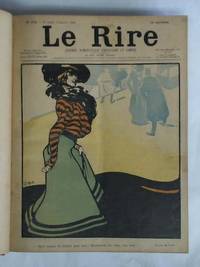
rif. 5L3313Félix Juven Paris 1902. Insgesamt ca. 588 illustrierte Seiten mit colorierten Titelseiten im Halbleinen-Einband mit silbergeprägtem Rückentitel quart die Blätter geringfügig gebräunt/teils etwas eng beschnitten. - Die Zeitschrift "Le Rire" das Gelächter wurde 1894 von Félix Juven gegründet der auch "La vie illustrée" herausgab. Sie erschien jeden Samstag und trieb nach einem Wort von Gustave Flaubert besonders in den Jahren bis zum ersten Weltkrieg 'die allgemeine Schweinerei wie in den Tagen von Bouvard und Pécuchet'. "Le Rire" demaskierte die "falschen Ärsche" von Politik und Gesellschaft und sparte die Kleinbürger dabei nicht aus. Dabei ist es heuzutage eine Banalität von der "Belle Epoque" zu sprechen und dabei zu vergessen daß diese Zeit nur für einige Zeitgenossen schön war. "Le Rire" beschäftigte die besten Zeichner der Zeit wie Toulouse-Lautrec Félix Vallotton Steinlein Forain Léandre der den Gotha du Rire erfand Caran d'Ache Charles Veber Charles Huard Rabier Abel Faivre Roubille Lucien Métivet um nur die bekanntesten unter ihnen zu nennen. Es gibt Karikaturen von Leandre die in ihrer Schärfe und Unversöhnlichkeit an die Arbeiten von Daumier erinnern / Vergl. Georg Pilz. Geschichte der Europäischen Karikatur Berlin 1976 / Text französisch - unknown
rif. 6i3441Bureau du Petit Courrier des Dames Paris 1832. Seiten 169-288 und 168 Seiten mit je 1 Titel und mit 43 koloriarten Kupferstichen reich goldgeprägter Original-Halbledereinband etwas berieben / Kapitale ausgebrochen und fleckig / einige Stempel am Seitenrand. - Colas 2216. Hiler 703. Lippheide ZB 32. Sehr schöne Kupfertafeln im zeitgenössischem Kolorit/ gestoch-Wappenexlibris der Familie "Roschab" auf Vorsatz - unknown
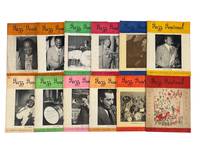
1950rif. 223221950. Complete 1950 run of Jazz Journal Vol. 3 Nos. 1-12. London: L. M. Publications 1950. Complete run of the 1950 volume. Twelve issues with each issue around 20 pages. Black-and-white photo illustrations throughout. Printed paper wraps. Founded in 1948 by editor Sinclair Traill Jazz Journal became a critical platform for serious jazz criticism in Britain at a time when the country began appreciating the impact of African American musical innovation. This volume features twelve monthly issues each spotlighting legendary musicians in deeply reverent portraits: Louis Armstrong Baby Dodds Coleman Hawkins Fats Waller Earl Hines and others. The December cover has a Christmas theme. This archive is a window into Britain's postwar jazz awakening. The articles range from retrospectives to musicology and artist discographies. Floyd Levin's "The American Jazz Scene" captures the transatlantic tone of the journal mourning the death of Buster Wilson and lauding figures like Sidney Anderson and Kid Ory as vanguards of "authentic" jazz-framed as endangered in a postwar America increasingly seduced by commercialism. Meanwhile Derrick Stewart-Baxter's "Preachin' the Blues" traces rural-to-urban migration patterns in blues development analyzing Sleepy John Estes' discography and folk influences. The December issue features a full-page bibliophilic essay "A Case for Books" reviewing A Treasury of the Blues by W. C. Handy whom it names "the composer of the classic Memphis Blues and Joe Turner Blues" emphasizing the book's role in preserving "the true and historical survey of the blues." Taken together the essays discographies and image curation construct a coherent theory of jazz not only as music but as cultural heritage. Moderate and consistent soiling and creasing to wrappers; binding intact but some covers remain delicate. Occasional chipping at spine. Covers remain vivid with strong photographic contrasts. Overall good condition. A complete year's run of one of the earliest and most influential British jazz journals with signatures from leading musicians of the era such as Armstrong Dodds and Hawkins. unknown
1877rif. ZB393070Commerce Printing and Publishing House 1877. Price HAS BEEN REDUCED by 10% until Monday Nov. 2 weekend sale item Volumes 2-8 an uninterrupted run of complete volumes partly bound library markings textually clean & tight price is for the lot. - If you are reading this this item is actually physically in our stock and ready for shipment once ordered. We are not bookjackers. Buyer is responsible for any additional duties taxes or fees required by recipient's country. Photos available upon request. Commerce Printing and Publishing House unknown
1860rif. 165691860. J. B. Remarks on the Obstacles to the More General Employment of Women and on the Means of Removing Them 1860. First edition of a pamphlet advocating expanded employment opportunities for British women and identifying discriminatory hiring practices opposition from male workers and limited occupational choices as causes of female poverty. Published through the English Woman's Journal a periodical closely associated with the Langham Place circle of women's rights reformers the pamphlet appeared during an organized campaign to open professions and skilled occupations previously reserved for men. Its author directly challenges workplace resistance to female labor: "Women however cannot be employed in England in this manner because of the jealousy of their fellow workmen. If a master were to employ women in any part of the business the whole of his workmen would strike at once." The passage identifies threatened industrial action by male employees as a practical obstacle to women's economic advancement even when employers were willing to hire them. J. B. Remarks on the Obstacles to the More General Employment of Women and on the Means of Removing Them. London: Published at the Office of the English Woman's Journal Company Limited 1860. First edition. 16 pages. Original paper wrappers measuring 8¼ x 5¼ inches. Reprinted from the English Woman's Journal the pamphlet examines barriers preventing women from obtaining sufficient paid employment and proposes measures to expand their opportunities. The author connects occupational exclusion with increasing demands upon public and private charitable institutions: "Workhouses were found to be overcrowded with able-bodies females while charities were besieged with women praying to be provided either with employment or bread." These observations link women's unemployment directly to poverty relief while the discussion of male workers' resistance identifies the exclusionary practices that prevented women from entering better-paid occupations. The pamphlet was published shortly after the establishment of the Society for Promoting the Employment of Women in 1859 an organization associated with Jessie Boucherett Barbara Leigh Smith Bodichon and other members of the Langham Place circle. The Society sought to expand women's access to commercial clerical and skilled employment through vocational training and direct engagement with employers. The pamphlet's discussion of workplace opposition and overcrowded workhouses provides contemporary evidence of the economic conditions these reformers sought to address preceding later campaigns for women's property rights and equal access to professions. Stain to upper left edge of front wrapper toning to final page and light pencil markings in margins. Very good condition. unknown
1966rif. 214071966. Counterculture Archive of five issues of The Realist the groundbreaking satirical and political magazine founded by Paul Krassner. Known for its radical leftist stance and boundary-pushing commentary The Realist was a critical voice in the countercultural movements of the 1960s blending investigative journalism with dark humor and unflinching critiques of American politics war race relations and the establishment. With contributions from figures such as Robert Anton Wilson Abbie Hoffman and Timothy Leary the publication played a significant role in shaping the political satire of the New Left. Archive includes: 1 The Realist. Issue No. 64 February 1966. Features a striking illustrated cover satirizing American apathy with references to the infamous Kitty Genovese murder the Ku Klux Klan and the House Un-American Activities Committee HUAC. Inside Krassner and his contributors skewer the failures of American justice and political hypocrisy with their signature blend of absurdity and biting critique. This issue exemplifies The Realist's approach to humor as a vehicle for exposing societal failures particularly in race relations and government repression. 2 The Realist. Issue No. 65 March 1966. Includes Robert Anton Wilson's The Fatal Snowball Fight on Cumberland Avenue a darkly humorous piece that examines law enforcement's overreaction to a student snowball fight in Knoxville Tennessee. The article serves as a microcosm of broader societal tensions highlighting the growing rift between youth counterculture and the authoritarian establishment. Other articles in this issue continue The Realist's sharp critiques of the Vietnam War police violence and political paranoia. 3 The Realist. Issue No. 69 September 1966. features one of the magazine's most notable pieces An Impolite Interview with Timothy Leary in which the controversial LSD advocate discusses drug policy consciousness expansion and the First Amendment. This issue also includes The Day the Supreme Court Banned Vaseline a satirical jab at America's obscenity laws and the broader censorship debate as well as Modest Proposals: The Whitey Survival Manual which critiques racial politics in a manner characteristic of The Realist's provocative and often incendiary approach. The cover's headline Lyndon Johnson Loves Nervous Nellie reflects the magazine's ongoing lampooning of the Johnson administration's political anxieties. 4 The Realist. Issue No. 71 November 1966. Provides a prescient discussion of Hollywood's role in politics with the article Remember Next Tuesday: Get Tufts! which speculates on Ronald Reagan's political rise following his election as Governor of California. The cover features a photograph of Reagan highlighting The Realist's scrutiny of the merging of celebrity and political power-a theme that would become increasingly relevant in decades to come. 5 The Realist. Issue No. 72 December 1966. Robert Anton Wilson's The Cybernetic Revolution anticipates the impact of automation and artificial intelligence on society reflecting the counterculture's growing fascination with technology as both a tool of liberation and oppression. Renfreu Neff's Automation and Aberration explores the evolution of sexual mores arguing that traditional notions of deviance and perversion are becoming obsolete in the face of modernity. The issue like many from The Realist blurs the line between genuine inquiry and satirical exaggeration making it both thought-provoking and deeply irreverent. During the 1960s The Realist served as a crucial alternative press outlet for leftist anarchist and countercultural thought. At a time when mainstream media was constrained by Cold War conservatism and corporate control Krassner's magazine became a hub for irreverent unfiltered political satire. The publication targeted institutions such as the military-industrial complex religious orthodoxy and government censorship while also providing a platform for psychedelic culture civil rights and radical activism. All issues are in newsprint format with varying degrees of age toning and edge wear typical of publications of this period. Overall very good condition. An important collection from one of the defining underground publications of the 20th century. unknown
1970rif. 221271970. FeminismSocialismLaborLGBTQ Underground newspaper Kaleidoscope Milwaukee WI archive of two issues. Vol. 1 No. 7 Oct. 29-Nov. 11 1970; Vol. 3 No. 23 Jan. 15-22 1971. Two original issues from Milwaukee's radical newspaper Kaleidoscope a cornerstone of New Left feminist and countercultural expression in the Midwest. These issues exemplify the intersectional editorial voice of the paper prominently featuring articles on feminist self-determination LGBTQ liberation reproductive autonomy and anti-racist solidarity. The October 29-November 11 1970 issue is especially notable for its explosive front-page headline "OFF SEXIST PIGS!" and its radical feminist manifesto demanding an end to male chauvinism and gender oppression. The text includes direct calls for solidarity among women critiques of workplace discrimination at Harley-Davidson and shout-outs to revolutionary women including Bernadine Dohrn and Angela Davis. Inside readers encounter a full-page satirical parody of the Madison-Milwaukee Bugle-American that mocks local liberal media's co-optation of radical aesthetics alongside critiques of law enforcement welfare policy and censorship. The January 15-22 1971 anniversary issue celebrates four years of Kaleidoscope's publication and centers on both introspection and community engagement. It includes prominent articles such as "OBSTETRICS IN THE WRONG HANDS" which critiques institutionalized misogyny in medical practice and "GAY GUIDE" a resource for Milwaukee's LGBTQ community. A striking article titled "THE EMPEROR'S NEW CLOTHES" explores queer identity and resistance through the lens of Warhol superstar Holly Woodlawn whose image dominates the spread. Elsewhere "faggot faggot faggot" provides a bold reclamation of slurs while analyzing anti-queer violence and legal discrimination. The layout's creative typography and photo-collage aesthetic reflect the underground press's rejection of mainstream journalistic forms. Mild toning to edges with expected brittleness to newsprint; light chipping to spine fold of the earlier issue; both issues remain legible with strong contrast to ink and graphics. Overall very good condition. A powerful primary source capturing the radical ferment of early 1970s Milwaukee this set documents the convergence of feminist queer and anti-authoritarian movements in the heartland-a scarce and potent artifact of Midwest underground publishing. unknown
1925rif. 2092902138302173Nihon-do shoten 1925. Soft Cover. Fine. Number of pages: 233p Size: 19cm Nihon-do shoten paperback