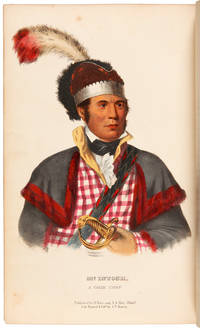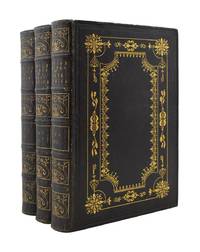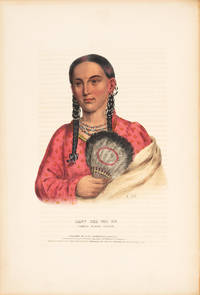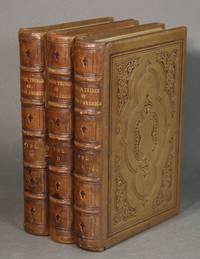
1854Best.-Nr. 53994Philadelphia: D. Rice & A. N. Hart 1854. Second octavo edition 3 volumes 120 brilliant hand-colored plates by J.T. Bowen mostly after Charles Bird King; a lovely set in publisher's full blindstamped brown morocco gilt-lettered spines a.e.g.; very neatly and professionally rebacked with the old spines laid down; the covers with minimal wear and the plates generally fresh and clean 2 plates and several pages in volume I with a tiny dampstain in the very top margin not affecting any text or illustration; a near fine sound copy. Originally published in three large folio volumes 1836-44. "These are the most colorful portraits of Indians ever executed . The original oil paintings of which these plates were copies were all destroyed in the 1865 Smithsonian fire" Howes. "The plates are accurate portraits of celebrated chiefs or of characteristic individuals of the race; and are colored with care to faithfully represent their features and costumes" Field. Field 992; Howes M129; Sabin 43411. D. Rice & A. N. Hart unknown books
1858Best.-Nr. 55790Philadelphia: Published by D. Rice & A.N. Hart 1858. Octavo Edition of McKenney & Hall The fourth octavo edition of McKenney and Hall's classic work after the first octavo edition of 1848-50 and the sumptuous large folio format produced in 1836-44. The plates for the first four octavo editions were all produced by the same lithographer J.T. Bowen and retain the high quality of printing and coloring of the plates found in the first edition. McKenney the superintendent of Indian Affairs and James Hall the famous Cincinnati author joined forces to create the Indian Gallery in the 1830s. Hall supplied the text while the Indian Bureau commissioned artist Charles Bird King to paint portraits of the leading Indian chiefs either from life or by repainting the earlier cruder attempts of James Otto Lewis. The result was a spectacular series of images certainly the best series of such portraits to be produced. A classic Americanum increasingly hard to find in nice condition. Large octavo. Publisher's brown morocco covers elaborately blocked in blind spines gilt in six compartments with raised bands lettered in gilt in the second and fourth the others ruled in blind with repeat decoration of a simple leaf tool a.e.g. Very light wear to corners joints and spine ends. Older ownership inscription on front pastedown of each volume. Scattered soiling light tanning and foxing heavier to a few plates. About very good. HOWES M129. SABIN 43410a. BENNETT p.79 ref. FIELD 992. REESE BEST OF THE WEST 68 ref. hardcover
1858Best.-Nr. 55790Philadelphia: Published by D. Rice & A.N. Hart 1858. Octavo Edition of McKenney & Hall The fourth octavo edition of McKenney and Hall's classic work after the first octavo edition of 1848-50 and the sumptuous large folio format produced in 1836-44. The plates for the first four octavo editions were all produced by the same lithographer J.T. Bowen and retain the high quality of printing and coloring of the plates found in the first edition. McKenney the superintendent of Indian Affairs and James Hall the famous Cincinnati author joined forces to create the Indian Gallery in the 1830s. Hall supplied the text while the Indian Bureau commissioned artist Charles Bird King to paint portraits of the leading Indian chiefs either from life or by repainting the earlier cruder attempts of James Otto Lewis. The result was a spectacular series of images certainly the best series of such portraits to be produced. A classic Americanum increasingly hard to find in nice condition. Large octavo. Publisher's brown morocco covers elaborately blocked in blind spines gilt in six compartments with raised bands lettered in gilt in the second and fourth the others ruled in blind with repeat decoration of a simple leaf tool a.e.g. Very light wear to corners joints and spine ends. Older ownership inscription on front pastedown of each volume. Scattered soiling light tanning and foxing heavier to a few plates. About very good. HOWES M129. SABIN 43410a. BENNETT p.79 ref. FIELD 992. REESE BEST OF THE WEST 68 ref. hardcover books
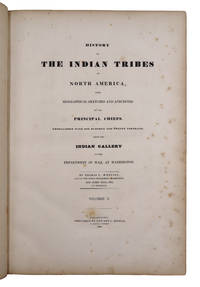
1848Best.-Nr. 69369Philadelphia: Published by J. T. Bowen 1848. HALL James. History of the Indian Tribes of North America. with Biographical Sketches and Anecdotes of the Principal Chiefs. Embellished with one hundred and twenty portraits from the Indian Gallery in the Department of War at Washington. Philadelphia: Published by J. T. Bowen 1848. Full Description: McKENNEY Thomas L. and James Hall. History of the Indian Tribes of North America with Biographical Sketches and Anecdotes of the Principal Chiefs. Embellished with One Hundred and Twenty Portraits from the Indian Gallery in the Department of War at Washington. In Three Volumes. Philadelphia: Published by J.T. Bowen 1848-1850. First octavo edition. Three large octavo volumes 10 1/8 x 6 1/2 inches; 258 x 167 mm. iv 1- 333 1 blank; xvii 1 blank 9-290; iv 17-392 pp. With hand-colored lithographed dedication leaf "To the Memory of Washington" and 120 hand-colored lithographed plates "Lithd. & Cold. & Published by J.T Bowen Philada." mostly after Charles Bird King the plates heightened with gum arabic. Protective tissue guard sheets. Publisher's deluxe blue-black morocco binding. Elaborately stamped and tooled in blind and gilt. Spines stamped and lettered in gilt. Board edges gilt. All edges giltSome wear to spines. A few invisible repairs to hinges. Previous owner's old ink signature on top margin of title-page of each volume. Volume I with some minor dampstaining to lower blank margin. Volume II with some dampstaining to inner gutter. Dampstaining never affecting plates most likely because leaves were stained before the book was bound. A small closed tear to the bottom margin of plate "Oche-Fincew" in volume III not affecting engraving. Overall an excellent copy the plates very bright and clean. Originally published in twenty folio parts three folio volumes between 1836 and 1844 with 120 hand-colored lithographed plates. The first octavo edition appeared in 1848-1850 with the plates reduced. Several octavo editions were published between 1850 and the 1870s with varying numbers of plates some maintaining the original 120 and some abridged to contain as few as forty or fifty plates. All are highly desired today. "As early as 1824 the practice was begun of taking portraits of the principal Indians who came to Washington and depositing them in the War Department. They were chiefly painted by Mr. King an artist of high repute who has been remarkably successful in transferring to his canvas the strong lineaments of the Indian countenance. Col. M'Kinney sic who was for many years superintendent of Indian affairs at Washington and was thus brought in constant association with the principal men of the nations and tribes which sent representatives to the seat of government conceived the plan of making this rare and curious collection more valuable to the world by publishing a series of engraved portraits exactly copies and colored from these paintings. With each portrait is connected a biographical sketch of the individual whom it is intended to represent interspersed with anecdotes and narrations. The work contains also a historical account of the various Indian tribes within the borders of the United States" Sabin 43410a describing the 1836-1844 edition. "The original oil paintings of which the plates were copies were all destroyed in the 1865 Smithsonian fire" Howes. Howes M-129 "the most colorful portraits of Indians ever executed". Sabin 43411 describing the 1850 octavo edition. Field 992 1837 ed. HBS 69369. $18500. Published by J. T. Bowen unknown
1848Best.-Nr. 69369Philadelphia: Published by J. T. Bowen 1848. HALL James. History of the Indian Tribes of North America. with Biographical Sketches and Anecdotes of the Principal Chiefs. Embellished with one hundred and twenty portraits from the Indian Gallery in the Department of War at Washington. Philadelphia: Published by J. T. Bowen 1848. Full Description: McKENNEY Thomas L. and James Hall. History of the Indian Tribes of North America with Biographical Sketches and Anecdotes of the Principal Chiefs. Embellished with One Hundred and Twenty Portraits from the Indian Gallery in the Department of War at Washington. In Three Volumes. Philadelphia: Published by J.T. Bowen 1848-1850. First octavo edition. Three large octavo volumes 10 1/8 x 6 1/2 inches; 258 x 167 mm. iv 1- 333 1 blank; xvii 1 blank 9-290; iv 17-392 pp. With hand-colored lithographed dedication leaf "To the Memory of Washington" and 120 hand-colored lithographed plates "Lithd. & Cold. & Published by J.T Bowen Philada." mostly after Charles Bird King the plates heightened with gum arabic. Protective tissue guard sheets. Publisher's deluxe blue-black morocco binding. Elaborately stamped and tooled in blind and gilt. Spines stamped and lettered in gilt. Board edges gilt. All edges giltSome wear to spines. A few invisible repairs to hinges. Previous owner's old ink signature on top margin of title-page of each volume. Volume I with some minor dampstaining to lower blank margin. Volume II with some dampstaining to inner gutter. Dampstaining never affecting plates most likely because leaves were stained before the book was bound. A small closed tear to the bottom margin of plate "Oche-Fincew" in volume III not affecting engraving. Overall an excellent copy the plates very bright and clean. Originally published in twenty folio parts three folio volumes between 1836 and 1844 with 120 hand-colored lithographed plates. The first octavo edition appeared in 1848-1850 with the plates reduced. Several octavo editions were published between 1850 and the 1870s with varying numbers of plates some maintaining the original 120 and some abridged to contain as few as forty or fifty plates. All are highly desired today. "As early as 1824 the practice was begun of taking portraits of the principal Indians who came to Washington and depositing them in the War Department. They were chiefly painted by Mr. King an artist of high repute who has been remarkably successful in transferring to his canvas the strong lineaments of the Indian countenance. Col. M'Kinney sic who was for many years superintendent of Indian affairs at Washington and was thus brought in constant association with the principal men of the nations and tribes which sent representatives to the seat of government conceived the plan of making this rare and curious collection more valuable to the world by publishing a series of engraved portraits exactly copies and colored from these paintings. With each portrait is connected a biographical sketch of the individual whom it is intended to represent interspersed with anecdotes and narrations. The work contains also a historical account of the various Indian tribes within the borders of the United States" Sabin 43410a describing the 1836-1844 edition. "The original oil paintings of which the plates were copies were all destroyed in the 1865 Smithsonian fire" Howes. Howes M-129 "the most colorful portraits of Indians ever executed". Sabin 43411 describing the 1850 octavo edition. Field 992 1837 ed. HBS 69369. $18500. Published by J. T. Bowen unknown books
1837Best.-Nr. 68710Philadelphia: Edward C. Biddle and Rice & Clark 1837/42/44. The Folio Edition of McKenney & Hall "One of the most costly and important works ever published on the American Indians" Field "a landmark in American culture" Horan and an invaluable contemporary record of a vanished way of life including some of the greatest American handcolored lithographs of the 19th century. After six years as superintendent of Indian Trade Thomas McKenney had become concerned for the survival of the Western tribes. He had observed unscrupulous individuals taking advantage of the American Indian for profit and his vocal warnings about their future prompted his appointment by President Monroe to the Office of Indian Affairs. As first director McKenney was to improve the administration of Indian programs in various government offices. His first trip was during the summer of 1826 to the Lake Superior area for a treaty with the Chippewa opening mineral rights on their land. In 1827 he journeyed west again for a treaty with the Chippewa Menominee and Winebago in the present state of Michigan. His journeys provided an unparalleled opportunity to become acquainted with American Indian tribes. When President Jackson dismissed him from his government post in 1829 McKenney was able to turn more of his attention to his publishing project. Within a few years he was joined by James Hall the Illinois journalist lawyer state treasurer and from 1833 a Cincinnati banker who had written extensively about the West. Both authors not unlike George Catlin whom they tried to enlist in their publishing enterprise saw their book as a way of preserving an accurate visual record of a rapidly disappearing culture. The text which was written by Hall based on information supplied by McKenney takes the form of a series of biographies of leading figures amongst the Indian nations followed by a general history of the North American Indians. The work is now famous for its color plate portraits of the chiefs warriors and squaws of the various tribes faithful copies of original oils by Charles Bird King painted from life in his studio in Washington McKenney commissioned him to record the visiting Indian delegates or worked up by King from the watercolors of the young frontier artist James Otto Lewis. All but four of the original paintings were destroyed in the disastrous Smithsonian fire of 1865 so their appearance in this work preserves what is probably the best likeness of many of the most prominent Indian leaders of the early 19th century. Numbered among King's sitters were Sequoyah Red Jacket Major Ridge Cornplanter and Osceola. This was the most elaborate plate book produced in the United States to date and its publishing history is extremely complex complicated by the work being issued serially in parts by multiple publishers who reissued title pages of previously published parts. BAL ascribes issues to the title pages as follows though this is an indication of the title only and not the text or plates: volume I first issue was by Edward C. Biddle and is dated 1836 or more usually 1837; the second issue Frederick W. Greenough with the date 1838; and the third issue is by Daniel Rice & James G. Clark dated 1842. Volume II first issue is by Frederick W. Greenough and dated 1838 and the second issue is by Rice & Clark and dated 1842. Volume III first issue is by Daniel Rice & James G. Clark and dated 1844 Large folio. Contemporary three-quarter pebbled cloth and brown morocco spine gilt rebacked with the original spine laid down. Spine and corners expertly restored. Scattered foxing minor offsetting from plates scattered minor dampstaing at the lower margin of a few leaves minor damage at fore-edge of the plate facing page 19 in vol. II. A very good set. HOWES M129. BAL 6934. BENNETT p.79. SABIN 43410a. FIELD 992. REESE BEST OF THE WEST 68. hardcover
1837Best.-Nr. 68710Philadelphia: Edward C. Biddle and Rice & Clark 1837/42/44. The Folio Edition of McKenney & Hall "One of the most costly and important works ever published on the American Indians" Field "a landmark in American culture" Horan and an invaluable contemporary record of a vanished way of life including some of the greatest American handcolored lithographs of the 19th century. After six years as superintendent of Indian Trade Thomas McKenney had become concerned for the survival of the Western tribes. He had observed unscrupulous individuals taking advantage of the American Indian for profit and his vocal warnings about their future prompted his appointment by President Monroe to the Office of Indian Affairs. As first director McKenney was to improve the administration of Indian programs in various government offices. His first trip was during the summer of 1826 to the Lake Superior area for a treaty with the Chippewa opening mineral rights on their land. In 1827 he journeyed west again for a treaty with the Chippewa Menominee and Winebago in the present state of Michigan. His journeys provided an unparalleled opportunity to become acquainted with American Indian tribes. When President Jackson dismissed him from his government post in 1829 McKenney was able to turn more of his attention to his publishing project. Within a few years he was joined by James Hall the Illinois journalist lawyer state treasurer and from 1833 a Cincinnati banker who had written extensively about the West. Both authors not unlike George Catlin whom they tried to enlist in their publishing enterprise saw their book as a way of preserving an accurate visual record of a rapidly disappearing culture. The text which was written by Hall based on information supplied by McKenney takes the form of a series of biographies of leading figures amongst the Indian nations followed by a general history of the North American Indians. The work is now famous for its color plate portraits of the chiefs warriors and squaws of the various tribes faithful copies of original oils by Charles Bird King painted from life in his studio in Washington McKenney commissioned him to record the visiting Indian delegates or worked up by King from the watercolors of the young frontier artist James Otto Lewis. All but four of the original paintings were destroyed in the disastrous Smithsonian fire of 1865 so their appearance in this work preserves what is probably the best likeness of many of the most prominent Indian leaders of the early 19th century. Numbered among King's sitters were Sequoyah Red Jacket Major Ridge Cornplanter and Osceola. This was the most elaborate plate book produced in the United States to date and its publishing history is extremely complex complicated by the work being issued serially in parts by multiple publishers who reissued title pages of previously published parts. BAL ascribes issues to the title pages as follows though this is an indication of the title only and not the text or plates: volume I first issue was by Edward C. Biddle and is dated 1836 or more usually 1837; the second issue Frederick W. Greenough with the date 1838; and the third issue is by Daniel Rice & James G. Clark dated 1842. Volume II first issue is by Frederick W. Greenough and dated 1838 and the second issue is by Rice & Clark and dated 1842. Volume III first issue is by Daniel Rice & James G. Clark and dated 1844 Large folio. Contemporary three-quarter pebbled cloth and brown morocco spine gilt rebacked with the original spine laid down. Spine and corners expertly restored. Scattered foxing minor offsetting from plates scattered minor dampstaing at the lower margin of a few leaves minor damage at fore-edge of the plate facing page 19 in vol. II. A very good set. HOWES M129. BAL 6934. BENNETT p.79. SABIN 43410a. FIELD 992. REESE BEST OF THE WEST 68. hardcover books
1837Best.-Nr. 123 volumes. Folio 507 x 365 mm. 120 hand-colored lithographed plates finished with gum arabic lithographed map leaf and 17 pp lithographed facsimile signatures of subscribers with two additional names added in manuscript to Pennsylvania subscribers. Original half-morocco upper covers gilt lettered "Indian Gallery / 120 Illustrations" lower spine lettered in gilt "L.A. Godey" yellow glazed endpapers rebacked retaining original spine hinges reinforced. Superb complete copy in its original binding of one of the most beautiful books printed in the United States which through 120 hand-colored plates preserves the memory of the Indian people. Provenance: Louis Antoine Godey 1804-1878 publisher of Godey's Lady Book spine stamped manuscript identification in another hand; Helen Godey Wilson 1879-1937 bookplates. FIRST EDITION of "one of the most distinctive and important books in Americana" Reese. In 1821-22 Thomas McKenney began assembling portraits of Native Americans that would eventually become part of a portrait gallery under the Smithsonian. He started by taking visiting Native American dignitaries to the studio of Charles Bird King in Washington who would paint their portraits in oil some copies for the dignitaries and some collected by McKenney. These portraits were eventually preserved in the War Department's "Indian Gallery" becoming part of the Smithsonian in 1858. The collection boasted 147 of McKenney's portraits of Native Americans alongside about 200 paintings by John Mix Stanley when it burned to the ground in 1865. Thankfully beginning in 1829 McKenney had embarked on a project to preserve his oil portraits in lithography rescuing most of these important projects for posterity. In September 1829 he signed a contract to publish a work to consist of a history biographies and 120 lithographed plates. The works were issued serially in wrappers and the first volume was collected and published in 1836. By the time the 3rd volume appeared in 1844 15 years after the first contracts were signed the monumental work had consumed six publishers and employed 5 different lithographers. "Its long and checkered publication history spanned twelve years and involved multiple lithographers mainly Peter S. Duval and James T. Bowen and publishers but the final product is one of the most distinctive and important books in Americana. Almost all the plates are portraits of individual Native Americans the majority painted from life by Charles Bird King" Reese. This copy in its original contemporary binding is from the contemporary American publisher Louis A. Godey. Godey was most famous for the influential Godey's Lady's Book beginning in 1830 famous for their representations of women's fashion employing hand-tinted lithographic plates. With the first issue of the title pages in volumes 1 & 3 the second issue of volume 2; the plates in mixed states as usual. See Lane "A History of McKenney and Hall's History of the Indian Tribes of North America" Imprint Vol. 27 no. 2 Autumn 2002 2-15. Howes M-129; Reese Stamped With A National Character 24; Sabin 43410a. Edward C. Biddle and Daniel Rice and James G. Clark hardcover