L'eroe Cinese
1982Best.-Nr. 277111982 hardcover published without jacket/slight bumping on the cover & slight toning along the page block edges/clean & unmarked. Garland Publishing hardcover

School Haus Books · Vereinigte Staaten59,95 $≈ 53,46 €
127 Ergebnisse
Best.-Nr. 14734On his letterhead Kissing Tree House Alveston Stratford-on-Avon Warwickshire. 15 November 1965. 1p. 8vo. Priestley's agents have forwarded an invitation from Crozier 'to write a piece on Alan Herbert for a special issue you are planning'. Although Priestley has 'a high regard' for Herbert he is 'particularly anxious just now not to accept commissions of this kind and so must reluctantly refuse'. On his letterhead, Kissing Tree House, Alveston, Stratford-on-Avon, Warwickshire. 15 November 1965. unknown
Best.-Nr. 17512'Birmm: i.e. the Theatre Royal Birmingham Oct. 13: 1824'. The Oxford DNB's entry on Bunn states that from 1819 to 1824 he held the lease of the Theatre Royal Birmingham. 1p. 8vo. Bifolium. Addressed on reverse of second leaf to '- Perkins Esq'. In fair condition with light signs of age and wear. Bunn begins his letter: 'My dear Sir The dreadful bustle attendant on producing "Waterloo" must be my apology. The Music & Manuscript are herewith sent - & not a note or a syllable of either has been copied.' He thanks 'Mr Howes for his kindness' which he offers to reciprocate 'whenever in my power'. It is unclear which version of a pantomime of the Battle of Waterloo is being referred to here but the Duke of Wellington is said to have enjoyed the 1824 production at Astley's Amphitheatre in London and its revivals see Bradby James and Sharratt 'Performance and Politics in Popular Drama'. 'Birmm: [i.e. the Theatre Royal, Birmingham ] | Oct. 13: 1824'. unknown
Best.-Nr. 2518810 January 1993 with address label of ‘ERIC CROZIER OBE / 4 THE TIMBERYARD / GREAT GLEMHAM / SAXMUNDHAM / SUFFOLK’. See his entry in the Oxford DNB. 1p foolscap 8vo. In fair condition lightly aged and creased. Folded twice for postage. The address is printed on a small golden label affixed at the top left corner. Addressed to ‘Dear Mr. Catry’ and signed ‘With all best wishes - and thank you for writing! / Sincerely / Eric Crozier.’ He asks him to forgive a typed letter as he is ‘convalescing from a heart-attack and still not very good at hand-writing. / The opera I must enjoyed producing was I suppose my very first - Smetana’s THE BARTERED BRIDE in 1943 in a new English version made by Joan Cross and myself which stayed in the repertoire at Sadler’s Wells and Covent Garden for twenty years.’ He recalls that it was first staged ‘during the black-out to audiences starved of colour and gaiety: our first audience included the Czech government in exile - President Benes Jan Masaryk and others - and on the second night they took the whole theatre for their fellow-countrymen to see what all Czechs regarded as their national opera’. The rest of the letter concerns his next production Britten’s ‘Peter Grimes’ ‘a world-wide event’ premiered at Sadler’s Wells in 1945 ‘and one year later I staged the American premiere with Leonard Bernstein as conductor at Tanglewood. I worked with Britten and Montagu Slater the librettist throughout the writing and composition of that great work which has had I would guess a greater international success than any other English opera all through the past fifty years. It is still being staged - Rostropovich will conduct performances of it at the Barbican this March.’ 10 January 1993, with address label of ‘ERIC CROZIER, OBE / 4 THE TIMBERYARD / GREAT GLEMHAM / SAXMUNDHAM / SUFFOLK’. unknown
Best.-Nr. 2325612 October 1953. On London letterhead of 'The King and I' Williamson Music Limited 14 St George St W.1. 1p 4to. In fair condition lightly aged. Folded once. The printing of the letterhead in red and black extends along three edges with decorations including an oriental-style architectural motif in front of a tree at bottom right. At the head of the page the letterhead reads 'Williamson presents The King and I as originally produced by Richard Rodgers & Oscar Hammerstein 2nd.' The four directors of Williamson Music Limited are named at the foot including Rodgers Hammerstein and 'Louis Dreyfus British formerly American'. The note addressed to 'Mr. MacQueen Pope' at his Coventry Street address reads: 'Dear MacQueen Thank you for your book I know that I shall read it with great pleasure. We had the opening you predicted and I am very glad that you were not wrong. All the best to you.' 'The King and I' was written as a vehicle for Gertrude Lawrence who starred in the original Broadway run opposite Yul Brynner. The original London production opened on 8 October 1953 at the Theatre Royal Drury Lane and featured Valerie Hobson as Anna and Herbert Lom as the King. MacQueen-Pope was the Drury Lane publicist hence his ability to make a prediction about the production's success. 12 October 1953. On London letterhead of 'The King and I', Williamson Music Limited, 14 St George St, W.1. unknown
1982Best.-Nr. 277111982 hardcover published without jacket/slight bumping on the cover & slight toning along the page block edges/clean & unmarked. Garland Publishing hardcover
1870Best.-Nr. SP39-0142-14198Colombier 1870. Hardcover. Good. Libretto in French. 1870 Colombier Paris 7 1/2 x 11 inches tall beige cloth hardcover appears recently rebound with refreshed marbled endpapers 4 371 pp. Intermittent light foxing throughout especially to front and rear prelims. Moderate soiling and edge-chipping to front prelims including title page which has a blue Columbier publisher's stamp at the bottom. Moderate to heavy edge chipping to last 10 pages especially lower tips not impacting text. Otherwise a very good copy of this scarce imprint handsomely bound. ~SP39~ 4.0P Les brigands The Bandits is an opera bouffe or operetta by Jacques Offenbach to a French libretto by Henri Meilhac and Ludovic Halevy. Meilhac and Halevy's libretto lampoons both serious drama Schiller's play The Robbers and opera comique Fra Diavolo and Les diamants de la couronne by Auber. The plot is cheerfully amoral in its presentation of theft as a basic principle of society rather than as an aberration. As Falsacappa the brigand chieftain notes: 'Everybody steals according to their position in society.' The piece premiered in Paris in 1869 and has received periodic revivals in France and elsewhere both in French and in translation. Les brigands has a more substantial plot than many Offenbach operettas and integrates the songs more completely into the story. The forces of law and order are represented by the bumbling carabinieri whose exaggerated attire delighted the Parisian audience during the premiere. In addition to policemen financiers receive satiric treatment. The satire counterpoints lively musical romps and the frequent use of Italian and Spanish rhythms; 'Soyez pitoyables' is a true canon and each act finale is a well-developed whole. A 1983 New York Times article theorized that the music of the piece influenced Bizet in writing Carmen and noted that the librettists for this work supplied Bizet's libretto but standard Offenbach references do not mention any such influence. Colombier hardcover
Best.-Nr. 240121006Ricordi Subsidiary of G. Schirmer NY. unknown_binding. Very Good. 0x0x0. Please Read No marks on text - My shelf location 42-a-45 Ricordi (Subsidiary of G. Schirmer, NY unknown
1985Best.-Nr. 7949Manila: Shangkuan Press & School Supply. Very Good with no dust jacket. 1985. Hardcover. Shangkuan Press & School Supply Manila 1985 no further printing statement red boards Very Goodsome edgewear and bumping to the boards/no dust jacket 160 pages OPERA MONGOLIAN HISTORY CHRISTIANITY OPERA; A7227 Shlf; 8vo 8" - 9" tall; 160 pages . Shangkuan Press & School Supply hardcover
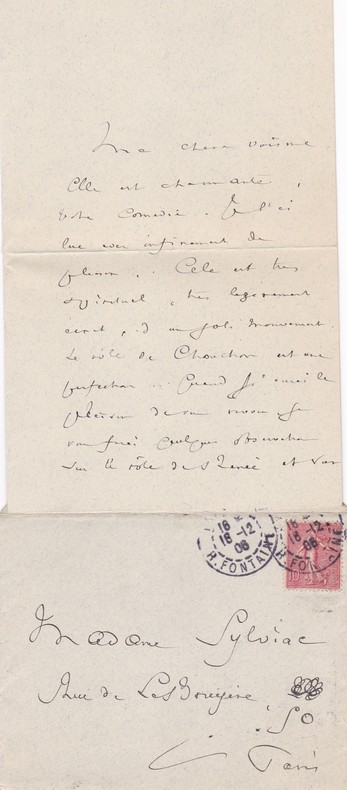
Best.-Nr. 006765L.A.S.+enveloppe, 11 décembre 1906, 2p in-8. A l'actrice Marie-Thérèse Sylviac. Il encense la comédie de Sylviac qui a dû lui envoyer le manuscrit. On sait que Sylviac a écrit et fait jouer plusieurs pièces. Certaines ont été publiées.
Best.-Nr. 012823Eugène Scribe (1791-1861), écrivain, librettiste. L.A.S., sd [1852?], 3p in-8. A Arsène Houssaye (1814-1896), alors directeur du Théâtre-français. Belle lettre dans laquelle il demande de repousser la reprise de sa pièce, La Camaraderie, le lendemain de ce courrier, malgré la demande de Napoléon III de reprendre la pièce. Il y a en effet une soirée de charité où la pièce sera jouée et il voudrait que la pièce soit d'abord reprise lors de cette soirée où elle sera jouée par Mme Volnys et Mlle Anaïs. [169b]
Best.-Nr. 013244Alphonse Royer (1803-1875), écrivain, librettiste, journaliste. L.A.S., samedi matin [7 septembre 1850], 2p in-8. A l'écrivain Jules Janin (1804-1874). Jolie lettre demande à son ami d'assister à une représentation du Jour et la nuit, comédie-vaudeville co-écrite avec Gustave Vaez, « la première ayant été troublée par une cabale qui est parvenue à rendre la pièce incompréhensible » mais « la seconde représentation a été excellent et l'effet très grand ». Il souhaite donc sa présente pour le soir, pour une représentation qui sera mieux encore. [306-2]
Best.-Nr. 013247Pol Mercier (1819-1874), écrivain, librettiste. L.A.S., sd [1851?], 1p in-8. A l'écrivain Jules Janin (1804-1874). Sympathique lettre dans laquelle il lui annonce que mademoiselle Bertin, une jeune fille du Théâtre Français recommandée par Janin, jouera dans sa prochaine pièce avec Regnier, Maillart, Judith et Fix. Il s'agit probablement de Christian et Marguerite, comédie jouée en mars 1851. Dans ce cas, il aura oublié un acteur : Monrose. [306-2]
Best.-Nr. 013999Ferdinand Langlé (1798-1867), écrivain, journaliste, librettiste de Le Sourd ou l'Auberge pleine d'Adolphe Adam (1803-1856). L.A.S., Paris, 15 octobre 186., 1p in-8. A Jean-Louis-Auguste Commerson (1803-1879), écrivain, journaliste. Entête du Tintamarre dont Commerson était rédacteur en chef. Il lui annonce son retour d'un « voyage à la mer » et mentionne un rendez-vous aux Bouffes, une pièce en trois actes, et demande un rendez-vous. Traces de scotch. [109-2]
Best.-Nr. 014001Edouard Mazères (1796-1866), écrivain, librettiste. L.A.S., 11 février 1826 [samedi soir et cachet du lendemain], 1p in-8. Au jeune compositeur Adolphe Adam (1803-1856). Il souhaite l'inviter pour le mercredi suivant, notamment pour lui montrer « le morceau » et causer. Il dit aussi avoir vu Adolphe Adam qui lui a parlé de lui. Peut-être s'agit-il d'Alexandre-Adolphe Delacour (1797-1878), homme politique ? [109-2]
Best.-Nr. 014022Gustave Vaëz (1812-1862), librettiste belge. L.A.S., Paris, 17 août 1844, 1p in-8. Belle lettre autour de la re-création de l'opéra Othello de Rossini le 26 août 1844, à l'éditeur Christophe Tresse : « Mon cher Monsieur Tresse, nous avons, Alphonse Royer et moi un Othello traduit et réarrangé qui se jour à l'opéra le lundi 26 de ce mois, dans 9 jours ; la musique, comme vous le savez, est de Rossini, les rôles sont joués par [Gilbert] Duprez, [Paul] Baroilhet, [Nicolas-Prosper Levasseur] et Mme [Rosine] Stolz [Stoltz], on y a mis de la danse et tout ce qu'il faut pour rendre la représentation brillante. Nous voulons, suivant l'usage, faire imprimer d'avance pour vendre le jour même à l'opéra. Vous convient-il de vous rendre acquéreur du libretto au prix de mille francs que nous avons déterminé comme le plus bas prix auquel nous céderons la propriété de la chose. Cela dit, vous n'avez qu'un mot de réponse à me faire : oui ou non ; vous me ferez connaître votre décision demain n'est ce pas car il ne reste qu'une semaine pour l'impression. Soyez assez bon pour m'écrire deux lignes. Bien à vous dans tous les cas. Gustave Vaëz ». Tresse a effectivement édité le livret en 1844. Très intéressant courrier. [134-2]
Best.-Nr. 014028Hippolyte Bis (1789-1855), écrivain, librettiste, auteur du livre de Guillaume Tell de Rossini. L.A.S., Paris, 3 décembre 1846, 3p in-4. A un « camarade » du ministère de la marine. Longue lettre à propos d'une recommandation que lui faisait son correspondant et une recommandation que Bis fait à son correspondant. [134-2]
Best.-Nr. 014131Victor Prilleux (1814-1876), chanteur, librettiste. L.A.S., vendredi 11 janvier 1867, 3p in-12. Au compositeur Léon Gatayes (1805-1877). Belle lettre pour le remercier d'un article. Il souhaite le rencontrer. Il mentionne aussi le ténor Jules Monjauze (1825-1877). [129-2]
Best.-Nr. 014934[Sarah Bernhardt] Emile Blavet (1838-1924), écrivain, librettiste. L.A.S., Hôtel de Bade, sd, 2p 1/2 in-12. Incroyable et étonnante lettre à l'actrice Sarah Bernhardt (1844-1923) : « Vous me disiez hier que vous m'aimiez bien. Et moi donc ! Seulement, chez vous, cela date de quelques semaines, et c'est de l'amitié pure. Chez moi, cela date de deux ans (devinez à quelle époque) et c'est. tout autre chose ! J'ai été bien bien discret, nest-ce pas ? [.] en tout cas, mon indiscrétion est bien inoffensive, puisque vous partez, que je pars, que nous nous sommes dit un long adieu et que nous nous reverrons pas de plusieurs mois, qui sait même de plusieurs années, jamais peut-être. Je suis au lit, très-souffrant. Vos derniers mot d'hier m'ont mis sans dessus-dessous. Ce qui me désespère c'est d'être à l'hôtel. Si vous saviez l'infirmerie que je rêve !. mais bah ç je crois que je serais plus malade encore. Adieu, ma chère Sarah, bon voyage et soyez heureuse. Moi-même je le serais aussi si j'avais la certitude que vous pensez parfois sans trop de déplaisir à certain toqué qui vous aimait bien. De coeur. ». Très belle d'un amoureux éconduit au moment de la séparation [362]
Best.-Nr. 010231Fabien Sollar (1886-1982), écrivain, librettiste. L.A.S., 6 octobre 1920, 1pœ in-8. Il a décidé avec Frappa « qu'il n'y a décidément rien à faire avec l'Amérique, dans les conditions actuelles » et demande par câble à Carl de Vidal Hundt de renvoyer les manuscrits retenus. [324]
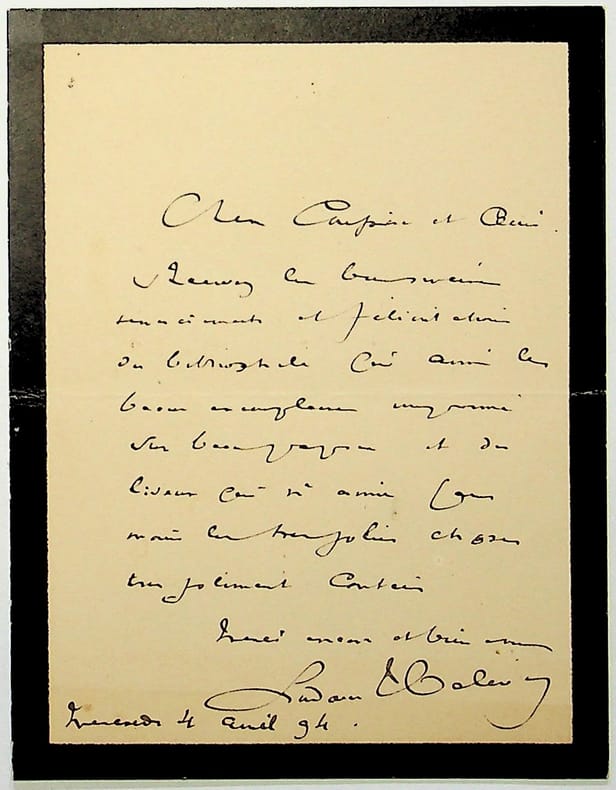
Best.-Nr. 017751Ludovic Halévy (1834-1908), écrivain, librettiste, membre de l'Académie française. L.A.S., 4 avril 1894, 1p in-12. « Cher confrère et ami, Recevez les bons remerciements et félicitations du bibliophile qui aime les beaux exemplaires imprimé sur beau papier et du liseur qui n'aime pas moins les très jolies choses très joliment contées. Merci encore et bien à vous. Ludovic Halévy ». Cachet de la collection Jean-Louis Debauve. [18]
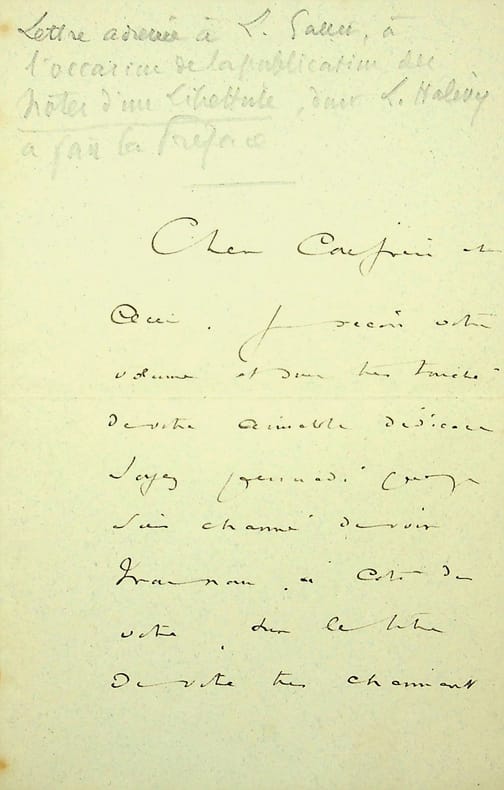
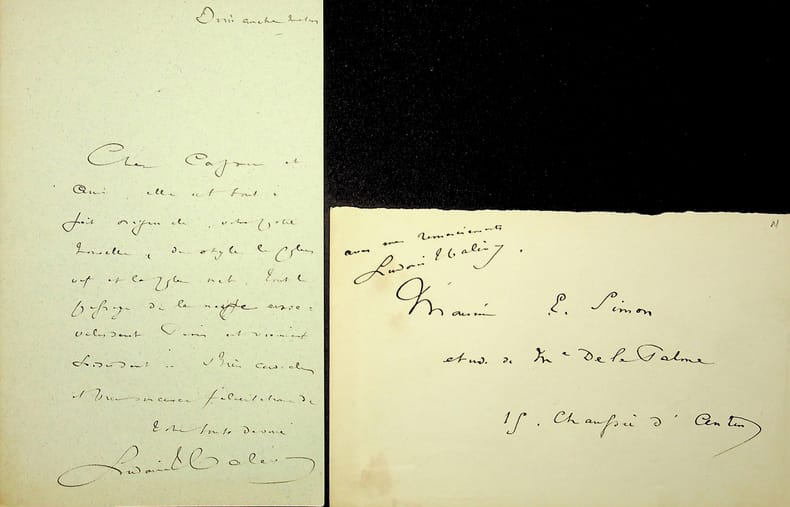
Best.-Nr. 017752Ludovic Halévy (1834-1908), écrivain, librettiste, membre de l'Académie française. L.A.S., 27 mai 1891, 1p 1/2 in-8. Au librettiste Louis Gallet (1835-1898). Belle lettre de remerciements pour un exemplaire dédicacé du livre de Gallet, Notes d'un librettiste, dont Halévy a fait la préface. Cachet de la collection Jean-Louis Debauve. [18]
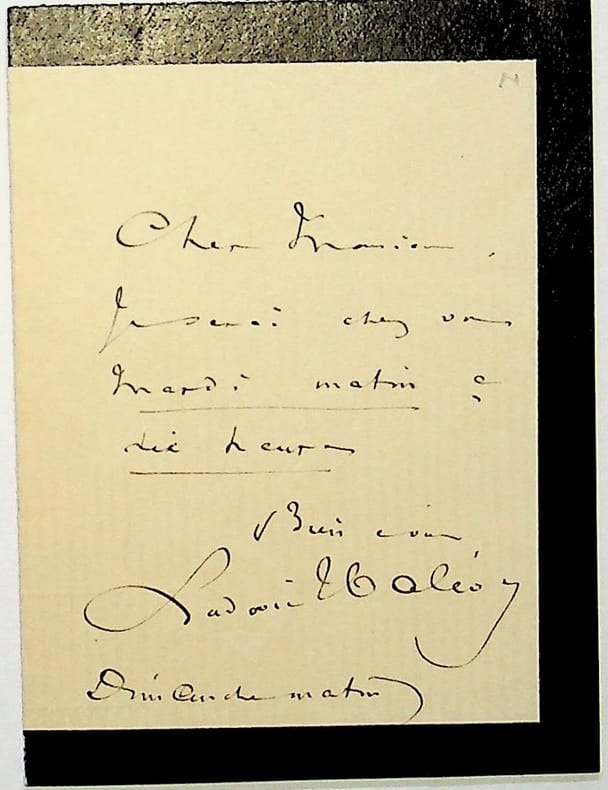
Best.-Nr. 017753Ludovic Halévy (1834-1908), écrivain, librettiste, membre de l'Académie française. L.A.S., sd [dimanche matin], 1p in-12. Pour fixer un rendez-vous. Cachet de la collection Jean-Louis Debauve. [18]
Best.-Nr. 017754Ludovic Halévy (1834-1908), écrivain, librettiste, membre de l'Académie française. L.A.S., sd [ca.1891], 1p in-8. Probablement au librettiste Louis Gallet (1835-1898). Lettre de félicitations. Cachet de la collection Jean-Louis Debauve. [18]
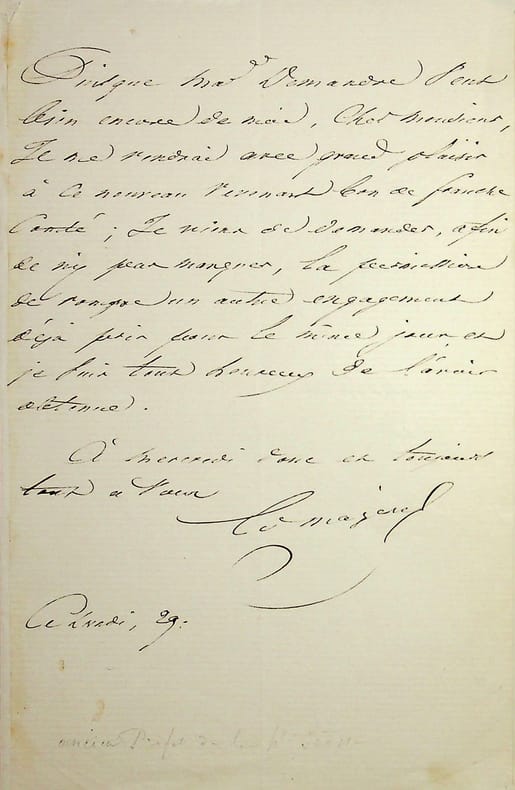
Best.-Nr. 020306Édouard-Joseph-Ennemond Mazères (1796-1866), écrivain, librettiste, collaborateur d'Eugène Scribe, haut-fonctionnaire, préfet. L.A.S., sd [ce lundi 29], 1p in-8. « Puisque madame Demandre veut bien encore de moi, cher Monsieur, je me rendrai avec grand plaisir à ce nouveau [mot illisible] de Franche Comté ; je viens de demander, afin de n'y pas manquer, la permission de rompre un autre engagement déjà pris pour le même jour et je suis tout heureux de l'avoir obtenue. A mercredi dont et toujours tout à vous. Ed Mazères ». [486]
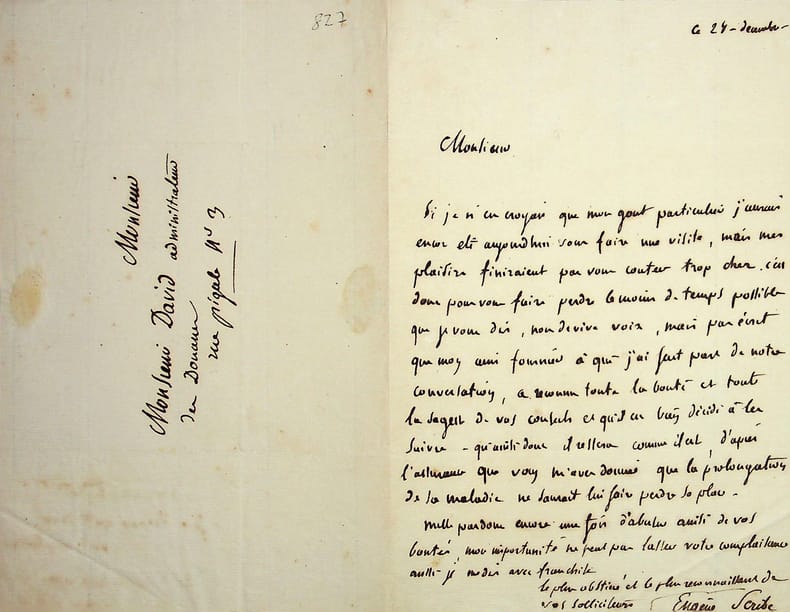
Best.-Nr. 020462Eugène Scribe (1791-1861), écrivain, librettiste. L.A.S., 24 décembre, 1p in-8. A M. David, « administrateur ». « Monsieur, Si je n'en croyais que mon goût particulier, j'aurais encore été aujourd'hui vous faire une visite, mais mes plaisirs finiraient par vous coûter trop cher. C'est donc pour vous faire perdre le moins de temps possible que je vous dis, non de vive voix, mais par écrit que mon ami [Marc] Fournier à qui j'ai fait part de notre conversation, a reconnu toute la bonté et toue la sagesse de vos conseils et qu'il est bien décidé à les suivre. Qu'ainsi donc il restera comme il est, d'après l'assurance que vous m'avez donnée que la prolongation de la maladie ne saurait lui faire perdre sa place. Mille pardons encore une fois d'abuser ainsi de vos bontés. Mon importunité ne peut pas lasser votre complaisance aussi je me dis, avec franchise, le plus obstiné et le plus reconnaissant de vos sollicitudes. Eugène Scribe ». [493]