231 results
1923ref. 212101Berlin: Chryfelius 1923. Limited. hardcover. very good. 23 hand colored original lithographs each signed in pencil by the artist Walter Wellenstein. 44 pages of text printed in gothic script tall slim 4to 3/4 vellum backed boards spine slightly soiled. Berlin: Chryfelius & Schulz 1923. Limited Edition. One of 200 numbered copies signed by the artist. Chryfelius unknown books
2007ref. 157456Heidelberg: Edition Braus 2007. Hardcover. VG- but art school ex-lib. with usual marks. Bw illus. boards with white lettering on bw spine. 323 with illus. throughout in color and bw. No dust jacket. A bit heavy and may require extra postage depending upon your location. Please inquire. Subtitle: zur Ausstellung Die Neuen Tendenzen. eine Europäische Künstlerbewegung 1961 - 1973 ; eine Ausstellung des Museums für Konkrete Kunst Ingolstadt 29. September 2006 bis 7. Januar 2007 ; Leopold-Hoesch-Museum Düren 28. Januar bis 25. März 2007. The project international maps the plurality of art directions represented through exhibitions symposiums and publications which were held under the terms of the New Tendencies the New Tendency and the Tendencies hereafter jointly as NT in Zagreb and in other centres and locations for presentations from 1961 to 1973 taking NT as a dynamic international network and a stage for different but unarguably advanced artistic theories and practices of the 1960s in the Contemporary Art Gallery what is today the Contemporary Art Museum Zagreb within the City of Zagreb Galleries which organized five NT exhibitions in Zagreb from 1961 to 1973 while major exhibitions were also held in Paris Venice and Leverkusen. A joint exhibition of European artists in 1961 grew into an international movement that would be referred to as the NT also significant for gathering artists gallery owners and theoreticians during the Cold War first from Eastern and Western Europe and dissidents from South America and from 1965 onwards also those from USA the Soviet Union and South America and subsequently from Africa and Asia. Such a unique situation was realized by the cultural and geo-political position of Zagreb in the then socialist and unaligned Yugoslavia. - oris.hr Text in German with English at back. Edition Braus hardcover books
1940ref. 8275Berlin: German Ministry of Propaganda 1940. First Edition presumed. Original Wraps. Very Good to Near Fine. First Edition presumed. Original Wraps. German text. Richly illustrated. Hoffmann was Hitler's personal photographer having visited & photographed Hitler while Hitler in Landsberg prison and remaining an important photographer for the Reich. Part of a series of 26 Hitler propoganda books issued by the German Third Reich from 1933 to 1940 with an additional 16 titles about Germany more broadly. Rather uncommon and quite scarce in clusters.a very nice start to a collection. Some show light shelf/edge wear one with a soft crease at the front one a small closed tear at spine most still have original display string else tight bright and unmarred. Color pictorial printed wraps. Each 2" x 1 3/4". 36pp. Illus. b/w plates. German Ministry of Propaganda unknown books
1937ref. 40282Berlin: Freiheitsverlag G.m.b.H. 1937. First edition. Softcover. g to vg. Quarto. 64pp. Original photo-illustrated dust-jacket over blind stiff wrappers. A collection of 45 photogravures documenting Mussolini's 5-day official visit to his friend and ally Adolf Hitler in Germany in late September 1937. Many of the photographs featured in this work were taken by Hitler's personal photographer Heinrich Hoffmann. Striding side by side the two dictators and partners of the Berlin-Rome Axis are seen touring Munich where they laid wreaths on various Nazi monuments. Among these was the Feldherrnhalle in Königsplatz which held the bodies of 16 Nazi heroes killed in the 1923 Munich Putsch. The next series of photographs were taken in the little village of Lalendorf where Hitler and Mussolini witnessed the most impressive military manoeuvres of post-WWI Germany. The following images show the two leaders visiting the mighty Krupp munitions works at Essen. Two photographs of Benito Mussolini attending a luncheon given by Göring and his wife at their famous hunting lodge Karinhall are placed between the largest series of pictures showing the two men during the grandiose Berlin celebrations in their honor. Indeed an estimated crowd of 650000 people attended the demonstration organized on the Maifeld the polo ground adjoining the Olympic Stadium. At the official tribune Mussolini delivered a speech where he spoke of the awakening of Germany through the Nazi revolution Bolshevism the common enemy and Germany's friendly stand during the Ethiopian War. The speech ended with a stress on the 115 million Germans and Italians and the need for them to unite "in one single unshakable determination." Closed tear and soiling at back cover of dust-jacket. Moderate abrasion along fore-edge of DJ. Clear and minor water-staining along fore-edge of the first 32 pages not affecting lettering. Text in German gothic script. DJ in overall good- wrappers and interior in good to very good photographs in very good condition. Freiheitsverlag G.m.b.H. unknown books
1890ref. 15103Frankfurt am Main: Literarische Anstait von Rutten & Loning 1890. With wood-engraved colored illustrations and text. Includes the extra leaf for the 100th edition of Wie der Struwwelpeter reprinted from Gartenlaube 1871 No. 46 with a portrait of Hoffmann. Original decorated wood engraved boards listing all the individual episodes on the front cover and publisher’s advertisements on the back cover. The 100th edition was published as a jubilee edition and all subsequent editions contain the additional leaf at the beginning. This is the famous group of stories of children who are not good do not listen to their parents and therefore suffer the results often drastic consequences of their cruel mischief. One story tells of a child who tortures animals receiving a deep bite another receives burns when playing with matches another is carried off in the wind while playing with an umbrella never to return. There are children who cut off a thumb from playing with scissors and another who refuses to eat his soup and starves to death. Each of these stories has been related to psychiatric conditions. Each story has its symbols for a variety of mental problems such as ADHD or hyperactivity syndrome. The boy who refuses to eat has been described as suffering from anorexia nervosa. Hoffmann was a Frankfurt doctor and psychiatrist. This book is one of the most successful German children’s books and has been translated into numerous languages. Literarische Anstait von Rutten & Loning unknown books
1942ref. 34941München: Zentralverlag der NSDAP Franz Eher Nachf. GmbH 1942. First edition. Hardcover. g to vg. Quarto. 702pp. Original gold-stamped orange cloth with Nazi eagle holding a swastika on front cover. Color frontispiece portrait of Hitler after a painting by Horn-Stauffer. Publisher's logo on title page. The Bavarian capital of Munich held a special place in the Nazi pantheon. It was the "Hauptstadt der Bewegung" - the Capital of the Movement - the birthplace of the Nazi Party. Throughout the Third Reich period Munich remained the spiritual capital of the Nazi movement with headquarters buildings museums to house the forms of artworks approved by Adolf Hitler and shrines to the attempted Nazi putsch in November 1923. These sites were used as the scenes of lavish annual memorial ceremonies and swearing-in ceremonies for new SS members. Illustrated with 20 photographic reproductions including 4 in full-color the buildings featured in this work are: - The "Brown House" the NSDAP's headquarters building in Munich. - The Königsplatz where in 1935 two "Honor Temples" were erected for the remains of the sixteen Nazis who died in the 1923 Beer Hall Putsch. - The "Führerbau" a major party office building. Hitler's office in the "Führerbau." - The two "Honor Temple" structures. - The "Verwaltungsbau der NSDAP" The Nazi party's administration building Very minor and sporadic staining on binding. Text in German. Binding in overall good to very good interior in very good condition. Zentralverlag der NSDAP, Franz Eher Nachf., GmbH hardcover books
1903ref. 6626Wien: Wiener monastshefte fur angewandte kunst 1903. First Edition. First Edition. 4to 8 x 12 inches. Original salmon-colored printed wrappers with superb cover illustration and the entire work loaded with photographs of exhibition pieces by Kolomon Moser and Joseph Hoffmann Issue June 6 1903 pp. 81-106 as issued. In fine condition. Rarely seen thus. Wiener monastshefte fur angewandte kunst unknown books
1963ref. 163078N.p.: N.p. 1963. Vintage borderless photograph of George Harrison getting his signature "Beatle" haircut trimmed at the Horne Brothers barbershop in Liverpool on March 25 1963. Stamp of photographer Dezo Hoffmann and annotations in manuscript pencil relating to cropping on the verso. From the archive of the PIX Agency an American photo house that acted as an intermediary between emigre photographers as well as those still living in Europe and the American magazine and newspaper market between 1935-1969. 8 x 10 inches archivally matted in an 8-ply white mat measuring 14 x 18 inches. Near Fine. N.p. unknown books
1963ref. 163077N.p.: N.p. 1963. Vintage borderless photograph of Ringo Starr getting his signature "Beatle" haircut at the Horne Brothers barbershop in Liverpool on March 25 1963. Stamp of photographer Dezo Hoffmann on the verso. From the archive of the PIX Agency an American photo house that acted as an intermediary between emigre photographers as well as those still living in Europe and the American magazine and newspaper market between 1935-1969. 8 x 10 inches archivally matted in an 8-ply white mat measuring 14 x 18 inches. Near Fine. N.p. unknown books
1933ref. 41640Stuttgart: Julius Hoffmann 1933. First edition. Softcover. g to vg. Large quarto 11 1/2 x 9 1/4". 163-218 2pp Text 30pp Advertisement. Original photo-illustrated wrappers. Remarkable issue of this renowned German architecture magazine with articles on Ulfert Janssen and Heinz Wetzel's WWI Memorial project in Bad Berka 2 pages with 5 b/w photographic reproductions and 3 plans; Alfred Daiber's Ortskrankenkassen Local Health Insurance Ressource Center in Stuttgart 19 pages with 27 b/w photographic reproductions and 14 plans and floor plans; Swedish physician and author Axel Munthe's Villa San Michele on the Isle of Capri Italy 7 pages with 12 architectural drawings 6 photogravures 4 floor plans and 1 plan; a lengthy article on furnishing small rooms with 46 b/w photographic reproductions depicting furniture by Hungarian architect and furniture designer Kalman Lengyel p.191-220; a 4-page article with 22 b/w photographic reproductions of chairs; and the last two pages contain the b/w drawings of two modern kitchens by Hans Müller and Margot Gerster. Includes 3 color plates of Interior design by Oskar Fischer Rudolf Frank and Hans Müller. Head and tail of spine slightly chipped. Text in German. Wrappers in overall good interior in very good condition. WITH 8 larger loose leaves 11 7/8 x 9 1/4" reproducing 11 of the 46 photographs featured in the article on furnishing small rooms. Also included are 3 original silver gelatin prints of furniture by Kalman Lengyel. Two of the photographs measure 7 x 9 3/8" and one is 6 1/2 x 8 7/8". Each print has the following stamp at verso Lengyel 78 Av. Pasteur Vanves Seine. Julius Hoffmann unknown books
1930ref. 48783's-Gravenhage: Heinz & Co 1930. Review Copy. Softcover. Very good condition. Octavo. 359 20pp. X plates. Original ochre cloth with gilt lettering on covers and spine protected by modern mylar. Lightly textured cream endpapers. Title page printed in red and black stamped "Recensie Exemplaar" with N. V. Boekh. v.h. W. P. van Stockum & Zoon label pasted below red publisher's device. Cover design by Josef Hoffmann. Welcome addresses by Dr. Hainisch Trade Minister and Ex-President Alfred Roller Director of the Vienna Arts % Craft School and Josef Hoffmann architect and head of Planning Department. Elaborate publication introducing Austrian arts & crafts including the Vienna School of Arts and Crafts Wiener Werkstätte its extensive curriculum and faculty including Franz Cizek and Josef Hoffmann and the products created in various departments the Vienna Porcelain Factory Augarten and other branches like tapestry carpets silk chairs and small furniture glass and silver products jewelry a piano by Joseph Frank built by Bösendorfer clothing fashion ceramics accessories cabinets lamps typography posters and iron work. The guide is profusely illustrated with b/w photographs of products throughout. Ten color plates depict the work of Michael Powolny ceramic Lucia Stadelmeyer and Elsa Engel-Meinfelden ornamental fabric an original design for toys by Emmy Zweybrück-Prochaska rendered lithographically with gilt decorative overlay Joseph Binder poster Ernst Ludwig Franke poster Ernst Ludwig Franke corporate logos two plates Otto Exinger poster Atelier Kosel poster and Gaertner and Klose two designs for posters. Contains list of Institutes Schools and Museums and epilogs by Hainisch Hoffmann and Roller indices by subject and names and tables of illustrations as well as addresses and bibliography. With twenty pages of advertisement at rear some of them illustrated. Text in German French and English. Binding with very light wear along edges and lightly rubbed. Stamped "Recensie Exemplar on front free endpaper and title page. Starting slightly at page 161. Original watercolor with slight thumbprints at corners not affecting image. Heinz & Co unknown books
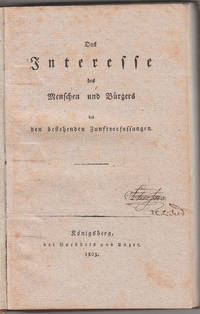
1803ref. 10056Konigsberg: Goebbels und Unzer 1803. First Edition. Contemporary paper backed boards and label. Very good; spine label partially abraded. 8vo xvi 1 - 232 pp. Statesman statistician and economist the author had an eminent career in public policy making and teaching. He was for a time the principal advisor to Hardenberg and present at Paris for the peace conference in 1813 as well as the Congress of Vienna. He was also responsible for the complete overhaul and modernization of the Prussian satistical bureau beginning in 1810. He was the author of several books on statistics as well as economics and law. The work offered here is his first publication. It is a detailed exposition of how the social and commercial maintenance of the guild system is an obstacle to the economic progress of the state and its populace. Given the author's proximity to the center of Prussian power and government it can be read as a 'map' for the future development of the German state under Prussian leadership after unification. Palgrave II p. 318. Goebbels und Unzer hardcover books
1937ref. 54455Dießen am Ammersee: Raumbild-Verlag Otto Schönstein 1937. First edition. Hardcover. Good to near fine condition. Large quarto. 61 3pp. 8 plates. Original cream linen cover with red lettering stamped to spine and front cover. Beveled edges. The Haus der deutschen Kunst House of German Art was constructed from 1934 to 1937 following plans of architect Paul Ludwig Troost as the Third Reich's first monumental propaganda building. Its inaugural exhibition July 18 1937 was the "Tag der deutschen Kunst" Day of the German Art and was intended as an illuminate contrast to the condemned modern art on display in the concurrent Degenerate art exhibition Entartete Kunst also held by the Nazis in Munich on July 19 1937. This scarce stereoscopic album contains 100 stereographic images size: 2 1/2 x 5" 22 of which are pasted on heavy card stock within the textual portion and 78 resting in lowered pockets inside back board. All the photographs were taken by Hitler's personal photographer Heinrich Hoffmann and pertain to the opening of the "Tag der deutschen Kunst" exhibition. They show striking views of the city of Munich adorned with decorations and swastikas; outside and inside views of the impressive "Haus der deutschen Kunst"; Hitler's arrival for the inauguration of the building and the exhibition as well as views of numerous showcased artwork duly approved by the Nazis. This album is complete with its stereoscope resting in lowered pocket inside front board and stereo-views in three compartments of inside back cover. Text in German Gothic script. Binding with light wear along edges and rubbed some light chipping of first few words on front cover. Minor age-toning of text pages. Raumbild-Verlag Otto Schönstein hardcover books
1984ref. 214208New York: Crown 1984. First edition and first printing. Hardcover. 102 pages. Number 90 from an edition of only 250 copies. A wonderful rendition of this classic Christmas story. Features a translation by Ralph Manheim. The illustrations are based on Sendak's sets and costumes that he designed for a Nutcracker production for the Pacific Northwest Ballet. A clean near fine copy in blue cloth boards with some very slight sunning to the spine and in a near fine slipcase with the same sunning to the opening. Signed by Sendak on the limitation page. Includes the original hand-drawn lithograph "Faithful Nutcracker" printed on chine applique paper which is adhered to a hand torn sheet Lana mould made paper. The lithograph is in fine condition and is signed and numbered by Sendak as well. Crown unknown books
2004ref. 1390768New York: World Security Network Foundation 2004. Limited First Edition 1/2000 Copies. Hardcover. Quarto 204 pages. In Very Good condition. Bound in publisher's gray cloth with silver lettering and a decorative monocle to front board. Mild bumping to corners of boards. Minor scuffing to cloth. Inscribed by contributor Edward L. Rowny on second free endpaper: "Dear Bill / Please accept this book as a token of my appreciation for our friendship. Fritz shared your values and was also one of your great admirers. / Best wishes to my favorite non-stovepiper! / Warm regards Ed Rowny." With a pocket to rear pastedown containing papers and prints from the publisher. Fritz Kraemer worked as the Senior Legal Advisor to the League of Nations in the 1930s. After serving in World War II he acted as Senior Civilian Advisor to the US Army Chief of Staff in the Pentagon until 1978. Kraemer is often credited with discovering Henry Kissinger and influencing the Department of Defense during the Cold War. Contributor and signer Edward L Rowny served as the US Representative to Strategic Arms Limitation Talks under Presidents Nixon Ford and Carter. He also served as an advisor on arms control for Presidents Reagan and George H.W. Bush. Other contributors include Alexander M. Haig Henry A. Kissinger Madeleine Kraemer Bryant Sven Kraemer Wilhelm-Karl Prinz von Preussen and Donald Rumsfeld. 1390768. Special Collections - Downstairs. World Security Network Foundation hardcover books
1925ref. 43546München: Heinrich Hoffmann 1925. Loose leaf. vg. Silver gelatin postcards 3 1/2 x 5 1/2". This collection of photo-postcards provide a vivid impression of the pageant on the occasion of the opening of the German Museum in Munich. The photographs show the various sections of the pageant representing a number of professions e.g. carpenters butchers bakers potters galziers textile merchants engineers female citizens of Munich and the elements fire water and air. Many of the sections include horses as well as cars floats and marching bands all photographed with the backdrop of the illustrious Munich architecture. The collection contains a portrait photograph of the German engineer and founder of the German Museum in Munich Oskar von Miller. The majority of the photographs are by the photographers Hoffmann and Spiesse often copied into the photos with numbering in white respectively stamped to the verso of the cards. Two of the postcards are stamped Photo-Atelier Hans Möller on verso. Postcards partly with light oxidation in margins slightly wavy and some with light bumps and minor stpots. Overall in very good condition. Heinrich Hoffmann unknown books
ref. 140941240New York: Crown Publishers Inc 1984. Signed Limited First Edition. Fine. Signed limited first Sendak edition. Copy 97 of a limited 250 signed by Sendak on the limitation page with a signed and limited lithograph laid in. Bound in publisher's grey cloth-covered boards with front cover decorated in blind and titled in silver silver titles on spine; in original slipcase. Cloth lightly sunned else Fine. E.T.A. Hoffmann's early 19th-century tale illustrated here for the first time by Maurice Sendak. Crown Publishers, Inc unknown books
1822ref. 20155Frankfurt: F Wilmans 1822. First Edition. Original printed paper covers laid down; accompanied by a slipcase. Very good; recased with original decorated covers and spine laid down; new endpapers. 8vo 4 3 - 267 3 - adverts pp. Completed 3 months before the author's death. The book is regarded as a humourous fairy tale while being censored. It was first published with the expurgated chapters in 1908. See Goedeke. F Wilmans unknown books
ref. 4695Hoffmann draws two sketches to explain his instructions to Wilhelm Jonasch 1892-1961 artist and designer known for the textiles he created for the Weiner Werkstatte. Hoffmann asks Jonasch to take a box which can be found in a cabinet to a meeting. To be clear which cabinet Jonasch should find the box in Hoffmann draws both cabinet and box. Signed in full in the letter and signed "Professor Hoffmann" on the envelope. With such clear direction one would imagine Jonasch delivered the box to the meeting. unknown books
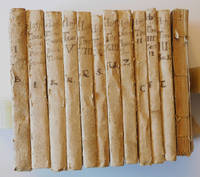
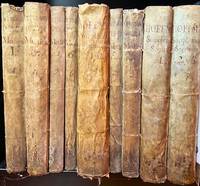
1753ref. 006549Neapoli: Benedicti Gessari 1753. Book. Very Good. Soft cover. First Thus. 4to - over 9¾" - 12" tall. The RARE First Italian edition published in Naples 1753-1763 this being a 12 volume partial set of Hoffman's major works containing the following: "Medicinae Rationalis Systematique" Tomus Secundus Tomus Tertius Section I and II all published 1753 and Tomus Quarti Pars Secunda and Pars Tertius 1754 ; "Observationum Physico-Chymicarum Selectiorum" Libri III 1755; "Operum Omnium Physico-Medicorum Supplementum" by itself a 13 volume set books 1 1754 5 1757 8 1760 10 1762 and 13 1763 ; and "Opuscula Medica Varii Argumenti Seu Dissertationes" 1756. Two of the volumes have handwritten " ex Libris Josephi de Bertolois Medici Physici Avia" an 18th century M.D. who appears to be the original owner. The "Opuscula Medici" and Book 1 of the "Operum Omnium" are Good only the "Opuscula Medici" lacking its binding but complete in its contents and Book 1 of the "Operum Omnium" the boards heavily soiled and loose in its binding. The rest of the 10 volumes Very Good soiling to boards some worm holes corner creasing. A remarkable collection of Hoffmann's works. Benedicti Gessari Paperback books
1943ref. 47584Camp McCain: n/a 1943. Original document. Loose leaf. near fine. Original one page letter 11 x 8 1/2" in original POW Camp envelop 4 x 6". Handwritten letter by Willibald Hoffmann a Jewish soldier in the army of Nazi Germany who was taken prisoner and held in the POW Camp McCain in Mississippi USA. Written on the official US POW mail-form of the camp dated September 13 1943 signed Willibald Hoffmann plus postmarked official envelope with "Prisoner Of War" printed on front and US Censor stamps examined by 763 on front and back. Prisoner of War Camp stamp dated 13th of September 1943 on back. With signed English translation of the original letter attached. There were thousands of men of Jewish descent Mischling and hundreds more of what the Nazis called "full Jew" serving in the army while their families were exterminated at the same time causing psychological trauma for most of them while keeping it a secret for the rest of their lives. The American author Bryan Mark Rigg has documented the Jewish ancestry of more than 1200 of Hitler's soldiers including two field marshals and ten generals some of whom were awarded the Knight's Cross Nazi Germany's highest military honor. Hitler himself had signed declarations that these soldiers were of German blood. These soldiers often believed that they were helping to save the lives of Jewish relatives. "Many while they were fighting their parents were being deported anyway." Rigg. Some 2300 relatives of a group of 1000 soldiers documented by Riggs were killed by the Nazis. See Bryan Mark Rigg "Lives of Hitler's Jewish Soldiers: Untold Tales of Men of Jewish Descent Who Fought for the Third Reich. University Press of Kansas 2009 Hoffmann in his letter September 13 1943 to Rabbi Max Koppel writes: "Dear Doctor You'll be astonished by my lines because I've lost every connection to my relatives who as far as I know are now in America. That is why I am approaching you confidentially with the request to help me in this matter. My father's name is Samuel Felix and comes from Austria-Hungary where we owned a large dye and weaving factory. My father has lived last in Cologne at the Rhine where he owned a textile wholesale. Due to his Jewish faith the events in Germany forced him to flee. I myself took on another name. Maybe I could ask you to visit me here or to send a representative since it is impossible in my situation to convey everything to you by letter. To facilitate this a permission has to be obtained from Washington. Hoping to get a confirmation of receipt of my letter. With sincere regards Willibald Hoffmann" POW Camp McCain was established in the Granada district of Mississippi USA in 1942 originally as a training camp for American infantry bound to join the fighting in Europe. During the war more that 7700 German prisoners of war were held in the camp. They were put to work in the cotton fields of the Mississippi delta. The camp operated until October of the year 1944. The addressee Rabbi Max Koppel was born in Mönchengladbach Germany in 1905. A graduate of the Jewish Theological Seminary of Breslau JTS and the universities of Breslau and Würzburg he served as a Rabbi in Hirschberg today Jelenia Góra in Poland and Berlin and was an educator at the Joseph Lehmann school of the Reform community in Berlin. In 1937 he immigrated o the USA and was one of the founders of the Congregation Emes Wodzedek in the Washington Heights section of Manhattan. WITH ADDED Neuda Fanny. Stunden der Andacht Hours of Devotion INSCRIBED. Basel. Verlagsbuchhandlung V. Goldschmidt. 1854. First edition. Inscribed "Zur Erinnerung an Ihren Lehrer. 28. Juli 1956 Rabb. Max Koppel To remember your teacher Rabbi Max Koppel" on inside front cover; with stamp of Koppel's New York Congregation. Duodecimo. viii 176pp. Original black cloth with gilt lettering and ruling on cover. A prayer and book for edification of the women and virgins of Israel to be used in public and private as well as all affairs of the female life. Published in honor and memory of her husband Abraham Neuda Rabbi in Lostice Czech. Contains one hundred and three prayers: including the prayer when entering the synagogue the daily prayers a prayer for the Sabbath prayers at the New Moon a prayer on the day of the destruction of Jerusalem a prayer for mothers on the wedding day of their sons etc. The book closes with a poem to be read during "Hagbaha" The raising of the Torah a legend from the Menorah Hamaor read on the day of reconciliation during the time of the morning prayer a poem expressing thanks for recovery and an address to the noble mothers and women in Israel dealing with the education of their daughters. Text in German. Binding with some wear along edges small chips and front joint partially cracked. Block browned. Binding in overall good- interior in good condition. n/a unknown books
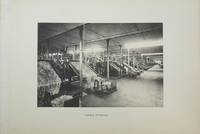
1890ref. 68489Calcutta: Johnston & Hofman 1890. JOHNSTON & HOFFMANN. . Jute. Photographic Album of the Jute Production in India. Calcutta: Johnston & Hofman n.d.c.a 1890. Four oblong quarto photographic volumes. mounts: 11 3/4 x 7 3/4 inches; 290 x 199 mm; photographs: 7 1/2 x 5 inches; 190 x 128 mm With 68 black-and-white photographs mounted one per page on stiff cardboard. Uniformly bound in original half navy cloth over green cloth. Front boards lettered in gilt. Volume one with water damage mainly to rear board and affecting the last seven photographs but the images are still clearly visible. A few other photos in this volume have some minor fading or spotting. Back endpapers to this volume have been replaced. Some minor spotting to the cloth on other volumes and a bit of wrinkling to the cloth of volume IV. All other volumes internally clean and crisp and the photographs are in very good condition. Overall a very good set. Complete sets are rare. Comprises: Volume I: "Cultivation and Preparation" 25 photos. Volume II: "Its Manufacture" 21 photos. Volume III: "Assorting and Baling" 20 photos. Volume IV: "Baling and Export" 22 photos. "Theodore Julius Hoffmann and P.A. Johnston. Calcutta Studio established in 1882. Probably after the studios of Bourne and Shepherd the second largest commercial photographers in India with their large catalog of views of North and Northeastern India Sikkim and Nepal." luminous-lint dot com. HBS 68489. $3000. Johnston & Hofman unknown books
1740ref. 153Geneva: De Tournes 1740 -1753. First Editions throughout. Contemporary full limp vellum. Very good; some dustiness; vol. II of Opera with small ink stain on pp. 64-70; rear hinge of Supp. I split. Folio. A frontispiece and three plates in Supplement II part 2. This is the first edition of all parts of Hoffmann's works. It contains the two series of supplements published in 1749 and '53 that are often not present. The nine volumes contain virtually all that was known at the time about medicine and the medical applications of chemistry. Hoffmann's published work ranges over both areas where he made original contributions e.g. see Partington on Hoffmann and the development of modern chemistry. G-M #72; DSB VI 460; Ferguson I 409; Partington II 693; absent from Neville who had only later printings. De Tournes hardcover books
1892ref. 1726491892. HOFFMANN Hermann. Systematische Farbenlehre Teil 1 und 2. Volume 1 with 115 pp. text and volume 2 with 41 plates. Folios ca. 265 x 185 mm. cloth binding plates loose as issued in cloth portfolio. Zwickau: Förster & Borries 1892. An interesting and scarce work by the German printer Hermann Hoffmann whose work was primarily concerned colour as it could be used by printing ink manufacturers. Tafel 1-2. 30 theiliges technisches Farben-System Plates 1-2. 30-part technical Color System Tafel 3-12. Farben-Akkord Triade Plates 3-12. Color Chord Triad Tafel 13-14. Schein-Farben Plates 13-14. Illusion Colors Tafel 15-16. Harmonie der Farben Plates 15-16. Harmony of Colors Tafel 17-21. Helligkeits-Kontraste Plates 17-21. Brightness Contrasts Tafel 22-30. Chromotypographischer Andruck Plates 22-30. Chromo Typographic Proof Tafel 31-39. Color printing commercial samples Tafel 40. Die gebräuchlichsten Tonfarben Plate 40. The most common clay colors Tafel 41. Schwarzdruck auf farbigem Grunde und umgekehrt Plate 41. Black print on a colored background and vice versa Neat ex-library copy with labels inoffensive library stamps throughout generally in the margins. hardcover books
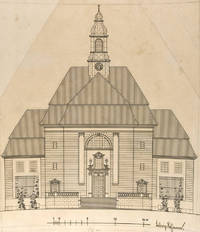
1909ref. 31997Berlin: NP 1909. Softcover. g to vg. Plans & drawings in various sizes all printed on light card stock some plans mounted. Seven of the ten are numbered. 5 plans/drawings annotated by Hoffmann 2 drawings signed by him 5 signed by Stadtbauinspektor / Magistrats-Baurat Tietze. Printed by "Gisaldruck v. Bogdan Gisevius Berlin." not numbered: 1 Large 46 1/2" x 59" Lageplan ground plan of the hospital also showing surrounding streets. Plan titled "Neubau des IV. Städt. Krankenhauses - Lageplan." Rudolf Virchow handwritten in blue crayon below title. Parts of folds as well as sporadic tears repaired with tape. Parts of edges chipped some closed tears along folds no missing pieces. 2 Drawing 13 3/4 x 16" showing the facade of the hospital mounted on 17 1/4 x 25" card stock. Signed by Ludwig Hoffmann with some of his annotations. 3 Drawing 16" x 21 1/2" of the "Operationshaus" mounted on 23 1/2" x 28 1/2" card stock. Signed by Hoffmann with his annotations. Numbered plans: # 4 - # 7 with original signature of Stadtbauinspektor Tietze dated 6. Januar 1909. Also with printed signature of the on-site architect Bietz Signatures accompanied with text: a "Revidiert und festgestellt: Berlin den 6. Januar 1909. Der Stadtbauinspektor: original signature "Tietze" Magistrats-Baurat. b "Die Richtigkeit und Uebereinstimmung mit der Ausführung bescheinigt: Berlin den 1sten Dezember 1908. Der Bauleitende printed signature of "Bietz" Architekt. 4 Blatt 1: 22" x 30" revised plan showing the foundation Revisionszeichnung Fundamente of the Doppeloperationshaus surgery building. With many handwritten annotations by the architect. Small number stamp on lower left margin. 5 Blatt 2: 26" x 30" revised plan showing the basement Revisionszeichnung Kellergeschoss of the Doppeloperationshaus. With architects handwritten annotations. Five-inch closed tear on upper left corner. 6 Blatt 3: 18" x 25" plan of the basement of the Doppel-Operationshaus. Lists rooms Raumbezeichnung and furniture Mobiliarbezeichnung. Small number stamp on lower left margin. 7 Blatt 4: 30" x 26 3/4" revised drawing of the ground floor of the Doppel-Operationshaus. Two-inch closed tear on right upper edge. 8 Blatt 5: 27" x 31" drawing of the attic Dachgeschoß of the Doppel-Operationshaus. Top left corner with closed tear almost detached. Bottom left corner creased. 9 Blatt 7: 25" x 26 3/4" drawing showing the facade Vorder-Ansicht cross- and longitudinal sections Quer- und Längsschnitt as well as details of the main cornice Hauptgesims and roof turret Dachreiter. 1/2" closed tear on bottom right corner. 10 Not numbered 16 1/4" x 22" drawing mounted on 28 1/4" x 23" card stock showing the facade longitudinal section main cornice and roof turret. Few annotations by architect. Two-inch closed tear on bottom edge. Unique collection of architectural plans & drawings by Berlin architect and Stadtbaurat Ludwig Ernst Emil Hoffmann. The architect attended the Kunstakademie in Kassel and the Bauakademie in Berlin where his teachers included Richard Lucae and Johann Heinrich Strack. After becoming a licensed government architect in 1884 he won a competition for the revised design of the Reichsgerichtgebäude in Leipzig. Hoffmann and Peter Dybwad worked on the monumental neo-classicist building from 1887-1895. A year later Hoffmann was elected city architect of Berlin being responsible for all types of public buildings in the city. Notable examples include the Märkisches Museum various public baths such as the Volksbadeanstalt Baerwaldstraße Berlin-Kreuzberg Volksbadeanstalt Dennewitsstraße Schöneberg Volksbadeanstalt Oderberger Straße Berlin-Prenzlauer Berg several bridges & fountains the Altes Stadthaus the Rudolf-Virchow-Krankenhaus and many others. On the initiative of Rudolf Virchow the fourth major city hospital was built between 1898 and 1906. Virchow was a German doctor anthropologist pathologist and politician known for his advancement of public health. He is considered as one of the founders of social medicine. The Virchow Krankenhaus was the last hospital that was built in the so-called "Pavillonstil." At the time the construction of the building cost 19 million Reichsmark. 57 separate buildings with 2000 beds were built on an area of 2906255 square feet. The staff buildings housed approx. 1000 employees doctors nurses and other personnel. Impeccable landscaping trees large green patches flower beds and benches gave the hospital grounds a park-like feel. Unique piece of Berlin architectural history by one of the most important German architects of the late 19th and early 20th century. NP unknown books