236 Ergebnisse
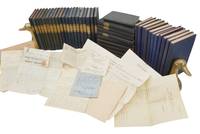
1943Best.-Nr. 47584Camp McCain: n/a 1943. Original document. Loose leaf. near fine. Original one page letter 11 x 8 1/2" in original POW Camp envelop 4 x 6". Handwritten letter by Willibald Hoffmann a Jewish soldier in the army of Nazi Germany who was taken prisoner and held in the POW Camp McCain in Mississippi USA. Written on the official US POW mail-form of the camp dated September 13 1943 signed Willibald Hoffmann plus postmarked official envelope with "Prisoner Of War" printed on front and US Censor stamps examined by 763 on front and back. Prisoner of War Camp stamp dated 13th of September 1943 on back. With signed English translation of the original letter attached. There were thousands of men of Jewish descent Mischling and hundreds more of what the Nazis called "full Jew" serving in the army while their families were exterminated at the same time causing psychological trauma for most of them while keeping it a secret for the rest of their lives. The American author Bryan Mark Rigg has documented the Jewish ancestry of more than 1200 of Hitler's soldiers including two field marshals and ten generals some of whom were awarded the Knight's Cross Nazi Germany's highest military honor. Hitler himself had signed declarations that these soldiers were of German blood. These soldiers often believed that they were helping to save the lives of Jewish relatives. "Many while they were fighting their parents were being deported anyway." Rigg. Some 2300 relatives of a group of 1000 soldiers documented by Riggs were killed by the Nazis. See Bryan Mark Rigg "Lives of Hitler's Jewish Soldiers: Untold Tales of Men of Jewish Descent Who Fought for the Third Reich. University Press of Kansas 2009 Hoffmann in his letter September 13 1943 to Rabbi Max Koppel writes: "Dear Doctor You'll be astonished by my lines because I've lost every connection to my relatives who as far as I know are now in America. That is why I am approaching you confidentially with the request to help me in this matter. My father's name is Samuel Felix and comes from Austria-Hungary where we owned a large dye and weaving factory. My father has lived last in Cologne at the Rhine where he owned a textile wholesale. Due to his Jewish faith the events in Germany forced him to flee. I myself took on another name. Maybe I could ask you to visit me here or to send a representative since it is impossible in my situation to convey everything to you by letter. To facilitate this a permission has to be obtained from Washington. Hoping to get a confirmation of receipt of my letter. With sincere regards Willibald Hoffmann" POW Camp McCain was established in the Granada district of Mississippi USA in 1942 originally as a training camp for American infantry bound to join the fighting in Europe. During the war more that 7700 German prisoners of war were held in the camp. They were put to work in the cotton fields of the Mississippi delta. The camp operated until October of the year 1944. The addressee Rabbi Max Koppel was born in Mönchengladbach Germany in 1905. A graduate of the Jewish Theological Seminary of Breslau JTS and the universities of Breslau and Würzburg he served as a Rabbi in Hirschberg today Jelenia Góra in Poland and Berlin and was an educator at the Joseph Lehmann school of the Reform community in Berlin. In 1937 he immigrated o the USA and was one of the founders of the Congregation Emes Wodzedek in the Washington Heights section of Manhattan. WITH ADDED Neuda Fanny. Stunden der Andacht Hours of Devotion INSCRIBED. Basel. Verlagsbuchhandlung V. Goldschmidt. 1854. First edition. Inscribed "Zur Erinnerung an Ihren Lehrer. 28. Juli 1956 Rabb. Max Koppel To remember your teacher Rabbi Max Koppel" on inside front cover; with stamp of Koppel's New York Congregation. Duodecimo. viii 176pp. Original black cloth with gilt lettering and ruling on cover. A prayer and book for edification of the women and virgins of Israel to be used in public and private as well as all affairs of the female life. Published in honor and memory of her husband Abraham Neuda Rabbi in Lostice Czech. Contains one hundred and three prayers: including the prayer when entering the synagogue the daily prayers a prayer for the Sabbath prayers at the New Moon a prayer on the day of the destruction of Jerusalem a prayer for mothers on the wedding day of their sons etc. The book closes with a poem to be read during "Hagbaha" The raising of the Torah a legend from the Menorah Hamaor read on the day of reconciliation during the time of the morning prayer a poem expressing thanks for recovery and an address to the noble mothers and women in Israel dealing with the education of their daughters. Text in German. Binding with some wear along edges small chips and front joint partially cracked. Block browned. Binding in overall good- interior in good condition. n/a unknown books
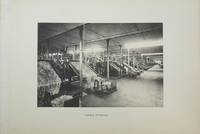
1890Best.-Nr. 68489Calcutta: Johnston & Hofman 1890. JOHNSTON & HOFFMANN. . Jute. Photographic Album of the Jute Production in India. Calcutta: Johnston & Hofman n.d.c.a 1890. Four oblong quarto photographic volumes. mounts: 11 3/4 x 7 3/4 inches; 290 x 199 mm; photographs: 7 1/2 x 5 inches; 190 x 128 mm With 68 black-and-white photographs mounted one per page on stiff cardboard. Uniformly bound in original half navy cloth over green cloth. Front boards lettered in gilt. Volume one with water damage mainly to rear board and affecting the last seven photographs but the images are still clearly visible. A few other photos in this volume have some minor fading or spotting. Back endpapers to this volume have been replaced. Some minor spotting to the cloth on other volumes and a bit of wrinkling to the cloth of volume IV. All other volumes internally clean and crisp and the photographs are in very good condition. Overall a very good set. Complete sets are rare. Comprises: Volume I: "Cultivation and Preparation" 25 photos. Volume II: "Its Manufacture" 21 photos. Volume III: "Assorting and Baling" 20 photos. Volume IV: "Baling and Export" 22 photos. "Theodore Julius Hoffmann and P.A. Johnston. Calcutta Studio established in 1882. Probably after the studios of Bourne and Shepherd the second largest commercial photographers in India with their large catalog of views of North and Northeastern India Sikkim and Nepal." luminous-lint dot com. HBS 68489. $3000. Johnston & Hofman unknown books
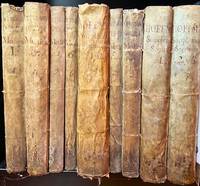
1740Best.-Nr. 153Geneva: De Tournes 1740 -1753. First Editions throughout. Contemporary full limp vellum. Very good; some dustiness; vol. II of Opera with small ink stain on pp. 64-70; rear hinge of Supp. I split. Folio. A frontispiece and three plates in Supplement II part 2. This is the first edition of all parts of Hoffmann's works. It contains the two series of supplements published in 1749 and '53 that are often not present. The nine volumes contain virtually all that was known at the time about medicine and the medical applications of chemistry. Hoffmann's published work ranges over both areas where he made original contributions e.g. see Partington on Hoffmann and the development of modern chemistry. G-M #72; DSB VI 460; Ferguson I 409; Partington II 693; absent from Neville who had only later printings. De Tournes hardcover books
1892Best.-Nr. 1726491892. HOFFMANN Hermann. Systematische Farbenlehre Teil 1 und 2. Volume 1 with 115 pp. text and volume 2 with 41 plates. Folios ca. 265 x 185 mm. cloth binding plates loose as issued in cloth portfolio. Zwickau: Förster & Borries 1892. An interesting and scarce work by the German printer Hermann Hoffmann whose work was primarily concerned colour as it could be used by printing ink manufacturers. Tafel 1-2. 30 theiliges technisches Farben-System Plates 1-2. 30-part technical Color System Tafel 3-12. Farben-Akkord Triade Plates 3-12. Color Chord Triad Tafel 13-14. Schein-Farben Plates 13-14. Illusion Colors Tafel 15-16. Harmonie der Farben Plates 15-16. Harmony of Colors Tafel 17-21. Helligkeits-Kontraste Plates 17-21. Brightness Contrasts Tafel 22-30. Chromotypographischer Andruck Plates 22-30. Chromo Typographic Proof Tafel 31-39. Color printing commercial samples Tafel 40. Die gebräuchlichsten Tonfarben Plate 40. The most common clay colors Tafel 41. Schwarzdruck auf farbigem Grunde und umgekehrt Plate 41. Black print on a colored background and vice versa Neat ex-library copy with labels inoffensive library stamps throughout generally in the margins. hardcover books
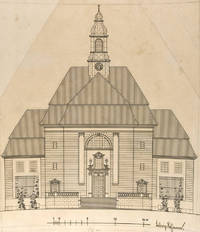
1909Best.-Nr. 31997Berlin: NP 1909. Softcover. g to vg. Plans & drawings in various sizes all printed on light card stock some plans mounted. Seven of the ten are numbered. 5 plans/drawings annotated by Hoffmann 2 drawings signed by him 5 signed by Stadtbauinspektor / Magistrats-Baurat Tietze. Printed by "Gisaldruck v. Bogdan Gisevius Berlin." not numbered: 1 Large 46 1/2" x 59" Lageplan ground plan of the hospital also showing surrounding streets. Plan titled "Neubau des IV. Städt. Krankenhauses - Lageplan." Rudolf Virchow handwritten in blue crayon below title. Parts of folds as well as sporadic tears repaired with tape. Parts of edges chipped some closed tears along folds no missing pieces. 2 Drawing 13 3/4 x 16" showing the facade of the hospital mounted on 17 1/4 x 25" card stock. Signed by Ludwig Hoffmann with some of his annotations. 3 Drawing 16" x 21 1/2" of the "Operationshaus" mounted on 23 1/2" x 28 1/2" card stock. Signed by Hoffmann with his annotations. Numbered plans: # 4 - # 7 with original signature of Stadtbauinspektor Tietze dated 6. Januar 1909. Also with printed signature of the on-site architect Bietz Signatures accompanied with text: a "Revidiert und festgestellt: Berlin den 6. Januar 1909. Der Stadtbauinspektor: original signature "Tietze" Magistrats-Baurat. b "Die Richtigkeit und Uebereinstimmung mit der Ausführung bescheinigt: Berlin den 1sten Dezember 1908. Der Bauleitende printed signature of "Bietz" Architekt. 4 Blatt 1: 22" x 30" revised plan showing the foundation Revisionszeichnung Fundamente of the Doppeloperationshaus surgery building. With many handwritten annotations by the architect. Small number stamp on lower left margin. 5 Blatt 2: 26" x 30" revised plan showing the basement Revisionszeichnung Kellergeschoss of the Doppeloperationshaus. With architects handwritten annotations. Five-inch closed tear on upper left corner. 6 Blatt 3: 18" x 25" plan of the basement of the Doppel-Operationshaus. Lists rooms Raumbezeichnung and furniture Mobiliarbezeichnung. Small number stamp on lower left margin. 7 Blatt 4: 30" x 26 3/4" revised drawing of the ground floor of the Doppel-Operationshaus. Two-inch closed tear on right upper edge. 8 Blatt 5: 27" x 31" drawing of the attic Dachgeschoß of the Doppel-Operationshaus. Top left corner with closed tear almost detached. Bottom left corner creased. 9 Blatt 7: 25" x 26 3/4" drawing showing the facade Vorder-Ansicht cross- and longitudinal sections Quer- und Längsschnitt as well as details of the main cornice Hauptgesims and roof turret Dachreiter. 1/2" closed tear on bottom right corner. 10 Not numbered 16 1/4" x 22" drawing mounted on 28 1/4" x 23" card stock showing the facade longitudinal section main cornice and roof turret. Few annotations by architect. Two-inch closed tear on bottom edge. Unique collection of architectural plans & drawings by Berlin architect and Stadtbaurat Ludwig Ernst Emil Hoffmann. The architect attended the Kunstakademie in Kassel and the Bauakademie in Berlin where his teachers included Richard Lucae and Johann Heinrich Strack. After becoming a licensed government architect in 1884 he won a competition for the revised design of the Reichsgerichtgebäude in Leipzig. Hoffmann and Peter Dybwad worked on the monumental neo-classicist building from 1887-1895. A year later Hoffmann was elected city architect of Berlin being responsible for all types of public buildings in the city. Notable examples include the Märkisches Museum various public baths such as the Volksbadeanstalt Baerwaldstraße Berlin-Kreuzberg Volksbadeanstalt Dennewitsstraße Schöneberg Volksbadeanstalt Oderberger Straße Berlin-Prenzlauer Berg several bridges & fountains the Altes Stadthaus the Rudolf-Virchow-Krankenhaus and many others. On the initiative of Rudolf Virchow the fourth major city hospital was built between 1898 and 1906. Virchow was a German doctor anthropologist pathologist and politician known for his advancement of public health. He is considered as one of the founders of social medicine. The Virchow Krankenhaus was the last hospital that was built in the so-called "Pavillonstil." At the time the construction of the building cost 19 million Reichsmark. 57 separate buildings with 2000 beds were built on an area of 2906255 square feet. The staff buildings housed approx. 1000 employees doctors nurses and other personnel. Impeccable landscaping trees large green patches flower beds and benches gave the hospital grounds a park-like feel. Unique piece of Berlin architectural history by one of the most important German architects of the late 19th and early 20th century. NP unknown books
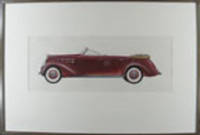
1937Best.-Nr. 18773Utica 1937. Tempera on paper. Exquisite drawing of a quintessential 1930s roadster. The old established Willoughby firm coach body makers in Utica New York had a reputation for conservative quality coachwork in 1930 when Viennese born Otto Hoffmann was hired as draughtsman/designer. He quickly moved the company's design philosophy to the forefront of the streamline school translating traditional luxury car body types such as this touring car into the modern idiom. Willoughby designed bodies for many major luxury car manufacturers including Lincoln and Rolls Royce. Provenance: Acquired from Hoffmann's widow January 1985. unknown books
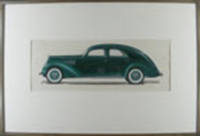
1937Best.-Nr. 187971937. Mixed media on paper. Exquisite drawing of a 1930s concept car. The old established Willoughby firm of Utica New York had a reputation for conservative quality coachwork in 1930 when Viennese born Hoffmann was hired as draghtsman/designer. He quickly moved the company's design philosophy to the forefront of the streamline school translating traditional luxury car body types such as this touring car into the modern idiom. Willoughby designed bodies for all the major luxury car firms. We have attributed this drawing to Hoffman on the basis of a very similar drawing of the period that was acquired in 1985 from Hoffmann's widow clearly done by the same hand and exhibiting the same exquisite touch and sense of proportion. unknown books
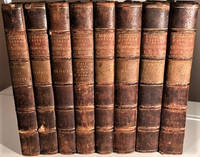
1811Best.-Nr. 23068Freiberg: Craz und Gerlach 1811-1818. First Edition. Contemporary three-quarter leather. Very good; front joint of vol.1 & 4 part one and rear joint of the second section of vol. 1 & vol. 4 part two are beginning to split; small gouge to the backstrip of the seventh volume. 8vo. Volumes 2 3 and 4 were published in 2 parts each; volume 1 is here bound as two volumes this was a convenience introduced by the binder because of the length of the second section of text in the first volume. This is not designated on the title page of the first volume later volumes are clearly printed with a part number subordinate to the volume number. The binder in this instance inserted the fly-title before the text of the second section that constitutes this additional volume. The following Roman numerals designate the volume numbers in conformity with the printed title pages. I - xxiv 1 - 349 1 - blank 2 - fly-title 353 - 685 1 - errata 2 - adverts pp. folding table; II1 - 4 1 - 382 pp.; II2 - x 1 - 322 2 - adverts pp.; III1 - iv 1 - 339 1 - errata pp.; III2 - 2 3 - 311 1 - blank pp.; IV1 - 2. 3 - 288 pp.; IV2 - x 2 3 - 208 xiv 1 - 58 209 - 245 index 1 - errata pp. There are also two sheets of detailed contemporary notes that are bound in. One dealing with gold and another with a peculiar mineral formation found formed as a nodule accompanied by a hand drawn illustration in the Italian Alps. There is also a 13 line note on the verso of the front free endpaper of volume one that faces the title page and runs on to it below the imprint. The note discusses the "bequem" format of the 8 volume binding of the book; it is signed: E. v. Uechtritz. Inspector of precious stones Hoffmann studied at the Freiberg Bergakademie under A.G. Werner ". the great oracle of the sciences of the earth" Hoover catalog quoting Cuvier. "Very scarce" Schuh. This work is one of the greatest encyclopedias of Werner's mineral theories ever published. It was the only authorized publication of Werner's mineral system. It was begun by Hoffmann who died after the first two volumes were published and continued by August Breithaupt who completed the third and fourth volumes. In this monumental treatise the Wernerian doctrine of mineralogy is propounded in its most detailed presentation. The authors accept all of Werner's theories concerning mineral formation and classification and include numerous illustrative examples. The text is generous in its treatment of the subject sometimes devoting long detailed sections to minute points. Werner did not publish much on his theories but his students and followers insured that his ideas would reach a larger audience by their own works following his guidelines. The first volume provides a short history of mineralogy definitions descriptions of physical properties including color optics streak hardness specific weight transparency luster and crystal form chemical characteristics the use of the blow-pipe nomenclature and a synopsis of the classification system. Later volumes contain essentially a descriptive mineralogy; all that was known was included in the descriptions. See Schuh; Freilich sale catalog #251; see Dibner Heralds . #91 for Werner; see Hoover #878 for Werner; Ward & Carozzi #1094; see DSB II p. 440. Craz und Gerlach hardcover books
1910Best.-Nr. 97511910. Letters. Collectible; Very Good. 1910 HANDWRITTEN LETTER FROM LEGENDARY AUSTRIAN ARCHITECT JOSEF HOFFMANN Vienna Secessionist and co-founder of the Wiener Werkstatte TO EDUARD JOSEF WIMMER-WISGRILL the first Artistic Director of the fashion department of the Wiener Werkstatte. Clean and bright and very well-preserved. Written on the stationary with lavish letterhead of The Hotel Hassler in Rome. In a strong clear hand in fountain pen and on a single sheet folded into quarters -- with very minor crease folds. A translation into English from the original German on another sheet of paper is includeds as well. 8" x 10 1/2". Also includes the original envelope handwritten by Josef Hoffmann. unknown books
1920Best.-Nr. 24429Leipzig: W. Drugulin 1920. Vorzugsausgabe. Limited numbered edition. Hardcover. vg. 1/120. Elephant folio. VIII 1032pp. & 13 unnumbered illustration pages. Gold-stamped full green calf with gold lettering on cover and spine in original dust wrapper and sturdy paper-covered green clamshell box. Gold-lined raised bands. All deckled edges. Inside of front and back board stamped with double gold borders. Binding designed by R. Hadl handcrafted by A. Köllner. Elaborate deluxe edition of Hoffmann's novel "Signor Formica". E. T. A. Hoffmann 1776-1822 was a German author composer draftsman caricaturist jurist and music critic. He was one of the major authors of the Romantic movement. Signor Formica was first published in 1820 and a year later was included in the forth volume of Hoffmann's work "Serapionsbrüder." His few literary works are stories in which supernatural and sinister characters appear in people's lives revealing grotesque and often tragic sides in human nature. This deluxe edition is illustrated with original artwork by the Hungarian sculptor and etcher Richard Hadl. The illustrations consist of one original signed full-page pencil drawing as well as 12 full-page- and 7 in-text drawings in aquatinta-manier. Additional signature of illustrator on limitation page. "Dieses Buch wurde im Jahre neunzehnhundert und zwanzig in der Offizin W. Drugulin in Leipzig gedruckt. Die Auflage beträgt einhundert und zwanzig numerierte Exemplare auf van Gelder-Zonen-Bütten. Nach Beendigung des Druckes wurden die Platten vernichtet. Dieses Exemplar ist Nr. XXXIV und wurde gedruckt für Freiherrn Erich von Goldschmidt-Rothschild. Durchgesehen: signed Richard Hadl." Printed on handmade van Gelder-Zonen paper. Foreword by Hadl. Text in German. This particular copy was printed exclusively for Erich von Goldschmidt-Rothschild 1899-1987 of the famous Rothschild lineage. Goldschmidt-Rothschild was also well-known for his extensive rare book collection. Slip with information on binding laid-in as issued. Very slight rubbing on head and tail of spine. Minor creasing on spine of dust wrapper. Slight scuffing on clamshell box tiny tear on top section on spine of box. 10mm offsetting from interior leather-lining on outer edges of front and rear free endpaper. Dust wrapper and clamshell box protected by modern mylar. Exceptional copy in a stunning binding. Fine condition. Scarce with dust wrapper. W. Drugulin hardcover books
1938Best.-Nr. 140946061London: No publisher 1938. Very Good. 41 volumes. Bound in varying blue cloth bindings most stamped in gilt. Includes handwritten diaries for 1896-1899 1901-1911 and 1913-1938. Very Good with light shelf wear a few volumes have staining to the covers else fine. Various ephemera laid-in including a note relating to his Czech passport numbered receipts from clients insurance cards pay scale rate cards applications for work letters of intent from prospective employees. An incredibly meticulously logged diary archive into the life and work of noteworthy London architect Paul Hoffmann likely born in Vienna in 1869 passing away in 1938. He was notably involved in Queen's Gate mansion blocks the Philimore Estate and Earl's Court in early 1900. In tiny ink script he kept a diligent yearly diary of his work until just ten days before his death on August 19th 1938 detailing his professional relationships as an architect nearly every day for four decades except Sundays. Includes names of clients colleagues and accounts of his projects. As for what he did in his spare time an intriguing 1902 article in the Anglo-American Press mentions that he was also a librettist and author of the opera "The Little Innocents" under the pen name Hugh Stranger. Hoffmann designed and maintained Capel House in 1905-06 now Cable House in London at 56 New Broad Street. His journal entries describe his work at Capel House including the annual building costs over the years applications for work at the House architect's insurance and more. Not only does this archive describe the day-to-day tasks of a busy architect but also keeps log of the outbreak of WWI from a Londoner's perspective. His diaries kept between 1914-1918 log important WWI dates. He declares that the "Banks are closed due to 'war scare' on July 31st1914. He logs that "Germany declares war on England" on August 5th 1914. An insurance slip by "The Government Scheme of Aircraft and Bombardment Insurance" laid-in his 1916 diary charged his account 1500 pounds on the 1st of February to insure Capel House from air raids. On June 13th 1917 he writes "Airplane bombs in city" -- later on the 7th of July he writes "2 airplane raids over London." He writes on Armistice Day November 11 1918 "Armistice between Germany & Allies unchanged." In the interim of air raids and bombings he still keeps a daily log of calls meetings and projects. One of his most noteworthy projects Roxburgh Mansions Kensington London constructed in 1899 were eventually destroyed in The Blitz of WWII. A remarkable archive for enthusiasts of late 19th & early 20th century London architecture. [No publisher] unknown books