1 524 résultats
2009New English Paperback. 4to. (28 x 24 cm). In English and Turkish. 229 p., color and b/w ills. The logbook of the Ottoman navy: Ships, legends, sailors.= Osmanli donanmasinin seyir defteri: Gemiler, efsaneler, denizciler. Ottoman Principality was introduced to the dark sea of the Middle Ages early in the 14 th century. The battles with the Venetians and the Genoese, conquests in Rumelia, and the establishment of the first shipyards all occurred during this period. As the conquest of Istanbul marked the end of the period of transition from Principality to Empire, the foundations of a strong navy that would unite the Mediterranean and the Black Sea over a political geography were laid. The power of the corsairs diminished by the end of the Renaissance; Barbaros Hayreddîn Pasha personified the golden age of Ottoman sea power. The discovery of the New World had instigated a revolution in the maritime world. Traditional Venetian galleys gave way to Spanish galleons and manpower was replaced by wind power. The Ottoman navy assumed a pioneering role in the process of modernization that extended from the 18 th to the 20 th century. Naval education in the Western sense, the implementation of new technologies and the organization of a modern fleet were all consequences of this period. Advancing from the galley to the battlecruiser, Ottoman sea power had the final say in the affairs of the Empire. "The Logbook of the Ottoman Navy: Ships, Legends, Sailors" exhibition intertwines three distinct, yet integrated mythologies of the sea. The imprint of the ships in Ottoman seafaring history, the battles they were engaged in and the heroes who became legendary in these battles assume their places on the stage of civilization in all their historic magnitude. At the center of the construct lies the extraordinary adventure of the transition from traditional to modern seafaring methods. The quest for power, the demolished thrones and man's identification of his fate with the sea is perhaps the oldest story behind this adventure. The cornerstones of a long history that extends from the legacy of a 16 th century Ottoman galley to the battlecruiser, Yavuz, is brought to light through the memories of seamen.
1929Very Good English In contemporary bdg. Roy. 8vo. (24 x 17 cm). In English and Persian.[4], 96 p., 2 b/w plts. Falakî-i Shirwânî: His times, life, and works. "The Falaki par excellence, Falaki-i Shirwani, was, with Abu'l Ala and Khaqani, a court-panegyrist of the SHirwanshah, Minuchihr II. Taqiu'd Din Kashi writes in 985 A.H. Similarly, the Ahsanu't-tawarikh.". First and Only Edition.
2017New German Original cloth bdg. In publisher's special box. 4to. (29 x 25 cm). In German. 176 p., ills. Yildiz Sarayi fotograf koleksiyonu üzerinden Osmanli-Almanya iliskileri. Ottoman-German relations with photographs from the Yildiz Palace Photography Collection. Die osmanisch-deutschen Beziehungen im Lichte der Yildiz palast Fotografie-Kollektion.
2017Fine French Original bdg. HC. 4to. In French and Turkish. 168 p., ills. Pierre Loti et les silhouettes de Hassan: Portraits avant La II. Constitution.= Pierre Loti ve Hasan silüetleri: II. Mesrutiyet öncesi portreler. The novelist Julien Viaud, famous for his nickname Pierre Loti, is a traveling maritime officer. At the end of the 19th century and the beginning of the 20th century, he makes seven trips to Istanbul. In 1903, at the age of 53, Pierre Loti takes over Le Vautour, the first station ship to the French Embassy in Istanbul, during his fifth trip to Turkey. In the same period, Hasan signed cartoons start to circulate in Istanbul.The person who is hiding under Hasan is actually Robert de Guiroye, a naval officer. This person was then assigned to the auxiliary ship "La Mouette" (Seagull) under the command of Pierre Loti. It is thought that this officer made drawings on this ship in the evening after having spent a long time in important social clubs such as Cercle d'Orient, Pera Palas Ballroom, Tepebasi Theater. Who is actually Hasan / Who is the real Hasan? The answer to this problem is in the exhibition and detailed catalog. Let's see if they can help bring Hasan's identity to light. The "Pierre Loti and Hasan Silhouettes" exhibition is made up of documents obtained as a result of years of research by numerous collections and valuable collector Sayen Erol Makzume, who has vast knowledge of Hasan's lithographs in the early 20th century. The exhibition contains texts, cartoons and in-depth information, and sheds light on the transition period of Turkey after the Second Constitutional Monarchy.
1985Fine English Paperback. Roy. 8vo. (24 x 17 cm). In English and Japanese. 787, 144, 91 p. (Toyo Bunko) Bibliography Islamic and Middle Eastern studies in Japan, 1868-1988, 1992. [With] Index & Directory of Asian historical studies in Japan.
réf. DADAX0415538564New unknown
réf. 71872 tomes en 2 volumes in 12 demi-chagrin foncé à nerfs et à coins,titre,filets, tomaison, caissons dorés.Tome1:faux-titre titre,285 pages,1 page de table.Tome2:faux-titre, titre 251 pages 1 page de table,non rogné,tête dorée, premier plat de couverture conservé.Paris Librairie Alphons Lemerre sans date.Très bon état
1895(Medio Oriente - Storia - Archeologia - Orientalismo - Persia - Iraq - Iran - Mesopotamia) Due volumi in 8°, legatura coeva in mezza pergamena, al dorso ricca decorazione impressa in oro e tassello in pelle rossa con titoli dorati, carta marmorizzata policroma e dentelle in oro ai piatti, tagli marmorizzati, pp. complessive 1028, con 113 figure nel testo, 23 tavole a piena e doppia pagina, tra cui una carta geografica della Babilonia (dalla "Nouvelle carte générale des provinces asiatiques de l'empire ottomane" di Kiepert, 1884) e due illustrazioni in cromolitografia fuori testo. Volumi solidi e ben conservati con ex libris applicato ai risguardi anteriori.
1898réf. 1254671898 Paris, Calmann Lévy, Editeur - 1898 - In-4 (20x28,5cm environ), demi basane à coins signée A. S., gardes marbrées, dos à 5 nerfs avec titrer et filets horizontaux en doré, signet - 298 pages
1922réf. LCI-4251Paris, La renaissance du livre 1922 1 in -8 Reliure demi chagrin grenat dos à nerfs Inscrit dans la lignée des épopées orientalisantes héritées de Salammbô, ce roman des frères Charles et Henri Omessa ressuscite la Carthage antique à travers une fresque vibrante où se mêlent tragédie passionnelle, souffle dramatique et reconstitution historique. L'ouvrage témoigne du vif engouement des Années folles pour les récits méditerranéens et le décorum flamboyant de l'Antiquité.L'exemplaire est revêtu d'une élégante reliure en demi-chagrin grenat. Le dos à nerfs, porté par une teinte profonde et le grain caractéristique du chagrin, offre un superbe rendu visuel en bibliothèque. L'ensemble se trouve en très bon état de conservation.Un beau titre d'atmosphère, recherché pour son décor antique et magnifié par un habillage cuir de belle facture.
réf. 45895P., Maisonneuve (Bibliothèque Orientale), 1872, grand in 8° broché, 425 pages ; texte sur deux colonnes ; des rousseurs ; quelques passages soulignés au crayon ; couverture fanée, manques au dos.
1989réf. 28034ACR Édition Jaquette en très bon état Couverture rigide toile Paris 1989
1998réf. 42102ACR Édition Jaquette en très bon état Couverture rigide toile Paris 1998
1890réf. YRG-124Paris - Maison Quantin, 1890 1 volume In-4° Introduction et planches de reproductions de 153 motifs de tapisseries dont 9 en couleurs Reliure éditeur toile beige (piquée), illustrée d’une grande vignette en brun au 1er plat - Bon intérieur - Ex-libris gravé à la 2nde garde blanche : Hélène Cauquil
19réf. boz_003413Anonyme - Dessin original à l'encre et lavis - Figure féminine et orientale, XIX ème. Dimensions : 11,7 x 15,3 cm État : Dessin, Présence de taches de rousseurs, et papier froissé sur le haut, sinon bel état de conservation.
1787réf. 96501787 Constantinople et Paris, Buisson, 1787; 2 tomes reliés en un volume in-12°, demi-basane brune, dos lisse orné en long de larges fers dorées, petites palettes et tête et pied, titre doré, tranches marbrées ; (iv), 236pp.; (ii),174, (1)pp.
réf. 19266Paris, Librairie nouvelle, 1853. In-12, 354 pp., broché, couverture originale imprimée (rousseurs, une mouillure angulaire au 2nd plat).
In-8, broché, couverture imprimée, 23 p. Édition originale. Précoce plaidoyer pour le renforcement de la colonisation que l'auteur tente d'envisager sous une forme "moderne". Il réfute les affirmations d'un rapport selon lequel les indigènes auraient été dépouillés de leurs biens et traite largement des conditions de collaboration avec ces populations. L'auteur Paul-Ambroise Volland, dit "Baron Volland" était intendant militaire de l'Algérie et délégué des colons d'Alger. (Tailliart, 2579). Bel exemplaire, à l'état de parution.
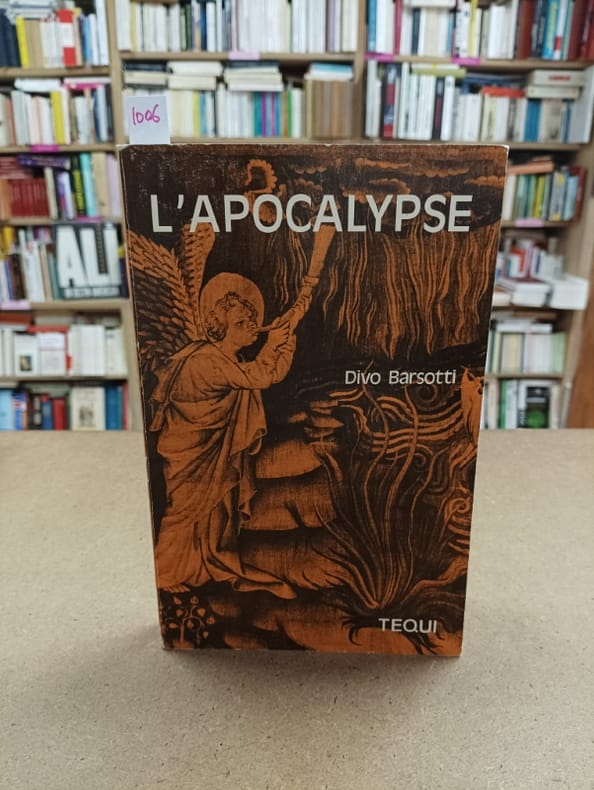
réf. 1006- broché - Editions Pierre Téqui - 1974 - In-8 (21 x 13,5 cm) broché - 412 pages - Traduction de Elisabeth de Solms - A PROPOS : Commentaire spirituel de l’Apocalypse de saint Jean, qui ne se présente pas comme un traité d’exégèse universitaire. Barsotti y propose ce texte comme une source de consolation et d’aliment pour l’espérance, en en méditant le sens à la lumière de la Bible et des Pères de l’Église.
1900(Orientalismo - Etnologia - Antropologia - Asia - Oriente) Due volumi in 8° grande (27x19,5), legatura coeva in mezza pelle color testa di moro con punte, dorso a 5 nervi con filetti e titoli dorati, carta marmorizzata ai piatti e alle guardie, tagli di testa in colore rosso, pp. (8),591,(9) ; (8),583,(9) con complessive 675 illustrazioni nel testo, molte a piena pagina e 14 (su 18) tavole in cromolitografia a doppia pagina fuori testo. Collana ''Popoli del mondo. Usi e costumi''. Indice delle materie, Vol. I : ''Caratteri generali della civiltà asiatica. I popoli della Siria, della Mesopotamia e dell'Arabia. Gli abitanti della Siria. Gli abitanti della Mesopotamia. Gli Arabi dell'Arabia. Leggende e superstizioni arabe, bibliche e cristiane. I Curdi. Gli Armeni. I Persiani. I Caucasici. I Turchi. I Turcomanni. I Kirghisi. Gli Indiani. I Parsi. I Singalesi.''. Vol. II : ''I Mongoli propriamente detti. I Tibetani. I Bhutanesi e Buthia ed i Lepcha (Lepcia). I Birmani. I Malesi delle Molucche e Giavanesi. I Giavanesi. Gli abitanti di Sumatra. Gli abitanti di Nias. Borneo. Gli abitanti delle Filippine. I popoli dell'Indocina: Siamesi. Gli Annamiti. I Tonchinesi. I popoli della Cina. Le cinque veglie dell'oppio. I Formosani. I Coreani. I Giapponesi. I Siberiani''. Alcune circoscritte tracce di ossidazione all'interno, peraltro volumi solidi e ben conservati.
1857Original boards. 8vo, 240 pages, 19cm. SUBJECTS: Chronology. Egyptian language -- Writing, Hieroglyphic.. Some wear to outer boards, otherwise Good Condition. (AC-2-8)
1951réf. 117551951 Beyrouth, 1951; fort in-8 de XLI - 626pp. - (1)f. Reliure de demi-basane grenat à coins, auteur et titre dorés au dos cernés de deux jeux de faux-nerfs, nom doré en pied. Portrait en frontispice. Ex- dono manuscrit à l'encre sur la page de titre daté de 1952. Plusieurs passages soulignés au crayon dans l'introduction.
réf. 429Chez l’Auteur (thèse de 3ème cycle/HISTOIRE) sous la Direction de Pierre GUIRAL), Université de Provence, 1974
réf. 053164Paris ACR Edition 1983 in 4 1 volume reliure cartonnée de l'éditeur sous jaquette illustrée en couleurs, 303 pages, avec 290 illustrations en couleurs. Les Orientalistes, volume 5. Bel exemplaire
1995réf. DZN-2322ACR édition 1995, in-4, 288 pages, nombreuses illustrations . Cartonné sous jaquette illustrée. Petite déchirure sans manque à un coin de la jaquette, mais bon état général. (CXII)-(1900 gr.).