GENET Jean - COCTEAU JeanLivre Rare Book
979 résultats
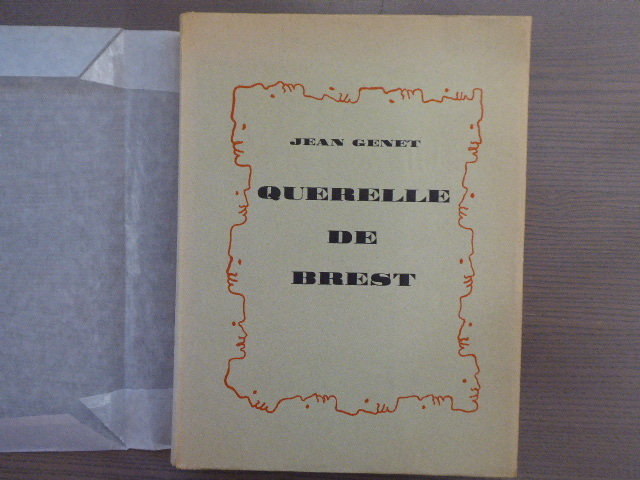
réf. 816827Paul Morihien Paris 1947 In-4 carré de 305 pages, broché sous couverture illustrée rempliée. Edition originale clandestine sans date et sans nom déditeur publiée en novembre 1947 par Paul Morihien, illustrée par Jean COCTEAU de 30 compositions hors-texte tirées en lithographie ( 1 frontispice, un titre décoré [répété en rouge et noir sur le premier plat de la couverture] et 28 dessins à pleine page compris dans la pagination, une lettrine, tirée en rouge, complète l'illustration ). Tirage limité à 525 exemplaires numérotés strictement hors-commerce. Un des 460 exemplaires sur vélin à la forme ( N°166 ). Rousseurs claires passim, bel exemplaire, de cette édition originale rare, bien complet de la note de lauteur sur un feuillet volant commençant en ces termes: «Une brusque lassitude nous a fait abandonner "Querelle" qui déjà seffilochait.». Pia Enfer, p. 638.
1837Very Good Turkish, Ottoman (1500-1928) Contemporary quarter leather binding with gilt decorations without title lettering. Demy 8vo. (22 x 14 cm). In Ottoman script (Old Turkish with Arabic letters). Seven different books and tractates (nine works) in one volume: (235, [1] p., 24 p., 143 p., 80 p., [6], 71 p., 84 p., 22 p.). Two leaves are torn from the hinge in the first book but not missing, one tractate is trimmed by margins, the board's extremities are worn, overall a good volume including multiple books. First editions (except for one) of these exceedingly rare poetic tractates collected together contemporarily in one handsome volume, reflecting early Ottoman poetic pleasure, including thematic mystic and erotic poetry mostly printed in the early 19th century. This volume includes the multiple works of Enderunlu Fazil and Sünbülzâde Vehbi, which are the earliest erotic and homosexual poems that seem to have been concealed by adding Keçecizâde's works to the beginning and the end of the volume. "Defter-i ask" [i.e. The book of love] by Fazil, in which he tells about his own romances, is a masnavi of 438 couplets. It begins with a description of divine love and tells the story of the poet's romances, which he fell into only to regret and repent afterward. "Hubannâme" [i.e. The book of beautiful young men] consists of 796 couplets with various titles and it has a mystical analysis of beauty in the first chapter. After an introduction that gives geographical information that may be considered novel for its period, it describes the beauties of male bodies of many countries from India to America. This style is unique and the first in Turkish / Ottoman literature. In the work titled "Zenannâme" [i.e. The book of women], which is a masnavi of 1101 couplets, women of various nations are described. The poet indicated in the introduction of his work that he does not want to talk about women, and that he has no orientation towards women. Enderunlu Fazil was an Ottoman poet who depicted the beauty of men from various lands of the Ottoman Empire. He achieved fame through his erotic works, which were published posthumously. Among his most famous works is The Book of Women, which was banned in the Ottoman Empire. The book describes the advantages and disadvantages of women from different nations. Fazil was born in Acre into an Arab family originally of Medina. He spent his early years in Safed in Ottoman Palestine. His grandfather Zahir al-Umar and father Ali Tâhir were both executed (in 1775 and 1776, respectively ) for participating in a rebellion. After his father's death, Fazil moved to Istanbul. There, he was admitted to the Enderun palace school (thus taking on the name Enderuni or Enderûnlu), but was expelled in 1783 as a result of his love affairs with other men there. In 1799, he was exiled to Rhodes because of his satirical writings and was only allowed to return to Istanbul after becoming blind. He spent the rest of his life there, ill and bedridden. Other books in the volume: Manzumetü'l-müsemma be-mihnet-kesan, Ceride-i Havadis Matbaasi, Ist., AH 1269 = AD 1853. 235 p., 1 portrait of Keçecizâde. Lithography. Özege 13354.; Two copies are located in OCLC 57242940 - 51281526. This work is a social satire type masnavi in which Izzet Molla was exiled to Kesan, telling of the troubles he suffered there, and his pardon and returns to Istanbul. Destar-i hayâl., Osman Nevres Efendi (1820-1876), Matbaa-i Âmire, Ist., AH 1289 = AD 1872. 24 p., Özege 3899. First and Only Edition. This rare work is a masnavi consisting of six stories. Defter-i ask, Hubannâme, Zenânnâme and Sevkengîz., Enderuni Fazil (1757-1810) and Sümbülzâde [or Sünbülzâde] Vehbi, (1718-1809)., Darü't-Tibaatü'l-Âmire, Ist., AH 1253 = AD 1837., 143 p. (pp. 1-20 Defter-i ask; pp. 22-55 Hubânnâme; pp. 56-111 Zenânnâme; pp. 112-143 Sevkengîz.). Özege 18902. First Edition. Tuhfe-i Dilkes Nâli, Yusuf Nabi [sic] [Nâlî, Muhammed b. Osman el-Konevî, (For more info please visit our website)
1943réf. 0055931943 Paris, Jean Vigneau, 1943. In-quarto (252 X 210 mm) maroquin rouge, dos lisse, auteur et titre dorés, doublures et gardes de daim rouge dans un encadrement de listel de box gris souris, tranches dorées sur témoins, couverture conservée, chemise à petits rabats, étui bordé (C. et J.P. Miguet) ; 380 pages, (1) feuillet d'achevé d'imprimer, (1) feuillet blanc.
1949réf. 20139Paris, Paul Morihien, [1949]. Petit in-4 en plein box gris brume (ou blanc ombragé) orné au premier plat du titre mosaïqué en lettre de box blanc, dos lisse orné d'un point bleu, gardes de papier couché bleu, couvertures et dos conservés, tranches dorées. Chemise à rabat de box et papier identiques. Reliure signée P. L. Martin.

