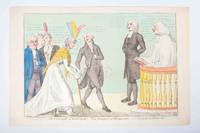
1800rif. 5629London: S. W. Fores 1800. First edition. Illustrated hand-colored broadside measuring 270 x 400mm and printed to verso only. Faint offsetting to recto and faint traces of mounting to corners. In all a Fine example of this visual satire commenting on the phenomenon of younger men seeking marriage with elderly widows for their own financial gain -- and the cultural anxiety surrounding the marital sexuality of such brides. Unrecorded in ESTC and OCLC we have located two examples of the present work at the British Museum and Yale. The present broadside draws together a wide matrix of debates and social anxieties surrounding the economic and sexual status of widows and the financial motivations for marriage among second sons and men of the middle class. Though women were more frequently forced into experiencing marriage as a form of 'honorable prostitution' in which their physical desirability served as their key for accessing wealth and stability under coverture it was increasingly acknowledged that large swaths of young men also suffered under this system. And while widows could escape the system -- shifting from the disempowered femme covert to the more legally independent femme sole on their husbands' deaths -- there was both a social fantasy of reinserting them into the marriage market as a means for regaining control over their money and bodies as well as a social anxiety about their ability to corrupt through the range of knowledge and authority they gained through previous marital experience. Here a young man walks his aging crone down the aisle. Ornately clad and expressing her anticipation for "the comforts of matrimony" she is ridiculed by the ministers at the pulpit who posit that if "matrimony was first ordained.for a remedy against fornication" then "the remedy will be worse than the disease" in this instance. Untroubled the young groom focuses on the land deeds bank notes and jewelry accounts which stuff his pockets -- assets which will legally become his after the ceremony and which serve as his marital comforts. Meanwhile two young women observe from the sidelines one of them planning her future with the groom after his aging bride's eventual demise. "Those jewels will look better on me than on the last owner" she notes as her companion whispers hopefully "you'll let me take a morning ride with you sometimes." A visual commentary on the financial and social issues surrounding marriage under coverture which Daniel Defoe would deride as "matrimonial whoredom." British Museum 1935.0522.8.109. Yale Center for British Art B1974.12.328. S. W. Fores unknown books
1864rif. 5626London: Richard Bentley 1864. First English language edition. Contemporary half calf over marbled boards with morocco label to spine. All edges marbled. Marbled endpapers. Measuring 179 x 119mm and collating complete including photographic frontis: x 374. A square tight copy with some loss to upper spine label and gentle rubbing to boards. Amorial bookplate to front pastedown. Light scattered foxing largely confined to preliminary and terminal leaves; pages 161-162 partially detached but holding. A female-authored memoir that participates in both anti-Catholicism and convent-fetish eroticism it is somewhat scarce institutionally but is a rarity in trade with its most recent appearance at auction occurring a century ago. The present is the only example currently on the market. Frank in her delivery Henrietta Caracciolo recounts how her rise to young womanhood under the jealous eye of her mother -- combined with the untimely death of a sympathetic father -- led to her unwilling confinement in a Benedictine convent. Denied early opportunities for engaging in the courtship and marriage economy she longs to be a part of Henrietta Caracciolo instead is forced by her mother to repress her sexual identity and disappear into a life of solitude and chastity. What she finds there instead is a space of sexual abuse unexplained deaths illicit affairs physical abuse and theft. "My sole aim in writing these Memoirs has been to confirm" she writes in the preface "as far as lay in my power with the arguement drawn from fact the opportune and just decree of the Italian government in the suppression of Convents and to disabuse the minds of those if haply any such remain who deem these places the repositories of religious virtues." Timely social commentary in her native Italy her memoirs hit a different note in Protestant England where Catholic convents and monasteries had long been closed; indeed it participated in the anti-Catholic fetish fantasy of convents and monasteries as bastions of deviant and violent sexuality. She herself by the memoir's end emerges to a new and more promising life -- one which participates in popular Victorian cult of domesticity and motherhood which she positions as far more godly and fulfilling. Yet it also leaves open the door of female desire and sexual fulfilment. "By the side of a husband who adores me and to whom I respond with equal love I am where the Almighty placed woman at the close of Creation's first week." Register of Erotic Books 2950. Richard Bentley unknown books
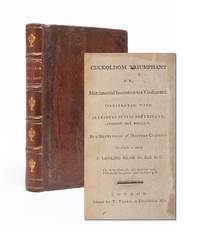
1771rif. 5080London: Printed by T. Thorn 1771. First edition. Contemporary sheep recornered and rebacked to style with gilt and morocco to spine. Measuring 163 x 95mm. Collating 4 203 1 blank: complete with A Looking Glass beginning at page 146 with continuous register. Nineteenth century bookplate to front pastedown. Offsetting to outer margins of title and of pages 198-203 not affecting text; lower corner of dedication leaf neatly excised with no loss to text; marginal paper flaw to pages 45-46. Overall internally unmarked and clean. One of two equally scarce variants with no priority the other printed by J. Bird. ESTC reports only one surviving copy of each both of these held by the British Library of these only the Bird variant is digitized. Neither these first issues nor the later re-issue titled Cupid Turned Spy appear in the modern auction record. An exceptionally rare work. The widespread cultural assertion that men had control over their own fates led to equally widespread anxiety in the seventeenth and eighteenth century. Despite a preponderance of laws and traditions that privileged men and sought to subjugate women and queer peoples sex outside the boundaries of marriage undermined those systems. Few figures encapsulate this truth better than the cuckold. "Cuckolds were seen as being unable to satisfy and control their wives; as literary tropes "they are more often than not the target of derision to both their peers on the stage and the audience the theatre nearly universally to be greeted with laughter as they follow a predictable path of failure in marriage" Corcoran. As much as these figures assisted male audience members in projecting their fears onto allegedly weaker men they signify that complete control over women marriages and lines of inheritance isn't possible. The denial of women's agency does not equate the complete absence of women's agency. Women's sexual agency had become highly visible in key sectors of London society by the eighteenth century thanks in part to the rise of a famed generation of courtesans often called the "demi-monde" who dominated not only their own brothels and houses but also theatres opera houses and the court itself. Sex work more generally had become extremely common with studies estimating that anywhere from 8600 to 80000 citizens of the city were engaged in some level of the sex trade Rogers. In this atmosphere depictions of the cuckold shifted in some erotic works. Rather than symbolizing men's sexual failures the cuckold's acceptance of his position acknowledged and at times even celebrated women's sexual autonomy. If being cuckolded was inevitable as a result of women's equal participation in sexual desire then fault might not lie with the cuckold. Indeed being a cuckold may even have benefits when more conservative social judgment is set aside. Authored by the pseudonymous "Cornuto" -- a Latin joke naming the author after the cuckold's "horn" -- Cuckoldom Triumphant is dedicated to the gentry noting "the amazing encrease of antlers of late among the nobility whose customs the common people are so fond of copying which gives me the pleasing promise of cuckoldom's becoming universal." Indeed the author notes cuckoldom is inevitable and each must choose his own reaction to the state. To that end "this work is intended to comfort the afflicted and confirm the contented among those who are married as well as prepare the unmarried for the happy state of cuckoldom." In what follows the author provides readers with a sensational erotic story following the awakening of Mrs. Latitat to the pleasures of extramarital sexuality as well as her husband's transformation from jealous resistance to acceptance and contentment within a more peaceful marital state. ESTC T62268 T226126 for the J. Bird variant. Register of Erotic Books 1197 for a later issue re-titled Cupid Turned Spy. Printed by T. Thorn unknown books
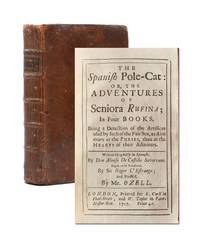
1717rif. 5378London: Printed for E. Curll in Fleet Street 1717. First thus. Contemporary full calf with gilt label to spine. All edges speckled red. Measuring 155 x 90mm and collating complete including frontis and terminal advertisement: 4 394 2. Shelfwear to extremities and slight bowing to boards. Contemporary annotations to front pastedown and front and rear endpapers with portions of rear endpapers excised; rear pastedown neatly removed. Internally a clean copy with a long closed tear to pages 213-214 professionally repaired with no loss to text and brief examples of pencil marginalia to pages 237-38. A pleasing copy of a scarce erotic book which last appeared at auction over three decades ago and which ESTC lists at only 12 U.S. libraries. Drawn from a 17th century Spanish picaresque novel following the intrigues of the female rake Rufina Alonso de Castillo's La Garduna de Sevilla 1642 first appeared in English in 1665 as a romantic adventure translated by John Davies as La Picara or The Triumphs of Female Subtilty. By the time of this translation however Rufina's persona took a more overtly libertine turn as she was declared a "whore" even within the title i.e. "pole-cat". Published by unscrupulous bookseller and printer Edmund Curll the text has clear erotic rather than romantic implications. "A notorious figure among the publishers of the early eighteenth century for his boldness lack of scruple publication of work without authors' consent and taste for erotic and scandalous publications" Curll did not involve himself in the release of texts that aimed to educate men and women into socially dictated marital roles Baines and Rogers. Instead his version of the Rufina story revels in its heroine's sexual appetite and capitalizes on the popularity of the English demi-monde -- courtesans such as Kitty Fisher Lucy Cooper and Charlotte Hayes -- by making her a more exoticized iteration of the fantasy they presented to men and women alike. Positioned as it is outside the British Empire Rufina's narrative invites readers to engage at a slight distance with questions not only about her sexual agency or even the agency of courtesans but instead about the agency of women more broadly. As Kathleen Lubey has pointed out erotic works from this period positioned "decadent sexual description" within a much larger prose structure that "posed questions about social justice and elaborated on gender inequity"; indeed "pornographic prose fiction" such as The Spanish Pole-Cat "rethinks which people count as persons to what degree they can claim property in their own bodies and the correspondence of those bodies to social identity" What Pornography Knows. Capable of stimulating the senses of all readers physically and intellectually Rufina the female libertinism and the sex trade she invokes encourage excitement over what can happen when limitations are stripped away from certain portions of the population that don't in reality have the ability to move with such freedom. ESTC T89213. Not in the Register of Erotic Books. Printed for E. Curll in Fleet Street unknown books
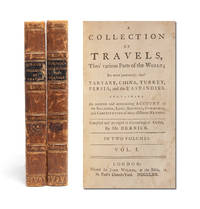
1762rif. 5478London: John Wilkie 1762. First edition. With title page of volume II erroneously dated MDCCXII as called for by ESTC. Contemporary half calf over marbled boards measuring 168 x 100mm and collating complete: 20 338; 12 324. A square copy with joints professionally renewed; some chipping to spine labels and gentle shelfwear to boards. Faint dampstaining to lower corner of contents in volume I and paper loss to upper corner of pages 203-204 affecting 9 lines each. Volume II overall clean with long archivally reinforced tear to pages 131-132 and paper loss to lower corner of pages 171-172 with no text loss in either case. An exceptionally scarce fantastical travel narrative with erotic content published by notorious Grub Street writer and demi-monde ally Samuel Derrick. ESTC locates only three copies at institutions BL Columbia and UCLA and of the three copies to appear in the modern auction record the most recent was in 1941. The present is the only example on the market. In a 1763 review in The Critical Review or Annals of Literature vol. 15 Samuel Derrick's Collection of Travels is derided as a book for "those who read merely for amusement and care not for turning up the huge collection of voyages traveled by Purchas Churchill Astley Harris &c" due to its "total neglect of dates total want of maps a strange perversion of names a general lack of precision or accuracy." These same reviewers make a dismissive nod to how "the adventures of captain John Smith savour strongly of romance" and suggest that the work "does not seem to have been intended so much for serious reading as for pleasing the imagination" but they fail to grasp just how much this is the case. No matter how deeply Samuel Derrick sought to portray himself as a participant in London's intelligentsia he was ultimately a Grub Street hack who "wrote to eat" and not from "any great artistic urge" Rubenhold. Having learned early on that "hacks and whores shared much common ground" Derrick became not only a "gentleman defender" and friend to several of London's demi-monde he also used their escapades as inspiration for his writing and his writing to promote their reputations and services. Such is the case with the present work designed for stoking the reader's fantasies and for lining the author and publisher's pockets. Among "the period's richest funds of data erotica and pornography permeated the culture.and the 18th century bookshop" Pettit and Spedding. Works operating under the thin guises of travel law medicine politics history or religion presented readers across genders with graphic depictions not only of cis-gendered and heterosexual encounters but even more often with scenes that cenered queer polyamorous and female pleasure. In the case of Collection of Travels Derrick used preexisting popular travel narratives as the backdrop for his main work: depicting sexual behaviors common within London's sex trade but setting them within exotic locales. Within volume I for example his explorers encounter "the prostitution of the women of Camul and their hospitable reception of strangers" "the common use of women" in Thebet rites of "marriages of the people of Servia" and the "wives and concubines" of Constantinople including how they are valued how virginity is tried and how they are punished. The second volume builds on this including such content as the "courtezans of Persia" the "women lewd" of Turkey and "the usage of their wives" in Algiers. Given his own appreciation for the power of the sex workers in his own life -- notably Lucy Cooper Kitty Fisher and Charlotte Hayes -- he also includes a section on "the authority of the women in this country" of the Congo. One of Derrick's few stand-alone multi-volume works to be published and a rarity in the collecting areas of erotic literature and travel fiction. ESTC T135777. Not in the Register of Erotic Books. John Wilkie unknown books
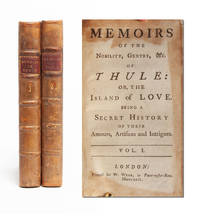
1742rif. 5133London: Printed for W. Webb 1742. First edition. Bound to style in 19th century sheep with morocco and gilt to spines. Measuring 168 x 96mm and with occasional mispagination but collating complete: xxiv 300; 2 336. Some offsetting to preliminary and terminal leaves and occasional light foxing and marginal chips not affecting text; discreet archival repairs to short tear on pages 115-116 and long tear to 285-286 of volume I preserving all text. Early amateur cloth tape repair to recto of front endpaper to volume II. Pinholes to lower spines of both volumes with minor associated worming to the lower front hinges. A scarce example of early erotic literature centered on London's famous courtesans ESTC lists only 6 copies with institutions. The present copy aside the last example to appear at auction was in 1882. Published two years apart the two volumes of Memoirs of the Nobility are different in their approaches to London's elite including the infamous Great Impures who hosted the wealthiest men in their parlours and their beds. Volume I launches its readers into a thinly veiled satire wherein the protagonist Aloisa visits the mythical kingdom of Thule. During her tour on arrival Aloisa discovers a city of extreme decadence whose cast of characters would be familiar to most Londoners indeed the copy housed at the British Museum has contemporary annotations from William Cole denoting some of the avatars' real-life identities. "there was scarce a Thing as a Virgin of twenty Years of Age to be found in all the Island.all was flaming Lust; and from the Court to the Cottage all had their Share in amorous Intrigues." While sexual violence is rampant in Thule Aloisa's host the Chevalier Faire-Franc informs her of numerous girls assaulted and left pregnant by the son of the new Lord Chancellor for example much of the kingdom's activities center on the sex trade. Ambition and wealth drive residents "to get Money which at Night they as lavishly spend" at various houses of pleasure. In these descriptions readers visit the brothels of such real-life bawds as Mother Elizabeth Wisebourn here called Madona who dresses as a nun to recruit girls and uses medicine and magic to "restore" their virginity and continuously demand the highest prices -- a practice she infamously used to market her girls particularly Sally Salisbury and Sally Lodge before they rose to success in their own rights. Nearby Miss Edwards of Kensington possibly Kitty Fisher or Lucy Cooper resides "in open Fornication" yet "defies all Scandal." A string of famous men -- authors dignitaries and gentry -- are also exposed for their engagement with courtesans their elopements and their affairs. By volume II these details fade and the stories shift toward a more general erotic fantasy. But both notably participate in celebrating and expressing anxiety about the growing power of London's sex trade. With estimates of London's sex workers ranging widely from 8600-80000 it was undeniable that a vast portion of the population was engaged in sex-for-money whether as a provider or consumer Rogers. The money and public influence of courtesans like Kitty Fisher Lucy Cooper Sally Salisbury Sophia Baddeley Mary Robertson and others highlighted how women who defined traditional marriage economies could carve out their own wealth independence and community. ESTC T75813. Lowndes 2681. Not in the Register of Erotic Books. Printed for W. Webb unknown books
1846rif. FF2480Cantabrigiae:: J. et J.J. Deighton; Londini: Joh. Gul. Parker 1846. 1846. Two parts in one vol. 8vo. xii 13-335 1 pp. Title & leaves with red borders throughout. Text mostly in Latin and English with some Greek. Original full dark green gilt-stamped morocco raised bands all edges gilt "Bound by Dodd" Cambridge; rubbed. Foxed. Armorial bookplate of Thomas Sebastian Bayley M.A. "Finem Respice". With an erotic fore-edge painting showing a bedroom scene the young man wearing only his shirt lying in bed the nude lady-lover stroking his erect penis and taking some pleasure as his feet play between her legs. Painted for Harrington's London by their house artist ca. 1995. / The text is compiled by Drury with numerous poetic contributions from various sources. Includes "A Song of Sixpence." p. 113. Among the English selections are contributions by Samuel Rogers Gray Burns Shakespeare Tennyson Gammer Gurton unknown Sheridan Byron Andrew Marvel Ben Jonson Cowper Milton Congreve Prior Colton etc. "In 1838 Drury became classical lecturer at Caius but having been ordained he left Cambridge in 1839 to take sole charge of Alderley Gloucestershire a curacy which he exchanged the following year for that of Bromham Wiltshire. Drury together with some friends projected and published the Arundines Cami a collection of translations into Latin and Greek verse by several Cambridge men. The first edition was published in a beautiful form in 1841 and four subsequent editions appeared during Drury's lifetime; a sixth after his death was edited by his son-in-law Mr. H. J. Hodgson in 1865. These successive editions contained several new pieces." Wikipedia. See: "Sudden Death of the Archdeacon of Wilts and Chaplain to the House of Commons" The Times London Tuesday 27 Jan 1863 p. 8. PROVENANCE: Thomas Sebastian Bayley M.A. fl.ca.1855 Lancashire. J. et J.J. Deighton; Londini: Joh. Gul. Parker, 1846. hardcover books
1931rif. 1238081931. Luxembourg: Privately Printed n.d. but Paris: Guibal c.1931. 4to 214 pp. With 53 color pochoir illustrations. Original printed wrappers binding cracked and shaken but just holding wrappers unevenly sunned internally fine. § Privately published in an unknown edition. Worldcat lists copies only at Yale and the Bibliothèque nationale de France although it is not rare in commerce. This copy from the library of Gershon Legman. A collection of fifty bawdy ballads beginning with the venerable and obscene "Les Trois Orfevres a la Saint Eloi." In the forward the compiler under the pseudonym "Vidame de Bozegie" explains the book was demanded by subscribers to his previous work 3 Orfèvres à la Saint-Èloi privately printed in Paris in 1930 who welcomed it as a monument de la chanson étudiant but lamented the lack of printed music. In this volume he presents fifty of "the best songs" in "a luxury edition on beautiful paper illustrated with color drawings worthy of a bibliophile." The music for each song is illustrated by pochoir. The author goes on to state: "I have avoided giving the illustrations an erotic character. They are obviously saucy but do not shock too-puritan eyes. I believe them to be worthy of the text." Puritan eyes would probably disagree in the strongest possible terms but it is true that alongside the lyrics the illustrations are comparatively restrained. Gershon Legman the great bibliographer of erotica erotic folklore and origami attributed the work to Edmond Bernard who was responsible for other significant collections of erotic folksongs. See Legman G. "Erotic Folksongs and Ballads: An International Bibliography." The Journal of American Folklore vol. 103 no. 410 1990: 417-501 referencing his own presumably this copy: "Copy: G. Legman. Edited by Edmond Dardenne Bernard as a supplement to his Anthologie Hospitaliere et Latinesque 1911-13 and its partial reprinting in 1930 as Trois Orfevres a la Saint-Eloi. Gives the musical notation apparently for the first time for these "Chansons de Salles de Garde" all later printed music for these except that of STAUB q.v. being largely derived from this edition and not collected in the field. unknown books
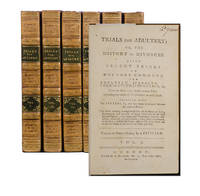
1780rif. 3796London: Printed for S. Bladon 1780. First edition. Contemporary full calf covers decoratively bordered in blind spines with four wide raised bands decoratively tooled in gilt and blind in compartments two green morocco labels lettered in gilt blind-stamped board edges and turn-ins all edges gilt. Some minor wear to a few corners otherwise a near fine set. Volumes 1-6 only of 7. Six octavo volumes 7 3/4 x 4 7/8 inches; 197 x 124 mm. Collating 392; 392; 404 384; 426 of 428; 406. Twenty-one of twenty-four fine engraved plates. Volume I lacking two of the engraved plates Daly facing page 39 and Draper facing page 20 and clean inner marginal tear on Q4 pages 5/6; Volume II with light marginal stain on 3A4 pages 59/50; Volume IV Z3 pages 87/88 trimmed at fore-margin; Volume V Z3 pages 55/56 trimmed at fore-margin and lacking last leaf 3H4 pages. 305/306 Address to the Public verso blank; Volume VI lacking one engraved plate Grosvenor facing pages 114. Armorial bookplate on front paste-down of each volume and early ink signature of Thos. Grant at top of title-pages. Trials for Adultery was published over a period of two years and was completed in seven volumes with thirty engraved plates. Because of their 'pornographic' nature some or all of the plates are often not found. In our set three of the plates have been excised by a previous owner. "The genre of pornographic trial reports was fully developed in the late 1770s a fact which is borne out by the publication in seven volumes of a special collection of interesting cases Trials for Adultery: or the History of Divorces. The editor remarks to the reader that 'conjugal infidelity is become so general that it is hardly considered as criminal; especially in the fashionable world'. In view of the many erotic and obscene prints contained in the seven volumes the moral justifications offered in defence of the publication of the trial reports appear quite ridiculous if not hypocritical. Mostly erotic but occasionally also obscene such pictorial material now became a standard feature of trial reports for the rest of the century" Boucé. Printed for S. Bladon unknown books
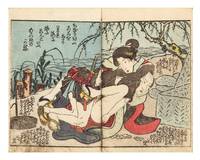
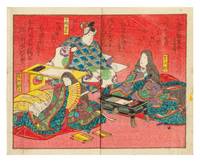
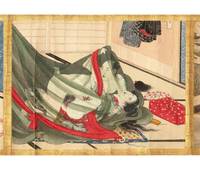
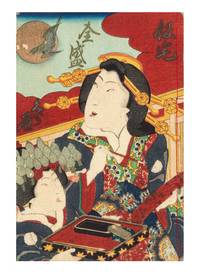
rif. 771516 double-page & four single-page color-printed woodcuts. 13; 11; 9 folding leaves. Three vols. Small 8vo orig. speckled semi-stiff boards boards rubbed orig. block-printed title labels on upper covers new stitching. Japan probably Edo: manuscript inscription dated "1832" at end of each volume. First edition and very rare; we do not find this book listed in WorldCat or in the Union Catalogue of Japanese Books. The Preface is signed by Akikei or Akikage Higashikuni. This work is an erotic version of Shiki no en an 18th-century group of songs on the four seasons of love from the Yamada ryu school of the Japanese harp koto. The poems of Haku Rakuten or Bai Letian 772-846 the Chinese poet of the mid-Tang dynasty are sources for the songs along with Japanese waka poems. Haku Rakuten "became the favorite poet of Heian times.He was the Chinese poet to whom allusions and from whom recollections were most frequent in Heian Japan. His verses were often used for kudai waka and he epitomized Chinese poetry."-Earl Miner et al. The Princeton Companion to Classical Japanese Literature p. 160. The first color-printed woodcut depicts a woman preparing to play the koto. There follows a series of erotic double-page woodcuts: kabuki actors young samurai Chinese characters and women of various social classes are shown engaged in sex through the changing seasons. It is fascinating to see the various rooms and their furnishings the participants' costumes and the landscapes in the background. The fine woodcuts were clearly created by a member of the Utagawa school however we are unable to establish their artistic authorship. Very good set but with some thumbing. The second and third volumes have some worming touching several of the woodcuts. unknown books
rif. 23760Northern India: n.p. mid 19th century. Hardcover. Very good. 8vo. 25 leaves. Ten full page sexually explicit and masterfully painted miniatures nine of which feature a man and a woman and the other a woman and a dog. Printed text. Later non-descript full leather plain black binding. Some leaves are rough at the edges else thsi is in very good condition with superb miniatures. . n,.p. hardcover books
rif. 9827Three frontis. & 21 double-page color-printed woodblock illus. 16; 12.5; 13.5 folding leaves. 12mo 113 x 80 mm. orig. decorated semi-stiff wrappers with images of rabbits snowflakes & flowers labels on upper covers with motif of flowers old stitching. Japan: late Edo or early Meiji. A very rare small-format erotic work written by IkkadÅ Injin 逸桂堂淫人 and illustrated by KaikÅtei Shujin 開好亭主人 both clearly pen names. These volumes are very finely illustrated with the theme of "snow moon and flower." The artist was very accomplished and the images are highly complex and skilled. The volumes use almost all of the techniques that make Japanese illustrated books so remarkable. This late shunga is richly colored and employs bokashi the delicate variation of shading of pigment within the image; blind-embossing; and the very ample use of gold silver and copper pigments. The depicted garments are a mixture of extremely complex textures colors and patterns all accentuated by blind-embossing and multiple woodblock impressions. There are two kinds of black flat black and shiny black rendering a most unusual appearance. A very fine example. The title-page in Vol. I is a little cracked due to the use of metallic pigment. unknown books
rif. 96105001China n.d. c. 1790. An erotic hand painted color scroll 12 individual scenes each painting ca. 21.5 x 15 cm. overall width is 18 cm. in very clean pristine condition external phoenix cloth inside dark blue silk mounting jade ends. This work is an excerpt from the Chinese erotic novel the Chin P'ing Mei written during the Ming dynasty. It depicts the sexual exploits of the hero Hsi-men and is China's most famous classic novel of erotica. This lovely hand scroll illustrates twelve erotic scenes with Hsi-men and his willowy female consorts. Sapphicsm a common theme but this example shows the hero engaged in a host of sexual pleasures. He adores the vulva and her tiny "Lotus-hooks" or bound feet. In one superb view he is embraced by three lovely paramours as he attempts to gratify each with his tender touch. In another sensual scene while his "jade stick" pierces and ravishes an old favorite a younger concubine is voyeuring at them with desire as we see her pink-flushed face as she masturbates with relish. Several other marvelous paintings show various positions employed for mutual benefit. Each scene is done in the Ming dynasty style with lovely furniture and furnishings graphically illustrated including scholar's desk items scrolls brushes vases flowers & other period objects. Executed in fine color brush work mounted with silk borders paper mounted some 3 meters plus long embellished with pale jade end pieces. BIBLIOGRAPHY: R. H. Van Gulik: SEXUAL LIFE IN ANCIENT CHINA for more and copious details on this subject and theme. R.H. Van Gulik: EROTIC COLOUR PRINTS OF THE MING PERIOD. DREAMS OF SPRING: Erotic Art in China. This useful illustrated reference shows many similar erotic examples from pages 158-161. Erotic Chinese scrolls of this quality and period are SCARCE. BEURDELEY Michel: CHINESE EROTIC ART. . unknown books
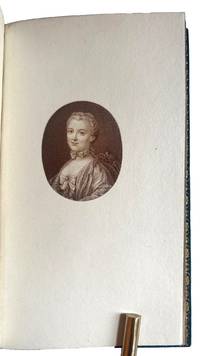
1756rif. 4477Paris: s.n. 1756. 12mo 169 x 96 mm. 10 2 blank pages. Woodcut ornament on title. Title soiled. Extra-illustrated with three states of an engraved bust portrait of Mme. Pompadour of which two avant la lettre one in black and one in sepia the latter on very thick paper. Jansenist blue-green morocco turn-ins gilt gilt edges silk ribbon marker 5 blank leaves at front and 6 at back spine slightly sunned. Provenance: Jules Noilly his gilt monogrammed booklabel sale Paris 15-20 March 1886 lot 432 lot ticket preserved. First and apparently only edition of a loosely constructed mildly satirical erotic poem almost a prose poem that pretends to be a self-celebration by Louis XV's mistress friend and influential advisor Madame de Pompadour. Praising her own looks - her skin face eyes mouth and hair even her "two-storey chin" standards of beauty change she moves on to her intelligence wit lack of pretense carefully constructed and other attractions finally circling back to the most enticing part of all for the lascivious male. The culmination of the poem is a rather trite metaphorical description of her "private parts" as a welcoming grotto and the mounting excitement of the daydreaming poetess. In the last lines she shakes herself: "what am I saying where is the rhyme taking me" and she summons a cold shower in the form of "the sad reminder of a husband a mother a hunchbacked prelate and a battleaxe of an Abbess." The first two references may be to Mme de Pompadour's husband Charles-Guillaume Le Normant d'Étiolles and to her by then deceased mother Madeleine de La Motte; I have not identified the other two. An enlightened patron of literature and the arts Mme de Pompadour would have scoffed at this silly concoction but the generally complimentary if disrespectful tone of the piece implies that it may have been produced by someone in her circle. It is not a Poissonade in the classic sense. The pamphlet was sometimes bound with various editions of Mme de Pompadour's equally apocryphal letters. The Parisian bibliophile Jules Noilly had this fine copy bound by Marius-Michel with three states of a small oval stipple-engraved portrait of Mme de Pompadour which he or the cataloguer of his collection described as "after Céroni"; cf. Catalogue de livres rares et curieux anciens et modernes et d'une précieuse collection de livres de l'École Romantique composant la bibliothèque de M. J. Noilly Paris: veuve Labitte 1886 lot 432. s.n. unknown books
rif. 9828Three frontis. & 18 double-page color-printed woodblock illus. Colored title-page in Vol. I with gold printing. 15; 11.5; 12.5 folding leaves. Three vols. 12mo 115 x 81 mm. orig. decorated semi-stiff wrappers with a few careful repairs orig. block-printed title labels on upper covers new stitching. Japan: late Edo. A very rare shunga with the artist's pen name KairÅ dÅketsu 開楼童傑 on the title; and the author's pen name KaikÅsha ShikishÅ 開好舎色照 at the end of the Preface. The theme of this work is celebrating the New Year and hoping for a good future. The books are very finely illustrated with a number of highly complex and skilled images. The volumes use almost all of the techniques that make Japanese illustrated books so wonderful. This late shunga is richly colored and employs bokashi the delicate variation of shading of pigment within the image incredibly delicate embossing and the very ample use of gold silver and copper pigments. The furniture art and sliding doors all suggest a happy present and an auspicious future. Fine copy. unknown books
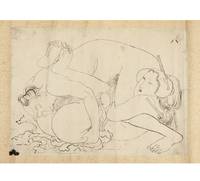
rif. 9739Scroll 320 x 5250 mm. silk-brocade front outer endpaper with floral drawing in color at beginning wooden core roller. Japan: after 1823. The 12 finely rendered erotic drawings present on this scroll in the famous "set of 12" format have been attributed on the manuscript label of the scroll's box to ChÅkyÅsai Eiri active 1790s-1801 a little known pupil of Hosoda Eishi 1756-1829 who for some years was an equal rival to Utamaro. ChÅkyÅsai Eiri produced an album of 13 large-size color woodblock prints entitled Fumi no kiyogaki Neat Version of the Love Letter or Pure Drawings of Female Beauty 1801 see Clark et al. Shunga pp. 310-11 & 400-01 for two images in the series and their descriptions. The underdrawings for six of the prints in the series drawings 1 2 3 5 partial 7 and 12 including the well-known image of two women using a dildo together are present. Drawings 8 9 10 and 11 can be identified as images from Hokusai's FukujusÅ Adonis Flower ca. 1822-23. The remaining two drawings are independent images that might have appeared in other publications. The artist has placed small manuscript annotations on the images regarding colors. In spite of the manuscript information on the box's label we believe these are highly skilled later copies. Fine condition. References Akiko Yano "Shunga Paintings before the 'Floating World'" in Timothy Clark et al. eds. Shunga. Sex and Pleasure in Japanese Art British Museum: 2013 pp. 62-72-"The concept of twelve in shunga had more to do with a general sense of completeness a full cycle.". unknown books
rif. 979524 color-printed panels with 12 illus. & 12 panels of love poems on verso on reverse 20 erotic color-printed panels pasted-in. Miniature book 48 x 50 mm. orig. color-printed pictorial boards with color-printed endpapers. Japan: n.d. A very rare example of a miniature shunga book color-printed on the one side with a conventional but rather "suggestive" series of love poems and on the reverse with a series of 20 erotic prints pasted-in. Each of these erotic prints has a medallion with a gently erotic title. There is no author title place of publication or date for this rare object. We suspect that it was printed in the late Edo period. Fine copy a little thumbed. unknown books
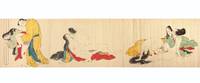
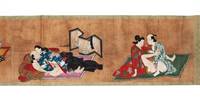
rif. 8537Scroll 290 x 5840 mm. including endpapers silk brocade endpaper at front depicting a pair of Mandarin ducks symbol for fidelity between two people wooden core roller. Japan: late Edo. A fine erotic scroll with 12 paintings the well-known "set of 12" format in vivid coloring depicting a range of sexual activities. As in many shunga handscrolls the paintings feature a sequence of lovemaking positions in no apparent order with no development simply presenting a variety of couplings and sexual techniques. All the participants in this scroll have Heian-period hairstyles and several of the couples are clearly aristocrats. In the scenes the copulating figures are outlined only in black ink while their private parts and robes are vividly colored. In one scene we see a lesbian couple. One of the women is disguised as a man and the other woman is tied up but able to insert a dildo in her companion's vagina. Three of the scenes depict ménage à trois situations involving one man and two women. In one of these scenes the man is having intercourse with a woman who appears to be a nun while at the same time performing cunnilingus on a very young woman. Fine condition preserved in an old wooden box. ⧠Akiko Yano "Shunga Paintings before the 'Floating World'" in Timothy Clark et al. eds. Shunga. Sex and Pleasure in Japanese Art British Museum: 2013 pp. 62-72-"The concept of twelve in shunga had more to do with a general sense of completeness a full cycle.". unknown books
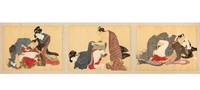
rif. 8539Scroll 210 x 3690 mm. endpapers of gold with silk brocade backing wooden roller. Japan: late Edo. This attractive scroll executed by a highly accomplished artist comprises of 12 erotic scenes the well-known "set of 12" format in vivid coloring depicting a range of sexual activities. As in many shunga handscrolls the paintings feature a sequence of lovemaking positions in no apparent order. The scenes are finely painted with considerable detail employing much gold silver and other metallic pigments. Throughout the artist has used a fine brush to achieve great detail of fabric hair and faces. All the women have elaborate hairstyles and the kimono are very luxurious with many layers of fabric evident. We learn much about the variety of kimono and obi belts of the period. 1. The first scene shows a man with an erect penis seated behind a woman caressing her breasts underneath her kimono. The penis is highlighted with gold dust and one of the inner layers of her kimono is accentuated with the application of mica. Two maids or servants are seated on the other side of a screen listening attentively to the couple's activities. 2. In this scene are travelers: a sword-carrying samurai and a woman both wearing walking sandals. They are taking a break and having an intimate moment the man penetrating the woman who is lying on her back on a roadside bench her broad-brimmed hat next to her. Behind them is a beautiful landscape of rice paddies. The folds of the woman's kimono are finely expressed. 3. This is a very beautifully executed scene of a man and woman having sex underneath a collapsed summer mosquito net. The ability of the artist to show the activity of the couple through the netting is remarkable. The woman's hair is extremely mussed. 4. A naked man and woman are having sex with another woman observing the activity through a sliding door. The inevitable tissues are nearby. There is a small wormhole. 5. An older court lady and a young man are having an intimate moment with him masturbating her. The artist has used much mica and gold. The numerous layers of the kimono are revealed. Small wormhole. 6. A prostitute is servicing a client in a brothel. Secretions are dripping from her vagina. The man's head is concealed in their embrace. The paintings on the sliding doors are very beautiful. Tissues are nearby. 7. A naked man is masturbating a woman on an outside deck. The woman is wearing an open kimono. A harp is nearby. 8. This beautiful scene situated just outside of a tea ceremony room shows a man and woman engaged in sex. They are clearly having a secret meeting. Her kimono is extremely luxurious. We see a small part of the next room with a silver wall. 9. A man and woman are engaged in sex. The man is wearing a business kimono and in the background are fine pictorial screens. 10. A man and a woman both naked are engaged in sex while a "Peeping Thomasina" observes. 11. In this scene a man and four women are having an orgy. He is masturbating two woman while penetrating another. Her vaginal secretions indicate the fourth woman has already had sex with the man. 12. This scene shows a man and woman in the missionary position. In the background is a most beautiful silk screen painted in gold depicting two cranes. There is another room with sake containers suggesting this scene takes place in a brothel. Fine condition preserved in a black lacquerware box with gold images and a metal clasp which has an unidentified family crest in the shape of a Paulownia tree. The outer silk brocade endpapers are a little stained and worn. ⧠Akiko Yano "Shunga Paintings before the 'Floating World'" in Timothy Clark et al. eds. Shunga. Sex and Pleasure in Japanese Art British Museum: 2013 pp. 62-72-"The concept of twelve in shunga had more to do with a general sense of completeness a full cycle.". unknown books
rif. 8670Scroll 290 x 4780 mm. with gold paper inner endpaper at front wooden core roller. Japan: n.d. but late Edo or early Meiji. A fine example of an erotic scroll anonymously painted as usual but with great skill. The scroll contains 12 erotic scenes painted on silk the well-known "set of 12" format of men and women engaged in various sexual activities. As in many shunga hand scrolls the paintings feature a sequence of lovemaking positions in no apparent order. The figures are drawn to express a fluidity of movement passion and pleasure. The accomplished artist has used delicate shading to heighten the scenes. The kimono are richly decorated. In several scenes the women's pleasure is expressed by curled toes and fingers. The paintings are richly detailed with metallic pigments elaborately rendered hairstyles and renderings of luxurious kimono fabrics. Erotic paintings in Japan have a long tradition established well before the Edo period. "Many aspects regarding the production of early paintings with sexual content - when where and by whom they were made how they were appreciated - are still obscure.There was apparently a radical change in the form of erotic hand scrolls from around 1600 onwards when paintings with a sequence of twelve erotic scenes became common.Each scene in hand scrolls of this type does not normally show any clear relationship with the adjacent scenes nor is there usually any development other than presenting a variety of couplings and sexual techniques. Each group of copulating figures exists within its own enclosed space set against a plain or simply decorated background as if functioning as an example of a possible sexual position. "Shunga painting remained an important genre in terms of both quality and quantity right up until the modern era and should no longer be excluded from the study of Japanese art and the broader study of the humanities.The concept of twelve in shunga had more to do with a general sense of completeness a full cycle."-Akiko Yano "Shunga Paintings before the 'Floating World'" in Timothy Clark et al. eds. Shunga. Sex and Pleasure in Japanese Art British Museum: 2013 pp. 62 & 70-72. In fine condition. The extreme edges of each silk panel are slightly spotted due to the glue used. unknown books
rif. 7716Seven double-page one of which has flaps & folds out into a four-panel scene and two single-page woodcuts all finely color-printed and nine double-page black & white woodcuts. One color-printed title-page pasted down on inner upper wrapper 24 folding leaves. Small 8vo orig. color-printed upper wrapper with embossing decorated lower wrapper new stitching. Edo: Preface dated 1864. First edition and very rare; we find no copy in WorldCat. The Preface was written by Tanekiyo Ryusuitei 1823-1907 using his pen name "Insuitei." Following one of the frequent fires in the famous pleasure quarters of Yoshiwara often started by the prostitutes in an effort to free themselves many brothels temporarily re-established themselves in other locations throughout Edo. This book was issued as sort of a guide to the newly relocated brothels and very much reflects the changes that shunga books were going through during the end of the Edo period. The first double-page woodcut depicts the exterior of a thriving brothel in Edo with many prostitutes within looking out to the numerous passing men and women on the bustling street. This opens up into a four-panel image of the interior of the brothel showing men being entertained and engaging in several sexual activities. The following six double-page woodcuts depict the "star" prostitutes all engaged in sex with the names of the brothels where they worked. All the rooms shown are very luxuriously furnished with silk screens ornate fabrics and beautiful furniture. These woodcuts are all printed in richly saturated colors including silver and gold pigments and with complex embossing. The cult of sex organs where phalluses are objects of veneration and worship is also exhibited here in a most uncommon image. The final color-printed woodcut - single-page - depicts an altar inside the brothel where a phallus is the center of worship. Envelopes containing cash left by clients are piled in front. See Suzuki Kenko's most fascinating "Popular Cults of Sex Organs in Japan: Guardian Deities Auspicious Objects and Votive Paintings" in Timothy Clark et al. eds. Shunga. Sex and Pleasure in Japanese Art British Museum: 2013 pp. 364-67. The text section contains nine very interesting double-page black-and-white woodcuts showing elaborate scenes of entertainment men and women having "intimate moments" the aftermath of sex with copious dribbling secretions used napkin wipes on the floor etc. These scenes can be described as "action-packed." Fine and fresh copy. One black-and-white woodcut has two small holes. unknown books
rif. 7719Scroll 300 x 4150 mm. with pale green silk borders & endpapers wooden core roller. Japan: n.d. but probably early Edo. This is a fine example of an erotic scroll anonymously painted as usual but with great skill. The scroll contains ten scenes of men sometimes samurai and women engaged in various sexual activities. Two of the scenes are threesomes one of which shows a young samurai copulating with two older women. The hairstyles of both the women and men are typical of the pleasure courts of the early Edo period. Erotic paintings in Japan have a long tradition established well before the Edo period. "Many aspects regarding the production of early paintings with sexual content - when where and by whom they were made how they were appreciated - are still obscure.There was apparently a radical change in the form of erotic handscrolls from around 1600 onwards when paintings with a sequence of twelve our example has ten erotic scenes became common.Each scene in handscrolls of this type does not normally show any clear relationship with the adjacent scenes nor is there usually any development other than presenting a variety of couplings and sexual techniques. Each group of copulating figures exists within its own enclosed space set against a plain or simply decorated background as if functioning as an example of a possible sexual position. "Shunga handscrolls of the seventeenth century are not usually signed.The production of shunga paintings during the seventeenth century was considerable and widespread involving artists who ranged from the elite official schools to popular town painters.Shunga painting remained an important genre in terms of both quality and quantity right up until the modern era and should no longer be excluded from the study of Japanese art and the broader study of the humanities."-Akiko Yano "Shunga Paintings before the 'Floating World'" in Timothy Clark et al. eds. Shunga. Sex and Pleasure in Japanese Art British Museum: 2013 pp. 62 & 70-72. The paintings are richly detailed with metallic pigments elaborately detailed hairstyles liberal use of a thick white pigment giving a 3D effect to fabrics and sprays of gold and mica. In very good condition preserved in a nice old wooden box. Several of the paintings have minor abrading affecting the pigments. There is some unimportant occasional worming carefully backed on verso. unknown books
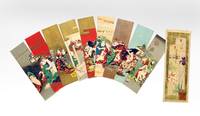
rif. 7720Ten cards 181 x 50 mm. all preserved in the orig. folded color-printed wrapper entitled on upper panel Furyu e tanzaku Elegantly Illustrated Tanzaku Cards. Japan: Meiji Era. Ten erotic cards issued together each in the tanzaku ban format and accompanied by their original color-printed wrapper. Tanzaku cards were popular in the Meiji era 1868-1912; see Rosina Buckland's "Erotic Art of the Meiji Era 1868-1912" in Timothy Clark et al. eds. Shunga. Sex and Pleasure in Japanese Art British Museum: 2013 pp. 454-55. The upper panel of each is very finely color-printed with saturated inks embossing and rich use of metallic pigments revealing the Japanese printer's art at its best. They all depict men and women engaged in a series of sexual acts. The woodblock-printed lower panels feature the conversations of the couples while engaged in their sexual acts and kyoka poems which are rich in sexual innuendos and racy double-meanings. The original wrapper that contains the ten cards has also been very finely color-printed again with saturated colors and embossing. In fine condition. unknown books
1955rif. 321891Luneville: Ediions de l'Orchidee 1955. Limited. unbound. fine. Gaston de Sainte-Croix. An infamous erotic crime novel. Illustrated with highly erotic original dry-point etchings some in color attributed to Gaston de Sainte-Croix. Small 8vo stiff paper wrappers in a cloth chemise & slipcase; gatherings unsewn. Luneville: Editions de l'Orchidee. 1955. Fine With an extra suite of plates. Number 60 of 325 copies. Ediions de l'Orchidee unknown books
rif. 69483Publisher not identified No date actual year of this set's publication not known. Reprint. Hardcover. Very Good. 67; 84; 106; 83; 57; 54; 120pp. Small octavos 21 cm. Volume 7 is a duodecimo 19.5 cm. 1/4 white cloth with gray paper over boards. Extremities moderately bumped and lightly soiled. Endpapers with areas of darkening. Text block of volume 7 cracked a couple of times. Seven tracts on flagellation flogging. The Library Illustrative of Social Progress was a series of books dealing with erotica and published by John Camden Hotten circa 1872. John Camden Hotten claimed that his series of flagellation reprints had been taken from Henry Thomas Buckle's collection but that was untrue as reported by Henry Spencer Ashbee. Ashbee claims that the books were actually reprinted from a collection of books that were in his collection. Publisher not identified hardcover books