4 307 résultats
1938réf. 71806New York:: The Viking Press 1938. First edition. original cloth in dust jacket. Usual faint browning to inner hinges caused by binder's adhesive used by Viking. The unclipped and unchipped dust jacket has the slightest of rubbing to the top of the backstrip and one tiny closed tear to the bottom of the front panel. The jacket is otherwise brilliant. . 8vo. The Viking Press, hardcover
1937réf. 21167New York: Covici Friede 1937. First edition. Hardcover. Orig. pictorial cream cloth. Near fine in original publisher's slipcase. 81 pages. 25.5 x 17.5 cm. Limited edition copy 343 of 699 signed by John Steinbeck set in monotype Italian Oldstyle printed on hand-made La Garde paper and printed by the Pynson Printers under the supervision of Elmer Adler. Steinbeck's novella in which the first three chapters were published in magazines 1933-1936 -- stories of a boy's life on a California ranch. Small bump front cover lower corner. Covici Friede hardcover
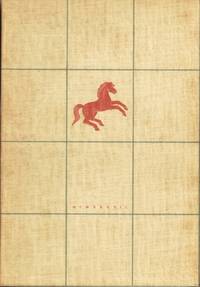
1947réf. 005765Viking Press. Bright DJ in archival cover corner chips edge wear clipped with $2.00 price listed. Stated Published by the Viking Press in February 1947. Front hinge starting. . Near Fine. Hardcover. 1st Edition. 1947. Viking Press hardcover
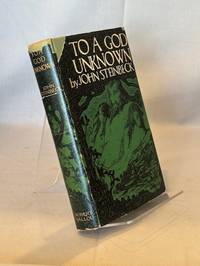
1933réf. 10093New York: Robert O. Ballou 1933. First Edition. Near Fine/Good. octavo 325 pages; publisher's green cloth pictorial green end papers. Dust jacket nearly separated at front fold 1/4" loss at spine head and one inch "V" shaped chip at top of front panel. First Issue one of just 598 copies printed. Jean Hersholt's copy with his bookplate SIGNED by him on the bookplate. Internally clean and bright with no markings of any kind. Robert O. Ballou unknown
1939réf. 3545New York: Viking Press 1939. First Edition. Hardcover. Very Good in Good DJ. First Edition. Hardcover. "First Edition" at lower tab of front flap. Noted flaws in the DJ notwithstanding a very presentable copy of this Pulitzer Prize winning classic. Minor shelf/edge wear hint of toning at spine light toning at hinges minor dust staining at top of text block else tight bright and unmarred. DJ shows moderate shelf/edge wear focused at head tips and flap folds minor chipping at head and tips bottom half of spine missing facsimile laid under light toning overall slightly heavier at spine else clean and bright. Beige cloth boards brown ink lettering and pictorial elements pictorial end pages music sheet. 8vo. 619pp. Viking Press hardcover books
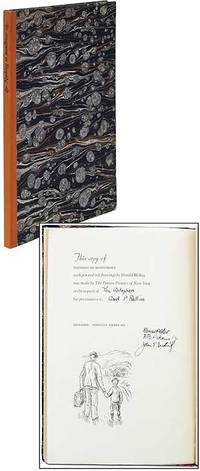
1936réf. 56139New York: Pynson Printers 1936. Hardcover. Fine. First Separate Edition originally published in The Pastures of Heaven 1932. An unusually fine fresh copy with the corners square and virtually unrubbed. Goldstone notes that the paper supply allowed only 370 copies to be printed. Published for subscribers to use as Christmas gifts the colophon was customized with the subscriber's name following "made by the Pynson Printers of New York at the request of blank for presentation to blank." Fifty copies were so designated for Elmer Adler 100 for Frederick B. Adams Jr. 150 for Ben Abramson 50 for Edwin J. Beinecke and 20 for antiquarian bookseller Howard Mott although evidently fewer were issued with his name; only one is known. Unknown to Goldstone there were six copies for Steinbeck as well. This copy has the subscriber's name The Colophon handwritten in for presentation to the noted printer Carl P. Rollins. Additionally this copy is Signed by the subscribers Adams and Adler as well as by bookman John T. Winterich. All three were editors of The Colophon a magazine for book collectors. Rollins was the first "University Printer" at Yale. Goldstone A2f. Pynson Printers hardcover books
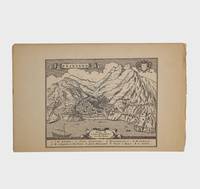
1954réf. 377801Salerno Italy: Ente Provinciale per il Turismo 1954. First edition first issue. 30 pp. Yellow printed paper wrappers some wear to wrappers. Interior clean in unrecorded dust jacket with woodcut of "Posetano" on front panel and "Auguri / Dorothy and Truman" printed on the inner flap some light wear along top edge of jacket otherwise its in near fine condition. First edition first issue. 30 pp. This copy specifically states "1954" on the inside front cover and would therefore precede the Italian edition published in 1955 as well as Goldstone & Payne's first English language edition. Variants have been noted see Bradford Morrow's Steinbeck catalogue which bear the date 1954 - whether this represents a different edition or later issue is unclear. Steinbeck's article had appeared in Harper's Bazaar for May 1953 and the Italian translation preceded the English version. This dust jacket is unrecorded. Goldstone & Payne A34b; Morrow 236 Ente Provinciale per il Turismo unknown books
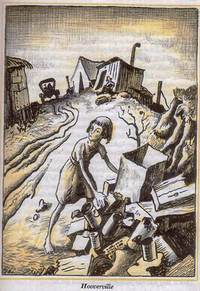
1940réf. 021966New York: Limited Editions Club 1940. First Illustrated Edition. Hardcover. No mottling of the rawhide which is typical for this title and it remains supple with the silver lettering clear. Both books are very tight and unread. About Fine in a Good slipcase with the bottom edge split and the top edge partially so. Thomas Hart Benton. Two quarto 7-1/2" x 10-1/4" volumes bound in decorated grass cloth boards with rawhide spines. Designed by George Macy with introductions by Joseph Henry Jackson and Thomas Craven. The First Illustrated Edition of this Pulitzer Prize winner with 67 ORIGINAL TWO-COLOR LITHOGRAPHS black and yellow made on zinc plates by Thomas Hart Benton and printed by George Miller. Copy #35 of only 1146 printed SIGNED by the illustrator. Laid in is a printed note from the publisher about this most unusual binding. One of the most desirable books of the press because of the combination of a smaller than normal printing a popular author and Pulitzer Prize-winning book first published only the year before beautiful lithographs by Benton and an attractive and unusual binding. Limited Editions Club hardcover books
1937réf. 21167New York: Covici Friede 1937. First edition. Hardcover. Orig. pictorial cream cloth. Near fine in original publisher's slipcase. 81 pages. 25.5 x 17.5 cm. Limited edition copy 343 of 699 signed by John Steinbeck set in monotype Italian Oldstyle printed on hand-made La Garde paper and printed by the Pynson Printers under the supervision of Elmer Adler. Steinbeck's novella in which the first three chapters were published in magazines 1933-1936 -- stories of a boy's life on a California ranch. Small bump front cover lower corner. Covici Friede hardcover books
1933réf. 10093New York: Robert O. Ballou 1933. First Edition. Near Fine/Good. octavo 325 pages; publisher's green cloth pictorial green end papers. Dust jacket nearly separated at front fold 1/4" loss at spine head and one inch "V" shaped chip at top of front panel. First Issue one of just 598 copies printed. Jean Hersholt's copy with his bookplate SIGNED by him on the bookplate. Internally clean and bright with no markings of any kind. Robert O. Ballou unknown books
1937réf. 000006New York~Covici Friede Publishers1937. Very Good/none. Hardcover. First Edition second state. April 1937. With the word loosely on page 9. pps 186. Solid collectible copy. VG/none. Binding tight. Spine straight corners sharp. Pages are clean. Appears unopened unread. . Covici Friede hardcover
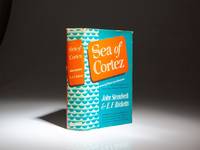
1941réf. 18886New York: The Viking Press 1941. First Edition First Printing. Cloth. Fine/near fine. First edition first printing of Sea of Cortez by John Steinbeck and Edward F. Ricketts an attractive copy. Octavo 6 vii-x 598pp. Green cloth title stamped in silver on spine and front panel. The first printing with "First Published in December 1941." Top edge dyed pink. Illustrated endpapers with maps of Baja California. Complete with 40 photographic plates 8 in color. In the publisher's first state dust jacket $5.00 on front flap short closed tear along bottom edge of front panel bright illustrations a near fine example. Goldstone & Payne A15b. The Viking Press unknown
1941réf. 18886New York: The Viking Press 1941. First Edition First Printing. Cloth. Fine/near fine. First edition first printing of Sea of Cortez by John Steinbeck and Edward F. Ricketts an attractive copy. Octavo 6 vii-x 598pp. Green cloth title stamped in silver on spine and front panel. The first printing with "First Published in December 1941." Top edge dyed pink. Illustrated endpapers with maps of Baja California. Complete with 40 photographic plates 8 in color. In the publisher's first state dust jacket $5.00 on front flap short closed tear along bottom edge of front panel bright illustrations a near fine example. Goldstone & Payne A15b. The Viking Press unknown books
réf. 000300Privately Printed 1964 Book. As New. Hardcover. Signed by Authors. Cloth. As New/As New. First Thus. 8vo - over 7¾" - 9¾" tall. Ruth Ford's copy signed by her. She was married to Zachary Scott. Privately Printed, 1964 Hardcover
réf. 000300Privately Printed 1964 Book. As New. Hardcover. Signed by Authors. Cloth. As New/As New. First Thus. 8vo - over 7¾" - 9¾" tall. Ruth Ford's copy signed by her. She was married to Zachary Scott. Privately Printed, 1964 Hardcover books
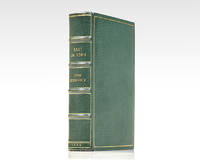
1952réf. 153428London: William Heinemann LTD 1952. First British edition of Steinbeck’s epic and moving story of a modern Cain and Abel. Octavo bound in full morocco by the Harcourt Bindery with gilt titles and tooling to the spine in five compartments within raised gilt bands gilt ruling to the front and rear panels gilt inner dentelles stamp-signed by the Harcourt Bindery marbled endpapers all edges gilt. In fine condition with light thumbprint soiling to the title page. Founded over a century ago in 1900 the Harcourt Bindery is the oldest and largest traditional bindery in America devoted to fine traditional leather bookbinding by hand. An exceptional presentation. "A novel planned on the grandest possible scale.One of those occasions when a writer has aimed high and then summoned every ounce of energy talent seriousness and passion of which he was capable.It is an entirely interesting and impressive book" The New York Herald Tribune. William Heinemann LTD hardcover
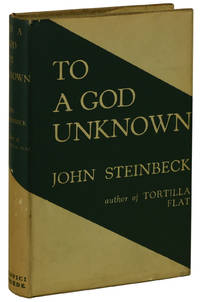
1935réf. 180102014New York: Covici Friede 1935. First Edition. Hardcover. Very Good. First edition second issue. Very Good with foxing to cloth tiny pin-holes to cloth at front gutter previous owner name to front paste down. In a Very Good dust jacket with price intact small closed tear to bottom of front panel near flap fold with light associated creasing has been neatly mended from the verso toning to spine panel light soiling. One of 900 copies of the second issue. Goldstone & Payne A3b. Covici Friede hardcover
1935réf. 180102014New York: Covici Friede 1935. First Edition. Hardcover. Very Good. First edition second issue. Very Good with foxing to cloth tiny pin-holes to cloth at front gutter previous owner name to front paste down. In a Very Good dust jacket with price intact small closed tear to bottom of front panel near flap fold with light associated creasing has been neatly mended from the verso toning to spine panel light soiling. One of 900 copies of the second issue. Goldstone & Payne A3b. Covici Friede hardcover books
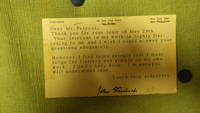
1964réf. 272531964 Postcard Has small piece tape on either side & small ink mrks at top Steinbeck Signature is in Bold Black Ink Typed Postcard Mailed from New York Reads: Dear Mr. Peleaux: Thank you for your letter of May 29th. Your interest in my work is highly flattering etc. VG AS-IS. Signed by Authors. 1st Edition. No Binding. Very Good/No Jacket. paperback
1929réf. 10936CUP OF GOLD Mcbride 1929 first edition spine a tad dulled two small areas of board edges worn else a tight vg copy in the original gold cloth and fine facsimile dust-wrapper. The authors most desirable first book. 1/1537 copies. McBride hardcover
1929réf. 10936CUP OF GOLD Mcbride 1929 first edition spine a tad dulled two small areas of board edges worn else a tight vg copy in the original gold cloth and fine facsimile dust-wrapper. The authors most desirable first book. 1/1537 copies. McBride hardcover books
1950réf. 170893New York: Viking 1950. First Edition; First Printing. Hardcover. Near Fine in a Very Good dust jacket. Light chip at spine heel. 1/4 inch closed tear at top of rear panel. Viking hardcover
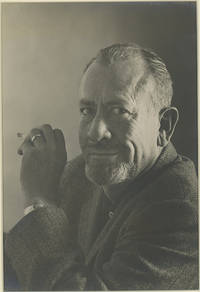
1960réf. 28275N.p. n.d. but circa 1960 1960. Hinged on the verso of a board and matted which should probably be replaced. Original wooden frame preserved but chipped and worn. 27 x 20 cm signed on the verso in pencil by the photographer William Ward Beecher. A photographic portrait of John Steinbeck taken by artist William Ward Beecher 1921-2006 a descendant of the famous New England Beechers. How many portraits were produced from this one sitting is not recorded but there were at least two: this one and a similar one that was used in 1961 on the rear panel of the dust jacket of Winter of Our Discontent. This one which apparently was not published was the personal property of John and Elaine Steinbeck and was sold as part of the remains of their estate in February 2020. Betty and William Ward Beecher and the Steinbecks were apparently friends. The Beechers had books inscribed to them by John Steinbeck and the Steinbecks owned a few of Beecher's lithographs and paintings. N.p., n.d. [but circa 1960] unknown
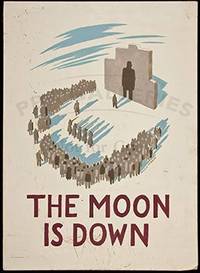
réf. 16-5572New York: Martin Beck Theatre1942. Gouache in 4 colors on board.66 x 48 cm. Witold Gordon was a Polish-born American Art Deco painter best known for his murals in Radio City Music Hall completed in 1932. He painted a 6000 square foot mural for the 1939 New York World's Fair and a series of New Yorker covers depicting the city in its recent past. He also designed the poster for the original Broadway production of Rodgers and Hammerstein's Oklahoma! .Gordon was born in Warsaw Poland in 1885 and studies at the Ecole des Beaux-Arts in Paris. After he finished his studies he moved to New York. He worked with Donald Deskey in the design of Radio City Music Hall where two of his murals are exhibited. He illustrated books and designed the poster for the Olympic Games in Lake Placid NY in 1933. In 1939 he created a painting for the New York Worlds' Fair. He traveled throughout the South and produced a series of paintings with the name "American Scene" which was exhibited in 1941 at the Museum of Modern Art in New York. During his travels he painted in Gouache storefronts and housefronts that he felt showed the true face of America. In 1934 he was commissioned by Conde Nast to paint a series of "New York Shops" New York Shops you Never See which were published in Vanity Fair Magazine in July of 1934. In 1932 when Georgia O'Keefe accepted the commission to paint a mural in the Ladies' Room in Radio City Music Hall and abandoned it at the advice of her husband Alfred Steiglitz who said "Ms. O'Keefe does NOT do bathrooms!" Witold Gordon was given the commission and painted two murals for Deskey's masterpiece.Witold Gordon died in 1968.1943."Free men cannot start a war but once it is started they can fight on in defeat. Herd men followers of a leader cannot do that and so it is always the herd men who win battles and the free men who win wars.”― John Steinbeck The Moon Is Down.The Moon is Down was John Steinbeck's second attempt at writing a novel in play form Of Mice and Men was his first. It was composed while on assignment from the Foreign Information Service a division of the Office of Strategic Services charged with combating Nazi propaganda. His original story depicting a small American town invaded by enemy troops was rejected by the FIS who feared that it might demoralize the civilian public. In his revised manuscript published by Viking in 1942 Steinbeck kept the same plot but set it in an unnamed Scandinavian town rather than the United States. Despite mixed critical reception the book was a remarkable public success outselling The Grapes of Wrath two-to-one in pre-publication; it would eventually pass through 76 editions. Shortly after publication the producer Oscar Serlin purchased the dramatic rights to The Moon is Down Herman Shumlin initially bought them but passed them on saying he “did not care for The Moon is Down’s politics.” Serlin known for his production of “Life with Father” accepted the challenge believing Steinbeck’s play would attract a large audience. “The Moon is Down” premiered on Broadway in April 1942 starring Otto Kruger as Colonel Lanser and Ralph Morgan as Mayor Orden. Like the novel before it the play was publicly adored but critically lambasted. Life magazine reported that it was “trumpeted louder than any literary event of the season” while the critical consensus was that “Steinbeck was too easy on the Germans too optimistic about the ultimate victory of the Allies and ultimately too moralistic." Despite its initial Broadway run lasting only nine weeks the play was immensely successful on the road and abroad especially in London and Stockholm. Rather surprisingly it was nominated for Best Play by the New York Drama Critics’ Circle and placed second.Provenance: From the estate of producer Oscar Serlin. New York: Martin Beck Theatre,1942 unknown
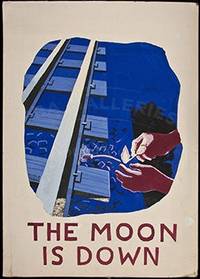
réf. 16-5573New York: Martin Beck Theatre1942. Gouache in 7 colors on board. 70 x 51 cm. Witold Gordon was a Polish-born American Art Deco painter best known for his murals in Radio City Music Hall completed in 1932. He painted a 6000 square foot mural for the 1939 New York World's Fair and a series of New Yorker covers depicting the city in its recent past. He also designed the poster for the original Broadway production of Rodgers and Hammerstein's Oklahoma! .Gordon was born in Warsaw Poland in 1885 and studies at the Ecole des Beaux-Arts in Paris. After he finished his studies he moved to New York. He worked with Donald Deskey in the design of Radio City Music Hall where two of his murals are exhibited. He illustrated books and designed the poster for the Olympic Games in Lake Placid NY in 1933. In 1939 he created a painting for the New York Worlds' Fair. He traveled throughout the South and produced a series of paintings with the name "American Scene" which was exhibited in 1941 at the Museum of Modern Art in New York. During his travels he painted in Gouache storefronts and housefronts that he felt showed the true face of America. In 1934 he was commissioned by Conde Nast to paint a series of "New York Shops" New York Shops you Never See which were published in Vanity Fair Magazine in July of 1934. In 1932 when Georgia O'Keefe accepted the commission to paint a mural in the Ladies' Room in Radio City Music Hall and abandoned it at the advice of her husband Alfred Steiglitz who said "Ms. O'Keefe does NOT do bathrooms!" Witold Gordon was given the commission and painted two murals for Deskey's masterpiece.Witold Gordon died in 1968.1943."Free men cannot start a war but once it is started they can fight on in defeat. Herd men followers of a leader cannot do that and so it is always the herd men who win battles and the free men who win wars.”― John Steinbeck The Moon Is Down.The Moon is Down was John Steinbeck's second attempt at writing a novel in play form Of Mice and Men was his first. It was composed while on assignment from the Foreign Information Service a division of the Office of Strategic Services charged with combating Nazi propaganda. His original story depicting a small American town invaded by enemy troops was rejected by the FIS who feared that it might demoralize the civilian public. In his revised manuscript published by Viking in 1942 Steinbeck kept the same plot but set it in an unnamed Scandinavian town rather than the United States. Despite mixed critical reception the book was a remarkable public success outselling The Grapes of Wrath two-to-one in pre-publication; it would eventually pass through 76 editions. Shortly after publication the producer Oscar Serlin purchased the dramatic rights to The Moon is Down Herman Shumlin initially bought them but passed them on saying he “did not care for The Moon is Down’s politics.” Serlin known for his production of “Life with Father” accepted the challenge believing Steinbeck’s play would attract a large audience. “The Moon is Down” premiered on Broadway in April 1942 starring Otto Kruger as Colonel Lanser and Ralph Morgan as Mayor Orden. Like the novel before it the play was publicly adored but critically lambasted. Life magazine reported that it was “trumpeted louder than any literary event of the season” while the critical consensus was that “Steinbeck was too easy on the Germans too optimistic about the ultimate victory of the Allies and ultimately too moralistic." Despite its initial Broadway run lasting only nine weeks the play was immensely successful on the road and abroad especially in London and Stockholm. Rather surprisingly it was nominated for Best Play by the New York Drama Critics’ Circle and placed second.Provenance: From the estate of producer Oscar Serlin. New York: Martin Beck Theatre,1942 unknown